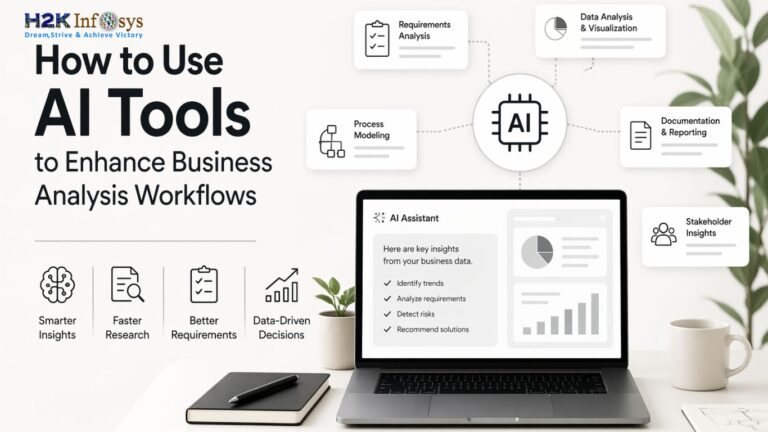
While you are learning during a Business Analyst Course or undergoing Business Analyst Training, one of the most interesting aspects will be how artificial intelligence impacts typical BA workflows. The integration of AI tools into BA processes has made many of them much easier.
Using AI, BA practitioners can streamline requirements gathering, speed up documentation, and even automate some decision-making in real BA projects. Modern Business Analysis Workflows incorporate a structured approach from experienced professionals completing structured Business Analyst Courses and BA Trainings.
1. Understanding how AI actually impacts BA Workflows
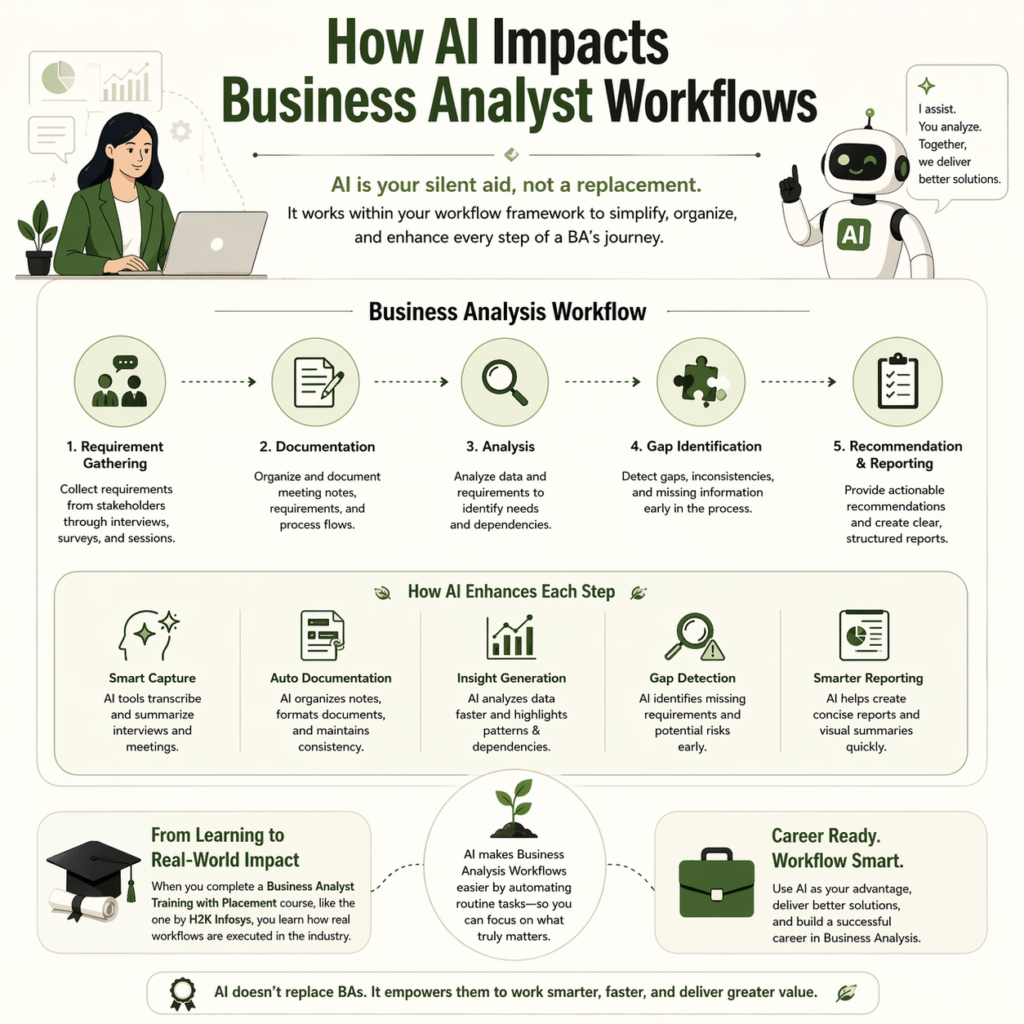
Most novices assume that AI is doing everything for analysts, but this is not quite true. Instead, AI acts as a kind of silent aid within a workflow framework.
Modern Business Analysis Workflows include tools for organizing raw data from requirement gathering and documenting meetings as well as identifying potential gaps that may arise. This becomes particularly helpful during training programs for BAs.
When a learner completes one of the available Business Analyst Training with Placement courses, such as the one provided by H2K Infosys, he or she begins understanding how real-world workflows are performed.
Business Analysis Workflows at this stage become much easier thanks to AI, since it automates many routine operations that normally burden beginners.
2. More structure in requirement gathering
Requirement gathering sessions can be very chaotic. Many participants have various views and interests and they are prone to talking over each other.
In modern BA Workflows, AI assists in the summarization of raw meeting notes and the creation of preliminary drafts of the documentation. This becomes more common in Business Analyst Certification and BA Trainings with Placement courses, as they reflect realistic business settings.
Once you become familiar with this technique, you will find that your requirement-gathering activities will take much less time.
3. Automated conversion of raw notes into professional documentation
Another typical pain point for beginners is writing documentation. It can take a lot of time to create user stories and process flows based on raw discussion data.
However, modern Business Analysis Workflows incorporate automated support from AI tools, which help in creating preliminary documents that require only minor modifications.
During Business Analyst Training, students note that this feature helps them feel more confident in their abilities to perform similar operations in real settings.
Corporate management expects faster documentation cycles, which are possible through the use of AI tools in Business Analysis Workflows.
4. More accurate decision-making based on AI-supported pattern recognition
One aspect that many professionals neglect is the ability to identify consistent patterns in requirement gathering. While listening to stakeholders, it is necessary to understand the true needs and interests that underlie their statements.
Evolving BA Workflows allow recognizing these patterns using AI tools that help eliminate potential ambiguities. This is particularly important in BA Training, where learners try to develop their analytical skills.
For example, H2K Infosys trainers often conduct simulation exercises that reflect real-life conditions to teach students how Business Analysis Workflows are performed in practice.
Instead of speed alone, these exercises are focused on improving clarity within BA Workflows to prevent decision failure at any stage of product development.
5. Importance of training in comparison to mere AI tools
While many learners get attracted by new technologies, it is crucial to understand that properly structured training is far more important here.
BA Certification and training with placement courses, such as those offered by H2K Infosys, provide structured guidance that allows learners to comprehend the overall picture rather than perform separate operations.
This is the essence of modern BA Workflows, understanding how different processes interconnect within a certain business setting.
Many students choose to attend Business Analyst Courses at H2K Infosys because of the strong focus on practical learning experiences that expose them to Business Analysis Workflows.
6. Expectations of the industry in 2026
Obviously, the industry in 2026 will demand shorter turnaround times and more structured documentation from business analysts.
Thus, it becomes necessary to modify current BA workflows in order to improve productivity in terms of documentation and analysis. Students attending Business Analyst Training and Placement programs note that the current job market focuses on their ability to efficiently perform Business Analysis Workflows.
Some of the BA Certification exam questions are oriented towards practical workflow-related issues as well.
Conclusion
As it was mentioned above, the use of AI does not mean that the business analyst disappears from the picture.
Understanding the proper principles of BA Workflows allows an analyst to get a lot of support from AI tools which help him or her think better.
Therefore, a structured Business Analyst Course and appropriate Business Analyst Training with placement courses can help significantly in building a successful career in the field.