The best AI online training institutes in the U.S. don’t come from a single source they’re offered by a mix of universities, Artificial intelligence Certification Online platforms, and practical IT training providers like H2K Infosys. Each type of provider has its own strengths. Universities often emphasize theoretical foundations, while platforms and training institutes tend to focus more on hands-on skills the kind you’ll actually apply in real-world job scenarios.
Most solid programs cover the usual core areas: machine learning, deep learning, data science, and real-world project work. The tricky part isn’t finding a course it’s picking one that actually fits your goals. Things like how deep the curriculum goes, whether you get real project exposure, and how experienced the instructors are… those matter more than people think.
So, what exactly is AI training?
At its core, best AI online training institutes is about teaching machines to mimic certain aspects of human thinking. Sounds simple when you say it like that but the learning path itself can get pretty layered.
Most programs walk you through areas like:
- Machine Learning (ML)
- Deep Learning (DL)
- Natural Language Processing (NLP)
- Computer Vision
- Some data engineering basics
And the way it’s taught varies a lot. You’ll see:
- Self-paced courses (good if you’re juggling work)
- Live instructor-led classes
- Project-based learning setups (these tend to stick better, honestly)
Getting certified isn’t just about finishing modules it’s about showing you can actually apply these techniques in real systems.
Why do working professionals even bother with AI courses?
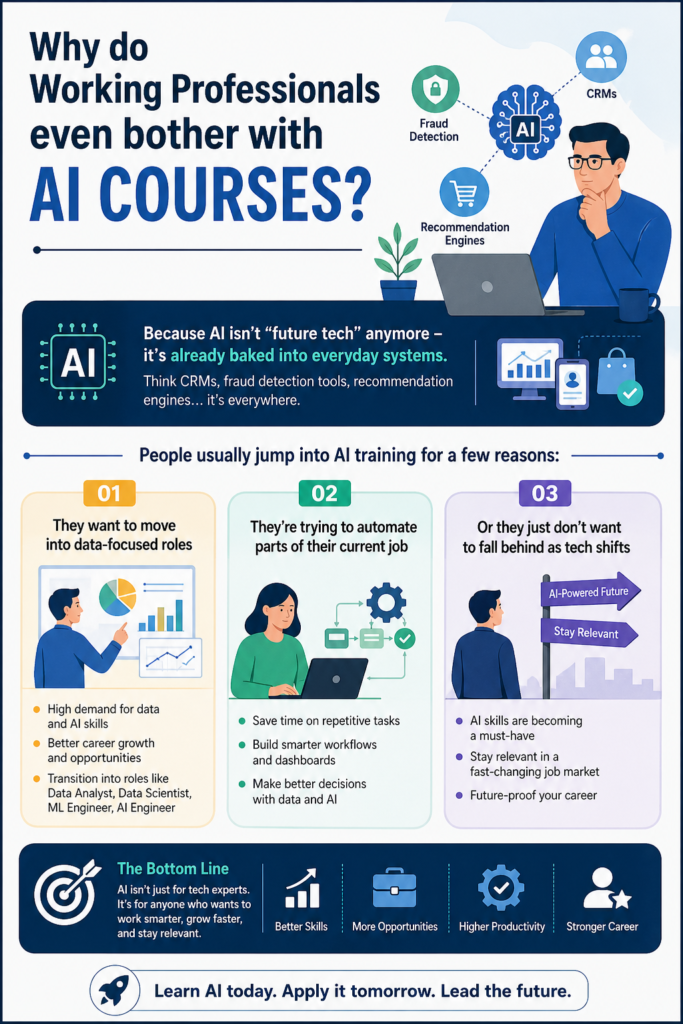
Because AI isn’t “future tech” anymore it’s already baked into everyday systems. Think CRMs, fraud detection tools, recommendation engines… it’s everywhere.
People usually jump into best AI online training institutes for a few reasons:
- They want to move into data-focused roles
- They’re trying to automate parts of their current job
- Or they just don’t want to fall behind as tech shifts
In larger companies, AI shows up in places like:
- Predictive analytics
- Customer segmentation
- Supply chain optimization
- IT automation (AIOps)
And once you’re in that space, your work might involve building models, prepping data, deploying pipelines, or just making sure everything keeps running smoothly after launch.
Where can you actually learn AI online in the U.S.?
There isn’t a single “best” option—it depends on how you like to learn.
1. Practical IT training providers
Programs Ai Training Courses those from H2K Infosys focus more on job readiness than theory.
You’ll usually get:
- Live classes with instructors
- Real-world project simulations
- Exposure to workflows used in QA, DevOps, and data engineering
- Help with resumes and interviews
These are especially useful if you’re switching roles say, moving from manual testing into AI-driven automation.
2. University-backed programs
Big names like:
- Stanford Online
- MIT Professional Education
- Harvard Extension School
They bring strong academic depth. You’ll get theory, research exposure, and structured learning.
That said… they don’t always focus on how AI systems are actually deployed in real business environments.
They’re flexible, affordable, and there’s a huge variety of courses.
The downside? You’ll need discipline. And sometimes, the “real-world” part feels a bit… simulated.
What does AI look like in real projects?
In actual IT environments, AI isn’t just theory—it follows a pretty structured pipeline:
- Collect data (logs, user behavior, transactions)
- Clean and prepare it
- Choose a model (classification, regression, etc.)
- Train and validate it
- Deploy it (often via APIs or cloud services)
- Monitor performance and tweak as needed
Take fraud detection, for example. You feed in transaction data, run it through a classification model, and get a probability score. Simple idea complex execution.
Common tools? Python (with Pandas, NumPy), Scikit-learn, and cloud platforms like AWS or Azure.
What skills do you actually need?
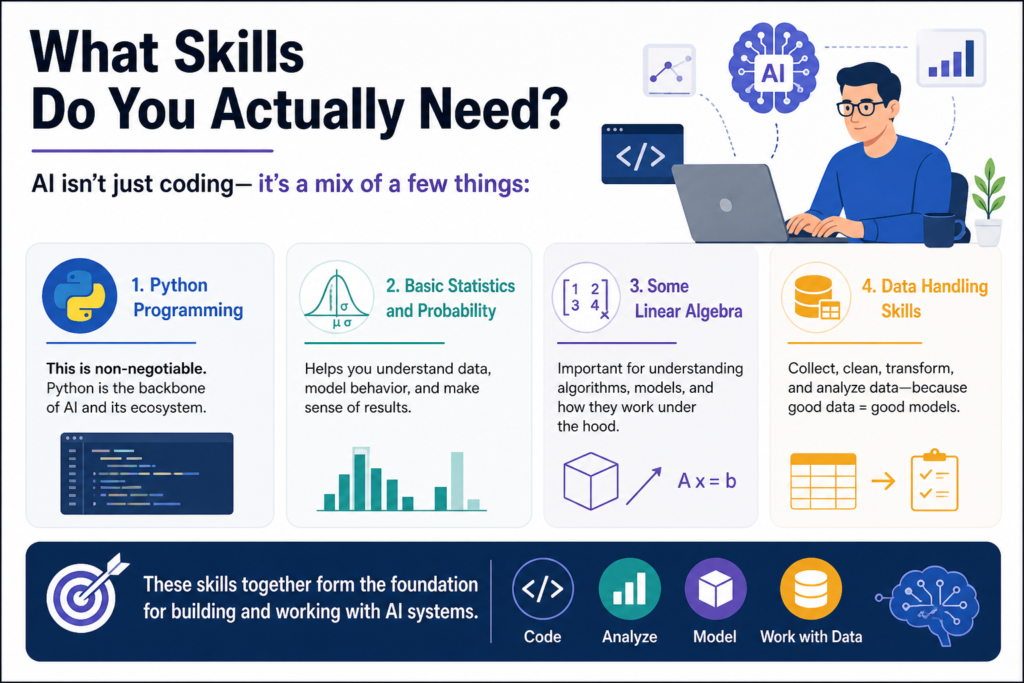
AI isn’t just coding—it’s a mix of a few things:
- Python programming (this is non-negotiable)
- Basic statistics and probability
- Some linear algebra
- Data handling skills
On the tools side, you’ll likely work with:
- TensorFlow or PyTorch
- Scikit-learn
- SQL
- Jupyter Notebook
Over time, you start connecting these pieces naturally but at the beginning, it can feel like a lot. That’s normal.
How is AI used inside companies?
Pretty much everywhere now:
- Customer analytics → recommendation systems
- Finance → fraud detection
- Healthcare → diagnostic tools
- IT → predictive maintenance
But there are always constraints privacy laws, scalability issues, explainability requirements. Real-world AI isn’t just about building models; it’s about making them usable and compliant.
What jobs use AI daily?
A few common ones:
- Machine Learning Engineer
- Data Scientist
- AI Engineer
- Data Analyst
- NLP Engineer
Each role leans on slightly different skills, but there’s overlap—especially around Python and data handling.
Career paths after AI training
Most people don’t jump straight into senior roles. The path usually looks something like:
Data Analyst → Junior Data Scientist → ML Engineer → AI Architect
It’s more of a progression than a leap.
Choosing the best AI online training institutes
A few things worth checking before you commit:
- Does the curriculum actually cover ML, DL, and NLP?
- Are there real projects—not just demos?
- Do instructors have industry experience?
- Is there any career support (resume help, interview prep)?
Those small details tend to make a big difference later.
Quick FAQs
What’s the best AI certification?
Depends on your goal. Practical programs (like H2K Infosys) focus on job readiness, while universities lean more theoretical.
Can beginners start AI?
Yes—most courses begin with Python and basic stats.
How long does it take?
Roughly 3–6 months for a solid foundation.
Do certifications help with jobs?
They help—but only if you also have hands-on project experience.
Which language should I learn?
Python. No real debate there.
Can I learn part-time?
Definitely. Many programs are built for working professionals
Final thoughts
AI isn’t some niche skill anymore it’s becoming a core part of how modern systems work. And honestly, the difference between just “learning AI” and actually using it comes down to practice.
If you’re serious about moving into this space, look for programs that don’t just teach concepts but show you how things work in real environments.