H2K Infosys Artificial Intelligence Online Training gives professionals a practical way to build real-world skills in machine learning, deep learning, natural language processing, AI deployment, and data-driven automation.
A lot of people step into AI expecting something straight out of a movie endless complex equations, futuristic robots, maybe someone coding alone in a dark room for 18 hours straight. Real AI work usually looks very different. In actual business environments, AI is often about integration. Teams spend just as much time connecting models with cloud platforms, APIs, databases, enterprise applications, and existing infrastructure as they do building algorithms themselves.
That’s one reason structured AI training matters. A good artificial intelligence training program doesn’t just explain concepts; it prepares learners for how AI operates inside real organizations. Most serious programs also help students prepare for industry certifications from cloud providers, universities, and major technology vendors.
An Artificial intelligence Certified Course typically blends theory with hands-on work using tools like Python, TensorFlow, PyTorch, AWS, Microsoft Azure, and Google Cloud AI services. And honestly, that practical side is where things start clicking for most learners.
Certifications Can You Earn Through Artificial Intelligence, Theory is important, obviously. But production systems are a different story entirely. Models need to scale. They have to work with systems companies already rely on. They cannot break workflows every other week. Reliability becomes just as important as accuracy at some point sometimes more important
What Is Artificial Intelligence Online Training?
Artificial Intelligence Online Training is a structured learning approach that teaches AI fundamentals, algorithms, enterprise tools, and practical applications through virtual learning platforms.
Some programs are instructor-led, while others are fully self-paced. Many sit somewhere in the middle recorded sessions combined with live labs, assignments, cloud exercises, and project work. That flexibility helps working professionals learn without completely rearranging their schedules.
Most modern AI programs cover topics like:
- Machine learning fundamentals
- Neural networks and deep learning
- Natural language processing
- Computer vision
- AI deployment workflows
- Cloud-based AI services
- Data preprocessing and analytics
- Responsible AI and governance
The interesting part is that AI training is no longer limited to data scientists. These programs are now useful for:
- Software developers
- Data analysts
- Cloud engineers
- DevOps professionals
- Business intelligence teams
- IT support professionals transitioning into AI-focused roles
A solid artificial intelligence certified course usually includes hands-on labs and cloud exercises based on real enterprise workflows. That practical exposure makes AI feel much less abstract.
Why Artificial Intelligence Matters for Working Professionals
AI has quietly become part of everyday business operations across healthcare, finance, cybersecurity, retail, logistics, manufacturing, and customer service. It is not just a research topic anymore.
Organizations now use AI to:
- Automate repetitive tasks
- Improve operational efficiency
- Analyze large datasets faster
- Detect fraud and suspicious activity
- Improve customer experiences
- Support predictive decision-making
For IT professionals, AI skills are becoming valuable partly because AI tools now connect directly with systems businesses already depend on every day.
Common AI Use Cases by Industry
| Industry | Common AI Use Cases |
|---|---|
| Healthcare | Medical imaging analysis, patient outcome prediction |
| Finance | Fraud detection, credit scoring, risk analysis |
| Retail | Recommendation engines, inventory forecasting |
| Cybersecurity | Threat detection and anomaly monitoring |
| Manufacturing | Predictive maintenance, quality inspection |
| Customer Service | Chatbots and virtual assistants |
Professionals who complete an Artificial intelligence Training Program often gain a better understanding of how AI interacts with APIs, cloud platforms, databases, and enterprise applications. That integration layer is becoming surprisingly important in hiring conversations lately.
What Certifications Can You Earn Through Artificial Intelligence Online Training?
Artificial intelligence online training can prepare learners for several certification paths depending on their goals, experience level, and specialization interests.
Vendor-Specific AI Certifications
These certifications usually focus on enterprise AI services and cloud deployment workflows.
Microsoft Certified: Azure AI Engineer Associate
This certification validates skills in:
- Azure AI services
- Cognitive services
- NLP solutions
- Computer vision integration
- Conversational AI systems
It’s particularly useful for professionals already working in Microsoft-heavy environments.
AWS Certified Machine Learning – Specialty
This certification focuses on:
- Machine learning pipelines
- Data engineering
- Feature engineering
- Model optimization
- Deployment on AWS infrastructure
A lot of cloud engineers pursue this one once they start working with scalable ML systems in production.
Google Professional Machine Learning Engineer
This Certifications Can You Earn Through Artificial Intelligence covers:
- TensorFlow implementation
- Vertex AI
- ML optimization
- Production deployment
- Monitoring and governance
It’s commonly pursued by teams working inside Google Cloud ecosystems.
AI Certifications From Educational Platforms
Many artificial intelligence certified course providers partner with universities and enterprise technology companies.
Popular examples include:
- IBM AI Engineering Professional Certifications Can You Earn Through Artificial Intelligence
- Stanford Machine Learning programs
- DeepLearning.AI specializations
- Applied AI programs from technical institutes
Some are heavily theory-based. Others are more practical and project-oriented. Neither approach is automatically “better” it really depends on what the learner wants out of the program.
Specialized Artificial Intelligence Certifications
Some certifications focus on specific AI domains instead of broad enterprise AI workflows.
Deep Learning Certifications
These programs often cover:
- Neural networks
- CNNs
- RNNs
- Transformer architectures
- Model optimization
Natural Language Processing Certifications
Typical topics include:
- Text preprocessing
- Sentiment analysis
- Named entity recognition
- Large language models
- Conversational AI systems
Computer Vision Certifications
Programs may focus on:
- Image recognition
- Object detection
- OCR systems
- Video analytics
- Image segmentation
How Artificial Intelligence Works in Real IT Projects
Real-world AI projects involve much more than training a model. Behind the scenes, there’s usually a full operational pipeline supporting everything.
A Typical Enterprise AI Workflow Includes
- Data collection
- Data preprocessing
- Feature engineering
- Model selection
- Model training
- Evaluation and testing
- Deployment
- Monitoring and retraining
Example: Fraud Detection Workflow
A financial organization may use AI to identify suspicious transactions in real time.
| Stage | Task |
|---|---|
| Data Ingestion | Collect transaction logs |
| Preprocessing | Normalize data and remove duplicates |
| Feature Engineering | Create spending pattern indicators |
| Model Training | Train anomaly detection models |
| Deployment | Integrate with transaction systems |
| Monitoring | Track false positives and model drift |
Most artificial intelligence training programs now include similar hands-on exercises using Python notebooks and cloud ML platforms. For many learners, this is the point where AI finally starts feeling practical instead of theoretical.
Prerequisites for Learning Artificial Intelligence
Artificial intelligence learning paths usually combine programming, mathematics, data handling, and cloud technologies.
Programming Languages
Commonly used languages include:
- Python
- R
- SQL
- Java for enterprise integrations
Python remains the dominant language mainly because its AI ecosystem is enormous and still growing fast.
Mathematics and Statistics
AI professionals often work with:
- Linear algebra
- Probability
- Statistics
- Basic calculus
Not everyone enjoys the math side of AI — and that’s fine — but understanding the fundamentals helps people avoid treating models like mysterious black boxes.
Data Handling Skills
Learners frequently work with:
- Pandas
- NumPy
- SQL databases
- Data visualization tools
Machine Learning Frameworks
Popular frameworks include:
- TensorFlow
- PyTorch
- Scikit-learn
- Keras
Cloud and Deployment Skills
Enterprise AI systems commonly run on:
- AWS
- Microsoft Azure
- Google Cloud Platform
- Kubernetes environments
Cloud knowledge becomes especially valuable once projects move beyond experimentation and into production systems.
Topics Covered in an Artificial Intelligence Training Program
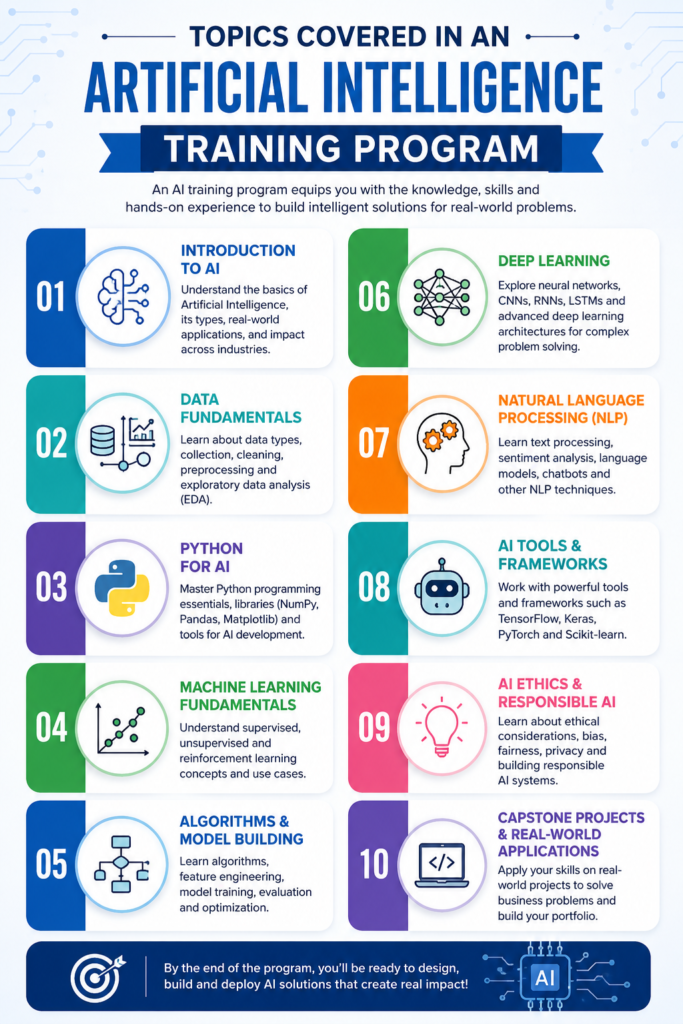
Most structured Certifications Can You Earn Through Artificial Intelligence training programs include both beginner and advanced concepts.
Machine Learning
Common subjects include:
- Supervised learning
- Unsupervised learning
- Reinforcement learning
Deep Learning
Learners often study:
- Neural networks
- CNNs
- RNNs
- Transformers
Natural Language Processing
Topics may include:
- Text classification
- Language generation
- Chatbot development
Computer Vision
Training commonly covers:
- Image recognition
- Video processing
- Object tracking
AI Model Deployment
Modern enterprise training increasingly includes:
- API integration
- Docker containers
- MLOps pipelines
- CI/CD for machine learning
A lot of beginners underestimate deployment. Building a model is hard enough already, but maintaining it in production — keeping it stable, scalable, and secure — becomes a completely different challenge.
Using Artificial Intelligence in Enterprise Environments
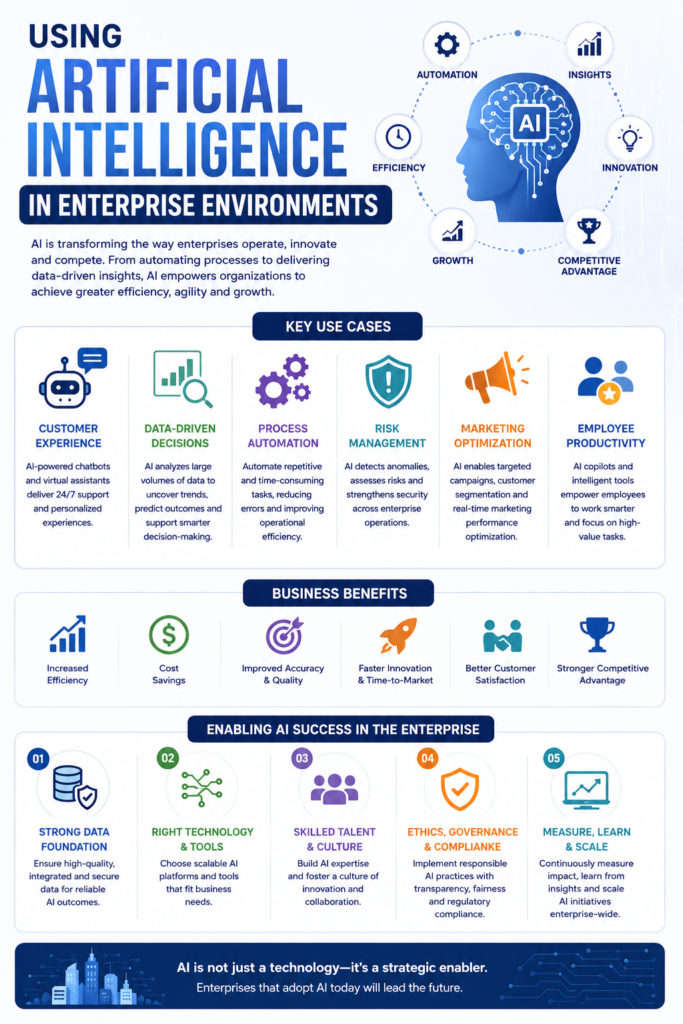
Enterprise AI deployment involves more than model creation. Organizations also need to manage governance, compliance, scalability, security, and infrastructure integration.
Common Enterprise AI Architecture
| Layer | Enterprise Function |
|---|---|
| Data Layer | Data warehouses and pipelines |
| Processing Layer | ETL and feature engineering |
| Model Layer | AI training and inference |
| Deployment Layer | APIs and cloud services |
| Monitoring Layer | Logging and performance tracking |
Enterprise Challenges
AI teams commonly deal with:
- Data quality problems
- Security concerns
- Model drift
- Infrastructure scaling
- Compliance requirements
- Explainability and bias management
Advanced Certifications Can You Earn Through Artificial Intelligence certified courses often introduce these challenges through enterprise labs and simulations because companies are paying much closer attention to operational AI risks now.
Common Tools Used in AI Projects
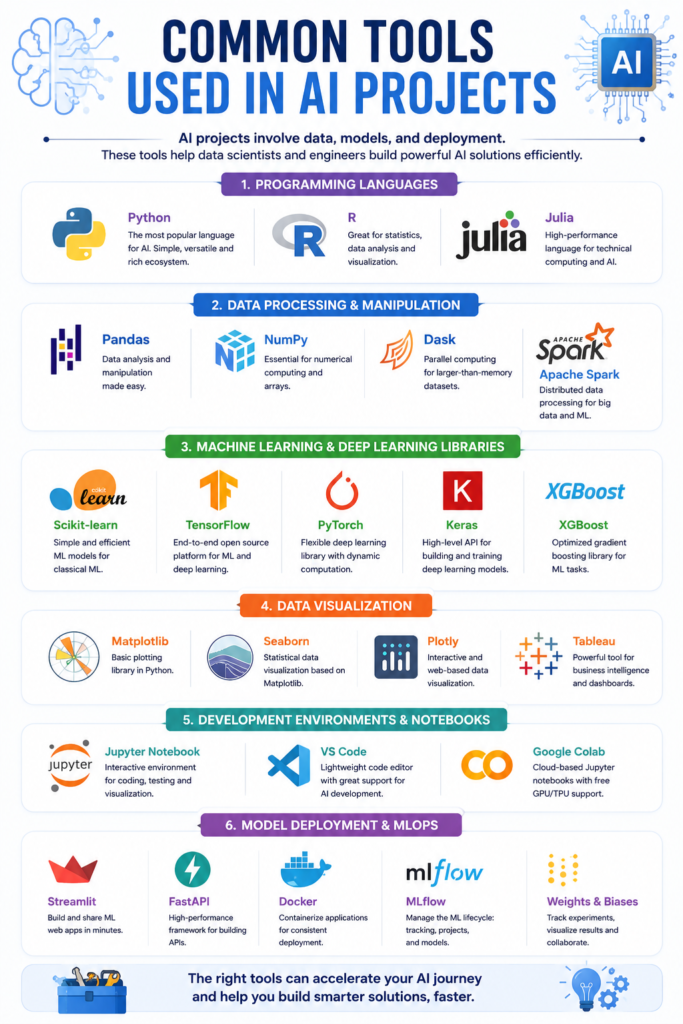
AI professionals use different tools depending on project requirements.
AI Development Tools
| Tool | Common Use |
|---|---|
| Python | AI programming |
| Jupyter Notebook | Experimentation and prototyping |
| TensorFlow | Deep learning development |
| PyTorch | Model training and research |
| Scikit-learn | Machine learning algorithms |
| Pandas | Data manipulation |
| Docker | Containerized deployment |
| Kubernetes | Scalable AI deployment |
Cloud AI Services
| Cloud Platform | AI Services |
|---|---|
| AWS | SageMaker |
| Azure | Azure AI Services |
| Google Cloud | Vertex AI |
These platforms appear in enterprise environments constantly now, so many training programs include them directly inside hands-on labs.
Artificial Intelligence Job Roles
AI skills now apply across technical and business-focused positions.
Common AI-Related Roles
| Role | Responsibilities |
|---|---|
| Machine Learning Engineer | Build and deploy ML models |
| Data Scientist | Analyze data and create predictive models |
| AI Engineer | Develop AI-powered applications |
| NLP Engineer | Build language processing systems |
| Computer Vision Engineer | Create image recognition solutions |
| AI Solutions Architect | Design enterprise AI systems |
| Business Intelligence Analyst | Use AI-driven analytics |
AI knowledge also supports careers in:
- Cloud engineering
- DevOps
- Software development
- Product management
- Cybersecurity
Career Options After an AI Course
Professionals who complete an artificial intelligence certified course may move into analytics, AI operations, enterprise implementation, or research support roles.
Career Progression Examples
| Entry-Level Role | Mid-Level Role | Advanced Role |
|---|---|---|
| Data Analyst | Machine Learning Engineer | AI Architect |
| Junior Developer | AI Engineer | Principal AI Engineer |
| BI Analyst | Data Scientist | AI Strategy Consultant |
Career outcomes often depend on:
- Prior technical experience
- Programming knowledge
- Domain expertise
- Hands-on projects
- Certification relevance
Interestingly, many professionals transition into AI gradually instead of making one huge career jump overnight. That slow transition is actually far more common than people assume.
How AI Certifications Support Career Growth
AI Certifications Can You Earn Through Artificial Intelligence help professionals demonstrate structured learning and practical readiness.
Skill Validation
Certifications provide evidence of:
- AI platform familiarity
- Machine learning knowledge
- Cloud AI deployment skills
Structured Learning
Certification preparation is often built around:
- Core AI concepts
- Applied labs
- Enterprise workflows
Alignment With Enterprise Tools
Many certifications focus directly on technologies used in production environments, including:
- AWS SageMaker
- Azure Machine Learning
- TensorFlow
- Kubernetes
Learn AI Through Hands-On Projects
Practical learning is one of the most valuable parts of any Certifications Can You Earn Through Artificial Intelligence training program.
Predictive Analytics Projects
Examples include:
- Sales forecasting
- Customer churn prediction
- Fraud detection
NLP Projects
Learners may build:
- Chatbots
- Resume analyzers
- Sentiment analysis systems
Computer Vision Projects
Projects often involve:
- Face detection
- Image classification
- Defect detection systems
Sample AI Project Workflow
Step 1: Data Collection
Learners gather structured or unstructured datasets.
Step 2: Data Cleaning
Typical tasks include:
- Removing duplicates
- Handling missing values
- Standardizing formats
Step 3: Model Development
Common libraries include:
- Scikit-learn
- TensorFlow
- PyTorch
Step 4: Evaluation
Models are often evaluated using:
- Accuracy
- Precision
- Recall
- F1 score
Step 5: Deployment
Models may be deployed through:
- REST APIs
- Docker containers
- Cloud endpoints
That deployment stage is usually where learners realize AI systems are not just notebook experiments sitting on a laptop somewhere. They have to function reliably in production, sometimes at large scale.
Challenges AI Professionals Commonly Face
AI implementation comes with challenges that are not always obvious early on.
Data Challenges
Organizations frequently struggle with:
- Incomplete datasets
- Data inconsistencies
- Privacy concerns
Infrastructure Challenges
Common issues include:
- GPU resource management
- Cloud cost optimization
- Distributed training complexity
Governance Challenges
Enterprise teams also need to address:
- Ethical AI practices
- Bias reduction
- Compliance standards
- Explainable AI requirements
Advanced artificial intelligence certified courses now include governance and operational AI topics because businesses are taking these risks much more seriously than they did a few years ago.
How Beginners Should Choose an Artificial Intelligence Certified Course
Learners should choose a course that fits both their technical background and career goals.
Technical Depth
Check whether the course includes:
- Basic AI concepts
- Advanced machine learning models
- Deployment workflows
Hands-On Learning
Look for:
- Real datasets
- Interactive labs
- Cloud exercises
- Capstone projects
Tool Coverage
Important technologies may include:
- Python
- TensorFlow
- PyTorch
- AWS
- Azure
Certification Alignment
Some learners prioritize:
- Vendor certifications
- University-backed credentials
- Industry-recognized AI certifications
Frequently Asked Questions
What is an artificial intelligence training program?
An Certifications Can You Earn Through Artificial Intelligence is a structured course that teaches AI concepts, machine learning algorithms, deployment methods, and enterprise applications.
What is an artificial intelligence certified course?
An artificial intelligence certified course provides formal certification after learners complete training and assessments related to AI technologies and workflows.
Do AI certifications require programming knowledge?
Many Certifications Can You Earn Through Artificial Intelligence benefit from basic Python knowledge, although beginner-friendly programs often introduce programming gradually.
Which AI certification is best for cloud professionals?
Cloud professionals commonly pursue certifications such as AWS Certified Machine Learning – Specialty or Microsoft Azure AI Engineer Associate.
How long does it take to learn artificial intelligence?
Learning timelines vary depending on technical background and specialization goals. Foundational programs may take a few months, while advanced AI paths can take significantly longer.
Are hands-on projects important in AI training?
Absolutely. Hands-on projects help learners understand debugging, deployment, integration, and real-world AI workflows much better than theory alone.
Is artificial intelligence used outside software development?
Yes. AI is now widely used in healthcare, finance, manufacturing, cybersecurity, retail, logistics, and customer service industries.
Can beginners learn artificial intelligence online?
Yes. Many online AI programs Certifications Can You Earn Through Artificial Intelligence are designed for beginner-to-intermediate learners and gradually introduce programming, machine learning, and data science concepts.
Conclusion
Artificial Intelligence Online Training helps professionals build practical skills in machine learning, cloud AI services, enterprise deployment, data analytics, and real-world AI applications.
Certifications Can You Earn Through Artificial Intelligence earned through an artificial intelligence training program can support career growth by validating both technical knowledge and hands-on experience with industry-standard tools.
As AI becomes more deeply integrated into business systems, professionals in IT, software development, analytics, and cloud computing are realizing that AI knowledge is becoming less optional over time. A strong foundation can create new opportunities and help people stay adaptable as enterprise technology keeps evolving — because honestly, the pace of change is not slowing down anytime soon.
Key Takeaways
- Artificial intelligence courses cover machine learning, NLP, deep learning, and deployment workflows.
- Major Certifications Can You Earn Through Artificial Intelligence providers include AWS, Microsoft Azure, Google Cloud, IBM, and universities.
- Enterprise AI projects require deployment, governance, infrastructure integration, and data management skills.
- Hands-on labs and practical projects are essential for real AI learning.
- AI skills are becoming valuable across industries and technical job roles.
- Cloud Certifications Can You Earn Through Artificial Intelligence and MLOps workflows are now standard parts of many production environments.