H2K Infosys Artificial Intelligence Online Training gives professionals a practical way to build skills in machine learning, automation, data analysis, natural language processing, and AI deployment through structured lessons and real-world projects. Most Artificial intelligence Certified Course blend theory with hands-on implementation, so learners are not just reading concepts they’re actually working with tools, writing code, testing models, and understanding how AI systems operate in business environments.
The better Artificial Intelligence Online Training usually lean heavily toward applied learning instead of staying stuck in textbook explanations. You’ll often find project-based assignments, cloud AI services, workflow simulations, and industry-standard frameworks that reflect how companies actually use AI in production. Healthcare, finance, cybersecurity, retail, software engineering AI touches all of them now, and training programs are slowly adapting to that reality.
What Is Artificial Intelligence Online Training?
Artificial Intelligence online training is essentially a structured learning program delivered through virtual platforms that teach AI concepts, tools, algorithms, and implementation methods. Depending on the provider, courses may include live instructor-led sessions, recorded lectures, labs, coding assignments, case studies, and project work.
Most AI training programs cover several major areas, including:
- Machine Learning (ML)
- Deep Learning
- Natural Language Processing (NLP)
- Computer Vision
- Generative AI
- Predictive Analytics
- AI Model Deployment
- AI Ethics and Governance
These programs are commonly designed for:
- Software developers
- Data analysts
- Cloud engineers
- QA professionals
- IT administrators
- Business analysts
- Professionals shifting into AI-focused roles
And honestly, that’s one of the biggest differences between academic Artificial Intelligence Online Training. Academic programs often focus deeply on theory and research. Practical AI training tends to focus more on implementation how things actually get built, deployed, monitored, and maintained in enterprise systems.
Why AI Matters for Working Professionals
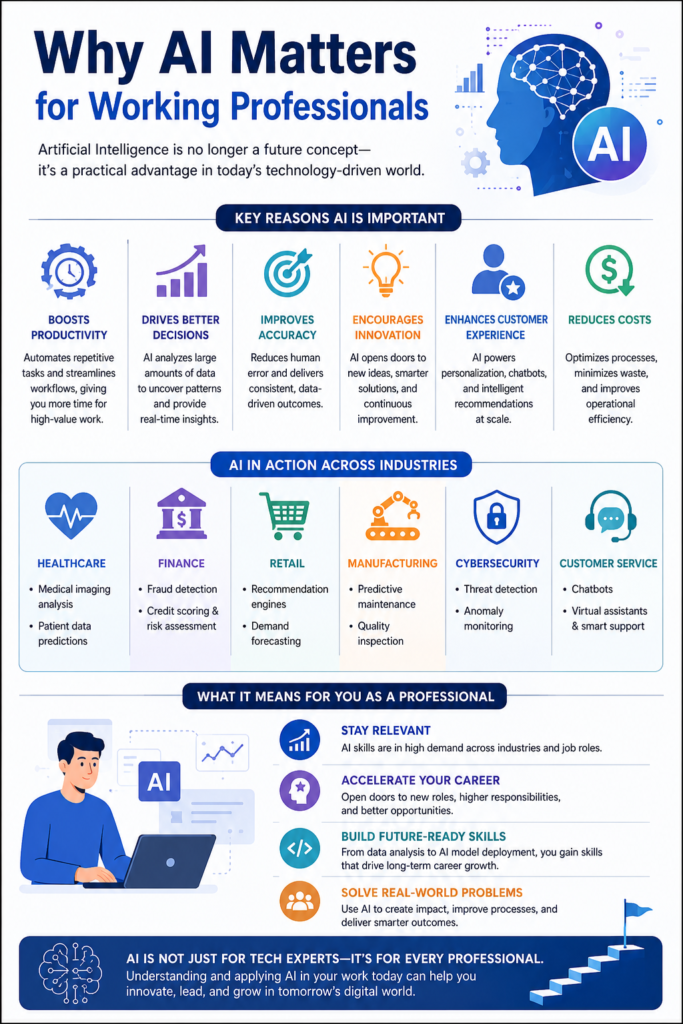
AI is no longer something sitting in isolated research labs. It’s now woven into regular enterprise workflows, sometimes quietly in the background. Organizations use AI to automate repetitive tasks, analyze huge datasets, improve customer experiences, detect anomalies, and support decision-making at scale.
For working professionals, understanding AI has become increasingly valuable because these tools are being integrated into existing systems people already work with every day.
Common Enterprise AI Applications
| Industry | AI Use Cases |
|---|---|
| Healthcare | Medical imaging, patient risk prediction |
| Banking | Fraud detection, credit scoring |
| Retail | Recommendation engines, inventory forecasting |
| Cybersecurity | Threat detection, anomaly monitoring |
| Manufacturing | Predictive maintenance, quality inspection |
| Customer Service | Chatbots, sentiment analysis |
Professionals working around AI are often expected to understand things like:
- Automation workflows
- Data-driven decision-making
- AI-assisted software development
- Model integration with business systems
- Responsible AI practices
Cloud-based AI services have lowered infrastructure barriers too. A few years ago, deploying AI systems often required heavy internal infrastructure. Now, companies can spin up AI services through AWS, Azure, or Google Cloud without building everything from scratch.
How AI Works in Real IT Projects
Real-world AI systems usually follow a workflow that combines data engineering, training, deployment, and monitoring. It’s rarely as simple as “train a model and you’re done.” In practice, most of the work ends up happening around the model rather than inside it.
Typical AI Workflow
| Stage | Activities |
|---|---|
| Data Collection | Gathering structured and unstructured data |
| Data Preparation | Cleaning, normalization, feature engineering |
| Model Selection | Choosing ML or deep learning algorithms |
| Training | Feeding historical data into models |
| Evaluation | Measuring accuracy and performance |
| Deployment | Integrating models into applications |
| Monitoring | Tracking drift, errors, and reliability |
Example: Fraud Detection in Banking
A bank using AI for fraud detection may:
- Collect transaction history
- Label fraudulent activity
- Train classification models
- Evaluate false positives and accuracy
- Deploy models through APIs
- Monitor suspicious transactions in real time
The interesting part? Monitoring never really stops. Models drift over time because user behavior changes. A model that worked six months ago may quietly become unreliable if nobody tracks it carefully.
Common Enterprise AI Tools
| Category | Tools |
|---|---|
| Programming | Python, R |
| ML Frameworks | TensorFlow, PyTorch, Scikit-learn |
| Data Platforms | Apache Spark, Hadoop |
| Cloud AI | AWS SageMaker, Azure AI, Google Vertex AI |
| Visualization | Power BI, Tableau |
| MLOps | MLflow, Kubeflow, Docker |
Good online AI training usually exposes learners to at least some of these tools through guided labs and implementation projects rather than only demonstrations.
How Online AI Courses Build Practical Skills
One major advantage of Online AI Certification Courses is the mix of theory and implementation. Watching videos alone rarely builds real confidence. Writing code, debugging broken models, and deploying projects — that’s where things start to click.
Hands-On Labs
Learners often practice:
- Building ML models
- Writing Python scripts
- Cleaning datasets
- Using AI APIs
- Training neural networks
Realistic Projects
Projects may involve:
- Predictive analytics
- Sentiment analysis
- Chatbot development
- Recommendation systems
- Image classification
Some courses also include cloud platform exposure, which matters more than many beginners realize. Enterprise AI environments rely heavily on cloud infrastructure.
Training may cover:
- AWS AI services
- Azure Machine Learning
- Google Cloud AI tools
Deployment practice is becoming increasingly important too. Many professionals now need to understand:
- Docker containers
- API deployment
- Monitoring production AI systems
- Scalability considerations
That operational side of AI often called MLOps gets overlooked in a lot of beginner content online.
Skills Needed to Learn AI
You don’t necessarily need advanced mathematics on day one, despite what some people assume. Strong analytical thinking and consistency matter more early on.
Core Skills
| Skill Area | Importance |
|---|---|
| Python Programming | Essential |
| Statistics | Important |
| Data Analysis | Important |
| SQL | Helpful |
| Linear Algebra | Useful |
| Problem Solving | Essential |
| Cloud Basics | Increasingly important |
Recommended Beginner Path
Step 1: Learn Programming Fundamentals
Focus on:
- Python syntax
- Functions
- Data structures
- Libraries like NumPy and Pandas
Step 2: Understand Data Analysis
Learn:
- Data cleaning
- Exploratory analysis
- Visualization techniques
Step 3: Study Machine Learning Basics
Start with:
- Regression
- Classification
- Clustering
- Model evaluation
Step 4: Explore Deep Learning
Learn about:
- Neural networks
- CNNs
- RNNs
- Transformer models
Step 5: Learn Deployment and MLOps
Understand:
- APIs
- CI/CD workflows
- Monitoring
- Model versioning
The strongest Artificial Intelligence Online Training online usually structure learning progressively so professionals don’t get overwhelmed trying to absorb everything at once. And honestly, AI has become such a broad field that pacing matters a lot.
AI in Enterprise Environments
Enterprise AI differs quite a bit from experimental or academic projects. Companies care less about flashy demos and more about reliability, security, scalability, and compliance.
A retail company using AI-based forecasting, for example, might:
- Pull sales data from ERP systems
- Process nightly pipelines
- Train forecasting models
- Push predictions into dashboards
- Monitor seasonal accuracy trends
Common Enterprise AI Challenges
| Challenge | Description |
|---|---|
| Data Quality | Incomplete or inconsistent data |
| Scalability | Large processing requirements |
| Bias | Unfair model behavior |
| Security | Protecting sensitive information |
| Governance | Compliance and auditing |
| Model Drift | Accuracy declining over time |
This is where practical AI education becomes valuable. Real systems are messy. Data is messy. Deployments fail. APIs break. Models behave unpredictably. Good training prepares learners for those realities instead of presenting AI as a perfectly clean workflow.
What the Best AI Courses Usually Include
High-quality Artificial Intelligence Online Training generally balance conceptual understanding with practical implementation.
Key Features
Structured Curriculum
The learning path should move logically from basics to advanced topics.
Industry-Relevant Tools
Courses often include:
- Python
- TensorFlow
- PyTorch
- SQL
- Jupyter Notebook
- Cloud AI platforms
Hands-On Projects
Projects remain one of the best ways to understand implementation workflows.
Instructor Support
Live mentoring or guidance can help learners troubleshoot technical issues faster.
Assessments and Certification
Many Artificial Intelligence Online Training include:
- Quizzes
- Assignments
- Capstone projects
- Technical evaluations
MLOps and Deployment
Modern AI roles increasingly expect deployment knowledge, not just model training.
How Professionals Use AI Skills at Work
AI skills are often integrated into broader responsibilities rather than existing as standalone tasks.
Examples by Role
| Role | AI-Related Responsibilities |
|---|---|
| Data Analyst | Predictive reporting |
| Software Engineer | AI feature integration |
| Cloud Engineer | AI infrastructure deployment |
| QA Engineer | AI-based testing automation |
| Cybersecurity Analyst | Threat detection models |
| Business Analyst | AI-driven insights |
A software developer, for instance, may use AI to analyze logs, automate ticket classification, detect anomalies, or improve recommendation features. Customer support teams may rely on NLP-powered chatbots or sentiment analysis systems without even directly calling it “AI work.”
That’s part of why AI literacy has become useful beyond purely technical data science roles.
Career Opportunities After Learning AI
Artificial Intelligence Online Training can support transitions into multiple career paths depending on someone’s background and experience.
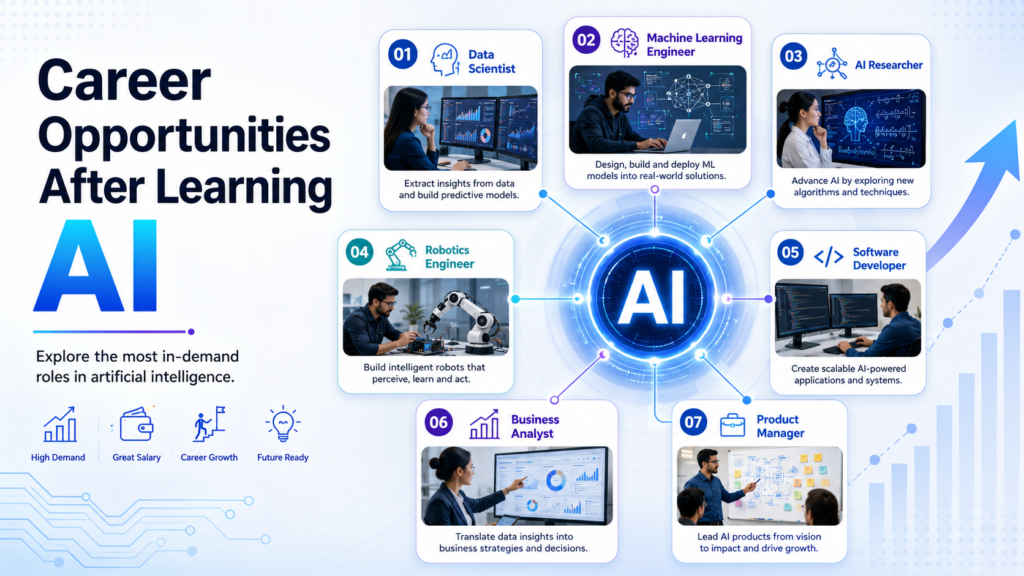
Career Paths
| Background | Possible Direction |
|---|---|
| Software Development | AI Engineer |
| Database Administration | Data Engineer |
| Business Analysis | AI Business Analyst |
| QA Testing | AI Testing Specialist |
| Cloud Administration | Cloud AI Engineer |
| Data Analytics | Machine Learning Analyst |
Typical Role Progression
Entry-Level
- Junior Data Analyst
- AI Support Specialist
- ML Associate
Mid-Level
- Machine Learning Engineer
- AI Developer
- Data Scientist
Advanced
- AI Architect
- Lead ML Engineer
- AI Solutions Consultant
Practical experience usually matters just as much as certifications. Portfolio projects, deployment experience, and workflow familiarity often help professionals stand out more than theoretical knowledge alone.
Why Hands-On Learning Matters
Practical implementation tends to reinforce concepts far better than passive reading or video-only courses.
Hands-on work exposes learners to:
- Missing data
- Outliers
- Poor model performance
- Deployment failures
- Debugging challenges
A learner building a sentiment analysis project, for example, may:
- Collect customer reviews
- Preprocess text data
- Train NLP models
- Evaluate classification accuracy
- Deploy predictions through APIs
- Monitor performance metrics
That kind of workflow creates operational understanding — something difficult to develop through theory alone.
Common Challenges Beginners Face
Learning AI can definitely feel overwhelming at first, especially for professionals moving from non-programming backgrounds.
Common Challenges
| Challenge | Explanation |
|---|---|
| Mathematics | Statistics and linear algebra basics |
| Programming | Debugging Python code |
| Tool Ecosystems | Many frameworks and platforms |
| Data Preparation | Cleaning consumes significant time |
| Model Evaluation | Understanding metrics |
Helpful Learning Strategies
- Start with fundamentals
- Build small projects first
- Practice consistently
- Use structured learning paths
Fragmented self-study resources can make AI feel more confusing than it actually is. A well-organized training program usually helps reduce that noise.
AI Deployment in Production Systems
Deployment is one of the most practical — and most ignored — parts of beginner AI education.
Typical AI Deployment Architecture
| Component | Function |
|---|---|
| Trained Model | Prediction engine |
| API Layer | Handles requests |
| Database | Stores data |
| Monitoring Tools | Tracks performance |
| Cloud Infrastructure | Supports scaling |
Typical Deployment Workflow
- Train and validate the model
- Export model artifacts
- Containerize using Docker
- Deploy to cloud infrastructure
- Monitor latency and accuracy
Production systems also require attention to:
- API security
- Response times
- Data privacy
- Cost optimization
- Continuous retraining
This operational awareness helps learners align with actual enterprise expectations instead of only academic exercises.
FAQ: Artificial Intelligence Online Training
What are the benefits of Artificial Intelligence Online Training?
They provide structured learning, hands-on experience, and exposure to industry-standard AI tools without requiring in-person attendance.
Do beginners need programming experience?
Basic Python knowledge helps, though many beginner-friendly programs start with fundamentals.
Which language is most commonly used in AI?
Python remains the dominant language because of its extensive ecosystem of ML libraries.
Are projects important?
Absolutely. Projects help learners understand deployment, debugging, workflows, and data preparation.
What tools are commonly taught?
TensorFlow, PyTorch, Scikit-learn, Jupyter Notebook, SQL, and cloud AI platforms are widely used
Key Takeaways
- Artificial Intelligence online training combines theory with implementation-focused learning.
- Online AI certification courses often include projects, labs, and cloud platform experience.
- The best AI courses online emphasize real-world workflows and production-level tools.
- AI knowledge is becoming increasingly valuable across software development, analytics, cloud engineering, and business operations.
- Practical learning helps professionals understand deployment, debugging, monitoring, and scalability challenges.
- Structured AI education can support career growth into machine learning, AI engineering, data science, and related technical roles.
Explore H2K Infosys courses to build practical Artificial Intelligence Online Training skills through guided labs, real-world projects, and industry-focused learning paths. Learn how structured AI training can help you apply AI concepts in real IT environments instead of only studying them theoretically.