
The Future of Business Analysis has definitely evolved from its former theoretical state and has grown more practical, action-driven, and pro-business approach. Instead of recruiting BAs just for documentation of requirements in 2026, companies expect that those BA specialists will be able to enhance their customers’ experience and support their team in decision-making.
Everyone who follows modern recruitment trends understands the only obvious truth they rarely come across any business professional who lacks analytical skills. Nowadays, businesses invest huge amounts in recruiting BAs who possess extensive knowledge of the processes and can execute strategies. This trend leads to making Business Analyst Training one of the most demanded career paths in 2026.
No surprises here.
Every business organization changes and evolves constantly. This requires BA professionals to be able to cooperate with people in other departments, to communicate effectively, and to solve operation problems.
Some years ago, you might still have been capable of using Excel and having informal discussions. Those approaches simply don’t work anymore.
Reasons for Businesses to Allocate More Money into Investing in Business Analysts in 2026
The Future of Business Analysis is going to depend a great deal on the way businesses react to the changes in market conditions. The rise of consumer needs, the shortage of resources, and the necessity to enhance the way business works have made them seek help from BAs. My observation during interviews with people who changed their jobs into BA positions showed me that modern recruiters do not care much about theory but about practical skills and problem-solving abilities.
Businesses of the current time want to find someone who is able to walk into the room, determine what should be done and suggest solutions that would either increase the level of efficiency or reduce costs.
Such industries like healthcare and finance services are a good example of areas where companies tend to update their systems of onboarding customers to satisfy their needs. This job is done by business analysts who collect requirements and analyze workflows among other things.
That is why students choose those educational programs where they combine practical BA projects with theoretical classes.
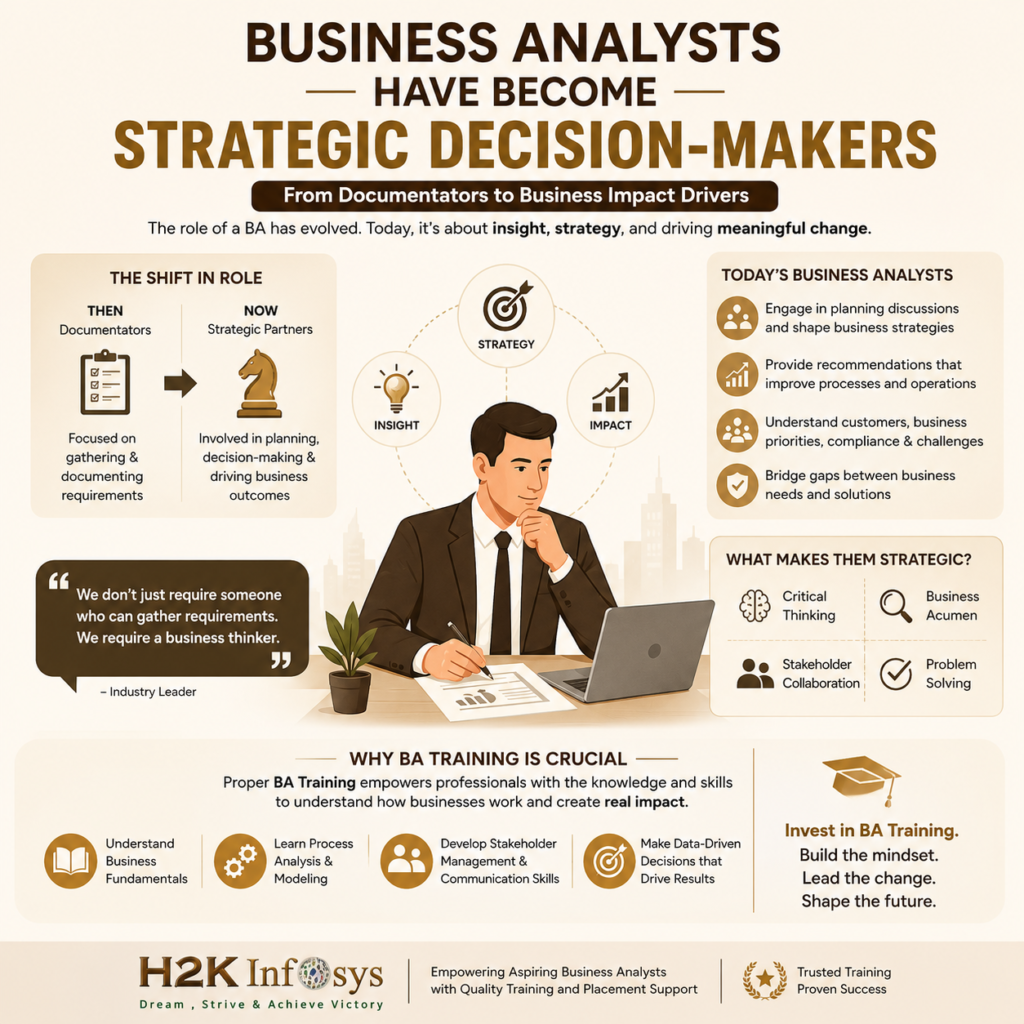
Business Analysts Have Become Strategic Decision-Makers
In several years ago, people perceived BAs mainly as documentators. This image is quickly changing.
Strategic thinking and impact have started to characterize the Future of Business Analysis. Professionals in BA roles have to engage in planning discussions and make recommendations that help companies to develop in terms of processes and operations.
Business analysts should know customers, current business priorities, compliance issues, and operational challenges.
One person stated the following during a recent virtual panel of industry representatives: “We don’t just require someone who can gather requirements. We require a business thinker.”
This quote is relevant not only for a particular company but for all industries.
BA Training is crucial in such a situation. Proper training helps people understand how businesses function.
More Practicality In The Field
In the Future of Business Analysis, practical BA skills will become increasingly important. Nowadays, businesses are very concerned about how people work rather than just what they write on their resumes.
Among many recent interviews, recruiters would always ask the following from learners:
- What did you do when you were facing changing needs?
- How did you interact with difficult stakeholders?
- How did you optimize particular processes?
- How did you document your work?
- What business problems did you solve?
This is exactly why learners prefer taking training programs that offer both theoretical BA education and practical BA training.
Learning BA terms for interviews is a lot different than knowing how to cope with similar challenges in the field.
Those who use case studies for self-study purposes usually do better during job interviews as they know how to speak about business cases.
This is one of the many reasons why learners prefer joining an H2K Infosys Business Analyst Course.
Impact of Remote & Hybrid Work Environment on the BA Field
The Future of Business Analysis is greatly influenced by the changes in business processes that happened under the impact of remote and hybrid working models.
Business analysts have to coordinate a lot with other people located remotely. Good communication skills are essential in the current environment.
It’s common for BA professionals to lead requirement workshop virtually, collaborate with stakeholders online, and document project-related information for globally distributed teams.
It’s changed recruiter’s attitude to BA candidates as well.
Nowadays, good written communication, meeting organization, and business presentation skills are mandatory for BA jobs.
To be honest, some candidates with advanced technical skills fail job interviews because they cannot explain complex situations related to business analysis competently. Companies notice this pretty quickly.
This is why modern courses teach learners not only business analysis but how to deal with business presentations, communicate with stakeholders, etc.
Importance of BA Certification to Increase by 2026
Future of Business Analysis provides additional information on the importance of BA certifications.
People who are planning to change their careers opt for BA certification courses to prove their abilities.
Similarly, companies also adopt this approach.
Certainly, possessing a certificate does not always ensure success. However, combined with practical experience and training, BA certification becomes extremely important.
BA certification indicates that the individual has the dedication to pursue his/her career in BA.
It will be effective for the following persons:
- Those who intend to switch careers.
- Those who plan to reenter the workforce.
- Fresh graduates.
- Those who seek BA jobs in an IT business organization.
- A combination of BA certification and experience training courses creates highly competent people.
Data-Savvy Mindset Required in Every BA
The Future of Business Analysis requires people with a data mindset.
Business analysts have to be able to interpret information, identify trends, and make decisions based on business metrics. And even non-technical businesses need people who can analyze such metrics to optimize processes.
Let’s consider retail organizations. Such businesses analyze client purchase behaviors to increase client loyalty. Healthcare organizations monitor patient workflow patterns to reduce delays. Financial businesses detect operational inefficiencies and improve service quality.
In all cases, business analysts can help.
That’s why companies appreciate BAs who can think in terms of business metrics yet understand how businesses operate.
Interestingly, successful business analysts don’t necessarily have to be loud at business meetings. Often they are just observing something that other people don’t.
Customers Are Important for Modern BAs
The Future of Business Analysis is no longer confined to business processes inside a company. It focuses much on customers.
Organizations monitor customer satisfaction levels, analyze onboarding experiences, evaluate delays in services delivery, and detect gaps in business communications.
Business analysts can facilitate such improvement processes since they understand customer behaviors.
Here’s an example. Recently, several banks redesigned their customer onboarding processes since BAs found out that users frequently abandoned the application forms midway due to complicated application requirements.
Such an optimization has a direct influence on the business’s revenues.
And that’s the place where successful BAs stand out since they know why requirements exist.
Career Advancement in Multiple Industries
The Future of Business Analysis is expanding outside one domain.
Healthcare, financial organizations, banking institutions, insurance companies, logistics businesses, retailers, educational organizations, and consulting firms are hiring BAs actively.
That’s why people tend to look for Business Analyst Courses and training programs.
The versatility of BA skills allows people to enter almost any domain once they receive appropriate BA training.
This expands the possibilities of BA professionals.
Soft Skills Play Key Role in Recruiting Process
The Future of Business Analysis proves the fact that technical knowledge alone doesn’t help.
Business analysts spend the largest part of the day communicating with people. They talk with business project managers, clients, developers, operations employees, and executives.
Often a business analyst’s ability to ask the right questions makes him/her as effective as a great documentation skill.
That’s why recruiters assess such skills as:
- Communication skills.
- Stakeholder management skills.
- Problem-solving skills.
- Meeting management skills.
- General business knowledge.
- Adaptability.
I’ve seen several times that candidates with average resumes perform better than competitors since they can explain business cases better and more confidently.
It’s impossible to hide such a skill during an interview.
Importance of Project-Based Learning
The Future of Business Analysis makes project-based learning more crucial than ever.
Interviewers tend to ask candidates how they completed projects, what business situations they had to face, how they identified the issues, etc.
It’s another reason why project-based business analyst courses are so popular nowadays.
Students benefit a lot from the possibility to complete:
- Case studies.
- Creating business requirement documents.
- Working with stakeholders.
- Workflow analysis.
- Requirement sessions.
All of these things boost your confidence.
And confidence plays an important role in the modern interview process.
High Demand for Business Analyst Positions in 2026
The Future of Business Analysis continues to bring many opportunities to candidates because businesses continue investing in their optimization.
Today’s companies have to reduce costs yet increase customers’ satisfaction levels. That combination requires skilled business analysts.
The reports on industry hiring in 2026 prove high demand for communicative and experienced BAs.
That’s why career advisors recommend taking a Business Analyst Course and learning how to analyze businesses.
The field is open for both beginners and experienced professionals willing to switch career paths.
Conclusion
The Future of Business Analysis is becoming more practical and centered on business interests and needs. Companies now hire people capable of interacting well, solving operational issues, and understanding customers.
Any future BA should take advantage of available BA Training courses to prepare for his/her new career. Those that provide both project-based learning and BA Certification preparation are especially helpful.
Programs provided by H2K Infosys attract learners since they focus more on practical BA training required by employers.