The features of Salesforce AI have become one of the most practical and business-friendly AI ecosystems available today because it combines automation, predictive analytics, CRM intelligence, and generative AI directly inside the tools companies already use every day. The biggest reason businesses are adopting it so quickly is simple: it helps teams work faster without making workflows more complicated.
If you’ve spent even a few weeks around CRM platforms lately, you’ve probably noticed how fast AI conversations have shifted. A year ago, companies were still experimenting. Now, organizations are actively restructuring customer service, sales forecasting, marketing automation, and internal workflows around AI-powered CRM systems. And Salesforce is sitting right in the middle of that transformation.
What makes this especially interesting is that the features of Salesforce AI aren’t trying to be a flashy chatbot platform alone. It’s becoming more like a deeply integrated business assistant. Sales reps use it to prioritize leads, marketers use it to personalize campaigns, and support teams rely on it to predict customer intent before a ticket even escalates.
Honestly, this is also why demand for professionals with Salesforce expertise has exploded. Companies don’t just want admins anymore. They want Salesforce professionals who understand AI-driven workflows, automation, analytics, and CRM intelligence together. That’s one major reason learners are enrolling in a H2K Infosys Salesforce certification course to stay competitive in the current hiring market.
Why Salesforce AI Matters More Than Ever in 2026
AI inside CRM platforms used to feel optional. Now it’s operationally critical.
Businesses are handling larger customer datasets, more communication channels, and much higher customer expectations. A support team might manage thousands of live conversations daily across chat, email, WhatsApp, and social platforms. Without AI, teams drown in repetitive tasks.
The strongest features of Salesforce AI solve this exact problem.
Instead of replacing employees, Salesforce AI reduces manual workload so teams can focus on higher-value decisions. That balance is why enterprises trust it more than standalone AI tools that don’t connect deeply into operational systems.
These features of Salesforce AI I recently spoke with a sales manager at a healthcare tech company who mentioned their reps were wasting nearly 12 hours weekly updating CRM notes manually. After implementing Salesforce Einstein Copilot and workflow automation, documentation time dropped dramatically. Small improvement? Maybe. But across a 70-person sales department, that became a serious operational gain.
That’s the kind of real-world value businesses actually care about.
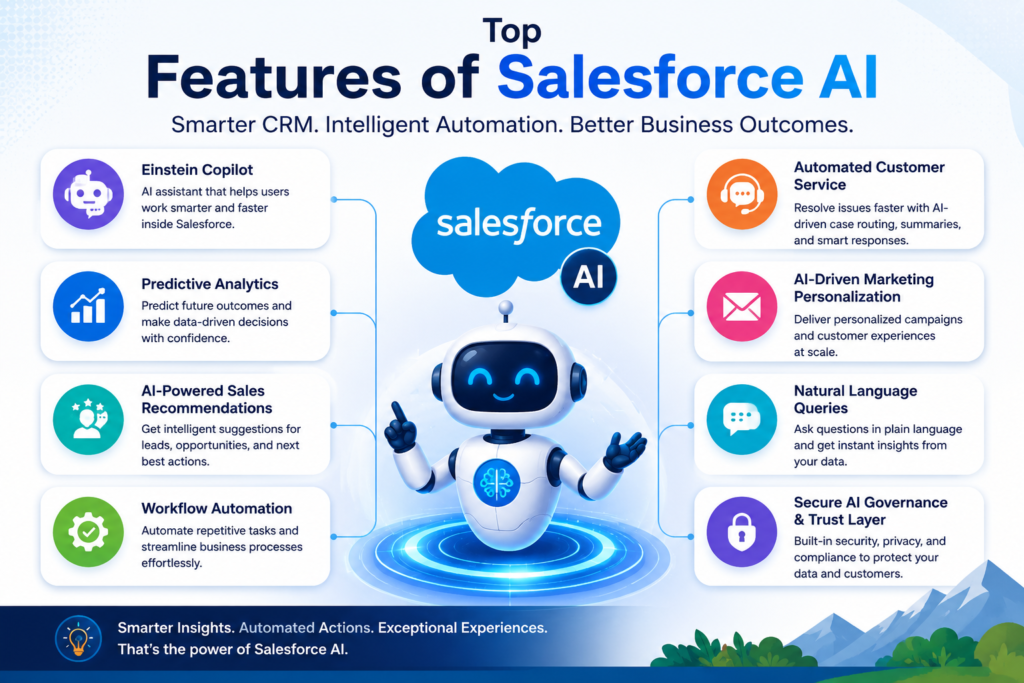
1. Einstein Copilot: AI Assistance Inside Salesforce
Currently, the most widely discussed features of Salesforce AI segment is Einstein Copilot.
This intelligent assistant, embedded in Salesforce workflows, eliminates the numerous inconveniences users face from switching between multiple systems and manually retrieving customer records, and it supports natural language queries.
For example:
The features of Salesforce AI include retrieving information on overdue business opportunities valued at more than 50,000 US dollars, summarizing client account details, and drafting the follow-up email for the day’s meetings.
What makes Einstein Copilot especially valuable is contextual awareness. It doesn’t just generate random AI text. It pulls real CRM data, customer histories, support records, and analytics together into actionable outputs.
Sales teams love this because speed matters. Support teams appreciate it because response quality improves. Driven by actual business outputs, Salesforce online courses prioritize AI workflow integration and no longer focus solely on traditional CRM management.
Another key reason why businesses value Salesforce AI is its predictive intelligence.
2. Predictive Analytics and Forecasting
Salesforce AI accurately predicts an enterprise’s future business results by analyzing four categories of core business data.
This can answer the following questions.
This helps businesses answer questions like:
- Which sales leads have high conversion potential?
- Which customers are at risk of churn?
- Which business opportunities require urgent follow-u
This helps businesses answer questions like:
- Which leads are most likely to convert?
- Which accounts are at risk of churn?
- Which sales opportunities need immediate attention?
- Which customers are ready for upselling?
That predictive capability changes how teams prioritize work.
A retail SaaS company I followed during a CRM implementation project reduced missed renewals significantly because features of Salesforce AI identified customer dissatisfaction patterns weeks earlier than humans noticed them manually.
And honestly, this is where Salesforce becomes more than just CRM software. It becomes a decision-support engine.
The smartest professionals pursuing a Salesforce certification course today are learning predictive analytics because employers increasingly expect those skills.
3. AI-Powered Sales Recommendations
One underrated area among the features of Salesforce AI is intelligent sales guidance.
Salesforce AI continuously analyzes customer interactions and recommends:
- Best next actions
- Follow-up timing
- Lead prioritization
- Product recommendations
- Engagement strategies
This is incredibly useful for sales reps juggling hundreds of opportunities simultaneously.
Imagine opening your dashboard Monday morning and instantly seeing:
- Which deals need attention
- Which customers are highly engaged
- Which opportunities are likely to stall
- Which prospects are ready for demos
That’s operational clarity. And clarity directly affects revenue.
The features of Salesforce AI. What’s interesting is how AI recommendations reduce guesswork for newer employees too. Junior reps can perform closer to senior-level efficiency because Salesforce AI provides data-backed suggestions in real time.
That’s one reason businesses increasingly prefer candidates with hands-on Salesforce AI exposure through structured Salesforce admin certification classes instead of purely theoretical CRM knowledge.
4. Automated Customer Service
Customer service has changed dramatically over the last two years.
Customers now expect instant responses. Waiting 24 hours for email replies feels outdated to many people.
One of the strongest features of Salesforce AI is service automation.
Salesforce AI helps businesses:
- Route tickets automatically
- Detect customer sentiment
- Generate support summaries
- Recommend knowledge articles
- Create AI-powered chat interactions
- Predict escalation risks
This saves support teams enormous time.
I tested a Salesforce-powered support workflow at a fintech conference demo recently, and honestly, the features of Salesforce AI felt surprisingly natural. The AI summarized a multi-email support thread in seconds and proposed a response draft that needed only minor edits.
That matters because support burnout is becoming a major operational issue globally.
Businesses adopting Salesforce AI aren’t just improving customer satisfaction. They’re protecting employee productivity too.
5. AI-Driven Marketing Personalization
Marketing teams probably benefit from the features of Salesforce AI more than almost anyone else.
Modern customers expect personalized communication. Generic email blasts barely work anymore.
Salesforce AI helps marketers personalize:
- Email campaigns
- Product recommendations
- Ad targeting
- Customer journeys
- Engagement timing
- Dynamic content
Features of Salesforce AI: Instead of manually segmenting huge customer lists, AI continuously analyzes behavior patterns automatically.
For example, Salesforce AI can detect:
- Which customers respond best to discounts
- Which users engage through mobile
- Which buyers prefer educational content
- Which leads are likely to unsubscribe
That insight improves campaign performance dramatically.
And this isn’t just enterprise-level stuff anymore. Mid-sized businesses are adopting AI personalization rapidly because competition online has become intense.
That growing adoption explains why comprehensive Salesforce training and placement programs are now emphasizing AI marketing workflows as core career skills.
6. Natural Language Queries
One of the surprisingly practical features of Salesforce AI is conversational data access.
Non-technical users can ask questions naturally instead of building complex reports manually.
For example:
- Which region had the highest conversion growth this quarter?
- Show me customers who are inactive for 90 days.
- What’s our highest-performing product category?
This reduces dependence on technical analysts.
Honestly, these features of Salesforce AI are huge for business operations because many teams struggle with dashboard complexity. Employees often avoid analytics tools simply because reporting systems feel intimidating.
Features of Salesforce AI lower that barrier.
And when more employees can access business intelligence independently, organizations move faster.
7. Workflow Automation
Automation remains one of the most valuable features of Salesforce AI because repetitive work quietly destroys productivity.
Salesforce AI automates:
- Data entry
- Lead assignments
- Follow-ups
- Approval workflows
- Customer notifications
- Reporting tasks
This sounds basic until you realize how much time companies lose on repetitive admin work.
A logistics company recently shared a case study showing their managers recovered nearly 15 working hours weekly after AI-driven workflow automation reduced manual reporting tasks.
That’s not just efficiency. That’s the operational scale.
People training through advanced Salesforce online classes often discover that automation becomes one of the most employable skills in the Salesforce ecosystem.
8. Data Insights and Real-Time Analytics
The ability to interpret data quickly is another reason businesses rely heavily on the features of Salesforce AI.
Real-time analytics help organizations react faster to:
- Customer behavior changes
- Revenue fluctuations
- Sales bottlenecks
- Support performance issues
- Campaign effectiveness
And Salesforce AI visualizes these insights clearly.
Executives don’t want giant spreadsheets anymore. They want actionable intelligence immediately.
That’s where AI-powered dashboards become valuable.
A healthcare organization using Salesforce recently discussed how predictive dashboards helped reduce appointment no-shows through behavioral trend analysis. Tiny operational improvements like that can produce huge long-term revenue impact.
9. AI-Powered Lead Scoring
Manual judgment used to form the basis of scoring leads.
Now, Salesforce Automates Lead Scoring by Using AI to Refine Customer Behavior to rank leads more accurately.
The AI takes into account the following:
- Email Traffic
- Website Behavior
- Intent to Purchase
- CRM Communication
- Past Patterns of Conversion
This refined approach means sales teams invest time on leads that have a greater chance of converting them to sales.
This also positively impacts Salesforce.
Sales Reps are frustrated when prospects are unresponsive.
The focus is prioritized and makes the performance of the pipeline more predictable.
10. Trust Layer and Secure AI Governance
Salesforce excels at enterprise trust and AI compared to several other players in the market.
This is justified as it is common for organizations to have challenges with AI in terms of security, compliance, and data protection.
Salesforce AI offers a unique trust layer that allows companies to govern data and stay compliant while using generative AI technology.
This is critically important in several markets including:
- Healthcare
- Finance
- Insurance
- Government
- Legal
Salesforce proactively ensures businesses don’t lose control of sensitive data and trust customer information, signaling its secure AI in enterprises.
Salesforce’s enterprise security focus instills confidence and helps the company grow in industries with strict customer data protection requirements.
The focus of many companies is no longer just Certified Salesforce Knowledge with the ability to manage data and produce reports.
Employers increasingly seek professionals who understand:
- AI-driven CRM systems
- Automation workflows
- Predictive analytics
- AI governance
- Customer intelligence
- Generative AI integration
That’s exactly why learners are investing in industry-focused Salesforce training programs that combine traditional CRM administration with modern AI applications.
H2K Infosys has become particularly relevant here because their programs focus heavily on real-world implementation rather than just theoretical certification preparation.
A lot of online courses still teach Salesforce like it’s 2019. That’s honestly a problem.
Today’s hiring managers want practical AI workflow experience.
Strong Salesforce admin certification classes should include:
- Real CRM projects
- Automation scenarios
- Einstein AI tools
- Cloud integrations
- Placement support
- Hands-on labs
And that’s where career-focused training providers like H2K Infosys are gaining attention.
The Future of Salesforce AI
The future of CRM is clearly AI-first.
Salesforce continues expanding AI capabilities across:
- Sales Cloud
- Service Cloud
- Marketing Cloud
- Commerce Cloud
- Slack integration
- Data Cloud
And honestly, we’re still early.
Right now, most companies are only scratching the surface of what AI-powered CRM can actually do.
Over the next few years, the features of Salesforce AI will likely become even more autonomous, predictive, and workflow-oriented.Companies are becoming more dependent on AI agents to manage basic customer interactions, run analyses on operations, and assist with decision making.
For these reasons, the Salesforce professionals of the future have a great opportunity.
Learning Salesforce today takes CRM to a whole new level. You learn about the dramatic impact AI has on the scale of business operations.
Final Thoughts
Salesforce utilizes AI to provide features of Salesforce AI, like smart automation, advanced predictive capabilities, personalized customer interactions, improved efficiency of different workflows, and enterprise-class AI. Companies are switching to Salesforce AI for productivity gains that are significant and come without a complete overhaul of the way the job has been done in the past.
Salesforce AI skills are particularly in-demand as the progression of AI tech gets faster all around the world.
For a part of the CRM profession that is future-proof, the most important thing is to invest in a good, practical, and industry-focused Salesforce certification. The combination of hands-on learning, AI workflow knowledge, and placement-focused preparation offered through H2K Infosys gives learners a much stronger advantage in today’s competitive tech job market.
Because at this point, understanding the features of Salesforce AI isn’t just a technical skill anymore. It’s quickly becoming a business necessity