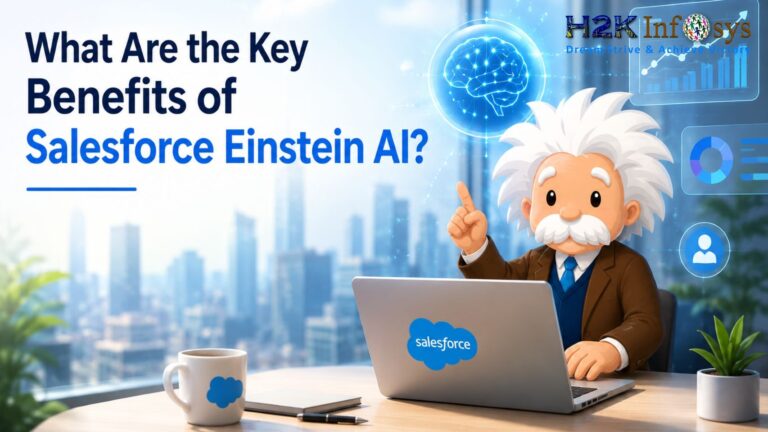
Businesses are using Salesforce Einstein AI to automate repetitive work, predict customer behavior, improve sales decisions, and create more personalized customer experiences without adding extra manual effort. The biggest advantage is that teams get faster insights and smarter workflows directly inside the Salesforce ecosystem they already use.
A lot of companies talk about AI transformation, like it’s some futuristic concept. But honestly, if you’ve worked around CRM platforms lately, you’ve probably already seen how quickly AI is becoming part of daily operations. Sales reps use predictive recommendations before client calls. Customer support agents rely on automated case summaries. Marketing teams test campaigns using AI-driven personalization instead of guesswork.
That shift is exactly why Salesforce Einstein AI has become such a major conversation in the enterprise technology world.
And here’s the thing many professionals are realizing in 2026 that understanding AI inside Salesforce is no longer optional if you want long-term career growth in CRM, automation, cloud consulting, or business analytics. That’s one reason enrollment demand for Salesforce certification courses and advanced Salesforce administrator training programs has increased so sharply over the past year.
Why Companies Are Paying Attention to AI Inside Salesforce
Most organizations already store massive amounts of customer data inside Salesforce. The challenge has never been collecting information. The challenge is actually using it well.
That’s where Salesforce Einstein AI changes the game.
Instead of forcing teams to export spreadsheets, build complicated external models, or wait days for reports, the platform brings predictive intelligence directly into workflows employees already use every day. It reduces friction. And in business operations, reducing friction is usually where the real money gets saved.
I was speaking with a CRM consultant earlier this year who worked with a healthcare provider struggling with patient outreach delays. Their support team spent hours prioritizing follow-ups manually. Once predictive scoring and automated recommendations were introduced, response efficiency improved dramatically within a few months. Not because the employees suddenly became smarter, the system simply surfaced the right actions faster.
That’s the practical side of AI that people sometimes miss.
It’s not just about flashy automation demos.
It’s about helping overloaded teams make better decisions without slowing down.
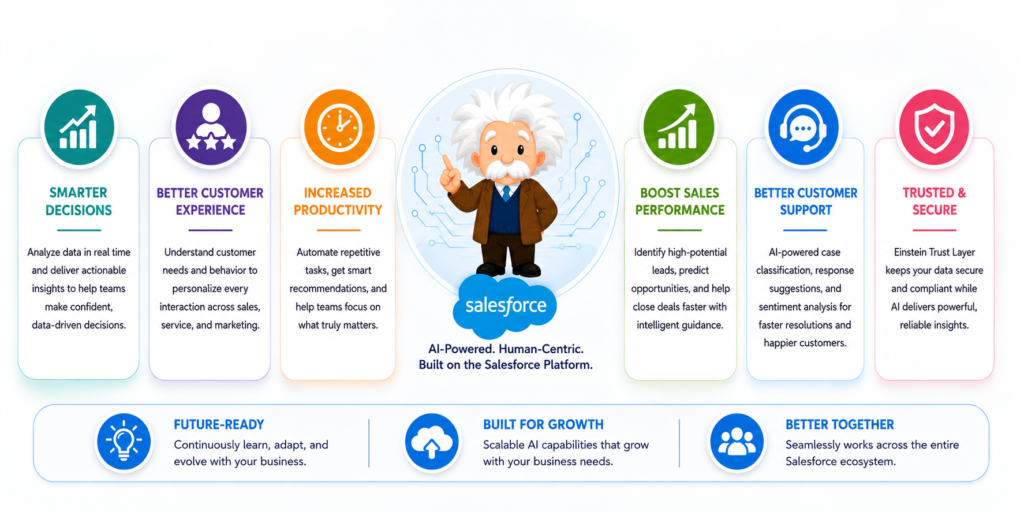
The Core Benefits Businesses Experience
1. Predictive Sales Insights
One of the strongest capabilities of Salesforce Einstein AI is predictive lead and opportunity scoring.
Sales teams have an excessive number of potential customer leads requiring follow-up, but lack sufficient time to process them.
Most sales teams fail to set priorities for their potential customers, which causes sales representatives to waste unnecessary effort following up on leads that cannot be converted. AI lead scoring can analyze four categories of core sales data to accurately identify leads with a high probability of closing a sale.
That means:
- Sales representatives focus on high-value business opportunities,
- Managers improve forecast accuracy,
- Enterprises reduce internal friction in their sales pipelines,
- Teams cut down time spent on guesswork.
A SaaS company based in Texas, the U.S., has implemented predictive lead scoring, cutting its invalid investment in outbound expansion by nearly 30%. That’s not a tiny operational tweak. That directly affects revenue efficiency.
Professionals learning these tools through a structured Salesforce course are now expected to understand both CRM administration and AI-supported sales workflows.
2. Smarter Customer Service Operations
Customer service teams are under pressure everywhere right now.
Customers expect immediate responses. Support agents handle larger ticket volumes. Businesses want better satisfaction scores without expanding payroll aggressively.
Salesforce Einstein AI helps by introducing features like:
- AI-generated case summaries
- Intelligent routing
- Suggested knowledge articles
- Automated next-step recommendations
- Sentiment analysis for customer conversations
One retail organization I read about recently used AI-driven service recommendations during holiday support surges. Their agents were able to resolve common cases faster because the system automatically surfaced likely solutions before the agent even finished reviewing the ticket.
That kind of workflow improvement matters more than people realize.
If an agent saves even two minutes per case across thousands of support interactions each month, the productivity gains become enormous.
And honestly, companies hiring Salesforce admins today increasingly expect familiarity with AI-assisted service cloud operations. Basic CRM setup knowledge alone is no longer enough in many enterprise environments.
3. Personalized Marketing at Scale
Marketing teams love data until there’s too much of it.
Then everything becomes messy.
Audience segmentation gets complicated. Campaign timing becomes inconsistent. Personalization starts feeling generic.
Salesforce Einstein AI helps marketers create more targeted customer journeys by analyzing behavioral patterns and engagement history automatically.
Instead of blasting the same message to everyone, businesses can:
- Recommend personalized products
- Trigger campaigns based on user behavior
- Predict customer engagement likelihood
- Optimize email timing
- Improve campaign ROI
This Salesforce Einstein AI has become especially relevant after recent shifts toward AI-assisted personalization across eCommerce and B2B marketing platforms.
Consumers now expect relevance almost immediately.
If someone browses a product category repeatedly and your marketing system still sends unrelated promotions, you’re already behind competitors.
That’s why companies investing in Salesforce administrator training often want professionals who understand automation logic, customer segmentation, and AI-driven campaign optimization together not as separate skills.
A growing number of enterprise marketing teams now treat Salesforce Einstein AI as part of their core customer retention strategy because personalization performance has become directly tied to revenue growth.
4. Better Forecasting and Decision-Making
Forecasting used to involve a lot of educated guessing.
Actually, sometimes not-so-educated guessing.
Executives relied heavily on spreadsheets, quarterly trends, and manager intuition.
The commercial AI tool Salesforce Einstein AI continuously analyzes four core categories of data to improve its prediction accuracy.
This allows organizations to:
- This tool enables more
- accurate revenue forecasting,
- earlier risk identification, faster detection of
- sales slowdowns, resource
- optimization, and strategic support.
A logistics enterprise implemented an AI-assisted customer relationship management (CRM) analysis tool, integrated predictive reports into its executive dashboard, optimized its demand planning, and obtained the capacity to proactively respond to market conditions, thus eliminating the lagging situation where remedial measures were only rolled out after revenue had already started to decline.
That’s a huge operational advantage.
And from a career standpoint, professionals who understand both CRM reporting and AI analytics are standing out in hiring conversations right now.
5. Workflow Automation That Actually Saves Time
Some automation tools sound impressive in demos but create more work in real business environments.
This is where Salesforce Einstein AI tends to stand out.
This business automation tool can be integrated into existing Salesforce Einstein AI workflows to prevent system disconnects.
For example:
- Sales representatives receive automated recommendations,
- customer service agents obtain suggested
- responses, managers receive early
- warnings, marketing personnel trigger campaigns,
- and analysts mine trends.
The Salesforce Einstein AI manufacturing enterprise has implemented AI-enabled automated processes, significantly cutting down on the repetitive data entry tasks required for its customer relationship management (CRM) system. Employees spent less time updating records manually and more time focusing on actual client communication.
That’s the type of improvement executives care about.
Several mid-sized organizations adopting Salesforce Einstein AI during digital transformation initiatives have reported faster onboarding for sales and support teams because the system reduces repetitive manual decision-making.
Not AI for the sake of headlines.
AI that saves labor hours and improves operational efficiency.
Why Salesforce Skills Are Becoming More Valuable in 2026
There’s been a noticeable shift in the job market lately.
A few years ago, many organizations mainly looked for admins who could configure objects, permissions, reports, and dashboards.
Now?
Companies want professionals who understand automation, AI workflows, analytics, integrations, and business process optimization together.
That’s why demand for Salesforce certification courses continues to grow globally.
Organizations need people who can bridge technical configuration with business outcomes.
And honestly, this makes sense.
A company doesn’t just want someone who knows where the settings button lives.
They want someone who can improve customer operations, automate reporting, optimize sales workflows, and support AI implementation projects.
That’s where hands-on Salesforce administrator training becomes extremely valuable.
Real-World Use Cases Across Industries
Healthcare
Healthcare providers use Salesforce Einstein AI to optimize three categories of core healthcare business.
This paper introduces two types of medical AI tools: prediction and recommendation tools that enable frontline healthcare workers to identify patients requiring clinical intervention, and Salesforce Einstein AI summarization tools that reduce the workload of support teams.
Banking and Financial Services
To date, multiple leading banks have deployed Salesforce Einstein AI across four core financial business scenarios.
AI-supported customer insights enable business consultants to quickly grasp user trends during customer interactions.
Retail and e-Commerce
Retailers have deployed their proprietary Salesforce Einstein AI to implement four retail operation upgrade initiatives.
Currently, online competition is growing increasingly fierce, and consumer demand has underscored the core importance of rapid personalization.
Technology and SaaS
Global technology enterprises generally rely on Salesforce Einstein AI to carry out four core types of sales and customer operations.
For subscription-based businesses, proactively predicting customer retention risks helps stabilize revenue.
The Career Advantage of Learning AI-Integrated Salesforce Skills
If you’re entering the Salesforce ecosystem today, AI knowledge gives you a major edge.
Not because every company suddenly became an AI company overnight.
But because CRM platforms themselves are evolving rapidly.
Recruiters increasingly search for candidates familiar with:
- AI-enhanced CRM workflows
- Predictive analytics
- Automation tools
- Customer intelligence systems
- Data-driven sales operations
And yes, certifications still matter.
A strong Salesforce certification course combined with project-based learning can help candidates demonstrate practical capabilities instead of only theoretical understanding.
At H2K Infosys, many learners specifically pursue training because they want exposure to real implementation scenarios instead of memorizing exam questions.
That distinction matters.
Many learners specifically choose programs covering Salesforce Einstein AI because employers increasingly ask scenario-based interview questions about predictive workflows and automation use cases.
Hiring managers can usually tell pretty quickly whether someone has actually worked through realistic CRM workflows or only watched isolated tutorial clips online.
Why H2K Infosys Stands Out for Salesforce Training
There are thousands of online learning platforms now. Some are excellent. Some honestly feel like someone recorded random slides five years ago and uploaded them without updates.
What makes H2K Infosys different is the focus on practical implementation and real-world project exposure.
Students learning through the Salesforce course programs receive training that aligns with current enterprise requirements, including:
- Salesforce administration fundamentals
- AI-supported CRM workflows
- Automation and reporting
- Real-time project scenarios
- Interview preparation
- Resume guidance
- Hands-on exercises
That practical orientation becomes extremely important when companies expect professionals to contribute immediately after hiring.
I’ve noticed a growing trend where employers care less about memorized definitions and more about workflow understanding.
- Can you configure automation?
- Can you troubleshoot CRM issues?
- Can you explain how AI improves customer operations?
- Can you optimize reporting for leadership teams?
Those are the conversations happening during interviews now.
The Growing Connection Between AI and CRM Careers
One thing people underestimate is how central CRM systems are becoming to enterprise AI adoption.
Many organizations are not building custom AI infrastructure from scratch.
Instead, they’re implementing AI capabilities inside existing business platforms like Salesforce.
That means professionals with Salesforce administrator training and AI workflow knowledge are positioned in a very strong market segment.
And the timing matters.
Right now, many companies are still early in AI adoption.
Before the CRM market becomes saturated, professionals who master CRM operations and AI automation skills will gain opportunities.
Common Challenges Businesses Face During AI Adoption
The deployment of Salesforce Einstein AI has not been entirely smooth.
Some organizations struggle because:
- This paper sorts out five core
- Barriers to CRM implementation inconsistent
- data quality, employee resistance to change,
- poorly designed rules, incomplete reports,
and unrealistic management expectations.
The utility of AI tools is determined solely by the data sources and supporting processes that underpin them.
Therefore, senior Salesforce professionals remain essential.
We observe that even the leading Salesforce Einstein AI still requires support from senior administrators and consultants to be successfully deployed.
Although intelligent technologies can realize intelligent process automation, humans still need to undertake four categories of core overall coordination and calibration work.
A badly configured CRM with AI layered on top is still a badly configured CRM.
Actually, sometimes it becomes a faster, badly configured CRM.
That’s why practical implementation knowledge matters so much.
What Future Trends Look Like
The Salesforce ecosystem is moving aggressively toward deeper AI integration.
Industry analysts expect continued growth in:
- Conversational AI inside CRM platforms
- Automated workflow generation
- Predictive customer retention modeling
- AI-driven analytics dashboards
- Real-time personalization
- Natural language reporting
Salesforce Einstein AI will likely continue expanding across sales, marketing, service, analytics, and operational workflows over the next several years.
Professionals who begin learning these systems now will probably have a much easier time adapting as enterprise AI adoption accelerates.
And honestly, we’re still early.
A lot of businesses are experimenting.
Some are succeeding quickly. Others are still figuring out governance, compliance, and process integration.
But very few serious enterprise organizations are ignoring AI completely anymore.
Recent enterprise hiring trends also show growing demand for specialists who can manage Salesforce Einstein AI integrations alongside analytics, workflow automation, and customer engagement platforms.
How to Start Learning Salesforce and AI Skills
If you’re completely new to Salesforce, the best path usually starts with understanding:
- CRM fundamentals
- Salesforce administration basics
- Workflow automation
- Reporting and dashboards
- AI-supported CRM features
- Real-world implementation scenarios
A structured Salesforce certification course helps create a clear roadmap instead of jumping randomly between YouTube clips, disconnected documentation pages, and outdated blog tutorials.
And yes, hands-on practice matters a lot.
Reading about automation is different from actually building workflows.
Reading about predictive scoring is different from configuring it.
That’s why project-based Salesforce administrator training tends to produce stronger job readiness outcomes.
Final Thoughts
Salesforce Einstein AI is transforming how businesses manage customer relationships, automate workflows, improve forecasting, and personalize user experiences. Companies adopting AI-supported CRM systems are gaining operational advantages through smarter decision-making, faster service delivery, and more efficient sales processes.
For professionals, this shift creates major career opportunities.
The combination of CRM expertise, automation knowledge, and AI workflow understanding is becoming increasingly valuable across industries.
Whether you’re an aspiring administrator, business analyst, consultant, or CRM specialist, learning these capabilities through high-quality Salesforce certification courses can position you strongly in a rapidly evolving job market.
And if you want training that focuses on practical implementation instead of only theory, H2K Infosys continues to be a strong option for learners looking to build real-world Salesforce and AI expertise.