
Yes, surely, online business analyst training can help you get remote job opportunities. Especially these days, when companies are hiring talent from different cities and even different countries. A good Business Analyst Online Courses doesn’t just teach theory anymore. The better ones focus on practical tools, Agile projects, communication skills, and real business scenarios that companies already use in remote environments.
And honestly, that shift changed everything.
A few years back, remote analyst jobs were mostly associated with big tech firms. Now, even healthcare companies, banks, retail brands, insurance firms, and startups are building distributed teams. They need people who can organize requirements, communicate clearly, and help projects move without confusion. That’s exactly where trained business analysts fit in.
Remote Work Changed the Business Analyst Role
One thing many people don’t realize is that business analysts were already doing “remote-friendly” work before remote jobs became mainstream.
Think about the daily responsibilities:
- Writing requirement documents
- Talking to stakeholders
- Managing workflows
- Tracking project updates
- Reviewing business processes
- Coordinating with development teams
Most of this happens through tools like Jira, Zoom, Slack, Confluence, or Teams anyway.
So when companies shifted to remote work permanently, the business analyst role adapted pretty naturally.
That’s also why demand for structured business analyst training has increased over the last few years. Employers now want candidates who already understand digital collaboration instead of needing months of adjustment.
Online Courses Teach Skills Companies Actually Use
This is probably the biggest reason online learning helps.
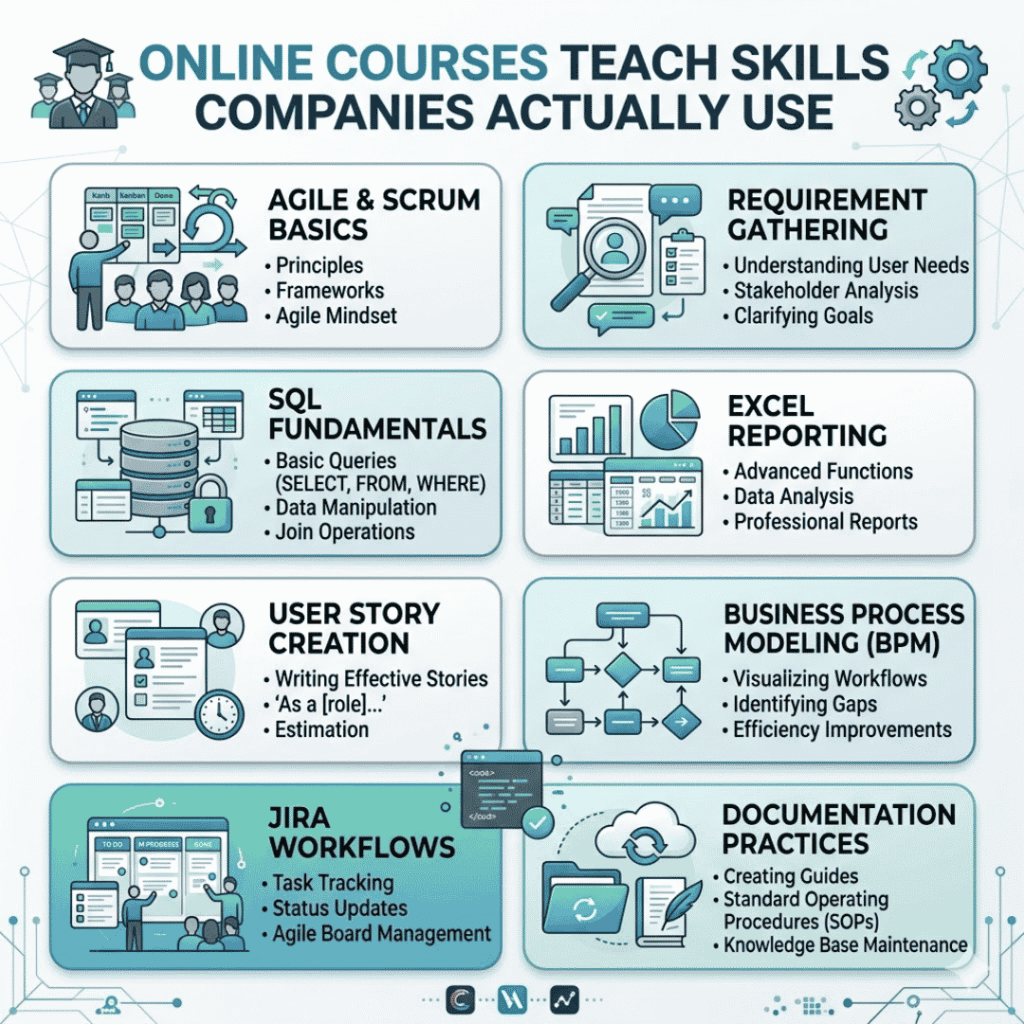
A proper business analyst course usually focuses on practical skills instead of textbook-heavy theory. Good training programs include things like:
- Agile and Scrum basics
- Requirement gathering
- SQL fundamentals
- Excel reporting
- User story creation
- Business process modeling
- Jira workflows
- Documentation practices
Those are real workplace skills.
I remember speaking with someone who completed a generic certification program but struggled during interviews because they had never worked on project simulations. Recruiters noticed immediately. They could define Agile perfectly, but couldn’t explain how sprint planning works in a real team environment.
That difference matters more than people expect.
Why Recruiters Notice Online Certifications Now
There used to be skepticism around online certifications. Not anymore.
Remote hiring changed employer expectations quite a bit. Companies now care more about whether candidates can contribute quickly rather than where they physically studied.
If someone has:
- Practical projects
- Hands-on assignments
- Tool experience
- Mock interview preparation
- Communication confidence
…they often perform better than candidates who only have theoretical academic backgrounds.
That’s one reason many learners now choose career-focused Business Analyst Online Courses instead of traditional classroom-only programs.
Remote Jobs Available After Business Analyst Training
A lot of learners assume “business analyst” is just one job title. It’s actually broader than that.
After completing a solid business analyst training program, people commonly apply for roles like:
Junior Business Analyst
Usually, the entry-level starting point. You support documentation, gather requirements, and assist project teams.
Agile Business Analyst
Works closely with Scrum teams, sprint planning, and backlog refinement.
Product Analyst
Focuses more on customer behavior, features, and product improvements.
Functional Analyst
Often involved in enterprise systems, ERP platforms, or workflow implementations.
Data-Focused Business Analyst
A hybrid role where business understanding and reporting skills overlap.
Many of these roles are now fully remote or hybrid.
Actually, some organizations specifically prefer remote analysts because documentation-heavy work often becomes smoother in digital environments.
Online Learning Quietly Builds Remote Work Habits Too
This part gets overlooked a lot.
Studying online helps you develop habits that remote employers value:
* Having your own schedule
* Virtual communication
* Meeting deadlines on your own.
* Learning without constant oversight
* Working together online
Sounds simple, but companies do pay attention to these things in interviews.
Candidates who completed live online training usually appear more comfortable during virtual discussions compared to people with no remote learning exposure at all.
Kind of interesting when you think about it.
Real-Time Projects Make a Huge Difference
A certificate alone usually isn’t enough anymore.
Interviewers often ask questions like:
“Can you explain a project where you handled requirements or solved a business problem?”
That’s where project-based learning becomes important.
Strong Business Analyst Online Courses include:
- Requirement documentation exercises
- Agile case studies
- Workflow diagrams
- Mock stakeholder meetings
- User story creation
- Reporting assignments
These experiences help candidates answer naturally during interviews instead of sounding memorized.
And honestly, recruiters can tell the difference pretty quickly.
Why Many Learners Choose H2K Infosys
Among various online learning platforms, H2K Infosys has become a popular option for people preparing for remote business analyst careers because the training is designed around practical exposure instead of only recorded theory.
Their Business Analyst Online Training Program includes:
- Live instructor-led classes
- Real-time project practice
- Agile methodology training
- Resume preparation
- Mock interviews
- Placement support
That combination is useful because remote hiring processes are heavily skill-based now. Employers expect candidates to explain workflows, projects, and communication approaches confidently during virtual interviews.
A lot of learners struggle not because they lack knowledge, but because they lack practical exposure.
Structured mentorship helps solve that gap.
Career Changers Are Entering Business Analysis Faster Than Before
This is another interesting trend lately.
People from completely different industries are moving into business analysis:
- Banking
- Retail
- Customer support
- Operations
- Healthcare
- Teaching
- Administration
And many transition successfully because business analysis relies heavily on communication and problem-solving skills.
You do not need advanced programming knowledge to begin.
That misconception scares people unnecessarily.
A strong business analyst course helps learners understand technical workflows gradually while still leveraging their existing business experience.
Communication Skills Matter More in Remote Jobs
Technical knowledge gets attention.
Communication creates trust.
Remote business analysts spend a huge amount of time:
- Explaining requirements
- Clarifying misunderstandings
- Writing documentation
- Conducting meetings
- Coordinating between teams
That’s why modern training programs increasingly focus on presentation skills and client interaction exercises alongside technical topics.
Some people underestimate this during preparation. Remote employers definitely do not.
The Demand for Remote Analysts Is Still Growing
Despite the rapid adoption of AI, businesses still require analysts who comprehend processes, user requirements, automation objectives, and operational enhancements.
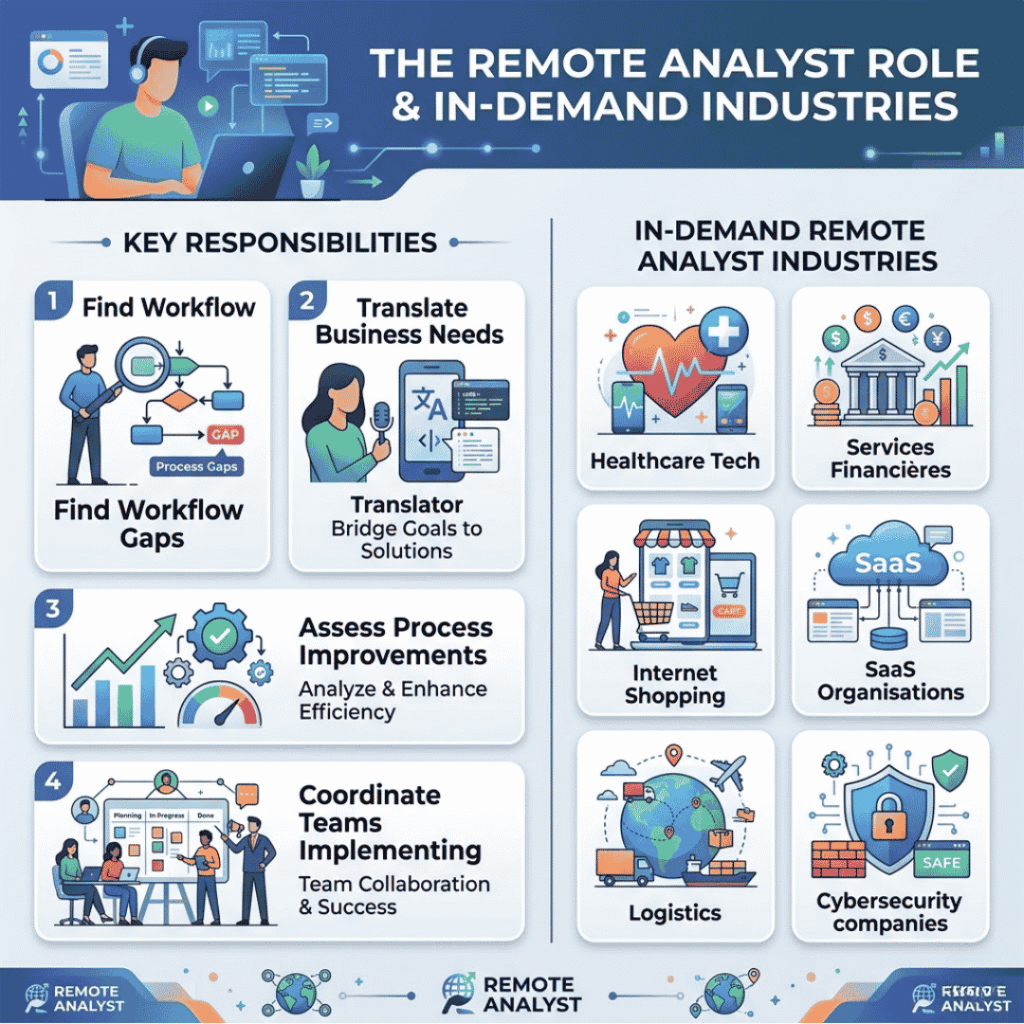
In fact, AI tools often create more demand for business analysts because companies require professionals who can:
The remote Analyst role in demand industries:
* Find workflow gaps
* Translate business needs
* Assess process improvements
* Coordinate teams implementing
In-demand remote analyst industries include:
* Healthcare tech
* Services financières
* Internet shopping
* SaaS organisations
* Logistics
* Cybersecurity companies
There are still growing opportunities, especially for candidates with practical project experience.
Conclusion
A good online course in business analysis can really help you land remote job opportunities because the training closely matches how modern companies already operate.
The important thing is to choose practical, project-based learning, not just theoretical content.
A good business analyst training helps you to develop technical understanding, communication confidence, and real-world experience, all of which count for a lot during remote hiring.
For those learners who are looking for guided mentorship, live projects, and career-oriented preparation, H2K Infosys is one of the top choices to consider when preparing for remote business analyst careers today.