H2K Infosys Artificial Intelligence online training helps individuals develop the technical and practical skills required to become an AI engineer. Structured training programs typically cover machine learning, deep learning, Python programming, data processing, neural networks, cloud AI services, and real-world deployment workflows. The Best AI Certification Courses also provide hands-on exposure to enterprise tools, project-based learning, and industry-relevant workflows used in production environments.
For beginners and working professionals, Become an AI Engineer offers a flexible pathway to understand how AI systems are designed, trained, tested, and deployed in modern organizations. Many best AI courses for beginners focus on foundational concepts first and gradually introduce advanced engineering practices such as model optimization, MLOps, and generative AI applications.
What Is Artificial Intelligence?
Artificial Intelligence refers to the development of computer systems capable of performing tasks that typically require human intelligence. These tasks may include:
- Pattern recognition
- Language understanding
- Decision-making
- Image analysis
- Predictive analytics
- Process automation
Artificial Intelligence is a broad field that includes several subdomains:
| AI Domain | Purpose | Common Applications |
|---|---|---|
| Machine Learning | Learning patterns from data | Fraud detection, recommendation systems |
| Deep Learning | Neural network-based learning | Image recognition, speech processing |
| Natural Language Processing (NLP) | Understanding human language | Chatbots, document analysis |
| Computer Vision | Interpreting visual information | Medical imaging, autonomous vehicles |
| Generative AI | Creating new content | AI assistants, content generation |
Modern enterprises commonly integrate AI into software systems, analytics platforms, cloud services, and customer-facing applications.
What Does an AI Engineer Do?
Become an AI Engineer designs, develops, trains, tests, and deploys AI models for real-world business applications. The role combines software engineering, data engineering, and machine learning expertise.
Typical responsibilities include:
- Preparing and cleaning datasets
- Building machine learning models
- Training neural networks
- Evaluating model performance
- Deploying AI services into production
- Monitoring model accuracy and scalability
- Integrating AI APIs with enterprise applications
AI engineers often work with:
- Python
- TensorFlow
- PyTorch
- Scikit-learn
- Jupyter Notebook
- Docker
- Kubernetes
- Cloud AI platforms
In enterprise environments, AI engineers collaborate with:
- Data scientists
- DevOps teams
- Business analysts
- Software developers
- Security and compliance teams
How Can Artificial Intelligence Online Training Help You Become an AI Engineer?
Artificial Intelligence online training provides a structured learning path that helps professionals move from theoretical understanding to practical implementation.
The best AI certification courses typically include:
- Foundational AI concepts
- Programming fundamentals
- Machine learning workflows
- Deep learning techniques
- Model deployment practices
- Real-world project implementation
- Industry-standard tools and frameworks
Online training is particularly useful for working professionals because it allows flexible learning schedules while maintaining exposure to practical labs and production-oriented workflows.
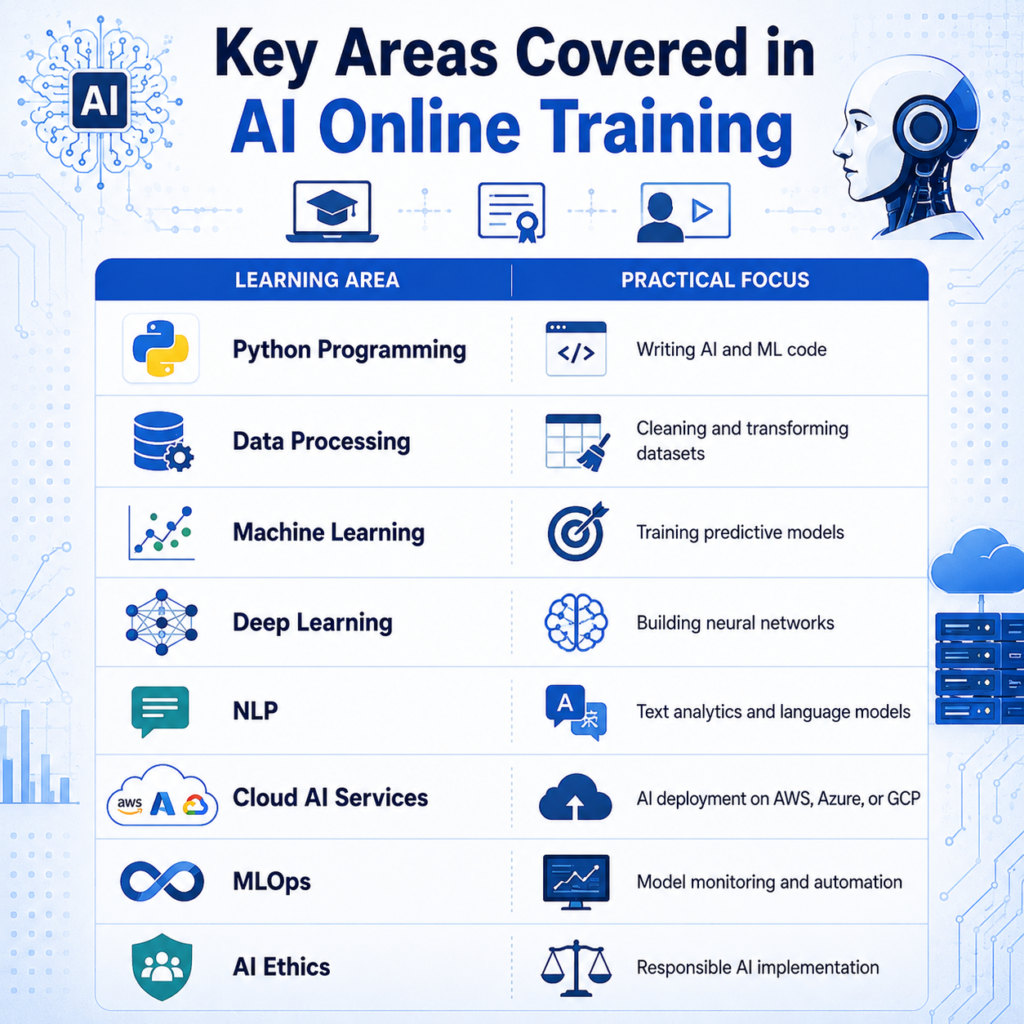
Key Areas Covered in AI Online Training
| Learning Area | Practical Focus |
|---|---|
| Python Programming | Writing AI and ML code |
| Data Processing | Cleaning and transforming datasets |
| Machine Learning | Training predictive models |
| Deep Learning | Building neural networks |
| NLP | Text analytics and language models |
| Cloud AI Services | AI deployment on AWS, Azure, or GCP |
| MLOps | Model monitoring and automation |
| AI Ethics | Responsible AI implementation |
Many best AI courses for beginners also include guided projects that simulate enterprise use cases.
Why Is Artificial Intelligence Important for Working Professionals?
Artificial Intelligence has become part of modern enterprise operations across industries such as healthcare, finance, retail, cybersecurity, manufacturing, and logistics.
Organizations commonly use AI for:
- Business process automation
- Predictive analytics
- Customer behavior analysis
- Fraud detection
- Recommendation engines
- Intelligent search systems
- Conversational AI platforms
For working professionals, AI skills can support career transitions into technical and analytical roles.
Professionals from the following backgrounds often pursue AI training:
- Software development
- Data analysis
- Cloud engineering
- QA automation
- Business intelligence
- DevOps
- Database administration
AI knowledge is increasingly relevant because enterprise software systems now frequently integrate machine learning capabilities and automation services.
What Skills Are Required to Learn Artificial Intelligence?
Learning Artificial Intelligence requires both technical and analytical skills. Beginners do not always need advanced mathematics initially, but foundational understanding becomes important as learning progresses.
Core Technical Skills
Programming Skills
Python is commonly used in AI development because of its extensive ecosystem and readability.
Common Python libraries include:
| Library | Purpose |
|---|---|
| NumPy | Numerical computing |
| Pandas | Data analysis |
| Matplotlib | Data visualization |
| Scikit-learn | Machine learning |
| TensorFlow | Deep learning |
| PyTorch | Neural networks |
Mathematics for AI
Become an AI Engineer often use concepts from:
- Linear algebra
- Probability
- Statistics
- Calculus
- Optimization
These concepts support tasks such as:
- Model training
- Gradient descent
- Feature engineering
- Performance evaluation
Data Handling Skills
AI systems rely heavily on data quality. Professionals must understand:
- Data preprocessing
- Missing value handling
- Data normalization
- Feature extraction
- Dataset balancing
Software Engineering Concepts
Enterprise AI systems also require:
- API integration
- Version control
- CI/CD workflows
- Containerization
- Cloud deployment
How Does Artificial Intelligence Work in Real-World IT Projects?
Artificial Intelligence projects usually follow a structured lifecycle.
Typical AI Workflow
| Stage | Description |
|---|---|
| Data Collection | Gathering structured or unstructured data |
| Data Preparation | Cleaning and transforming datasets |
| Feature Engineering | Selecting useful input variables |
| Model Training | Training algorithms using datasets |
| Model Evaluation | Measuring accuracy and performance |
| Deployment | Integrating models into applications |
| Monitoring | Tracking drift and system behavior |
Example: Fraud Detection Workflow
A banking application may use machine learning to identify suspicious transactions.
Workflow Steps
- Collect transaction history
- Label fraudulent transactions
- Train classification models
- Test prediction accuracy
- Deploy model into payment systems
- Continuously monitor false positives
Enterprise teams typically face challenges such as:
- Data privacy compliance
- Scalability requirements
- Real-time processing demands
- Model drift
- Infrastructure costs
Online AI training often introduces these operational realities through practical assignments and labs.
How Is Artificial Intelligence Used in Enterprise Environments?
Artificial Intelligence is commonly integrated into enterprise systems to automate decision-making and improve operational efficiency.
Healthcare
Healthcare organizations may use AI for:
- Medical image analysis
- Predictive diagnostics
- Clinical decision support
- Patient risk assessment
Financial Services
Financial institutions frequently apply AI to:
- Fraud detection
- Credit scoring
- Risk management
- Algorithmic trading
Retail and E-Commerce
Retail platforms use AI for:
- Product recommendations
- Demand forecasting
- Inventory optimization
- Customer behavior analysis
Cybersecurity
Security teams increasingly use AI for:
- Threat detection
- Log analysis
- Intrusion monitoring
- Malware classification
Manufacturing
Manufacturing organizations apply AI in:
- Predictive maintenance
- Quality inspection
- Supply chain optimization
- Robotics automation
These implementations often rely on cloud infrastructure, distributed computing, and real-time analytics systems.
What Tools and Platforms Are Commonly Used by AI Engineers?
Become an AI Engineer work with a combination of development tools, frameworks, and cloud platforms.
Popular AI Frameworks
| Tool | Common Use |
|---|---|
| TensorFlow | Deep learning model development |
| PyTorch | Research and production AI models |
| Keras | High-level neural network APIs |
| Scikit-learn | Traditional machine learning |
| OpenCV | Computer vision applications |
Cloud AI Platforms
| Platform | Services |
|---|---|
| Amazon Web Services | SageMaker, Rekognition |
| Microsoft Azure | Azure AI Services |
| Google Cloud Platform | Vertex AI |
| Databricks | Large-scale ML workflows |
MLOps and Deployment Tools
| Tool | Purpose |
|---|---|
| Docker | Containerization |
| Kubernetes | Orchestration |
| MLflow | Model tracking |
| Git | Version control |
| Jenkins | CI/CD automation |
Understanding these tools is important because enterprise AI systems require scalability, reliability, and maintainability.
What Are the Best AI Courses for Beginners?
The best AI courses for beginners usually focus on foundational concepts before moving into advanced model development.
A beginner-friendly AI learning path typically includes:
- Python fundamentals
- Data analysis basics
- Machine learning introduction
- Supervised and unsupervised learning
- Neural networks
- Deep learning fundamentals
- Real-world AI projects
Characteristics of Beginner-Friendly AI Courses
| Feature | Why It Matters |
|---|---|
| Structured curriculum | Reduces learning gaps |
| Hands-on projects | Improves practical understanding |
| Lab environments | Builds implementation experience |
| Industry tools | Aligns learning with enterprise usage |
| Mentorship support | Helps troubleshoot technical issues |
Many learners benefit from project-based environments that simulate enterprise workflows instead of purely theoretical lessons.
What Should You Look for in the Best AI Certification Courses?
The Best AI Certification Courses generally balance theory, practical implementation, and production-oriented engineering practices.
Important Evaluation Criteria
Curriculum Depth
A strong AI program should include:
- Machine learning
- Deep learning
- NLP
- Computer vision
- Generative AI
- MLOps basics
Practical Projects
Projects help learners apply concepts in scenarios such as:
- Recommendation systems
- Sentiment analysis
- Predictive analytics
- Chatbot development
Industry-Relevant Tools
Courses should expose learners to production tools and cloud environments.
Deployment Knowledge
Many AI learners understand model training but lack deployment skills. Practical deployment exposure is increasingly valuable.
Mentorship and Guidance
Structured feedback can help professionals troubleshoot:
- Model overfitting
- Data quality issues
- Hyperparameter tuning
- Deployment failures
What Job Roles Use Artificial Intelligence Daily?
Artificial Intelligence skills apply across multiple technical and analytical roles.
Common AI-Related Job Roles
| Job Role | Typical Responsibilities |
|---|---|
| AI Engineer | Build and deploy AI models |
| Machine Learning Engineer | Train and optimize ML systems |
| Data Scientist | Analyze data and develop predictive models |
| NLP Engineer | Build language-processing systems |
| Computer Vision Engineer | Develop image recognition systems |
| AI Solutions Architect | Design enterprise AI infrastructure |
| MLOps Engineer | Manage AI deployment pipelines |
Many organizations also expect AI collaboration skills from software engineers, cloud architects, and analytics professionals.
What Careers Are Possible After Learning Artificial Intelligence?
Artificial Intelligence training can support career progression into multiple technology domains.
Career Paths
Entry-Level Roles
- Junior AI Engineer
- Data Analyst
- ML Support Engineer
- AI Application Developer
Mid-Level Roles
- Machine Learning Engineer
- NLP Developer
- Data Scientist
- AI Platform Engineer
Advanced Roles
- AI Architect
- Lead ML Engineer
- AI Research Engineer
- Head of AI Engineering
Career progression often depends on:
- Practical project experience
- Understanding of production systems
- Cloud deployment knowledge
- Collaboration and problem-solving skills
How Do AI Engineers Apply Their Skills in Real Projects?
Become an AI Engineer involves much more than training machine learning models.
Real-World AI Engineering Tasks
Building Data Pipelines
Become an AI Engineer commonly create workflows to:
- Extract data from APIs
- Transform datasets
- Validate data quality
- Automate ingestion pipelines
Training Models
Professionals configure:
- Hyperparameters
- Training datasets
- GPU resources
- Evaluation metrics
Deploying AI Services
Deployment may involve:
- REST APIs
- Cloud endpoints
- Kubernetes clusters
- CI/CD pipelines
Monitoring Production Models
Teams monitor:
- Prediction accuracy
- Latency
- Drift detection
- Resource utilization
These operational responsibilities are increasingly important in enterprise AI environments.
Common Challenges Faced by AI Engineers
AI projects involve technical and operational complexity.
Frequently Encountered Challenges
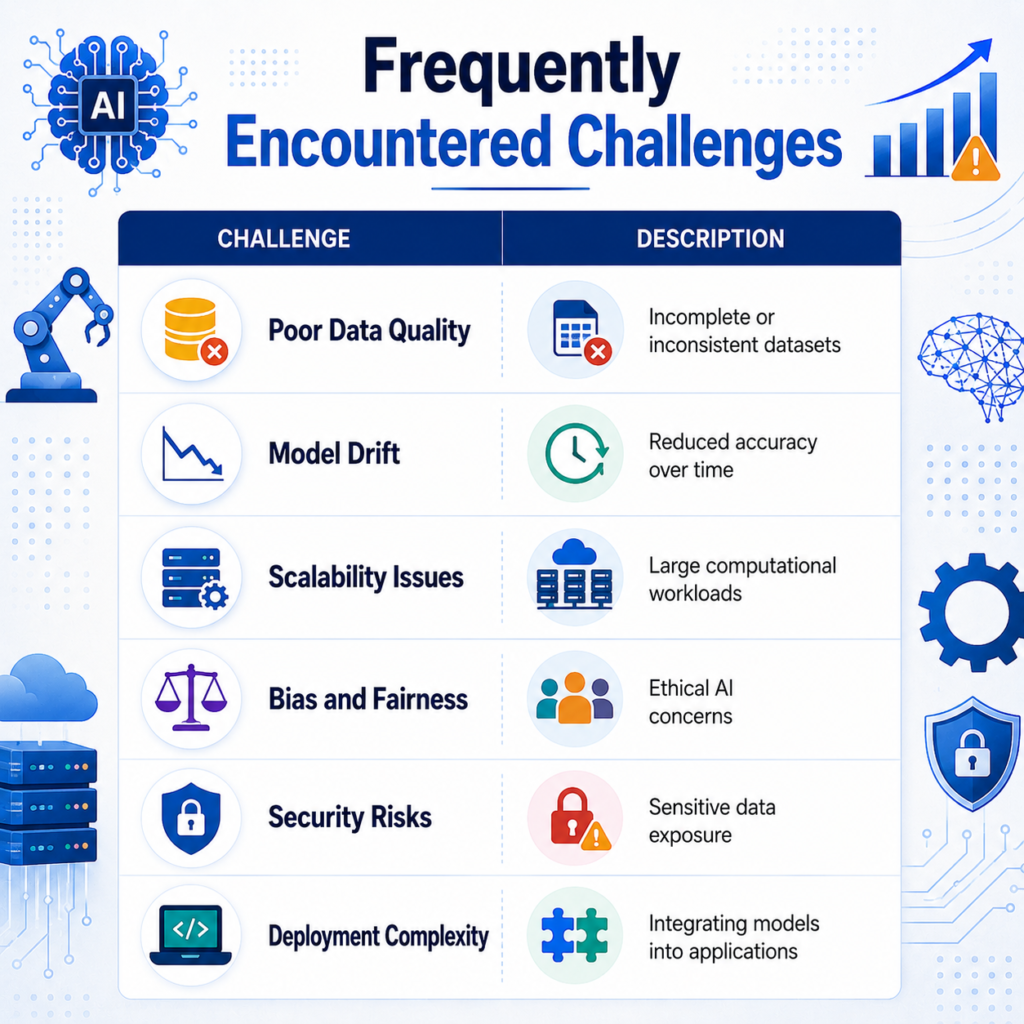
| Challenge | Description |
|---|---|
| Poor Data Quality | Incomplete or inconsistent datasets |
| Model Drift | Reduced accuracy over time |
| Scalability Issues | Large computational workloads |
| Bias and Fairness | Ethical AI concerns |
| Security Risks | Sensitive data exposure |
| Deployment Complexity | Integrating models into applications |
Understanding these challenges helps learners prepare for production-oriented Become an AI Engineer roles.
How Long Does It Take to Become an AI Engineer?
The timeline depends on prior experience and learning consistency.
Approximate Learning Timeline
| Background | Estimated Learning Time |
|---|---|
| Complete Beginner | 9–18 months |
| Software Developer | 6–12 months |
| Data Analyst | 6–10 months |
| Cloud Engineer | 6–12 months |
Consistent practice, project work, and hands-on implementation usually accelerate learning progress.
Frequently Asked Questions (FAQ)
Is Artificial Intelligence difficult to learn?
Artificial Intelligence can be challenging because it combines programming, mathematics, and data analysis. However, many best AI courses for beginners introduce concepts gradually with guided projects and practical labs.
Do I need coding experience before learning AI?
Basic programming knowledge is helpful, especially in Python. Some beginner courses start with introductory programming modules before moving into machine learning concepts.
What programming language is most commonly used in AI?
Python is widely used because of its extensive AI and machine learning ecosystem.
Are certifications important for AI careers?
Certifications can help demonstrate structured learning and technical exposure. Employers often also evaluate project experience and practical implementation skills.
Can working professionals learn AI online?
Yes. Online training allows professionals to learn through flexible schedules while continuing their current roles.
What industries hire AI engineers?
Become an AI Engineer work in industries such as finance, healthcare, cybersecurity, retail, manufacturing, logistics, and cloud computing.
What is the difference between AI and machine learning?
Machine learning is a subset of Artificial Intelligence focused on systems that learn patterns from data.
Is cloud knowledge important for AI engineers?
Yes. Many enterprise AI applications are deployed on cloud platforms such as AWS, Azure, or Google Cloud.
Conclusion
Artificial Intelligence online training helps professionals build foundational and advanced skills required for Become an AI Engineer. Structured learning paths combine programming, machine learning, deep learning, cloud deployment, and practical implementation workflows used in enterprise environments.
The best AI certification courses and best AI courses for beginners typically emphasize:
- Hands-on projects
- Industry-standard AI tools
- Real-world workflows
- Production deployment concepts
- Practical problem-solving skills
Explore H2K Infosys Artificial Intelligence courses to gain hands-on exposure to real-world AI tools, workflows, and enterprise project practices.
Learn practical Become an AI Engineer skills through guided training designed for working professionals and career-focused learners.