Certified business analysts are in high demand because companies today need professionals who can turn messy business problems into clear, profitable decisions. From healthcare and banking to retail and AI-driven startups, organizations are actively looking for people with structured business analysis skills, real project exposure, and recognized certifications that prove they can work in fast-moving environments.
A few years ago, many companies treated business analysis like a “support role.” That’s changed. Now, business analysts sit in strategy meetings, product discussions, Agile sprint planning sessions, and even AI transformation projects. Honestly, if you watch how companies are hiring in 2026, one thing becomes obvious: businesses no longer want guesswork. They want data-backed decisions, process improvements, and professionals who can bridge the gap between business teams and technical teams without creating confusion.
This is why training providers like H2K Infosys have grabbed the attention of aspiring professionals who want to build practical skills of business analysis as per current industry demands.
And that’s exactly where Certified Business Analysts stand out.
The Shift Happening in the Business Analyst Job Market
One thing I’ve personally noticed while talking to professionals switching careers is that employers are becoming much more selective. Earlier, having a degree and decent communication skills was often enough to get shortlisted. Today? Recruiters want proof of capability.
That’s why structured business analyst training programs and recognized certifications have become such a big deal.
Companies are investing heavily in:
- Digital transformation
- Cloud migration projects
- AI and automation initiatives
- Customer experience optimization
- Data-driven operations
Every one of those projects needs someone who can gather requirements properly, communicate with stakeholders, document workflows, analyze risks, and help teams avoid expensive mistakes.
A Certified Business Analysts becomes that “bridge person” companies depend on.
Why Employers Prefer Certified Business Analysts
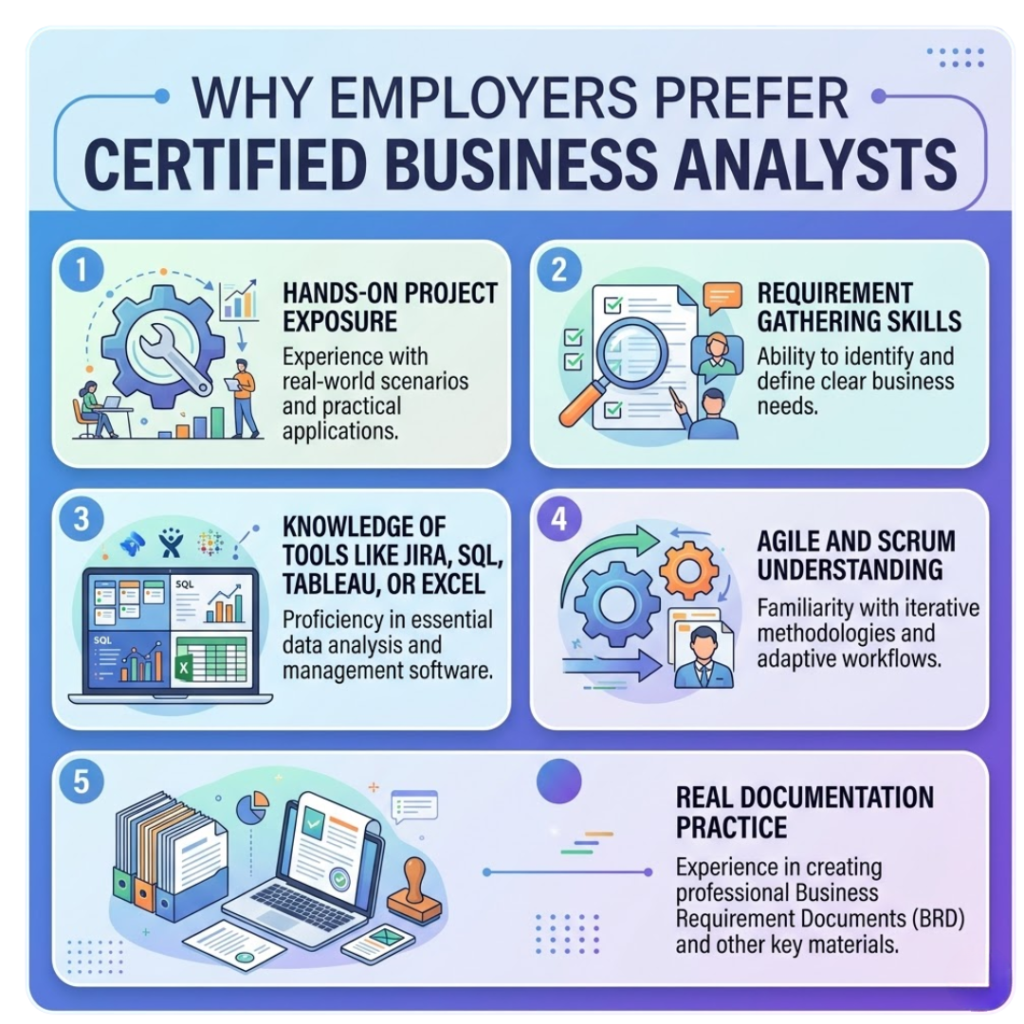
There’s a practical reason behind this preference. Certification tells employers that the candidate already understands core BA methodologies instead of learning everything from scratch after hiring.
When recruiters see someone with:
- Hands-on project exposure
- Agile and Scrum understanding
- Requirement gathering skills
- Knowledge of tools like JIRA, SQL, Tableau, or Excel
- Real documentation practice
…it reduces hiring risk.
That matters a lot in today’s economy, where companies are trying to hire smarter, not just faster.
I’ve seen many hiring managers openly mention that candidates with an online business analyst certification often perform better during interviews because they can explain real workflows instead of only theoretical concepts.
The Rise of Hybrid and Remote BA Roles
Another reason demand is growing? Remote work changed hiring patterns completely.
Companies are now hiring Certified Business Analysts globally, especially for:
- Remote Agile teams
- SaaS product companies
- IT consulting firms
- Healthcare technology projects
- Financial compliance systems
This opened opportunities for people who previously thought transitioning into tech was impossible.
A lot of working professionals from banking, HR, customer support, operations, and even teaching backgrounds are now entering BA roles after completing a proper business analyst course online.
And honestly, that transition makes sense.
Business analysis is less about hardcore coding and more about understanding problems, workflows, communication, and business logic. People with prior professional experience often adapt surprisingly fast.
Real World Example: How Certification Impacts Hiring Outcomes
I remember one particular example of a professional who was from a non-technical operations background. She had years of experience managing internal reporting and stakeholder coordination, but couldn’t get interviews for BA roles.
She finished structured business analyst training with project simulations and Agile exposure, and updated her resume to:
- BRD and FRD documentation projects
- User stories created
- Experience gathering requirements
- Participation in Mock sprint planning
Within months, recruiters began to respond differently.
Why? Because now her profile looked “job-ready.”
That’s something many people underestimate. Certification alone isn’t magic; the right training environment matters just as much.
Why H2K Infosys Gets Attention in Business Analyst Training
One reason many learners look toward H2K Infosys is that their programs focus heavily on practical exposure instead of only theory.
A lot of online courses teach concepts in isolation. But real BA work is messy. Requirements change. Stakeholders disagree. Documentation evolves constantly. Good training should reflect that reality.
H2K Infosys structures its business analyst course around:
- Real-time project scenarios
- Agile methodologies
- Mock interview preparation
- Resume building
- Hands-on assignments
- Placement-oriented learning
That practical angle matters more in 2026 than ever before because recruiters increasingly ask situational questions during interviews rather than textbook definitions.
AI Is Increasing Demand for Business Analysts – Not Replacing Them
This surprises many people.
There’s a common assumption that AI tools will reduce analyst jobs. But what’s actually happening is almost the opposite.
AI can generate reports or summarize data, sure. But businesses still need humans who can:
- Interpret business needs
- Validate requirements
- Ask the right stakeholder questions.
- Identify process gaps
- Translate business goals into implementation plans.
AI tools create outputs. Business analysts create direction.
In fact, companies implementing AI systems now rely even more on analysts to define workflows, compliance rules, user expectations, and operational requirements.
That’s one reason demand for professionals with online business analyst certification continues rising across industries.
Skills That Make Certified Business Analysts Valuable
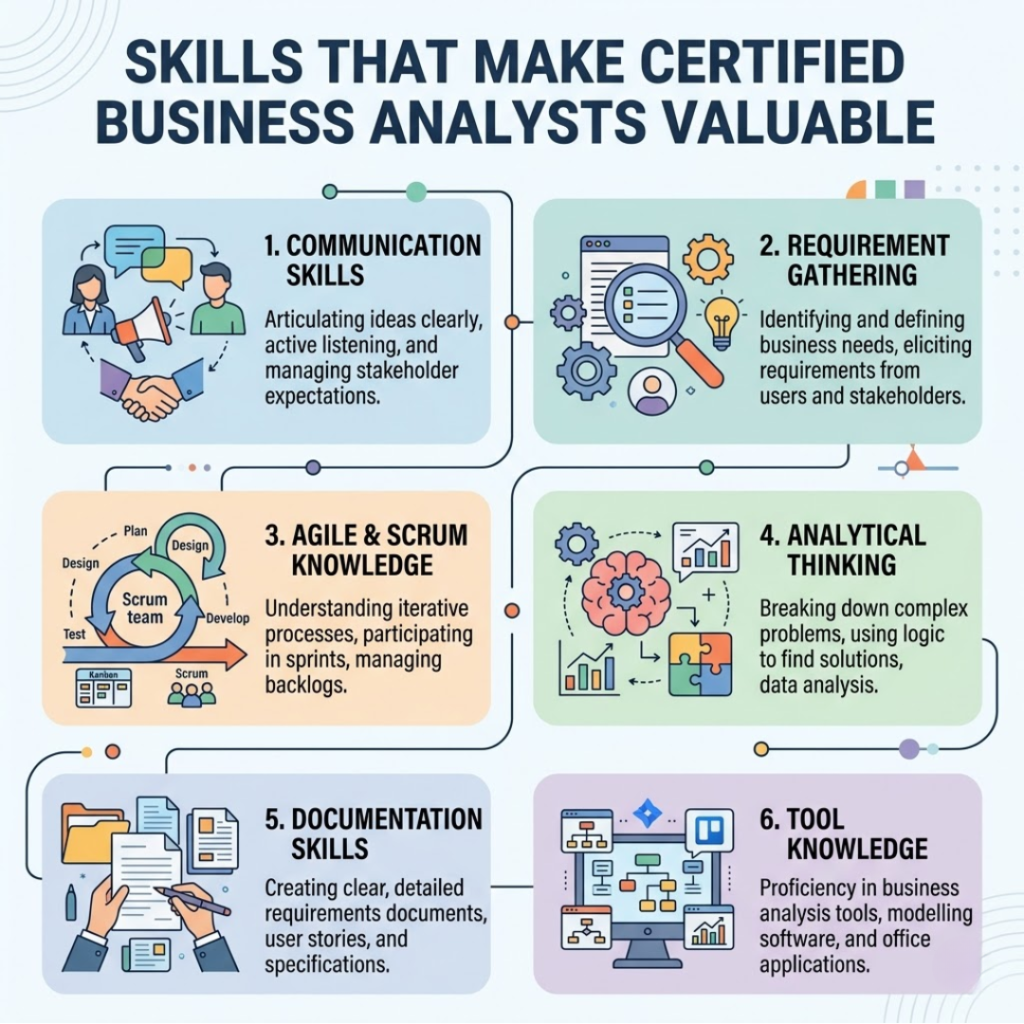
Here’s what employers actively look for right now:
Communication Skills
Honestly, this is huge. Analysts spend a lot of time talking with clients, developers, managers, testers, and operations teams.
Requirement Gathering
A poorly written requirement can delay an entire project.
Agile & Scrum Knowledge
Most companies now operate in Agile environments.
Analytical Thinking
Businesses need people who can identify inefficiencies and recommend realistic improvements.
Documentation Skills
BRDs, FRDs, user stories, and acceptance criteria are still core responsibilities.
Tool Knowledge
JIRA, Confluence, SQL, Tableau, Excel, Visio, and Power BI are frequently requested.
Strong business analyst training programs usually combine all these areas together instead of teaching them separately.
Why Beginners Are Entering This Career Path
One interesting trend lately is how many beginners are searching for flexible entry routes into tech without becoming software developers.
Business analysis has become attractive because:
- The learning curve is manageable.
- Most skills are transferable.
- More possibilities to work from home.
- Salary growth is strong.
- BAs work in a wide range of industries.
A structured business analyst course will help a beginner to avoid random learning and focus on the skills that are actually tested by employers while hiring.
That’s important because the internet is overloaded with fragmented tutorials that don’t prepare candidates for real interviews.
The Certification Advantage in Competitive Hiring
In competitive job markets, small advantages matter.
When recruiters compare two candidates with similar experience, the one with recognized certification and practical project exposure usually gets more attention.
Certification signals:
- Commitment
- Structured learning
- Industry awareness
- Professional credibility
And in many cases, it helps candidates pass initial resume screening systems, too.
That’s one reason professionals increasingly invest in online business analyst certification programs rather than only self-learning through YouTube videos or blogs.
Final Thoughts
If you are thinking of pursuing this career, the most important difference is often choosing the right place to study. A practical, placement-oriented business analyst training program will help the candidates gain confidence, hands-on experience, and interview-ready skills at a much faster pace than disparate self-study.
This is the reason why many aspiring analysts and career switchers keep looking for programs from H2K Infosys, especially those who want real-world project exposure and job-oriented preparation instead of just theoretical lessons.