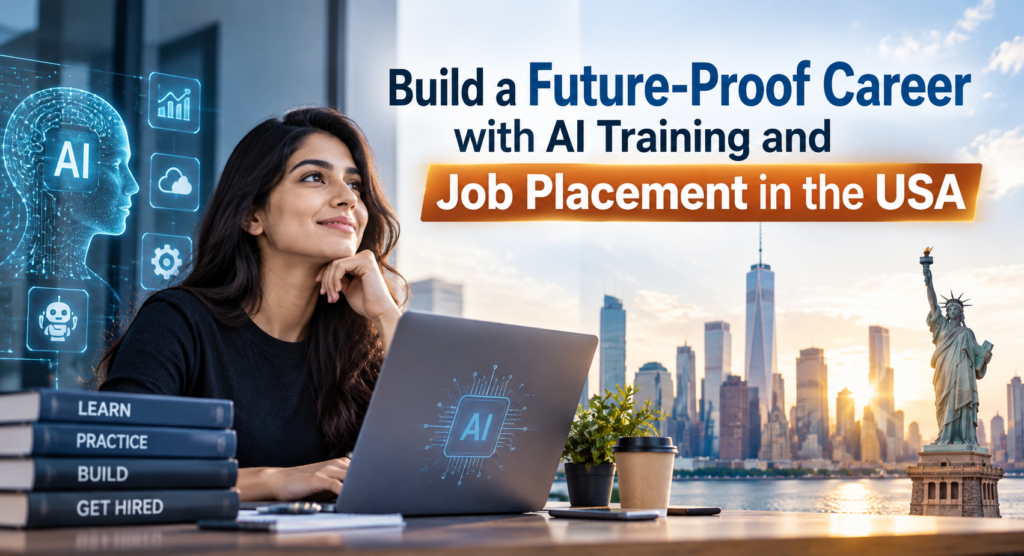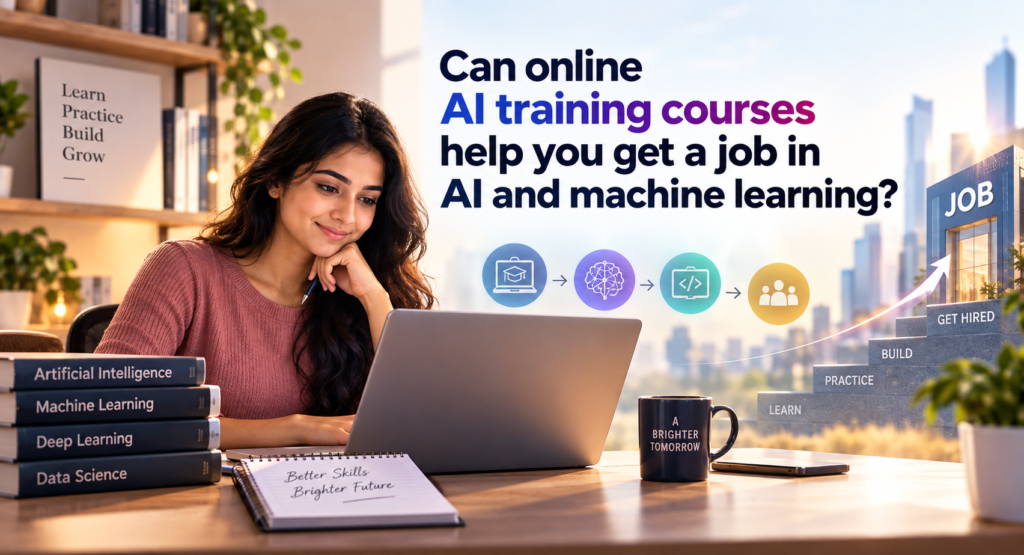
H2K Infosys Best Artificial Intelligence Course Online offer a structured remote learning experience designed to help professionals develop practical expertise in machine learning, data analysis, automation, natural language processing (NLP), and AI model deployment. These programs are widely pursued by IT professionals, software developers, data analysts, and business teams seeking to build industry-relevant AI skills while continuing in their current roles.
Artificial Intelligence Certification Online Training gives you access to hands-on laboratories, cloud-based AI tools, enterprise workflows and guided projects that simulate real-world implementation situations. Online AI programs are popular because they offer flexibility in learning schedules and teach technology used in today’s industrial systems.
What is Artificial Intelligence (AI)?
Artificial Intelligence is the study of computer systems that accomplish tasks that normally require human intelligence . These are the tasks:
- Pattern Identification
- Decision making
- Language comprehension
- Image analysis
- Predictive analysis
- Process automation
AI systems find trends and improve results over time using algorithms, statistical models, and big data sets.
Artificial Intelligence – Main Branches
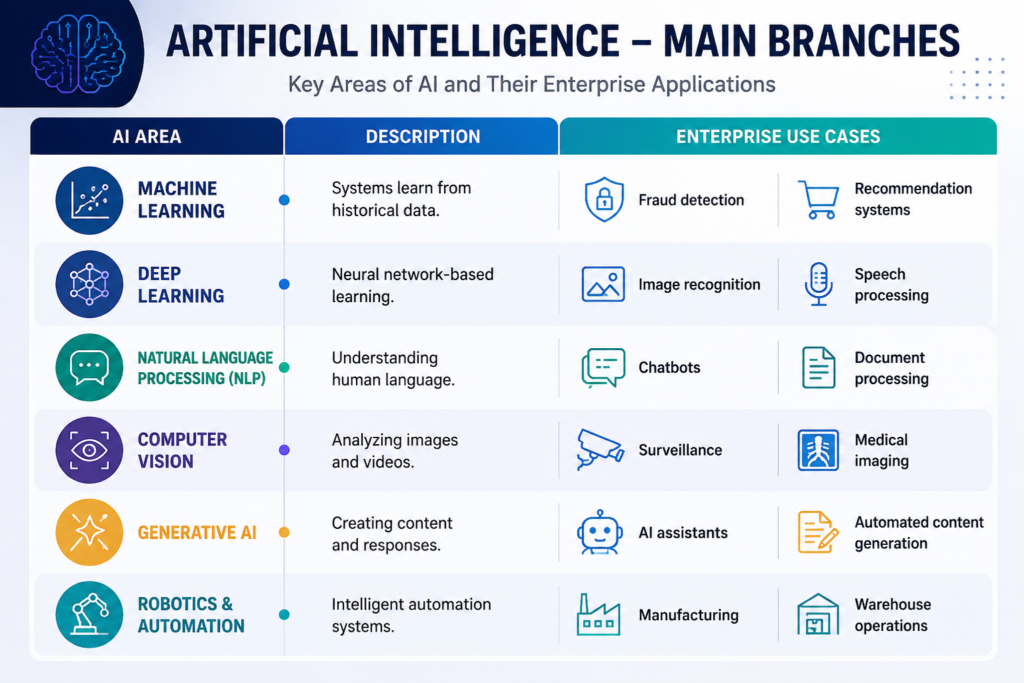
| AI Area | Description | Enterprise Use Cases |
|---|
| Machine Learning | Systems learn from historical data | Fraud detection, recommendation systems |
| Deep Learning | Neural network-based learning | Image recognition, speech processing |
| Natural Language Processing (NLP) | Understanding human language | Chatbots, document processing |
| Computer Vision | Analyzing images and videos | Surveillance, medical imaging |
| Generative AI | Creating content and responses | AI assistants, automated content generation |
| Robotics & Automation | Intelligent automation systems | Manufacturing, warehouse operations |
Modern organisations tend to include numerous AI technologies in integrated workflows.
Why is Artificial Intelligence so important for working professionals?
Artificial Intelligence is being more and more used in software development, cybersecurity, cloud computing, DevOps, corporate analytics and enterprise automation. Technical and non-technical professionals need to grasp how AI tools work and how they affect business operations.
Reasons Why AI Skills are in Demand
Organisations utilise AI systems to automate repetitive processes like:
- Log analyse
- Customer support call routing
- Document Classification
- QA testing
- “Data verification
Those with AI understanding can assist create and maintain such systems.
Data Driven Decision Making
AI helps teams to analyse vast amounts of structured and unstructured data. This is supported by:
- Predictive forecast
- Risk analysis
- Analysis of customer behaviour
- Operational optimization
- Integration with Legacy IT Systems
Often, enterprise AI solutions work together with:
- Cloud platforms
- ERP systems
- CRM Software.
- Data warehouses
- Security monitoring tools.
These integration patterns are helpful for working professionals.
Diverse Industry Requirements
The AI technologies are broadly employed in:
- MEDICATIONS
- Financial
- Retailing
- Production
- Telecoms
- Logistic
- Cybersecurity
Therefore, AI skills are gaining importance across occupational functions.
What are the benefits of enrolling in an online Artificial Intelligence certification course?
The Artificial Intelligence Certification offer systematic technical training and actual implementation exposure. These programs are especially valuable for professionals who are juggling work duties with the need to upgrade their skills.
Flexible Learning for Working Professionals
One big advantage of online AI programs is that you get to set your own hours.
Professionals may:
Attend classes at night or on weekends
Watch taped sessions
Practice remotely in cloud labs
Progress at their own rate
This flexibility allows for further learning without having to put one’s job on hold.
Access to AI Tools of the Industry
Most Artificial Intelligence Certification gives you exposure to the popular platforms and frameworks.
Common Tools Covered in AI Certification Courses
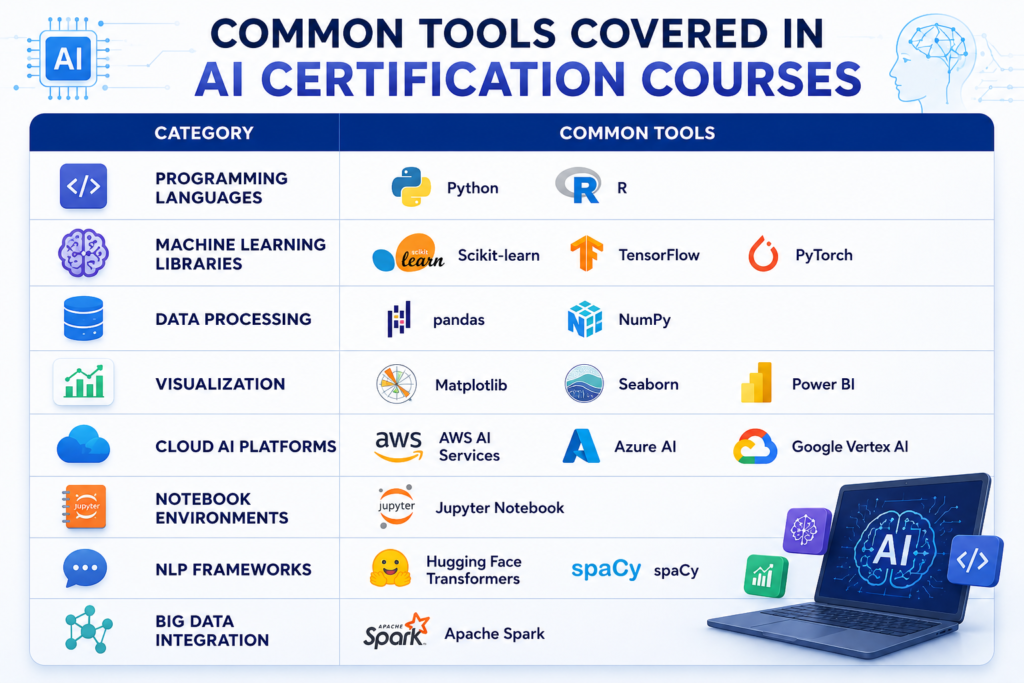
| Category | Common Tools |
| Programming Languages | Python, R |
| Machine Learning Libraries | Scikit-learn, TensorFlow, PyTorch |
| Data Processing | Pandas, NumPy |
| Visualization | Matplotlib, Seaborn, Power BI |
| Cloud AI Platforms | AWS AI Services, Azure AI, Google Vertex AI |
| Notebook Environments | Jupyter Notebook |
| NLP Frameworks | Hugging Face Transformers, spaCy |
| Big Data Integration | Apache Spark |
The learners will have hands-on familiarity with these technologies to understand enterprise AI workflows.
Pathways to Structured Learning
It’s hard to learn AI on your own from random websites because the topics are complicated.
The certification programs generally structure the learning in the following stages:
- Python Basics
- Statistics and Probabilities
- Data pre-processing .
- ML algorithms
- Fundamentals of deep learning
- Deployment of the model
- AI Ethics & Governance
- Capstone projects
This organised approach allows learners to gain core knowledge before moving on to sophisticated implementations.
Hands on Project Exposure
AI education needs to involve practical learning.
Projects in several online AI programs include:
- “Customerchurn prediction
- Sentiment analysis.
- Fraud detection systems
- Recommendation systems
- Predictive maintenance modelling
- Image classification employs
These projects replicate enterprise development scenarios and introduce learners to real-world implementation issues.
Exposure to Cloud-Based AI Environments
Many enterprise AI solutions today function in cloud ecosystems.
AI certifications generally expose students to:
- Model deployment pipelines
- API integrations
- ML workflows in containers
- AI services managed
- GPU-enabled training environments
Understanding cloud deployment models is critical for production ready AI systems .
Opportunities for Career Transition
AI certification programs are often used by professionals from a range of technical backgrounds to migrate into data-driven or AI-enabled jobs.
Common Transition Paths
| Current Role | AI-Related Transition |
| Software Developer | Machine Learning Engineer |
| Business Analyst | Data Analyst |
| QA Engineer | AI Testing Specialist |
| System Administrator | AI Infrastructure Engineer |
| Data Engineer | AI Platform Engineer |
| BI Professional | AI Solutions Analyst |
Certification programs provide targeted technical education to address skill shortfalls.
Enterprise Automation – A Better Understanding
AI is highly related to automation tactics.
Professionals learn how AI interfaces with:
- Robotic process automationRPA
- Workflow orchestration
- Intelligent document processing
- Predictive surveillance systems
- Business chat bot
That wider understanding encourages collaboration across technical teams.
Experience in AI Governance and Ethical Practices
Focus on: Enterprise AI adoption needs
- Data Protection
- Bias reduction
- Model interpretability
- Security Measures
- Standards of compliance
Increasingly modern Artificial Intelligence Certification programs incorporate topics of governance, as production AI systems have to work under organisational and regulatory limitations.
How is Artificial Intelligence used in real-world IT projects?
In the enterprise space, AI often goes via a prescribed workflow for deployment.
Typical Enterprise AI Workflow
| Phase | Activities |
| Data Collection | Gather structured/unstructured data |
| Data Cleaning | Remove inconsistencies and missing values |
| Feature Engineering | Prepare data for model training |
| Model Selection | Choose appropriate algorithms |
| Model Training | Train AI models using datasets |
| Evaluation | Measure model accuracy and performance |
| Deployment | Integrate model into production systems |
| Monitoring | Track drift, performance, and reliability |
Every implementation phase is a cooperative effort between developers, data engineers, analysts and operations teams.
Example: AI Workflow for Customer Service
Some real-world AI implementations could be:
Step 1: Load the data
Customer support tickets are extracted from CRM systems.
Natural Language Processing Step 2:
Tickets are classified by natural language processing models on:
Type of issue
Sentiment.
Sense of urgency
Type of product
Step 3: Automation rule
AI automatically sends tickets to the right support teams.
Step 4. Watch
Teams observe:
- Predictive accuracy
- Higher rates of
- Wrong classifications
This type of workflow is an example of how AI may be integrated with operational business systems.
What Skills Do You Need To Learn Artificial Intelligence?
AI learning is a mix of technical, analytical and problem-solving skills.
Technical Skills (Core)
Fundamentals of Programming
Python is popular for its ecosystem for machine learning and data analysis.
Fundamental programming ideas include:
- Features
- Cycles
- Data structures.
- API’s
- Object orientated programming
Mathematics & Statistics
Many AI algorithms rely on:
- Probabilities
- Linear algebra
- Statistics
- Calculus ideas
- Optimisation techniques
In practice, while training AI, the emphasis is usually on applied understanding rather than strictly theoretical mathematics.
Data Handling Capabilities
Professionals need to know:
- Data pre-processing
- Feature engineering:
- Querying with SQL
- Data visualization
- ETL pipelines
AI model performance is directly dependent on data quality.
Introduction to Machine Learning
Important ML ideas are:
- learning. supervised
- Unsupervised training
- Classification
- Go back
- Cluster analysis
- Metrics for Evaluating Models
Cloud and Deployment Fundamentals
Production AI systems typically need to be conversant with:
- Docker containers
- Kubernetes Essentials
- Cloud Deploy
- REST APIs (
- CI/CD pipeline
These talents enable to take models from development to manufacturing.
How does artificial intelligence work in enterprise environments?
The deployment of AI will vary for organisational needs and industry areas.
AI in Health Care
AI is used by healthcare organisations for:
- Med. Image Anal.
- Risk assessment of patients
- Clinical documentation assistance
- Help in drug discovery
These systems need strong governance and compliance controls.”
Financial Services AI
Banks and financial institutions typically use AI in:
- Fraud detection:
- Credit scoring
- Algorithmic trading
- Risk assessment
- Automated customer support
Security and explainability are critical issues in these settings.
Retail AI
AI is supporting retail companies with:
- Forecasting inventory
- Recommender Systems
- Segmentation of customers
- Dynamic pricing
- Supply chain optimization
AI systems are also frequently integrated with ERP and CRM systems.
AI in Cybersecurity
Security teams are increasingly turning to AI to:
- Threat recognition
- Behavioural analysis
- Detection of intrusion
- Correlation of security events
- Malware Categorisation
These implementations require the capability to process data in real time.
What Are the Top Jobs That Use Artificial Intelligence Daily?
AI skills are relevant for a wide range of enterprise tech professions.
Common AI-Related Roles
| Role | Responsibilities |
| Machine Learning Engineer | Build and deploy ML models |
| Data Scientist | Analyze datasets and generate insights |
| AI Solutions Architect | Design enterprise AI systems |
| Data Analyst | Interpret and visualize data |
| NLP Engineer | Develop language processing systems |
| AI Research Engineer | Experiment with advanced models |
| MLOps Engineer | Manage ML deployment pipelines |
| Business Intelligence Analyst | Use AI-driven analytics tools |
Some embed AI responsibilities inside their existing software engineering and DevOps teams.
What Are Career Options After Studying Artificial Intelligence?
There are several technical ways that Artificial Intelligence Certification might help professional advancement.
Entry-Level Positions
People starting in AI training can fill jobs such as:
- Junior Data Analyst
- AI Support Agent
- Data Operations Specialist Engage2
- Test Engineer (ML)
These roles tend to be focused on data preparation, reporting and operational assistance.
Mid-Level Career Track
After having practical experience, professionals may advance to:
- Engineering of machine learning
- Artificial Intelligence Development
- NLP Engineering
- Forecasting & Analytics
- Operations on AI Platform
These are usually jobs that deal with production workflows and deployment duties.
Specialization Area of Specialisation
| Specialization | Focus Area |
| Computer Vision | Image and video analysis |
| NLP Engineering | Language processing systems |
| Generative AI | LLMs and content generation |
| AI Security | Securing AI systems |
| MLOps | Model lifecycle management |
| AI Infrastructure | Distributed AI systems |
Specialisation is typically dictated by exposure to projects and the demands of the organisation.
How do online AI programs assist with practical learning?
Practical exposure is an important element of AI education.
Learning in the Lab
Many online AI programs offer cloud laboratories, where learners can:
- Train ML models
- Test data sets
- Develop APIs
- Use AI applications.
- Review performance metrics
These labs mimic enterprise implementation scenarios.
Senior Project
Capstone projects let learners bring together different abilities into end-to-end workflows.
Sample Project Structure
| Stage | Activities |
| Problem Definition | Define business objective |
| Data Preparation | Clean and transform datasets |
| Model Development | Train and validate models |
| Deployment | Expose model through APIs |
| Monitoring | Track prediction quality |
That’s how enterprise AI is developed in the real world, and it’s kind of like that approach.
Collaborative Learning Environments
Many certification programs offer:
- Peer discussion
- Code Review
- Mentor feedback
- Technical problem solving sessions
These encounters assist learners to comprehend the challenges of real application.
What are the Challenges of Learning Artificial Intelligence for Professionals?
AI learning can provide a number of technological and operational issues.
Handling Large Amounts of Information
AI incorporates ideas from
- Programming
- Maths
- Data engineering
- Statistics
- Cloud computing.
This is where structured training might help to organise these notions over time.
Real World Data Problems Understanding
Enterprise datasets frequently include:
- Missing values
- Duplicates
- Prejudice
- Unbalanced classrooms
- Formatting is inconsistent
Being able to deal with these challenges is a key practical skill.
Complexity of model deployment
But creating the model is just one phase of enterprise AI implementation.
Professionals should also consider:
- Scalability
- Surveillance
- Security 2
- API integration
- Capital expenditures
Such operational concerns are often raised in sophisticated AI applications.
How Professionals Should Select an Artificial Intelligence Certification Course Online?
Your choice of course will rely on your technical background, your professional aspirations and your learning preferences.
Key Factors for Evaluation
Depth of Curriculum
Look for programs such as:
- Machine learning
- Deep learning
- Natural Language Processing
- Deploying the model
- AI ethics
- Cloud AI services
- Hands-On Elements
Practical labs and projects are critical for the application of skills.
Tools Related to Industry
Programs should encompass technology utilised in enterprise settings.
Teaching Experience
People who have actually implemented a course tend to teach more practical courses .
Evaluations by Project
Project based learning is more effective in reinforcing concepts than theory only education.
Popular Questions and Answers (FAQ)
Is learning Artificial Intelligence hard?
AI can be tough as it includes a mix of programming, mathematics and data analysis. But planned learning paths and hands-on exercises can assist to demystify complicated topics for beginners.
What language is used to program AI?
The largest community and libraries of machine learning are available in python, which makes it the most popular programming language in AI.
Are online AI courses hands on?
Most Artificial Intelligence Certification programs come with labs, datasets, coding assignments, and capstone projects for hands-on learning.
Yes, working professionals can learn AI while working full-time.
Yes. In general, online AI programs provide flexible schedules so that professionals can study whenever they want, including evenings or weekends.
What industries are the biggest users of Artificial Intelligence?
AI is prevalent in healthcare, banking, retail, manufacturing, logistics, cybersecurity and telecommunications.
Is cloud knowledge relevant for AI careers?
Yes. Many enterprise AI systems run on cloud platforms such as AWS, Azure and Google Cloud.
What is MLOps ?
MLOps are a set of operational methods for deploying, monitoring, and maintaining machine learning systems in production contexts.
Can you get an AI job with certificates?
Certifications are helpful for building core knowledge, but employers also value experience with real projects, technical skills, and problem-solving aptitude.
Conclusion
Artificial Intelligence Online Training offers a clear path for professionals to acquire hands-on AI skills in flexible settings. Many Online Ai Classes offers a clear path for professionals to acquire hands-on AI skills in flexible settings. Many online AI courses integrate basic theory, practical project work, cloud laboratories, and enterprise workflow exposure to give learners a sense of real-world AI implementation techniques.
integrate basic theory, practical project work, cloud laboratories, and enterprise workflow exposure to give learners a sense of real-world AI implementation techniques.
Key points
AI certification programs provide flexible learning for working workers
Practical projects help learners grasp enterprise AI procedures.
AI talents are applicable in many sectors and technical professions
Cloud platforms and deployment techniques are key for modern AI systems
Structured training simplifies difficult machine learning ideas
Hands-on experience enhances comprehension of production AI environments
H2K Infosys Artificial Intelligence courses provide practical AI skills with guided projects, industry tools and hands-on learning environments.
See how online AI programs can assist in your progression in a profession and technical skills in enterprise IT.