The H2K Infosys AI Training and Placement Program Help you provides prospective professionals with hands-on artificial intelligence skills, real-world industry tool experience, and comprehensive preparation for entry-level and advanced technology roles. The program combines expert-led technical training, practical AI projects, career mentoring, resume-building support interview preparation, and placement assistance to help bridge the gap between learning and employment. By focusing on industry-relevant AI technologies and job-ready skills, H2K Infosys enables students and working professionals to pursue successful careers in the rapidly growing field of Artificial Intelligence.
If you’re looking for Artificial Intelligence Engineer Course, then a well-structured How Can an AI Training and Placement Program Help You will offer you a holistic learning experience including machine learning, fundamentals of data science, deep learning, generative AI, and practical implementation exercises.
Programs generally include:
How Can an AI Training and Placement Program Help You is a systematic learning pathway that enables learners to develop artificial intelligence skills and prepares them for the technology workforce.
Most programs include:
- Fundamentals of AI and machine learning
- Development of programming skills
- Hands-on project experience
- Industry-specific tools and platforms
- Resume & Interview Prep
- Mentoring careers
- Placement help
Unlike self-paced learning resources, these programs often provide guided instruction, project reviews, and career support that align learning with industry requirements.
Typical Components of an AI Training Program Component Purpose
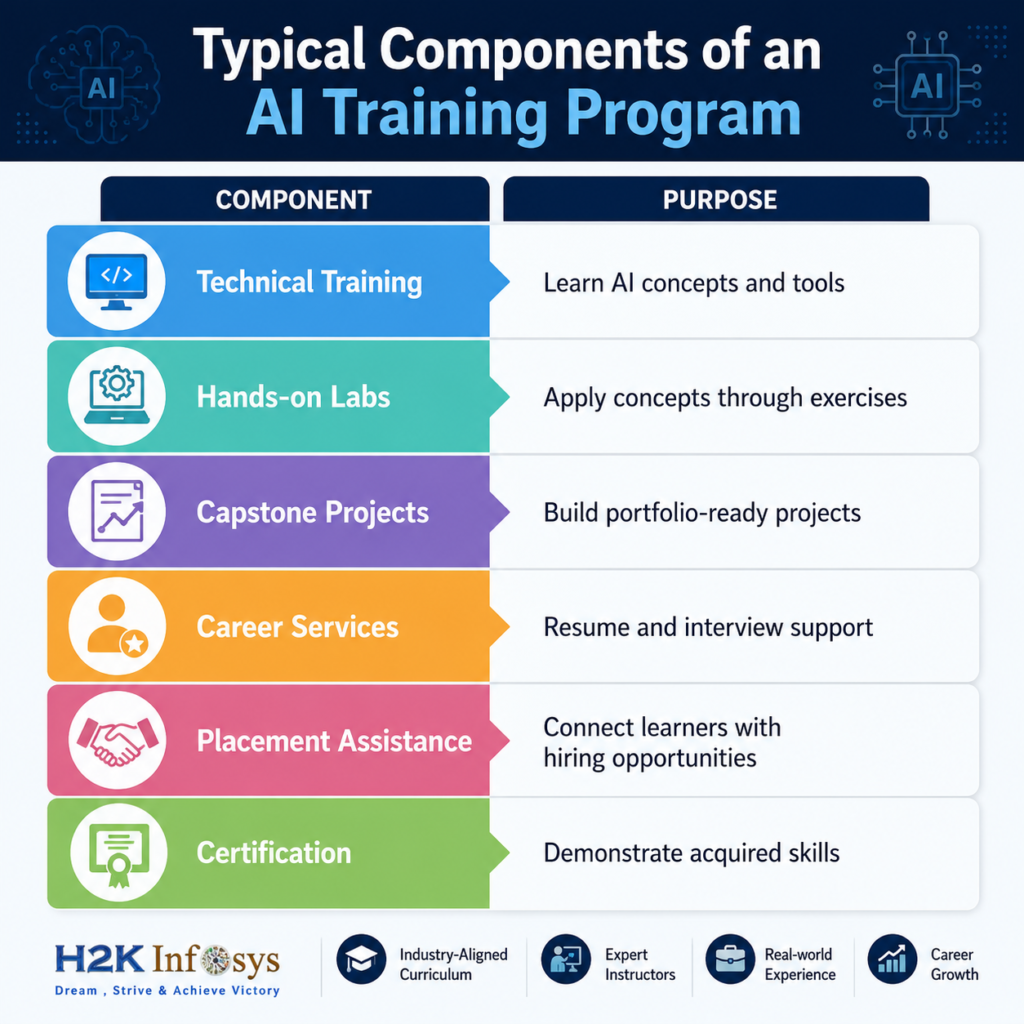
| Component | Purpose |
|---|---|
| Technical Training | Learn AI concepts and tools |
| Hands-on Labs | Apply concepts through exercises |
| Capstone Projects | Build portfolio-ready projects |
| Career Services | Resume and interview support |
| Placement Assistance | Connect learners with hiring opportunities |
| Certification | Demonstrate acquired skills |
What Is Artificial Intelligence?
Artificial Intelligence (AI) is when computer systems are programmed to accomplish tasks that normally require human intelligence such as:
- Learning from data
- Recognition of patterns
- Language comprehension
- Forecasting
- Automated decision making
- Content creation
Modern AI systems enhance performance over time using algorithms and models trained on massive datasets.
Typical areas in AI are:
- Machine learning (ML) Deep learning
- Natural Language Processing (NLP)
- Computer vision Generative AI Reinforcement learning
Organisations leverage AI to enhance operational efficiency, automate repetitive tasks, and facilitate data-driven decision-making.
How Can an AI Training and Placement Program Help You tech Professionals?
Many professionals aspire to move into tech professions, but confront hurdles such as:
- Limited basic knowledge in technical
- Absence of practical project work
- Uncertainty in learning routes
- Not understanding the expectations of the employer
These obstacles can be overcome by an organised How Can an AI Training and Placement Program Help You that provides:
Structured learning
Instead of learning from various resources, pupils are taught a specific curriculum.
Job-Ready Skills
Training is generally geared toward the technology currently in use in the industrial world.
Hands-on experience
Hands-on projects give learners a sense of how AI systems are constructed and implemented.
Career Preparation
Interview coaching and resume development enable learners to demonstrate their talents well.
Advice from a professional
Mentors can guide you through typical industry workflows and best practices.
How AI Works in Real World IT Projects?
AI Training systems usually follow a well-defined workflow.
Step 1: Data Collection
Organisations acquire data from sources including:
- Business Application
- Customer Conversations
- “Internet of Things” devices
- Data-bases
- Platforms in the cloud
- Step 2: Data Preprocessing
Step 2: The raw data is cleaned and processed.
Raw data is cleaned and transformed.
Common Tasks:
- Duplicate Removal
- Missing values handling
- Formats standardisation
- Feature Engineering and
- Step 3: Creating the model
Step 3: Creating the model
Data scientists and AI engineers use historical data to train machine learning models.
Common frameworks include
- Python
- TensorFlow
- PyTorch
- Scikit-learn
Step 4: Evaluating the Model
The teams measure model performance with metrics like:
- Accuracy, Precision
- Remember
- Score F1
- ROC AUC
Step 5: Deploy
The model is part of the production system.
Possible deployment scenarios
- Cloud platforms APIs
- Web apps
- Enterprise software apps
Step 6: Oversight
Continuous monitoring of AI systems to ensure:
- Accuracy factor
- Data quality is consistent
- Business requirements match performance
How Does AI Work in Enterprise Environments?
AI Training is widely used in corporate processes across all industries.
Finance Services
AI supports:
- Detecting fraud
- Credit Analysis of Risk
- Automated customer service
- Algorithmic trading Healthcare
Healthcare
Applications include:
- Medical image analysis
- Predictive diagnostics
- Patient monitoring
- Clinical decision support
Retail
Retail organizations use AI for:
- Demand forecasting
- Product recommendations
- Inventory management
- Customer segmentation
Manufacturing
Common use cases include:
- Predictive maintenance
- Quality inspection
- Production optimization
- Supply chain forecasting
Cybersecurity
Security teams use AI to:
- Detect anomalies
- Identify threats
- Analyze logs
- Improve incident response
What are the Skills Required for an Artificial Intelligence Engineer Course?
Most AI careers demand a blend of tech and people abilities.
Technical Skills Programming
Programming
Python is widely used because of its extensive AI ecosystem.
Important concepts include:
- Variables
- Functions
- Data structures
- Object-oriented programming
Mathematics
Core areas include:
- Linear Algebra
- Probability
- Statistics
- Calculus fundamentals
Data Analysis
Professionals should understand:
- Data cleaning
- Data visualization
- Exploratory data analysis
Machine Learning
Important concepts include:
- Supervised learning
- Unsupervised learning
- Model evaluation
- Feature engineering
Deep Learning
Topics include:
- Neural networks
- Convolutional Neural Networks (CNNs)
- Recurrent Neural Networks (RNNs)
- Transformers
Professional Skills
- Problem-solving
- Communication
- Business understanding
- Documentation
- Collaboration
What Is Included in an Online Artificial Intelligence Certificate Program?
An online program for an Ai learning Courses typically covers basic and intermediate AI principles.
Common Curriculum Areas
| Module | Topics Covered |
| Python Programming | Syntax, libraries, automation |
| Data Science | Data analysis and visualization |
| Statistics | Probability and inference |
| Machine Learning | Classification and regression |
| Deep Learning | Neural networks and frameworks |
| NLP | Text analytics and language models |
| Computer Vision | Image processing and recognition |
| Generative AI | LLMs, prompt engineering |
| MLOps | Deployment and monitoring |
| Capstone Project | Real-world implementation |
What AI Tools Do Industry Experts Use?
Enterprise AI teams leverage a variety of tools across the project life cycle.
Development Tools
| Tool | Purpose |
| Python | AI programming |
| Jupyter Notebook | Experimentation |
| VS Code | Development |
| Git | Version control |
Machine Learning Frameworks
| Framework | Common Use |
| TensorFlow | Deep learning |
| PyTorch | Research and production AI |
| Scikit-learn | Traditional machine learning |
| XGBoost | Predictive modeling |
Cloud Platforms
| Platform | AI Services |
| Amazon Web Services | SageMaker |
| Microsoft Azure | Azure AI Services |
| Google Cloud | Vertex AI |
MLOps Tools
- MLflow
- Kubeflow
- Docker
- Kubernetes
- Jenkins
What Hands-On Projects Help Build AI Skills?
Employers often evaluate practical project experience alongside theoretical knowledge.
Beginner Projects
- House price prediction
- Customer churn prediction
- Sentiment analysis
- Sales forecasting
Intermediate Projects
- Recommendation systems
- Fraud detection models
- Chatbots
- Image classification systems
Advanced Projects
How Does Placement Support Help New AI Professionals?
Placement support focuses on preparing candidates for the hiring process.
Resume Development
Candidates learn to:
- Highlight technical skills
- Present project experience
- Quantify outcomes where applicable
Mock Interviews
Practice sessions often cover:
- Machine learning concepts
- Coding exercises
- Case studies
- Behavioral questions
Portfolio Development
Students may create:
- GitHub repositories
- Project documentation
- Technical presentations
Professional Networking
Programs may provide opportunities to:
- Connect with mentors
- Participate in industry discussions
- Attend technical events
What Job Roles Use AI Daily?
Many technology roles involve artificial intelligence technologies.
AI Engineer
Responsibilities include:
- Building AI systems
- Training models
- Deploying solutions
Machine Learning Engineer
Focus areas include:
- Production ML pipelines
- Model optimization
- Scalability
Data Scientist
Tasks often involve:
- Data analysis
- Statistical modeling
- Business insights
NLP Engineer
Specializes in:
- Language processing
- Conversational AI
- Text analytics
Computer Vision Engineer
Works on:
- Image recognition
- Video analytics
- Object detection
MLOps Engineer
Responsible for:
- Deployment automation
- Monitoring
- Infrastructure management
Role-to-Skill Mapping for AI Careers
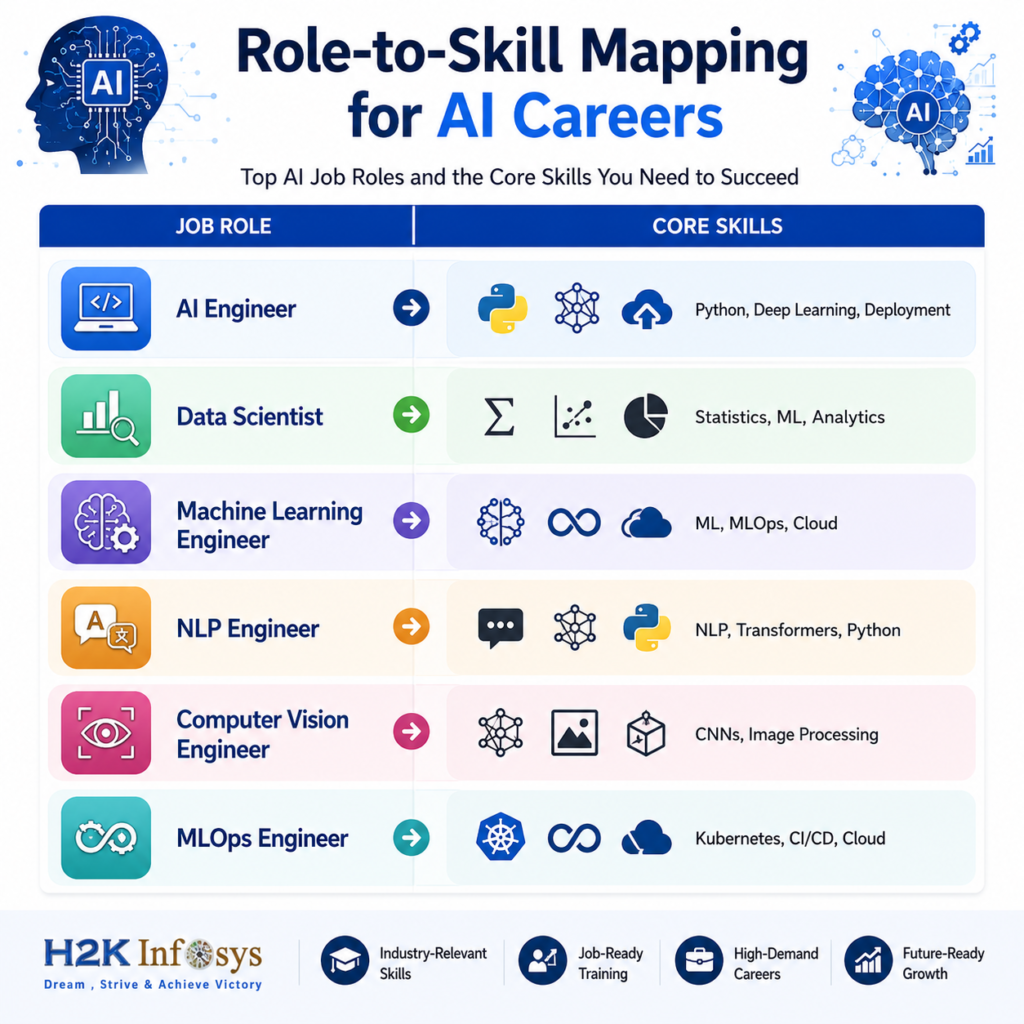
| Job Role | Core Skills |
| AI Engineer | Python, Deep Learning, Deployment |
| Data Scientist | Statistics, ML, Analytics |
| Machine Learning Engineer | ML, MLOps, Cloud |
| NLP Engineer | NLP, Transformers, Python |
| Computer Vision Engineer | CNNs, Image Processing |
| MLOps Engineer | Kubernetes, CI/CD, Cloud |
What Careers Are Possible After Learning an Artificial Intelligence Engineer Course?
Career opportunities vary depending on prior experience and technical depth.
Entry-Level Roles
- Junior AI Engineer
- Data Analyst
- AI Support Specialist
- Machine Learning Associate
Mid-Level Roles
- Machine Learning Engineer
- Data Scientist
- NLP Engineer
- AI Solutions Engineer
Advanced Roles
- Senior AI Engineer
- AI Architect
- MLOps Lead
- AI Product Manager
Many professionals also apply AI skills How Can an AI Training and Placement Program Help You within existing domains such as finance, healthcare, cybersecurity, and operations.
What Challenges Do AI Teams Commonly Face?
Understanding practical challenges helps learners prepare for real-world environments.
Data Quality Issues
Poor-quality data often leads to inaccurate models.
Model Drift
Performance can degrade as business conditions change.
Scalability Requirements
Production systems must support growing workloads.
Security and Compliance
Organizations must address:
- Data privacy
- Regulatory requirements
- Access controls
Explainability
Stakeholders often require transparency regarding model decisions.
Recommended Learning Path for AI Beginners
| Stage | Focus Area |
| Stage 1 | Python Fundamentals |
| Stage 2 | Statistics and Mathematics |
| Stage 3 | Data Analysis |
| Stage 4 | Machine Learning |
| Stage 5 | Deep Learning |
| Stage 6 | Generative AI |
| Stage 7 | MLOps and Deployment |
| Stage 8 | Capstone Projects |
| Stage 9 | Interview Preparation |
| Stage 10 | Job Applications |
This progression helps learners build knowledge systematically while developing practical skills.
Frequently Asked Question (FAQ)
Can I get a job with an online artificial intelligence certificate?
Certificates show learning, but companies also frequently examine practical projects, technical capabilities, and problem-solving ability along with credentials.
Is a computer science degree necessary for learning AI?
No. Many professionals transition into AI from engineering, math, business analytics, information technology etc. But some basic knowledge of programming and maths is helpful.
How much time does it take to learn Artificial Intelligence?
Depends on past experience. For many learners, it can be many months before they are ready to proceed from core abilities to advanced topics and projects.
What is the best programming language for AI?
Python is the most popular language because to the huge ecosystem of libraries for machine learning and data research.
What’s the difference between AI and ML?
Artificial Intelligence is a vast field that attempts to build intelligent systems. Machine learning is a part of AI where the system learns from data to find patterns.
Do AI abilities apply outside of tech companies?
Yes. AI use can be seen across areas such as healthcare, finance, retail, manufacturing, logistics and cybersecurity.
Conclusion
Key Takeaways
- How Can an AI Training and Placement Program Help You are a blend of technical education and career readiness.
- An online artificial intelligence certificate can give learners a structured introduction to the core concepts.
- An artificial intelligence engineer course may include machine learning, deep learning, generative AI, and deployment strategies.
- Hands-on projects are vital for building job-ready abilities.
- Enterprise AI settings require an understanding of data management, model creation, deployment, monitoring and governance.
- Career Opportunities: AI Engineer, Machine Learning Engineer, Data Scientist, NLP Engineer, MLOps Engineer
- Placement support can assist learners in enhancing their resumes, portfolios, interview preparation, and professional networking.
Explore H2K Infosys How Can an AI Training and Placement Program Help You Help on real world tools, projects & workflows.
Join H2K Infosys courses to upskill your technical knowledge and boost your long-term professional growth in artificial intelligence.