H2K Infosys provides artificial intelligence course helps students prepare for real-world AI jobs in the USA in 2026. This hands-on, job-oriented training focuses on Python, machine learning, deep learning, generative AI, cloud deployment, data engineering basics, MLOps, and AI governance. The top ai certified courses are not quick theory-only programs, but structured artificial intelligence certification courses that teach learners how to create, test, deploy, monitor, and secure AI solutions in enterprise environments. The Best Ai Certification Courses also include portfolio projects, model evaluation, prompt engineering, API integration, cloud AI services, and practice applying skills in real-world workflows.
Best Artificial Intelligence education to Prepare Students for Real AI Jobs in the USA in 2026 Hands-on, job-oriented education using Python, machine learning, deep learning, generative AI, cloud deployment, data engineering basics, MLOps, and AI governance. The top ai certified courses are not a quick theory only course, but a structured artificial intelligence certification course that teaches learners how to create, test, deploy, monitor and secure AI solutions in enterprise environments. The finest ai certification courses also include portfolio projects, model evaluation, quick engineering, API integration, cloud AI services and practise applying skills in real-world workflows.
What artificial intelligence course for real world AI jobs in USA 2026?
An artificial intelligence course for real-world AI jobs is a systematic training program that teaches you how to design, create, evaluate and deploy intelligent software systems. “Employers are increasingly looking for professionals who can work with prediction models, language models, automation workflows, cloud platforms and AI-enabled business applications, and this will include traditional machine learning and modern generative AI.
A practical course in AI will not view artificial intelligence as a mathematical subject. Math is necessary, but so are some software engineering, data handling, business problem analysis, security awareness, and production deployment abilities to work on AI in the real world.
A solid course will normally consist of:
- Python Programming for Data and AI
- Statistics, Probability and Model Evaluation
- Supervised & Unsupervised Machine Learning
- Fundamentals of Deep Learning and Neural Network
- Natural Language Processing & Large Language Models
- Generative AI Prompt Engineering Retrieval-Augmented Generation
- Cloud AI systems like Azure AI, AWS AI/ML, or Google Cloud AI
- MLOps concepts such model versioning, deployment, monitoring, retraining,
The most valuable AI course in 2026 will be one that takes learners from “knowing AI terminology” to contributing to AI-enabled systems used by businesses.
What Artificial Intelligence education prepares students for real-world AI careers in the USA in 2026?
The most suitable artificial intelligence course helps students option is a well-rounded Artificial Intelligence Certification Course that encompasses machine learning, generative AI, cloud deployment, MLOps, and hands-on projects. A narrow course that teaches only prompt writing or only machine learning theory may be useful, but it is usually not enough for job readiness.
A job-oriented course should assist learners answer practical problems like:
- How can I clean and prepare data for an AI model?
- How do I choose the correct machine learning algorithm?
- How do I judge if a model is good enough for production?
- How can I properly use a huge language model in an enterprise app?
- How can I link AI models to APIs, databases and business systems?
- How can I monitor the performance of a model after deployment?
- How do we record risks, assumptions and limitations?
For job training in the USA, a good AI course should incorporate both foundational and applied modules.
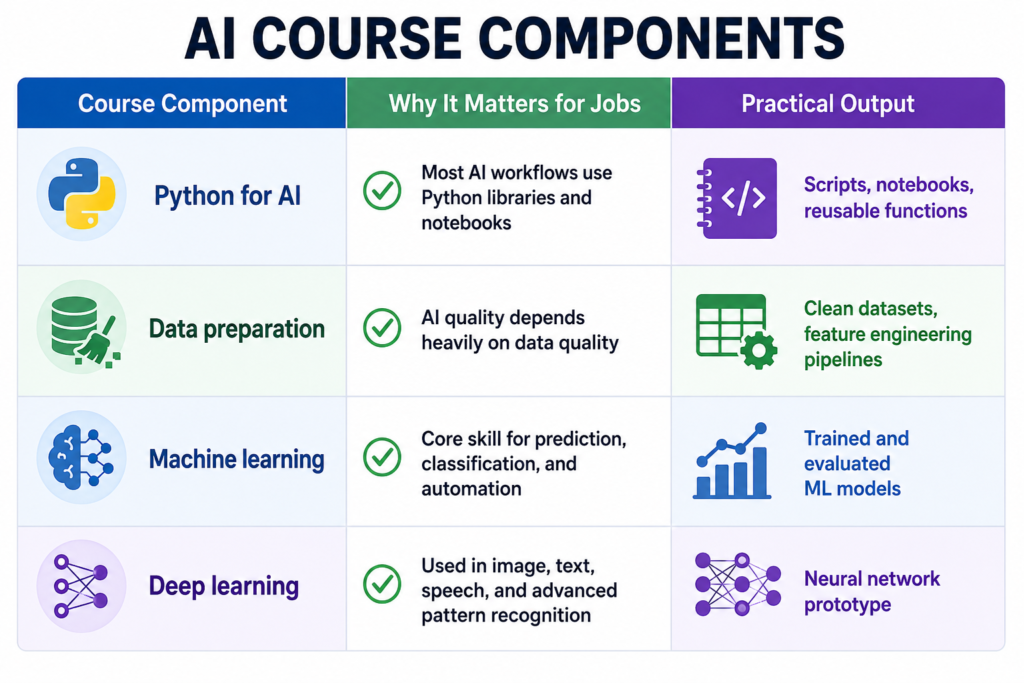
| Course Component | Why It Matters for Jobs | Practical Output |
|---|---|---|
| Python for AI | Most AI workflows use Python libraries and notebooks | Scripts, notebooks, reusable functions |
| Data preparation | AI quality depends heavily on data quality | Clean datasets, feature engineering pipelines |
| Machine learning | Core skill for prediction, classification, and automation | Trained and evaluated ML models |
| Deep learning | Used in image, text, speech, and advanced pattern recognition | Neural network prototypes |
| Generative AI | Commonly used for chatbots, summarization, code assistance, and content workflows | LLM-based applications |
| Cloud AI | Enterprise AI is commonly deployed on cloud platforms | Cloud-hosted models or AI services |
| MLOps | Production AI requires versioning, deployment, and monitoring | Model registry, deployment pipeline, monitoring plan |
| AI governance | Organizations must manage privacy, bias, security, and compliance | Risk checklist and model documentation |
The course should be project-driven. A learner who completes the course should have demonstrable artifacts such as notebooks, model evaluation reports, API-based AI applications, and deployment-ready project documentation.
Typical AI workflow in the real world
Artificial intelligence works in real-world IT projects by using data, algorithms, models, and software systems to automate or augment decisions. In a business setting, AI is usually part of a larger technology workflow rather than a standalone experiment.
A typical AI project begins with a business problem. For example, a company may want to classify support tickets, forecast demand, detect fraud, recommend products, extract information from documents, or build a chatbot for internal knowledge search.
Typical real-world AI workflow
| Step | What Teams Do | Common Tools |
| Problem definition | Define business goal, success metric, constraints, and users | Jira, Confluence, stakeholder workshops |
| Data collection | Gather structured or unstructured data from databases, APIs, logs, or documents | SQL, Python, APIs, cloud storage |
| Data preparation | Clean missing values, remove duplicates, transform features, label data | Pandas, NumPy, Spark, data validation tools |
| Model development | Train models or configure AI services | Scikit-learn, TensorFlow, PyTorch, Azure AI, AWS SageMaker, Vertex AI |
| Evaluation | Test model accuracy, precision, recall, latency, robustness, and fairness | Python metrics libraries, MLflow, evaluation dashboards |
| Deployment | Expose the model through APIs, batch jobs, or application integrations | Docker, Kubernetes, FastAPI, cloud endpoints |
| Monitoring | Track drift, errors, latency, user feedback, and cost | Cloud monitoring, MLflow, Prometheus, logging tools |
| Governance | Document risks, approvals, access controls, and model limitations | Model cards, risk registers, audit logs |
In production environments, the model is only one part of the system. Teams must also manage data pipelines, user interfaces, access permissions, logs, version control, testing, rollback plans, and performance monitoring.
Why is an artificial intelligence course relevant for working professionals?
Why is an artificial intelligence course relevant for working professionals?
For example:
- A QA analyst may need to validate AI results and edge cases for consistency.
- A business analyst may be required to document AI needs and acceptance criteria.
- A data analyst may need to apply machine learning to forecast or segment.
- AI services may need to be deployed securely by cloud engineers.
- Cybersecurity analysts might need to assess attack surfaces associated with AI.
- The project manager will likely need to grasp the risks, dependencies and delivery deadlines for AI.
Training in AI helps professionals understand what can realistically be automated, when human review is needed and how to evaluate AI outputs. This is particularly significant since real-world AI systems can fail in ways that traditional software systems do not.
Risks common to AI projects:
- Bad data quality
- Skewed Training Data
- Overfitting the model
- Incorrect or Unreliable Outputs
- Data breach
- Generative AI Hallucinations
- Prompt Injection for LLM Applications
- High cloud spending
- Absence of post-deployment monitoring
- Not understandable to business users
A practical education on artificial intelligence must make these limitations evident, rather than promoting AI as a cure-all.
What are the prerequisites to learn Artificial Intelligence Certification Course?
Students don’t need to be experienced data scientists to start an artificial intelligence course helps students, but they should have a firm basis. AI is learnable for IT professionals at beginner to advanced skill levels, providing the training is correctly scheduled.
Core pre-requisite skills
| Skill Area | What Learners Should Know | Why It Matters |
| Python basics | Variables, functions, loops, files, libraries | Required for AI development and automation |
| SQL basics | Select, filter, join, aggregate data | Most enterprise data is stored in databases |
| Statistics basics | Mean, variance, probability, correlation | Helps interpret model behavior |
| Data handling | CSV, JSON, APIs, missing values | AI projects depend on usable data |
| Software basics | Git, APIs, testing concepts | AI models are deployed inside software systems |
| Cloud awareness | Storage, compute, IAM, services | Many AI workloads run in cloud environments |
| Business analysis | Problem framing and metrics | Prevents building technically correct but unusable models |
Skills learned during the course
A good AI course should teach the following practical abilities
Data Preprocessing
Learners should pre-process, clean, transform and validate datasets prior to model training.
Model selection
Learners need to know when to utilise regression, classification, clustering, neural networks or LLM based systems.
Model assessment
Models should be evaluated with metrics such as accuracy, precision, recall, F1 score, ROC-AUC, mean squared error, latency and cost.
Designing a generative AI app
Prompts, embeddings, vector databases, retrieval-augmented generation, guardrails (etc) Learners should grasp them.
API Integration & Deployment
Learners should expose the AI capability via APIs or as cloud services.
Monitoring and betterment
Learners should monitor drift, errors, user feedback and retraining needs.
Practices for responsible AI
Familiarity with privacy, explainability, fairness, human review and audit documentation is expected from learners.
Top AI certification courses in 2026?
ertification prep and actual implementation. While certification might prove to an employer that a learner has mastery of a platform or concept, employers typically want to see proof that the learner can use the skill in real activities.
A good course should offer:
- Instructor explained the fundamentals of AI
- Hands-on labs using Python and cloud tools
- Realistic data sets for assignments
- Project work end to finish
- Various AI workflows exposure
- Certification exam help as appropriate
- Portfolio project and resume preparation
- Interview-focused project explanation
- Discussion on AI risk controls and constraints
Comparison of typical AI learning paths
| Learning Track | Best For | Strengths | Limitations |
| AI fundamentals certification | Beginners, business users, non-technical professionals | Builds vocabulary and conceptual clarity | Limited hands-on production depth |
| Machine learning course | Data analysts, developers, aspiring ML engineers | Strong modeling foundation | May not cover LLMs or deployment |
| Generative AI course | Developers, analysts, automation teams | Useful for LLM apps, chatbots, summarization, RAG | May ignore classical ML and data science |
| Cloud AI certification | Cloud engineers, developers, architects | Enterprise platform alignment | Often vendor-specific |
| Full AI engineering course | Working professionals targeting AI jobs | Broadest job preparation | Requires more time and practice |
The most job-relevant path is usually a full AI engineering or artificial intelligence certification course and cloud certification training.
How is AI applied in business contexts?
In workplace settings, AI is used to augment decision support, automate routine analysis, increase customer service, process documents, identify abnormalities, and customise digital experiences. Enterprise use cases are typically integrated with existing systems such as CRM platforms, ERP systems, data warehouses, cloud infrastructure, and ticketing tools.
Typical enterprise AI use scenarios
| Business Area | AI Use Case | Example Workflow |
| Customer support | Ticket classification, chatbot assistance, response suggestions | Classify issue type and recommend next action |
| Finance | Fraud detection, invoice processing, risk scoring | Detect unusual transactions or extract invoice fields |
| Healthcare IT | Document summarization, coding support, patient communication workflows | Summarize notes with human review |
| Retail | Recommendation systems, demand forecasting | Predict product demand by region |
| HR | Resume screening support, employee query bots | Search policies and answer common questions |
| Cybersecurity | Anomaly detection, alert triage | Prioritize suspicious activity for analysts |
| Software engineering | Code assistance, test generation, documentation support | Generate unit test drafts and review code changes |
| Data analytics | Forecasting, segmentation, trend detection | Predict churn or identify customer groups |
Enterprise AI systems need to meet operational benchmarks. Teams need to think about access control, data retention, logging, explainability, performance, security, and fallback processes.
For example, you do not want to just hook an LLM up to company papers in an internal AI chatbot. It needs authentication, document level rights, retrieval filtering, prompt injection defences, output validation, logging and human escalation pathways.
What are some jobs that employ artificial intelligence daily?
Today, artificial intelligence is used, directly or indirectly, in many jobs. Some positions develop AI systems, while others harness AI tools to enhance analysis, documentation, testing, operations, or decision support.
| Job Role | How AI Is Used | Required AI Skill Level |
| AI Engineer | Builds AI applications, LLM workflows, APIs, and integrations | High |
| Machine Learning Engineer | Trains, deploys, and monitors ML models | High |
| Data Scientist | Develops predictive models and analyzes business data | High |
| Data Analyst | Uses AI-assisted analytics, forecasting, and visualization | Medium |
| Software Developer | Integrates AI APIs, builds AI-powered features | Medium to High |
| QA Engineer | Tests AI outputs, validates edge cases, checks regression behavior | Medium |
| Cloud Engineer | Deploys AI workloads and manages infrastructure | Medium to High |
| MLOps Engineer | Manages pipelines, model registries, deployment, and monitoring | High |
| Business Analyst | Defines AI requirements, use cases, acceptance criteria | Medium |
| Cybersecurity Analyst | Assesses AI risks, detects misuse, evaluates AI-related threats | Medium to High |
| Product Manager | Prioritizes AI features and manages responsible rollout | Medium |
This role diversity is one reason working professionals should choose AI training that explains both technical implementation and enterprise workflow.
Job Role AI Use AI Skill Level Required
After completing an Ai Certified Courses, learners may pursue several career paths depending on their prior experience. A developer, tester, data analyst, or cloud engineer may move toward AI-related work faster than someone without an IT background, but a structured learning path can support both groups.
Career paths after AI training
| Career Path | Suitable Background | Skills to Emphasize |
| AI Engineer | Software development, data, cloud | Python, APIs, LLMs, RAG, deployment |
| Machine Learning Engineer | Development, math, data science | ML algorithms, model training, MLOps |
| Data Scientist | Analytics, statistics, programming | Python, statistics, modeling, visualization |
| Generative AI Developer | Software, automation, application development | Prompt engineering, embeddings, vector databases, APIs |
| MLOps Engineer | DevOps, cloud, ML | CI/CD, Docker, Kubernetes, MLflow, monitoring |
| AI QA Engineer | Manual or automation testing | Test design, AI output validation, data-driven testing |
| AI Business Analyst | Business analysis, domain expertise | Requirements, process mapping, risk documentation |
| AI Product Analyst | Product, analytics, operations | Metrics, experimentation, user behavior analysis |
| AI Governance Analyst | Compliance, risk, security, audit | Policy, documentation, risk controls, model oversight |
A certification course should help learners identify which path fits their background. For example, a QA professional may not need to become a research scientist. A more realistic transition may be AI testing, AI-assisted automation, data validation, or model evaluation.
What should students study in an AI course?
A job-oriented artificial intelligence course helps students must include tools that professionals are likely to face in modern IT contexts. We are not trying to master every tool but study the categories and be productive with common platforms.
AI tool comparison
| Tool or Platform | Category | Real-World Use |
| Python | Programming language | Data processing, model development, automation |
| Jupyter Notebook | Development environment | Experimentation and exploratory analysis |
| Pandas and NumPy | Data libraries | Cleaning, transforming, and analyzing data |
| Scikit-learn | Machine learning library | Regression, classification, clustering |
| TensorFlow and PyTorch | Deep learning frameworks | Neural networks, computer vision, NLP |
| SQL | Data querying | Extracting enterprise data for AI workflows |
| Spark | Distributed data processing | Large-scale data preparation |
| MLflow | MLOps tool | Experiment tracking and model registry |
| Docker | Containerization | Packaging AI applications for deployment |
| Kubernetes | Orchestration | Scaling AI services in production |
| FastAPI | API framework | Serving AI models as web services |
| LangChain or LlamaIndex | LLM application frameworks | RAG workflows, tool use, document retrieval |
| Vector databases | AI search infrastructure | Embedding storage and semantic search |
| Azure AI, AWS AI/ML, Google Cloud AI | Cloud AI platforms | Managed model training, deployment, and AI services |
| Git and GitHub | Version control | Collaboration and project history |
| Power BI or Tableau | Visualization | Communicating AI and analytics results |
Students need to learn how these tools go together. Python can prepare data, Scikit-learn can train a model, MLflow can log experiments, Docker can package the application, and a cloud platform can host the endpoint.
What does a viable learning route for AI look like?
An AI learning route should start with the basics and then progress on to applied tasks. Don’t dive headfirst into sophisticated generative AI without a firm grasp of data, evaluation, and system architecture.
Recommended learning path for working professionals
| Phase | Learning Focus | Practical Outcome |
| Phase 1 | AI concepts, Python, statistics | Understand terminology and write basic AI scripts |
| Phase 2 | Data preparation and SQL | Clean and analyze datasets |
| Phase 3 | Machine learning fundamentals | Build regression, classification, and clustering models |
| Phase 4 | Model evaluation | Compare models and explain metrics |
| Phase 5 | Deep learning and NLP | Build neural network and text-processing examples |
| Phase 6 | Generative AI and LLMs | Build prompt-based and retrieval-based applications |
| Phase 7 | Cloud AI services | Deploy or integrate AI solutions using cloud tools |
| Phase 8 | MLOps and monitoring | Track experiments, deploy models, monitor performance |
| Phase 9 | Governance and security | Document risks, controls, privacy, and safe use |
| Phase 10 | Capstone project | Present a portfolio-ready AI solution |
This approach enables learners to develop skill step by step. Each phase should involve practical exercises, not just lectures.
How do AI initiatives transition from prototype to production?
Many learners construct AI demos, but real employment demand comprehension of how prototypes become production systems. A prototype can work on a sample data set but production systems have to cope with real data, changing inputs, user behaviour, security needs and operational failures.
Prototype to Production Workflow
- Define the use case
Identify the business problem, users, expected output, and success criteria. - Validate the data
Check whether the available data is accurate, complete, representative, and legally usable. - Build a baseline
Start with a simple model or rule-based approach before using complex architecture. - Train and evaluate
Compare models using relevant metrics and test on unseen data. - Package the model
Save the model, dependencies, preprocessing steps, and configuration. - Deploy through an interface
Use an API, batch job, application feature, or cloud endpoint. - Add controls
Include authentication, logging, rate limits, input validation, and output validation. - Monitor performance
Track accuracy, latency, drift, cost, and failures. - Review and retrain
Update models when data changes or performance declines.
Conceptual pseudo-code for an AI service
receive user request
validate input format and permissions
retrieve required data or documents
apply preprocessing rules
send clean input to model or AI service
evaluate output against safety and quality rules
return response with confidence score or explanation
log request, model version, latency, and errors
route uncertain cases to human review
This type of workflow helps learners understand that AI work is not only about training a model. It is also about building reliable systems around the model.
How should learners evaluate ai certified courses before enrolling?
Learners should evaluate ai certified courses based on curriculum depth, hands-on practice, instructor support, project quality, and alignment with job roles. A course should not be judged only by its title or certificate name.
Evaluation checklist
| Evaluation Area | Questions to Ask |
| Curriculum | Does the course cover Python, ML, GenAI, cloud, MLOps, and governance? |
| Hands-on labs | Are learners building projects or only watching videos? |
| Tools | Does the course use industry-standard tools? |
| Projects | Are projects realistic and explainable in interviews? |
| Instructor support | Is there guidance for debugging and project review? |
| Certification alignment | Does the course prepare for relevant exams or credentials? |
| Career relevance | Does it map skills to job roles and workflows? |
| Portfolio value | Does the learner finish with demonstrable artifacts? |
| Risk awareness | Does it teach privacy, security, bias, and monitoring? |
| Update frequency | Is the curriculum updated for current AI tools and practices? |
A course that covers only generic AI concepts may be useful as an introduction. A course designed for job readiness should include project implementation, deployment, and evaluation.
What are realistic AI project scenarios for students?
Realistic AI projects should reflect common enterprise problems. Projects do not need to be overly complex, but they should demonstrate clear business logic, data handling, evaluation, and deployment awareness.
Recommended portfolio projects
| Project | Skills Demonstrated |
| Customer churn prediction | Classification, feature engineering, business metrics |
| Support ticket classification | NLP, text preprocessing, model evaluation |
| Resume-job matching assistant | Embeddings, similarity search, responsible AI concerns |
| Invoice data extraction | Document AI, OCR awareness, validation workflows |
| Sales forecasting | Time-series analysis, error metrics, visualization |
| Fraud detection prototype | Imbalanced data, precision-recall tradeoffs |
| RAG-based knowledge assistant | LLMs, vector search, prompt design, access control |
| AI-powered test case generator | Generative AI, QA workflows, human review |
| Model monitoring dashboard | Drift detection, logging, operational metrics |
A strong capstone project should include:
- Problem statement
- Dataset description
- Data preparation steps
- Model or architecture selection
- Evaluation metrics
- Deployment approach
- Limitations and risks
- Future improvements
This documentation matters because hiring teams often want to know how a learner thinks, not only whether the model runs.
What are the common challenges in learning artificial intelligence?
Artificial intelligence can be challenging because it combines programming, mathematics, data, systems thinking, and business judgment. Learners often struggle when courses move too quickly into advanced topics without building the foundation.
Common challenges include:
- Weak Python fundamentals
- Limited statistics background
- Difficulty understanding model evaluation metrics
- Confusion between AI, ML, deep learning, and generative AI
- Overreliance on tools without understanding assumptions
- Lack of real project practice
- Difficulty deploying models outside notebooks
- Limited understanding of cloud services
- Not knowing how to explain projects in interviews
The best approach is incremental learning. Learners should first understand data and basic models, then move into deep learning, LLMs, deployment, and governance.
How do AI certification courses connect to cloud platforms?
Many enterprise AI systems run on cloud platforms because cloud services provide scalable compute, managed storage, model deployment tools, APIs, monitoring, and security controls. Therefore, job-focused AI training should introduce at least one major cloud ecosystem.
Common cloud-AI certification areas include:
- Azure AI fundamentals and Azure AI engineering
- AWS machine learning and AI services
- Google Cloud machine learning engineering
- Databricks and data engineering platforms
- Cloud data warehouses and lakehouse architectures
Cloud AI skills are useful because organizations often prefer managed services for production workloads. A learner should understand how to train a model locally, but also how models are deployed and governed in cloud environments.
Important cloud concepts include:
- Identity and access management
- Data storage and encryption
- Compute instances and GPUs
- Managed model endpoints
- API gateways
- Monitoring and logging
- Cost management
- Data privacy and regional compliance
A practical artificial intelligence course helps students should teach learners how cloud AI fits into enterprise architecture rather than presenting cloud tools as isolated services.
How should AI courses address governance, ethics, and security?
AI governance, ethics, and security should be treated as core job skills, not optional topics. In enterprise environments, AI systems affect data privacy, customer experience, compliance, decision quality, and operational risk.
Learners should understand:
- How to document training data sources
- How to identify sensitive data
- How to test for biased or unfair outcomes
- How to use human review for high-impact decisions
- How to secure AI APIs and model endpoints
- How to reduce prompt injection risk in LLM applications
- How to log model behavior for auditability
- How to monitor model drift after deployment
- How to communicate limitations to business users
For generative AI systems, additional controls are often required. These may include input filtering, retrieval restrictions, output validation, source citation, rate limiting, permission-aware search, and escalation to human reviewers.
A job-ready professional should be able to explain not only how an AI system works, but also what could go wrong and how the team plans to manage those risks.
FAQ: Artificial Intelligence Courses for Real-World AI Jobs in 2026 USA
What is the best artificial intelligence course for job preparation in 2026?
The best artificial intelligence course for job preparation is a hands-on certification course that covers Python, machine learning, deep learning, generative AI, cloud deployment, MLOps, and AI governance. It should include realistic projects and portfolio-ready deliverables.
Are ai certified courses enough to get an AI job?
AI certified courses can help demonstrate structured learning, but certification alone is usually not enough. Learners also need practical projects, tool experience, problem-solving ability, and the ability to explain model decisions and limitations.
What are the best ai certification courses for beginners?
For beginners, the best ai certification courses are those that start with AI fundamentals, Python, data handling, and basic machine learning before moving into generative AI and cloud tools. Beginner courses should avoid assuming advanced mathematics or prior machine learning experience.
Do I need coding experience to learn artificial intelligence?
Coding experience is strongly recommended for technical AI roles. Python is the most important starting point. Non-technical professionals can begin with AI fundamentals, but AI engineering, machine learning, and deployment roles require programming practice.
Is generative AI enough for an AI career?
Generative AI is important, but it is not enough by itself for most AI careers. Learners should also understand data preparation, model evaluation, APIs, security, cloud deployment, and monitoring.
Which AI skills are most useful for working professionals?
Useful AI skills include Python, SQL, data preparation, machine learning, prompt engineering, LLM application development, cloud AI services, model evaluation, MLOps, and responsible AI practices.
Can QA testers learn artificial intelligence?
Yes. Business analysts can benefit from AI training by learning how to define AI use cases, gather requirements, document risks, evaluate outputs, and communicate between technical teams and stakeholders.
What projects should I build while learning AI?
Good projects include churn prediction, ticket classification, document extraction, sales forecasting, fraud detection, RAG-based knowledge assistants, and AI testing workflows. Projects should include documentation, metrics, and limitations.
How long does it take to become job-ready in AI?
The timeline depends on the learner’s background. A working IT professional with Python or data experience may progress faster than a complete beginner. Job readiness usually requires consistent practice, multiple projects, and comfort with both concepts and tools.
Key Takeaways
- The most useful artificial intelligence course for real-world AI jobs in 2026 USA is a hands-on, project-based certification course.
- Strong AI training should cover Python, machine learning, deep learning, generative AI, cloud AI, MLOps, governance, and security.
- The best ai certification courses connect theory with enterprise workflows such as data preparation, model evaluation, deployment, monitoring, and risk management.
- Learners should evaluate ai certified courses by curriculum depth, project quality, tool coverage, instructor support, and career relevance.
- AI job preparation should include realistic portfolio projects that demonstrate problem-solving, documentation, and production awareness.
- Working professionals can apply AI skills in development, testing, analytics, cloud, cybersecurity, business analysis, and product roles.
Explore H2K Infosys artificial intelligence courses to build hands-on AI skills through guided training, projects, and practical workflows.
Enroll to strengthen your AI foundation and prepare for career growth in real-world IT environments.