That is the direct answer. Forecasting is no longer just a manager asking reps, “Are you sure this deal will close?” and hoping the spreadsheet survives until Friday. In 2026, good forecasting blends clean CRM data, sales judgment, and AI that spots patterns people often miss.
A common real-world problem looks like this: a rep feels confident because the prospect “liked the demo,” but Salesforce shows no recent activity, two pushed close dates, and a quiet decision-maker. That is where Salesforce Einstein becomes useful. It does not replace sales experience. It adds a second set of eyes.
Why Einstein Capabilities matter in 2026
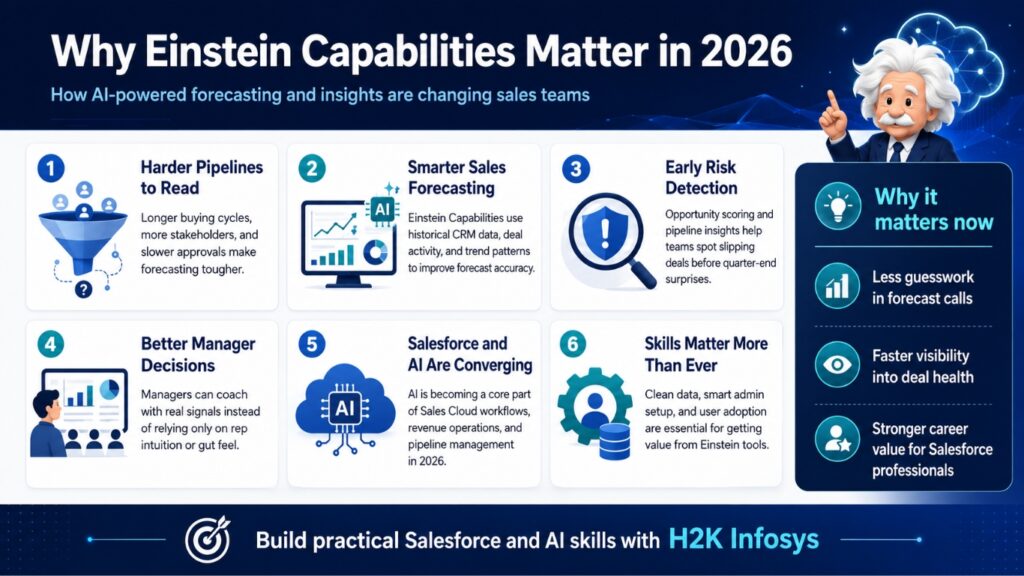
The biggest reason Einstein Capabilities matter is simple: pipelines are harder to read now. Buyers involve more stakeholders, approvals take longer, and deals stall inside procurement, legal, or security review.
Salesforce and AI are also moving quickly. Salesforce’s 2026 State of Sales research shows AI agent adoption is rising fast, so forecasting is moving beyond “commit, best case, pipeline.” It is becoming more predictive, more automated, and more dependent on admins who understand both data and business process.
This is where H2K Infosys fits well. Its Salesforce training classes connect Admin setup, Sales Cloud configuration, AI features, and practical sales scenarios. You cannot use AI well in Salesforce if you only know where the buttons are.
1. Predictive forecasting for stronger revenue calls
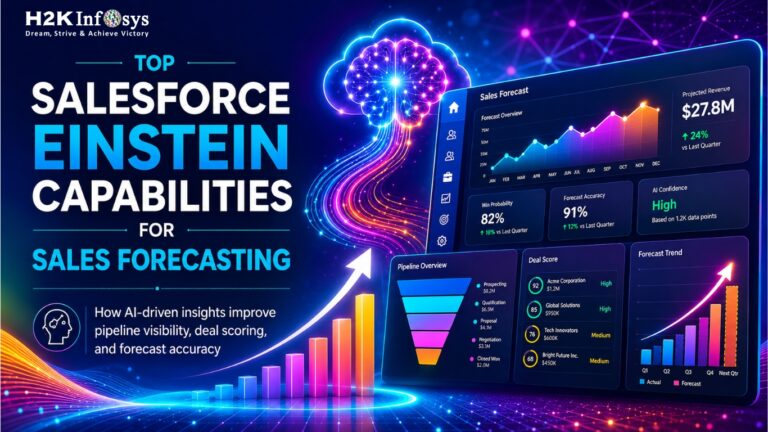
One of the most useful Einstein Capabilities is predictive forecasting. Salesforce Einstein Forecasting studies historical opportunities, account data, opportunity changes, activities, and owner performance to estimate what a team may sell by the end of a forecast period.
Picture a Monday forecast call. The sales manager rolls up $1.2 million, but Einstein predicts $940,000. That gap does not automatically mean the manager is wrong. It means the team should ask, “What makes this quarter different from the pattern Salesforce is seeing?”
That is better than “Do we feel good?” It also shows why Salesforce Admin Training matters. Forecast categories, opportunity stages, role hierarchy, amount fields, close dates, and forecast setup all affect whether Einstein Capabilities produce useful predictions.
2. Opportunity scoring for cleaner pipeline judgment
Opportunity scoring is one of those Einstein Capabilities people underestimate until the pipeline gets messy. It helps reps and managers see which opportunities are more likely to close.
Say a software company has 300 open opportunities. A new sales manager asks, “Which deals need attention today?” Without scoring, the answer often depends on rep confidence, deal size, or whoever speaks loudest. With Einstein Opportunity Scoring, the manager can spot high-value deals with weak signals, strong deals that deserve acceleration, and stale deals that need a reality check.
A score is not a verdict. It is a signal. If a deal has low activity, no executive engagement, and repeated close-date movement, Salesforce can highlight risk before the quarter-end scramble begins. In H2K Infosys Salesforce certification courses, this kind of example helps learners see how admins support the feature and how sales users interpret it at work.
3. Forecast insights that explain what changed
Forecasting is not only about the final number. It is also about movement. What changed since last week? Which big deal slipped? Which rep moved an opportunity out of commit?
Forecast insights are Einstein Capabilities that help managers avoid digging through endless reports. Instead of manually chasing every update, leaders can focus on the changes that affect forecast accuracy.
For example, a regional director sees the forecast drop by $180,000. Instead of filtering reports and messaging half the team, Salesforce highlights the movement so the director can coach faster.
4. Pipeline inspection before risk becomes forecast risk
Pipeline inspection is closely tied to forecasting because forecasts are only as healthy as the pipeline behind them. These Einstein Capabilities help teams review deal movement, activity patterns, opportunity changes, and risk indicators in one place.
A team may have a strong-looking quarter on paper. Then pipeline inspection shows several commit deals with no recent activity, pushed close dates, and no next step. That is not a forecast. That is hope wearing a nice jacket.
This is where trained admins become valuable. A capable Salesforce admin can clean up pipeline views, align stages with the real sales process, and help managers understand what the data is saying.
5. Activity intelligence for a more honest forecast
Sales forecasts become unreliable when activity data is missing. A rep may say, “The deal is progressing,” but there may be no logged call, meeting, email, or stakeholder update. Maybe the work is happening outside Salesforce. Maybe the deal is quiet. Either way, the forecast gets fuzzy.
Activity-related Einstein Capabilities connect customer engagement signals with forecasting judgment. When activity capture and insights are used properly, managers can see whether deal momentum is real or imagined.
Take two $75,000 best-case deals. Deal A has recent meetings, multiple contacts, and a clear next step. Deal B has been silent for three weeks. A manager still needs context, but Einstein gives a faster starting point.
6. Account and opportunity insights for sharper coaching
Some Einstein Capabilities are not dramatic. They simply nudge sellers and managers at the right time. Account insights and opportunity insights can surface relevant changes, risks, or engagement patterns tied to an account or deal.
That matters because leaders need context. A deal may look stable until a key contact leaves the company. A renewal may look safe until activity drops. An expansion deal may look unlikely until the account suddenly shows stronger engagement.
Good managers already look for these patterns. Salesforce Einstein helps surface them faster, especially when the pipeline is too large for manual review.
7. Revenue Intelligence for one version of the truth
Revenue Intelligence brings analytics, pipeline visibility, forecasting, and AI-powered insights together. It includes tools such as Einstein Forecasting, activity intelligence, CRM Analytics, and pipeline inspection capabilities that connect sales activity with revenue outcomes.
These Einstein Capabilities help when a company has outgrown basic dashboards. A VP of Sales does not only want the forecast number. They want to know why it changed, which regions are at risk, what actions managers are taking, and whether next quarter’s pipeline is healthy too.
Growing companies often struggle with “spreadsheet drift.” Sales ops has one number, finance has another, and managers keep side files. Revenue Intelligence pulls more of that conversation back into Salesforce.
8. AI readiness: the skill behind every forecast
The strongest Einstein Capabilities will not help much if the org has duplicate accounts, vague stages, missing amounts, random close dates, and fields nobody trusts.
AI readiness is now a real career skill. Companies are not only asking, “Do you know Salesforce?” They are asking, “Can you help us use Salesforce and AI responsibly?” That means admins, analysts, and consultants need permissions, data hygiene, forecasting setup, reporting, adoption, and user behavior.
This is where H2K Infosys can make a practical difference. Its Salesforce training classes give learners hands-on exposure instead of scattered videos and theory.
Why H2K Infosys is worth considering
Many people start learning Salesforce through random tutorials. That works for basics, but it gets frustrating when the goal is a job, promotion, or move into CRM consulting.
H2K Infosys gives structure. The value is not just “learn Salesforce.” It is learning how Salesforce is used at work: how teams manage pipeline, how admins support forecasting, how AI depends on clean data, and how Salesforce certification courses fit into career growth.
The better training path is not only about passing an exam. It is about being able to explain why a forecast is off and how Salesforce Einstein can help.
Final thoughts
The top Einstein Capabilities for sales forecasting are predictive forecasting, opportunity scoring, forecast insights, pipeline inspection, activity intelligence, account insights, Revenue Intelligence, and AI readiness. Together, these Einstein Capabilities move teams away from opinion-heavy forecasting and closer to data-backed decisions. The best Einstein Capabilities also make forecast conversations more specific.
But the tool is only half the story. The other half is people who know how to configure it, explain it, and use it without overpromising what AI can do. That is why H2K Infosys is a smart direction for learners exploring Salesforce training classes, Salesforce Admin Training, Salesforce certification courses, Salesforce Einstein, and the broader world of Salesforce and AI.
FAQs
1. What are Einstein’s capabilities in Salesforce sales forecasting?
Einstein Capabilities are Salesforce AI features that help sales teams predict revenue, score opportunities, inspect pipeline risk, and understand forecast changes using CRM data and machine learning.
2. Do Salesforce admins need to learn Einstein Capabilities?
Yes. Admins should understand Einstein Capabilities because AI features depend on configuration, data quality, permissions, forecasting setup, and user adoption.
3. Can Salesforce Einstein replace sales managers?
No. Salesforce Einstein supports managers it does not replace them. Managers still need judgment, coaching skills, customer context, and business experience.
4. Are H2K Infosys Salesforce certification courses useful for beginners?
Yes. H2K Infosys Salesforce certification courses can help beginners build admin fundamentals while also understanding practical business use cases.
5. Why is Salesforce and AI important for career growth?
Salesforce and AI are becoming closely connected as companies use predictive insights, automation, and AI agents to improve sales productivity. Professionals who understand CRM administration and AI-enabled workflows are better positioned for admin, sales operations, CRM analysis, and consulting roles.