
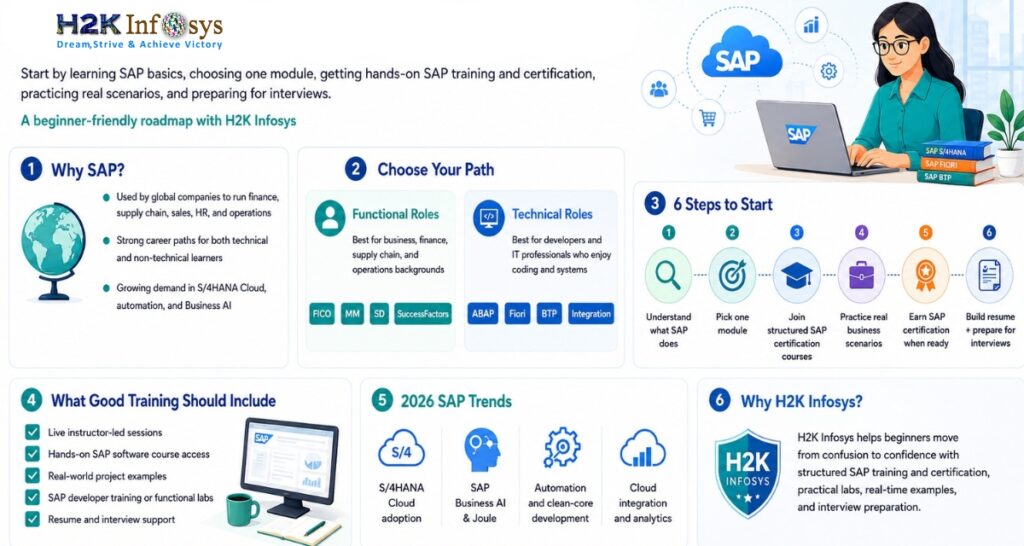
Starting a Career in SAP with H2K Infosys is a practical way to enter enterprise technology if you want structure, real project examples, and a clearer route to job readiness. The path is simple: learn what SAP does, choose one module, complete focused SAP training and certification, practice real scenarios, earn relevant SAP certifications when ready, and prepare for interviews with examples you can actually explain.
SAP looks confusing at first. S/4HANA, FICO, MM, SD, ABAP, BTP, Fiori, the names feel like a private language. SAP helps companies run finance, purchasing, inventory, sales, HR, manufacturing, analytics, and compliance in one connected system. That is why a Career in SAP attracts beginners from accounting, IT, testing, supply chain, HR, business administration, and non-technical backgrounds.
The timing is interesting too. SAP’s 2026 innovation messaging focuses on Joule Work, SAP Business AI Platform, and autonomous enterprise workflows, where AI assistants and agents support everyday business tasks. So a Career in SAP today is not just about old transaction screens. It is about business processes, cloud systems, automation, and AI-supported decisions.
Why SAP Is Still Worth Learning
This SAP path is not only for programmers. SAP has technical roles, but it also has functional roles where business process knowledge matters more than code.
If you understand accounting, SAP FICO may suit you. Procurement and inventory people often fit SAP MM. Sales operations learners may prefer SAP SD. Developers can move into ABAP, SAP UI5, Fiori, BTP, or integrations.
SAP describes its certification program as globally recognized and performance-based, covering its technology portfolio and increasingly reflecting how SAP works are done in the AI era. That matters because employers want people who can apply knowledge, not just repeat definitions.
Step 1: Know What SAP Does Actually
Before you join any SAP software training course, understand the problem that SAP solves. Think about a retail company having to buy goods, store stock, sell to customers, get paid, pay suppliers, and balance the books every month. If every team works in separate spreadsheets, errors pile up fast.
SAP connects those activities. A purchase order can lead to goods receipt, invoice verification, and accounting impact. A sales order can connect with inventory, delivery, billing, and revenue.
This is why a career in SAP planning should start with process understanding. A learner who knows what purchase orders, invoices, stock transfers, customer billing, or month-end closing mean will learn faster than someone memorizing screen paths without context.
Step 2: Pick One SAP Module
Choosing the right module is half the game. A Career in SAP becomes easier when your module matches your background.
For finance people, SAP FICO is the natural starting point. For supply chain learners, MM or SD usually feels more practical. For HR professionals, SuccessFactors is a modern cloud direction. For coders, SAP developer training in ABAP, Fiori, BTP, or integration can open technical roles.
A small honest note: do not pick a module only because someone online claims it has the “highest package.” The better question is: can you imagine solving problems in this area every day?
Step 3: Get Structured Training
Free videos are useful, but they often leave gaps. You learn one topic today, another random transaction tomorrow, and maybe exam questions next week. That is not a learning path.
This is where H2K Infosys can help beginners. A guided program can move in order: SAP basics, business process flow, module concepts, configuration or development practice, real-time examples, resume preparation, and interview practice.
When comparing SAP certification courses, look for live instruction, hands-on access, trainer support, assignments, project-style examples, interview coaching, and updated S/4HANA coverage. A Career in SAP is built through practice, not only slides.
SAP Learning Hub also highlights expert-led sessions, hands-on practice systems, role-based learning, and certification attempts as part of building job-ready skills. In plain terms, you need to touch the system and practice.
Step 4: Choose Functional or Technical
A functional consultant works with business users. They gather requirements, map out processes, configure SAP, test flows and support go-live. A career in SAP as a functional consultant is for people who like analysis, communication, business logic and problem solving.
A technical consultant builds/extends SAP systems. They could be writing ABAP programs, creating Fiori apps, building APIs, managing integrations or working on SAP BTP. A Career in SAP as a developer is suitable for people who like coding, debugging, architecture and system behaviour.
There is also a hybrid path. In 2026, that mix is becoming more valuable because AI, clean-core development, cloud migration, and automation all require cross-functional thinking.
Step 5: Practice Real Scenarios
Certification is useful, but hands-on confidence gets you through interviews. If someone asks, “How does procure-to-pay work in SAP MM?” they want the flow: purchase requisition, purchase order, goods receipt, invoice verification, and vendor payment.
So, make your Career in SAP practical from the beginning. If you study FICO, practice general ledger, payables, receivables, assets, and month-end basics. If you study SD, practice inquiry-to-cash. If you study MM, practice purchasing and inventory movement. If you take SAP developer training, build reports, forms, extensions, or integrations.
This is also where H2K Infosys deserves a stronger look. Beginners often need trainer-led labs, correction, and realistic examples. Reading about SAP is fine. Working through a broken configuration or debugging a small issue is where the learning actually sticks.
Step 6: Prepare for Certification Carefully
SAP certifications can strengthen your profile, especially if you are switching careers. Still, do not treat certification as a magic job ticket.
SAP’s certification path asks learners to choose a certification, prepare through expert-designed learning journeys, schedule the exam, and stay certified through assessments where required. For beginners, the best formula is simple: training plus practice plus certification plus interview preparation.
That is why support from a provider such as H2K Infosys can be useful. It gives you a sequence. Learn the module, practice scenarios, revise exam topics, then explain your work in business language. A Career in SAP grows faster when you can say what you did, why it matters, and what result the process creates.
Step 7: Build an SAP-Focused Resume
A generic resume will not help much. Use SAP language, but keep it honest. Instead of “learned SAP MM,” write: “Practiced procure-to-pay flow including purchase order creation, goods receipt, invoice verification, and basic inventory movement scenarios.” Instead of “completed SAP developer training,” write: “Built basic ABAP reports and practiced debugging, data dictionary objects, and modularization concepts.”
Specifics sound real because they are real. A Career in SAP resume should show scenarios, modules, tools, and outcomes. Recruiters scan, so keep it clear.
Why H2K Infosys Is a Practical Starting Point
Beginners usually do not fail because SAP is impossible. They fail because the path is messy too many modules, not enough practice, and delayed interview preparation.
H2K Infosys is a practical option for learners who want a guided route into a Career in SAP. The value is structured: trainer-led learning, module-focused practice, real-time examples, resume help, and interview preparation.
A Career in SAP with H2K Infosys also makes sense if you want training that connects with current market shifts. SAP’s latest direction is cloud, Business AI, Joule, automation, and cleaner extension models. Training that ignores those topics will feel dated quickly.
A Simple 90-Day Roadmap
Days 1–15: Learn ERP basics, SAP navigation, and functional versus technical roles.
Days 16–45: Choose one module and complete structured lessons through a focused SAP software course or guided training program.
Days 46–70: Practice real scenarios and build examples you can explain.
Days 71–85: Prepare for relevant SAP certifications if they match your goal.
Days 86–90: Finalize your resume, update LinkedIn, and apply consistently.
It is not glamorous, but it works. A Career in SAP is built through steady practice rather than one big breakthrough.
Final Thoughts
A Career in SAP is a strong choice for beginners who want to work where business and technology meet. The field is changing with S/4HANA Cloud, Business AI, Joule, automation, and clean-core thinking, but the foundation is still practical: learn one module properly, practice in the system, and explain your work clearly.
If you want a structured launch, H2K Infosys is worth considering. It can turn scattered self-study into a guided plan and help you move from “I am interested in SAP” to “I can discuss SAP scenarios in an interview.”
FAQs
Is SAP good for beginners?
Yes. If you choose a module relevant to your background such as FICO for finance, MM or SD for supply chain, SuccessFactors for HR or ABAP/BTP for developers, a career in SAP is easy to start.
Do you need to code in SAP?
No, not always. An SAP career can be functional or technical. Functional roles need business process knowledge, while technical roles need coding, integration or development skills.
Best SAP course for job hunters?
Pick a course that offers live teaching, hands-on practice, real-life scenarios, interview preparation, and certification guidance. H2K Infosys is a good option for learners who are looking for structured SAP training and certification instead of fragmented self-study.
Required SAP certifications?
You don’t always need certification to have a career in SAP. But SAP certifications can add credibility for beginners, career changers, and professionals who are applying without direct SAP project experience.
How long does it take to learn SAP?
For many beginners, job-ready basics can be developed in 3 to 4 months. A career in SAP is more realistic with all Training, labs, resume preparation and interview practice together.