
As a Business Analyst, you will understand business problems, capture requirements, analyse processes, and help teams build the right solution. If you are a learner and want to explore this career path, H2K Infosys offers practical support through a Business Analyst course option, Business Analyst training and BA training and placement guidance. In simple terms, a Business Analyst is a bridge between the business team and the technical team.
This is not just a position of writing documents. Business Analyst Job interviews people, asks questions, studies how work is done, finds gaps, and makes sure the final product actually solves the problem.
What Does a Business Analyst Do?
A Business Analyst helps a company improve the way it works.
For example, a company may say, “We need a new software system.” But a good Business Analyst will not simply accept that request. They will first try to understand why the company needs it.
They may ask questions like:
- What problem are we trying to solve?
- Who is facing this problem?
- How is the work being done right now?
- What is not working?
- What result do we expect after the change?
These questions help the team avoid mistakes. Sometimes the business may ask for one thing, but the real problem may be something else.
That is why the Business Analyst Job role is very important.
What are Business Analyst Job Responsibilities?
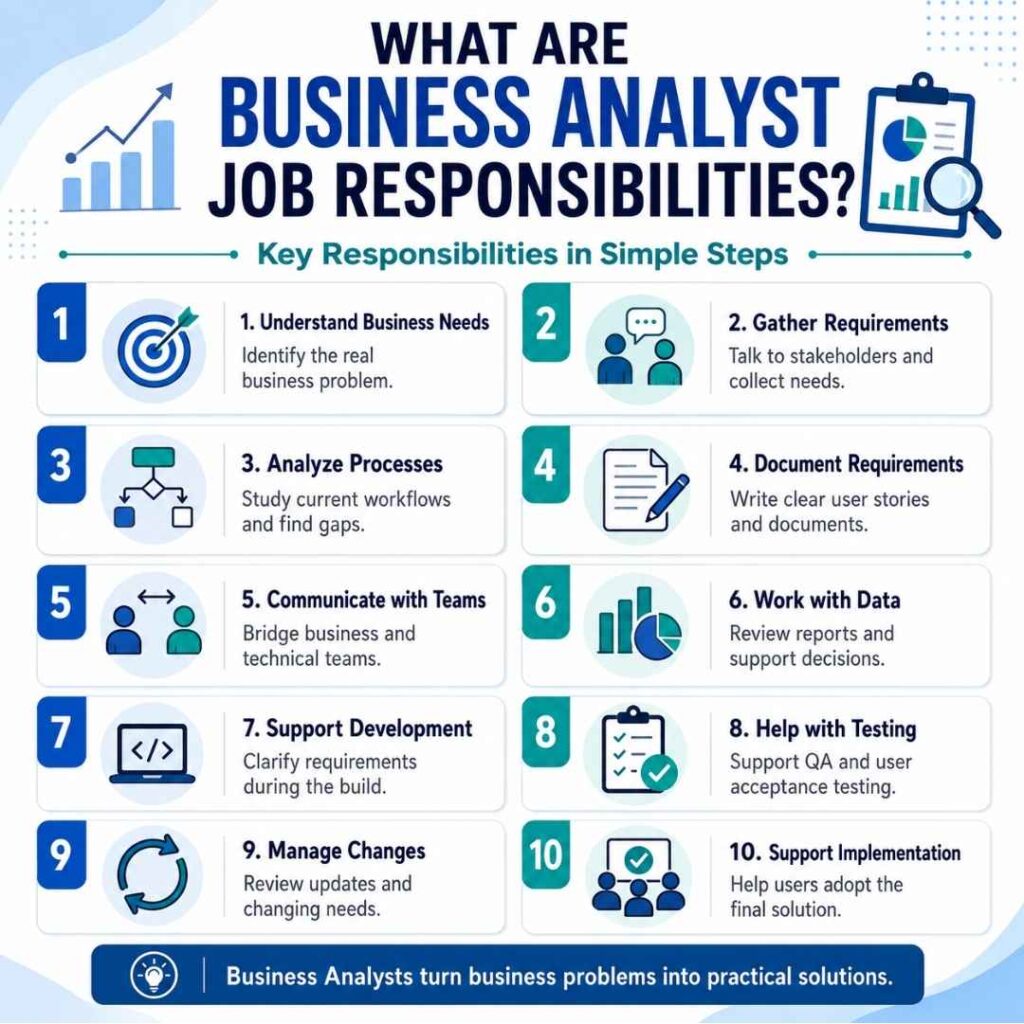
1. Understanding the Business Problem
The first Business Analyst Job is to understand the actual business problem.
Many times, stakeholders already have a solution in mind. For example, a manager may say, “We need a new report.” But after discussion, the BA may find that the report is not the real issue. The real issue may be that employees are entering wrong data into the system.
In that case, creating a new report will not solve the problem. The company may need better data entry rules, user training, or a simpler process.
A good Business Analyst Job does not rush. They listen carefully and try to find the root cause.
This is one of the most important skills taught in a good business analyst course.
2. Gathering Requirements
Requirement gathering is one of the main responsibilities of a Business Analyst.
Requirements are the details of what the business needs. The BA collects these details from managers, employees, customers, product owners, developers, testers, and other stakeholders.
A Business Analyst Job may gather requirements through:
- Meetings
- Interviews
- Workshops
- Emails
- Process reviews
- User discussions
- Document analysis
In real projects, people do not always explain things clearly. Some people forget small details. Some people explain only their part of the process. Sometimes two departments may give different answers.
The Business Analyst Job is to ask the right questions and bring clarity.
For example:
“What should happen if the customer enters the wrong information?”
“Who should approve this request?”
“What should the system do if payment fails?”
Small questions like these can prevent big problems later.
3. Writing and Documenting Requirements
The Business Analyst collects the requirements and writes them down in a clear manner.
This documentation helps everyone see how things need to be done. Clear requirements are critical for business users, developers, testers and project managers.
A BA may produce documentation like:
- Business Requirement Document
- Functional Specification Document
- User stories
- Acceptance criteria
- Use cases
- Process flow
- Wireframe
In Agile projects, user stories are frequently written by Business Analysts.
For instance:
As a customer, I would like to be able to reset my password via email, so that I can get into my account without having to contact support.
The BA also writes acceptance criteria, e.g.:
- The customer will be emailed a reset link
- The link should be valid for a specific period
- The customer should see a success message when the password is reset.
This helps developers develop the feature correctly and help testers verify the feature is working correctly.
Good business analyst training will teach you how to write simple and clear requirements because it is used almost every day in real BA jobs.
4. Analyzing Business Processes
A Business Analyst also studies business processes.
A process is the step-by-step way a task is completed. For example, how a customer order is placed, how a loan is approved, or how an employee request is processed.
The Business Analyst Job looks at the current process and checks where the problems are.
They may find:
- Too many manual steps
- Duplicate work
- Delays
- Missing approvals
- Poor communication
- Confusing system steps
- Wrong data entry
An insurance company, for example, may take several days to approve a claim. The BA after checking the process may find that the same document is being checked by two different teams. This is a waste of time.
The BA can provide an improved process such as removing duplicate steps, introducing automation or developing a tracking system.
This form of process improvement is a time-saver and makes the business run better.
5. Connecting Business and Technical Teams
A Business Analyst Job works like a bridge between business users and technical teams.
Business users usually explain problems in simple words.
They may say:
“We want faster service.”
“We need better reports.”
“Customers are facing issues.”
“The current process takes too much time.”
But developers need the details. They need to know the required fields, rules, buttons, screens, data and conditions.
The Business Analyst Job turns business needs into clear directions to the technical team.
For example, if the business says, “Customers should get updates,” the BA will explain it clearly:
- Send an email when the order is confirmed.
- Send an SMS when the order is shipped.
- Notify the customer if delivery is delayed.
- Store the message history in the customer profile.
This makes the work clear for developers and testers.
Without a Business Analyst, many teams may misunderstand what the business actually wants.
6. Working with Data
Today, Business Analysts also need to understand data.
They do not need to be data scientists, but they should know how to read reports, check numbers, and find useful information from data.
A BA may look at data to understand:
- Why customers are leaving a website
- Which process is taking too much time
- Which product feature is not being used
- Why support tickets are increasing
- Whether a new system improved performance
For example, an online shopping company may notice that many customers leave the website before completing payment. A Business Analyst may check the data and find that customers are leaving after seeing high shipping charges.
Now the business understands the real issue. The problem is not just the website. The problem may be unclear pricing.
This is how data helps a Business Analyst make better decisions.
7. Supporting Agile Teams
Many companies are now using Agile or Scrum.
In Agile projects, the Business Analyst works in close collaboration with the Product Owner, developers, testers, and stakeholders.
The Business Analyst Job may also assist with:
User story writing
- Backlog grooming
- Explanation of requirements
- Helping with sprint planning.
- Defining acceptance criteria
- Assessing feedback
- Demo support
- Clarifying doubts of developers and testers
Agile teams move quickly. So the BA needs to be clear, active, and ready to answer questions.
A good BA helps the team build the right feature, not just get tasks done fast.
8. Diagrams and Process Flows
Business Analysts often create diagrams to clearly explain processes. These diagrams help everyone to understand how something works.
Typical diagrams are:
- Flow diagrams
- Swimlane diagrams
- Use case diagram
- Data Flow Diagrams
- Journey mapping for customers
- Wireframes
Rather than explaining a long approval process in a meeting, the BA can simply show it in a flowchart. People can quickly see where the delay is or where a step is missing.
That’s why practicing process flows and diagrams should be included in practical business analyst training.
9. Requirement reviews and validation
A business analyst also needs to check whether the requirements are correct and complete.
This is called validation of requirements.
The BA goes through the requirements with the stakeholders and asks:
- Is this what you really want?
- Did we leave anything out?
- Are there any conflicts?
- Can the team build it in the timeline?
- How will we know if it works?
For example, a requirement may say “The system shall generate a monthly report”.
But the Business Analyst Job must ask more questions:
- What to put in the report?
- Who gets it?
- Is it PDF or Excel?
- When to produce it?
- Send automatically by e-mail?
If the team doesn’t have these details, they may build the wrong thing.
10. Supporting Testing
Business Analysts also help in the testing phase.
While they may not test all the features themselves, they ensure that the testing team understands what the business is expecting. They set the rules, clear doubts, and help testers verify that the system works the way it should.
User Acceptance Testing is the process of testing the system with actual users to find out how it fits their day to day routine. The Business Analyst Job helps to gather their feedback, clear the confusion and escalate the issues to the team.
For instance, a payment page may be free of any technical errors but the business user may see that the tax amount is not displayed properly. In that case, the BA helps to determine whether it is a bug, a missing requirement, or a new change request.
This support makes the final solution work better for the people who will actually use it.
11. Managing Stakeholder Communication
A huge part of a Business Analyst Job is communication.
A BA talks to business users, managers, developers, testers, and other team members. They report back. They clarify changes, check in on decisions, and make sure that everyone hears the same thing.
Different projects have different needs from different teams.
For example, the finance team might want strict approval steps, whereas the sales team might want to be able to move faster. The Business Analyst Job helps both sides get a feel for the impact and come up with a solution that works for the Business.
Good communication helps avoid confusion, delays and duplicated work.
This is why communication is not just a nice skill for a Business Analyst. It’s one of the most important parts of the job.
12. Handling Change Requests
In real projects, requirements often change.
A business user may ask for a new feature. A manager may change the priority. A rule may change. A customer may give new feedback.
The Business Analyst helps manage these changes.
Before accepting a change, the Business Analyst Job checks:
- Why is this change needed?
- What value will it add?
- What will it affect?
- Will it increase cost?
- Will it delay the project?
- Who needs to approve it?
This helps the project stay organized.
Without proper change management, projects can become confusing and difficult to control.
13. Helping with Implementation
The Business Analyst may also help the team during the implementation phase.
Implementation – the deployment of the new system, process or feature to users.
The Business Analyst Job can assist with:
- Training for users
- User assistance
- Release notes
- Support during go-live
- Gathering Feedback
- Bug tracking after release
A system can work correctly but be hard to use for the users if they don’t understand how to use it. The BA helps ease the transition for everyone.
If a company rolls out a new HR portal but employees continue to email for every request, the Business Analyst Job might check if the portal is confusing or if users need better training.
Skills Required For Business Analyst Responsibilities
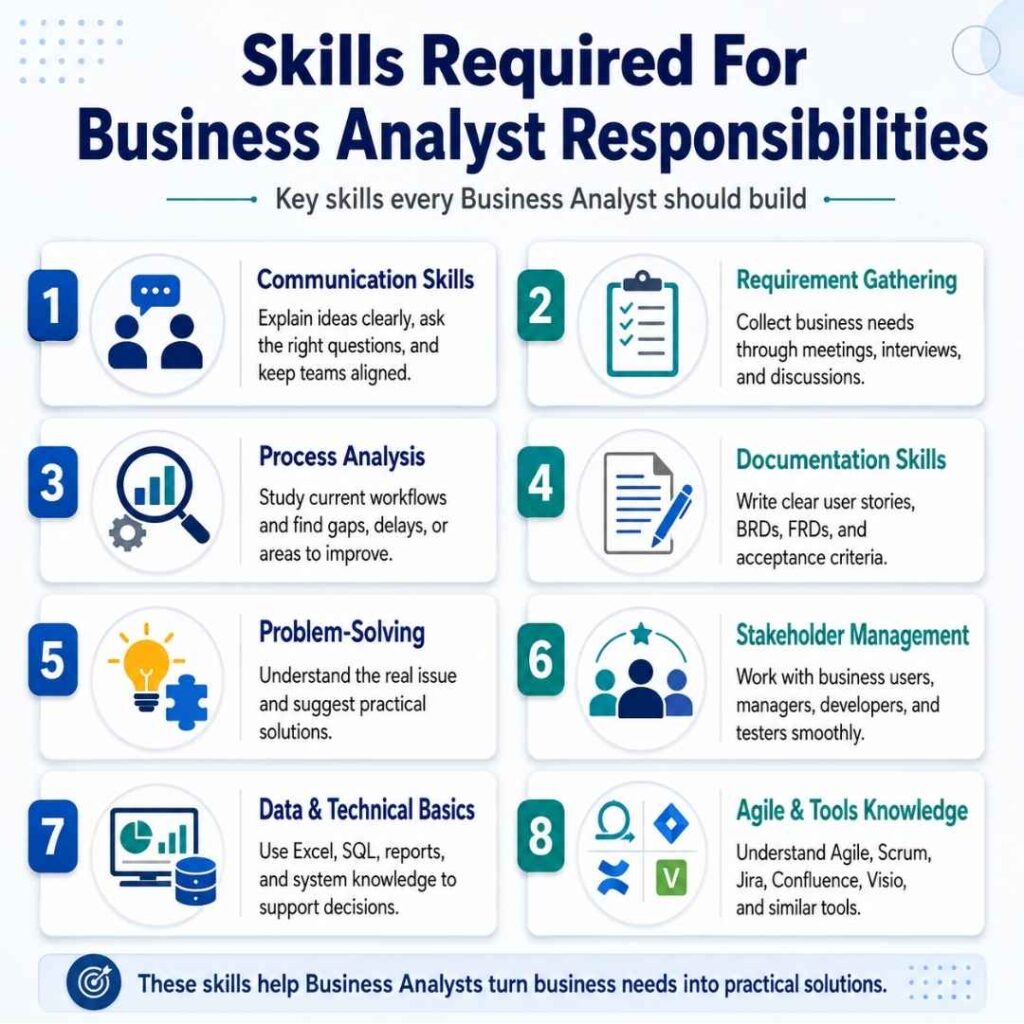
Business Analyst Job Skills: You require business, technical, and communication skills.
Core competencies:
- Requirements gathering
- Documentation Process analysis
- Communications
- managing stakeholders
- Problem solving
- Analytical thought
- Agile and Scrum understanding
- Writing user stories
- SQL (basic)
- Reporting and Excel
- Tools such as Jira, Confluence, Visio, Lucidchart, Power BI or Tableau
A beginner doesn’t have to learn everything at once. Most people pick up these skills by training and then practicing them step by step on real projects.
That’s why it is important to pick the right Business Analyst Job course. The course must have real-time projects, practical examples, mock interviews, and hands-on assignments.
Entry-Level Business Analyst Responsibilities
Entry-level Business Analyst Job usually support senior BAs or project teams.
They may work on:
- Taking meeting notes
- Updating requirement documents
- Creating simple process flows.
- Writing basic user stories
- Tracking action items
- Helping with testing
- Preparing simple reports
- Coordinating with team members
If you are looking for BA training and placement, choose a program that gives practical project experience. Placement support is helpful, but real practice gives you confidence in interviews.
FAQs:
1. What are the main responsibilities of a Business Analyst?
The main responsibilities of a Business Analyst are understanding business problems, gathering requirements, documenting them clearly, working with stakeholders, supporting technical teams, and helping with testing. A BA makes sure the team builds a solution that actually solves the business need.
2. Is a Business Analyst job only about documentation?
No, not in the least. Documentation is part of the Business Analyst Job, but a Business Analyst does a lot more than that. They talk to users, ask questions, study processes, find gaps, explain requirements to developers and help business make better decisions.
3. Do Business Analysts need technical skills?
Yes, but not expert programmers. Business Analysts are supposed to have a good understanding of technical concepts, data, systems and tools. Excel, SQL (basic), Jira, process mapping, Agile knowledge are all very helpful.
4. Can a fresher become a Business Analyst?
Yes, a fresher can become a Business Analyst with the right learning and practice. Beginners usually start by learning requirement gathering, documentation, user stories, process flows, and basic tools. A practical business analyst course can help build these skills step by step.
5. Why is business analyst training important?
The training of business analyst is important because the role requires practical skills rather than theory. Training enables learners to learn how to write requirements, talk to stakeholders, prepare process flows, use tools and deal with real project situations.
Final Thoughts
Business Analyst Job duties go beyond writing requirements. The Business Analyst understands business problems and gathers information, documents requirements, studies processes, works with stakeholders, supports testing, and helps the team deliver the right solution.
A good BA asks good questions, listens carefully, and keeps the project focused on business value.
As companies adopt more digital tools, automation, data and new technology the Business Analyst Job role is becoming more important. Tools change, but businesses will always need people who can see problems clearly and translate them into practical solutions.