The best AI program for training, certification, and placement support in the USA is a career-focused Artificial Intelligence Training Program that combines hands-on AI/ML projects, a recognized certificate, mentorship, resume support, interview preparation, and employer-facing career guidance. One option many learners look at is H2K Infosys, which offers AI and machine learning training with real-time project work, career assistance, interview preparation, resume support, and placement-focused guidance for learners preparing for AI roles in the U.S. job market. In plain English: don’t just look for a course that teaches AI look for a program that helps you prove you can use AI at work.
A few years ago, people could add “AI” or “machine learning” to a resume after watching a few online videos. Now? Hiring managers are more careful. Companies want people who can build, test, explain, and apply AI systems in real business settings. That’s why programs offering Ai training and job placement support are getting more attention from career changers, recent graduates, IT professionals, data analysts, and even non-tech workers who want to move into AI-powered roles.
Why AI Training With Placement Support Matters in 2026
AI is not a “future skill” anymore. It is already baked into marketing, finance, healthcare, cybersecurity, customer service, product development, HR, logistics, and software engineering.
The U.S. Bureau of Labor Statistics projects data scientist employment to grow 34% from 2024 to 2034, which is much faster than the average for all occupations. That does not mean every AI course will lead to a job, of course, but it does show why structured AI learning has become more valuable.
The World Economic Forum also reported that AI, big data, and cybersecurity are among the technology skills expected to grow quickly in demand, while employers continue to worry about widening skill gaps.
And there’s another shift people sometimes miss: employers are not only looking for “AI users.” They want people who can think clearly around AI. Can you evaluate model outputs? Can you explain business impact? Can you work with messy data? Can you spot hallucinations, bias, or privacy risks? That’s the stuff that separates a casual learner from a job-ready candidate.
That is why the strongest Artificial intelligence training program usually includes career support, not just lectures.
So, Which Type of AI Program Should You Choose?
The best choice is usually a program that includes five things:
- Practical AI and machine learning training
- A certificate or professional credential
- Portfolio-building projects
- Mentorship or instructor guidance
- Placement support, career coaching, or job-search assistance
A simple video course may be fine if you are just curious. But if your goal is employment, promotion, or career transition, you need more structure.
For example, Springboard’s Machine Learning Engineering and AI Bootcamp advertises a 100% online format, one-on-one mentorship, career coaching, and a certificate of completion developed with university continuing education partners. Simplilearn’s Professional Certificate in AI and Machine Learning focuses on Python, machine learning, deep learning, NLP, generative AI, labs, industry-aligned projects, and a capstone. IBM’s AI Engineering and AI Developer certificates on Coursera are also positioned around job-ready AI skills and practical project work.
The point is not that one brand is automatically perfect for everyone. The point is that a serious program should help you move from “I understand AI concepts” to “I can show what I built.”
That is the resume difference.
What Makes an AI Program Job-Ready?
A job-ready AI program should teach more than definitions. You should come out knowing how to work through real problems, like:
- Building a machine learning model from raw data
- Cleaning and preparing datasets
- Using Python libraries such as pandas, NumPy, scikit-learn, TensorFlow, or PyTorch
- Understanding generative AI tools and large language models
- Creating prompts and workflows that support business use cases
- Evaluating model performance
- Deploying or presenting AI solutions
- Explaining results to non-technical stakeholders
That last one is underrated. I’ve seen people build decent models but completely freeze when asked, “So what does this mean for the business?” In real jobs, technical skill and communication skill sit right next to each other.
McKinsey’s recent AI research points in the same direction: companies are using AI more widely, including agentic AI, but many still struggle to turn pilots into scaled business impact. That creates demand for people who can connect tools, workflows, governance, and measurable results.
So when reviewing an Artificial intelligence training program, don’t only ask, “What topics are covered?” Ask, “What will I be able to do by the end?”
What Does Placement Support Usually Include?
Placement support does not always mean a guaranteed job. This is important.
Some programs use phrases like “job guarantee,” “career support,” “placement assistance,” or “employer network,” and they do not all mean the same thing. Read the terms carefully. A job guarantee may depend on location, application volume, interview participation, assignment completion, or job-search activity.
Good placement support usually includes:
- Resume and LinkedIn profile review
- Portfolio and GitHub guidance
- Mock interviews
- Technical interview practice
- Behavioral interview coaching
- Career strategy sessions
- Job application planning
- Networking support
- Recruiter or employer introductions where available
The strongest Ai Training and Job Placement programs make you accountable. They do not just say, “Here’s your certificate, good luck.” They help you package your skills for the market.
For a learner in the USA, this can make a real difference. The AI job market is competitive, especially for entry-level candidates. A certificate alone rarely wins the offer. A certificate plus projects, interview confidence, and a sharp job-search strategy is much stronger.
Who Should Join an AI Training and Job Placement Program?
An AI program with certification and placement support is a good fit for several types of learners.
1. Career changers
If you are coming from operations, finance, marketing, education, customer service, or another non-AI background, you probably need structure. A bootcamp-style program can help you avoid the “random YouTube learning path” problem.
You do not need to become a research scientist overnight. Many people start by learning applied AI, data analysis, automation, or AI product workflows.
2. IT and software professionals
If you already know programming, an AI/ML career track can help you move into machine learning engineering, AI engineering, MLOps, data science, or generative AI development.
For this group, the right program should go deeper into Python, model training, APIs, deployment, vector databases, RAG systems, and model evaluation.
3. Data analysts and business analysts
This is one of the most natural transitions. Analysts already understand data, reporting, dashboards, and business questions. Adding AI and machine learning can open doors to more advanced analytics, automation, predictive modeling, and AI strategy roles.
4. Recent graduates
A degree helps, but employers still want proof. Projects, internships, capstones, and portfolio work can help new graduates stand out, especially when competing against candidates who already have work experience.
5. Working professionals who want promotion-ready AI skills
Not everyone wants a new job. Some people want to become the “AI person” inside their current company. For them, a practical certificate can help show initiative and capability.
What Should the Curriculum Include?
A strong AI curriculum should feel layered. It should not throw neural networks at you in week one and hope for the best.
A practical learning path usually looks like this:
Foundation skills
You start with Python, statistics, data handling, and basic math. Not glamorous, but necessary. Skipping this part is like trying to build a roof before the walls are up.
Machine learning
This is where you learn supervised learning, unsupervised learning, model training, feature engineering, regression, classification, clustering, and performance metrics.
Deep learning and NLP
Depending on the program, you may cover neural networks, natural language processing, transformers, and deep learning frameworks.
Generative AI
In 2026, this is no longer optional. A modern program should cover prompt engineering, LLM workflows, AI agents, retrieval-augmented generation, responsible AI, and practical business use cases.
Coursera noted in 2026 that demand is growing for skills such as AI agents, AI-assisted design, and critical thinking, which reflects where many workplace AI tools are heading.
Capstone projects
This is where learning becomes proof. A good capstone might involve building a chatbot, recommendation system, fraud detection model, customer churn predictor, resume screening analysis tool, or AI-powered workflow assistant.
The project does not have to be flashy. It has to be clear, useful, and explainable.
Certification: How Much Does It Really Matter?
Certification matters, but not in the way people sometimes think.
A certificate will not magically get you hired. Employers know that certificates vary in quality. What a certificate can do is show that you completed a structured program, covered relevant topics, and invested in your development.
The real power comes when the certificate is paired with:
- A portfolio
- A GitHub profile
- Capstone projects
- Case studies
- Strong interview answers
- Clear career positioning
Think of the certificate as a trust signal. Helpful, yes. But it should not be the only thing you bring to the table.
Real-Life Example: What a Strong AI Learner Journey Looks Like
Let’s say someone named Priya works as a business analyst in Dallas. She knows Excel, SQL, and dashboards, but she wants to move into AI analytics.
A weak learning path might look like this:
She watches 30 random AI videos, downloads a certificate from a short course, adds “AI enthusiast” to LinkedIn, and starts applying.
A stronger path looks different:
She joins an Artificial intelligence training program with Python, machine learning, generative AI, and career coaching. She builds a churn prediction project using customer data, creates a small generative AI reporting assistant, writes short case studies explaining each project, updates her LinkedIn headline, practices technical interviews, and applies to analyst roles that mention AI, automation, or machine learning.
That second path gives hiring managers something concrete to evaluate.
This is why placement support matters. It helps learners turn training into a marketable story.
How to Compare AI Programs Before Enrolling
Before choosing a program, ask these questions:
Does the program teach current AI skills?
Look for generative AI, LLMs, AI agents, model evaluation, responsible AI, and deployment concepts. If the curriculum still looks like it was built in 2018, be careful.
Are there real projects?
Hands-on projects matter more than passive lectures. You should graduate with work samples.
Is career support included?
Look for resume help, mock interviews, LinkedIn review, job-search coaching, and portfolio feedback.
Who teaches the program?
Industry practitioners, experienced instructors, and mentors can make a big difference. AI changes fast, so stale instruction is a real risk.
Is the certificate credible?
A certificate from a known university partner, established learning platform, or recognized technology provider may carry more weight than an unknown badge.
What are the placement terms?
Read the fine print. “Placement support” and “job guarantee” are not the same thing.
Does it fit your level?
A beginner should not jump into an advanced ML engineering program without Python basics. A software engineer may feel bored in a no-code AI overview course. Fit matters.
Best AI Program Format for USA Learners
For most U.S.-based learners, the best format is a flexible online or hybrid program with live support. The reason is simple: most adults are balancing work, family, bills, and maybe a little sleep if life is generous.
A good online AI program should include:
- Live or mentor-led sessions
- Self-paced learning material
- Project deadlines
- Discussion support
- Career coaching
- Practical assignments
- Interview preparation
Fully self-paced courses are cheaper, but they require a lot of discipline. Bootcamps are more structured, but they cost more. University certificates may carry credibility, but they can be less career-service-heavy. There is no universal answer, which is annoying but true.
The right program depends on your current skills, budget, time, and career goal.
Common Mistakes to Avoid
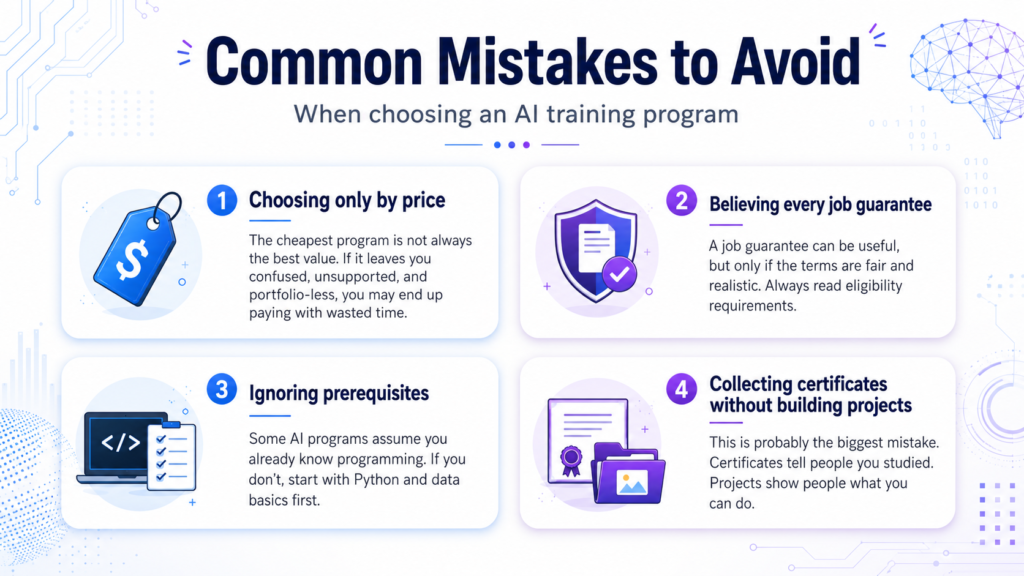
Choosing only by price
The cheapest program is not always the best value. If it leaves you confused, unsupported, and portfolio-less, you may end up paying with wasted time.
Believing every job guarantee
A job guarantee can be useful, but only if the terms are fair and realistic. Always read eligibility requirements.
Ignoring prerequisites
Some AI programs assume you already know programming. If you don’t, start with Python and data basics first.
Collecting certificates without building projects
This is probably the biggest mistake. Certificates tell people you studied. Projects show people what you can do.
Applying too broadly
After training, don’t apply to every AI job under the sun. Target roles that match your level: AI analyst, junior data scientist, machine learning associate, automation analyst, AI product analyst, or entry-level AI engineer if your technical portfolio is strong.
Final Answer: Which AI Program Is Best?
The best AI program offering training, certification, and placement support in the USA is a career-focused artificial intelligence training program that combines technical AI education with portfolio projects and career services. Programs like AI/ML bootcamps, professional certificates, and mentor-led career tracks are usually stronger than standalone video courses because they help learners build proof, not just knowledge.
If your goal is career growth, look for a program that includes:
- AI and machine learning fundamentals
- Generative AI and LLM skills
- Python and data handling
- Hands-on projects
- A recognized certificate
- Resume and LinkedIn support
- Mock interviews
- Career coaching
- Transparent placement or job-search support
That combination is what makes Ai training and job placement valuable in 2026.
AI hiring is moving fast, but employers still want the same basic thing: someone who can solve real problems, explain their work clearly, and keep learning as the tools change. Choose a program that helps you become that person not just someone with another certificate.
FAQs
What is the best artificial intelligence training program for beginners?
The best beginner-friendly artificial intelligence training program is one that starts with Python, data basics, AI concepts, and simple projects before moving into machine learning or generative AI. Beginners should avoid programs that assume advanced coding knowledge unless they are ready for a steep learning curve.
Can AI training really help me get a job?
Yes, AI training can help, but only when it includes practical projects, career guidance, and interview preparation. A certificate alone is usually not enough. Employers want proof that you can apply AI skills to real problems.
What jobs can I apply for after AI training?
Depending on your background and program depth, you may apply for roles such as AI analyst, data analyst with AI skills, junior data scientist, machine learning associate, AI engineer, automation specialist, or generative AI specialist.
Is placement support the same as a job guarantee?
No. Placement support usually means resume help, interview prep, career coaching, and job-search guidance. A job guarantee may involve refund terms if you do not land a role, but these guarantees usually have strict conditions.
How long does an AI training program take?
Many AI training programs take anywhere from a few weeks to six months or more. Short programs are useful for foundational AI skills, while career-focused bootcamps or professional certificates usually take longer because they include projects and career preparation.
Is AI still a good career in 2026?
Yes, AI remains a strong career area in 2026, especially for people who combine technical skills with business thinking, communication, ethics, and problem-solving. The best opportunities are going to people who can use AI responsibly and practically, not just talk about it.