The best Playwright course online for beginners is one that teaches you more than syntax. It should help you build real automation test scripts, understand QA workflows, practice with live projects, and prepare for actual QA Automation or SDET-style interviews.
If you are starting from zero or moving from manual testing into automation, H2K Infosys is a strong option because its best Playwright course online is built around practical implementation, instructor-led learning, real-time projects, and career-focused guidance rather than just recorded videos.
Why Playwright is becoming a smart skill for QA beginners
A few years ago, most beginners heard only one name in automation testing: Selenium. Selenium is still important, no doubt. But in real QA teams today, especially teams working with modern web applications, best Playwright course online is getting a lot of attention because it feels faster, cleaner, and less painful once you understand the basics.
Playwright is Microsoft’s open-source framework for web automation and testing. It supports testing across Chromium, Firefox, and WebKit using one API, which makes it useful for cross-browser testing scenarios.
That matters because real users are not all using the same browser. One person may open your website in Chrome, another in Safari, another in Microsoft Edge. A good QA engineer needs to think that way. Playwright helps you test those different user journeys without writing three totally separate testing systems.
And honestly, for beginners, that is a big win.
A beginner-friendly playwright testing course should not just say, “Here is a locator, here is a click command, now go practice.” That is not enough. You need to understand why tests fail, how to debug them, how to handle waits, how to structure test files, and how to explain your framework in an interview.
That is where structured training makes a real difference.
What should the best Playwright course online teach?
A good best Playwright course online should begin with the basics, but it should not stay there too long. Beginners need a clean path from “I have heard about automation testing” to “I can build and explain a working test framework.”
Here is what I would personally look for.
1. Strong foundation in QA and automation thinking
Before writing test scripts, students should understand what they are testing and why. For example, testing a login page is not only about entering a username and password. You need to check valid login, invalid login, empty fields, password masking, session behavior, error messages, and maybe even role-based access.
This is where many beginners go wrong. They jump directly into tools. But companies hire people who can think like testers, not just people who can copy code from documentation.
A good course should cover:
- Manual testing basics
- Test scenarios and test cases
- Functional testing
- Regression testing
- Smoke testing
- Bug reporting
- Agile QA workflow
- Automation testing strategy
If you already know manual testing, great. You will move faster. But if you are new, do not skip this part. It is the difference between being a script writer and being a QA professional.
2. Hands-on Playwright setup and scripting
Once the basics are clear, the course should move into best Playwright course online setup. This includes installing the required tools, creating a test project, understanding folder structure, writing your first test, and running it successfully.
A beginner should learn things like:
- Installing Playwright
- Creating test files
- Using locators
- Clicking buttons
- Filling forms
- Handling dropdowns
- Working with assertions
- Running tests in headed and headless mode
- Debugging failed tests
- Capturing screenshots and traces
Playwright includes useful debugging and test features like trace viewing, browser automation, and modern web-first assertions, which are very helpful when tests fail and you need to understand what happened.
And yes, tests will fail. That is normal. Actually, that is where the real learning begins.
3. Real project scenarios, not toy examples
This is one of the biggest reasons I would choose H2K Infosys over a random self-paced course.
Many online tutorials teach with small demo pages. Those are okay for the first hour. But they do not prepare you for real work.
A job-focused best Playwright course online should include examples like:
- Testing a login and logout flow
- Testing an e-commerce cart
- Validating search filters
- Automating form submissions
- Handling dynamic web elements
- Testing role-based dashboards
- Running test suites before deployment
- Reading test reports
- Fixing flaky tests
Here is a simple real-world scenario.
Imagine an online shopping website. A customer searches for “laptop,” filters by price, adds a product to the cart, applies a coupon, and checks out. A good automation tester should be able to build a best Playwright course onlinetest that follows this journey and verifies each important step.
That is the kind of practice beginners need. Not just “click here” and “expect text there.”
Why H2K Infosys is a strong Playwright training course choice
H2K Infosys stands out because the training is positioned for people who want career outcomes, not just casual learning. H2K Infosys lists best Playwright course onlinewith Java + Gen AI Testing among its course offerings, which fits the direction QA automation is moving in 2026.
The best part is the career-focused structure. H2K Infosys describes its training model as live virtual classroom training with industry-experienced trainers, hands-on projects, mock interview preparation, support, and job placement assistance.
That matters a lot for beginners.
When you are learning alone, you can watch 20 videos and still feel stuck on one locator issue. In live training, you can ask, “Why is this test failing?” and get an explanation. Sometimes that one explanation saves hours of frustration.
H2K Infosys is also based in Atlanta, Georgia, and focuses on IT online training for learners targeting the USA tech market. That USA-focused positioning helps if your goal is to prepare for QA roles, automation tester jobs, or SDET entry-level opportunities in the U.S. job market.
What beginners usually struggle with in Playwright
Let me be real here. best Playwright course online is beginner-friendly compared with some older tools, but that does not mean everything is easy on day one.
Most beginners struggle with these areas:
Locators
Choosing the right locator is a skill. Many beginners use unstable XPath expressions or CSS selectors that break when the UI changes. A good trainer will teach you how to choose reliable locators and why readable tests matter.
Waits and flaky tests
This is a big one. A flaky test passes today, fails tomorrow, and makes everyone doubt the automation suite. best Playwright course online has auto-waiting behavior, but you still need to understand how web pages load, how elements appear, and how to debug timing issues.
Framework structure
Writing one test is easy. Building a maintainable framework is different. Beginners need to learn how to organize tests, reuse code, separate test data, and create a structure that looks professional.
Interview explanation
This is where many learners freeze. They may know how to run a test, but when an interviewer asks, “Can you explain your framework?” they are not sure what to say.
A solid Playwright course online should prepare you for that moment.
Playwright, Java, and Gen AI testing: why this combo is useful in 2026
The QA field is changing fast. Teams are not only asking, “Can you automate a browser?” They are asking, “Can you test smarter, faster, and integrate with modern development workflows?”
That is why best Playwright course online with Java and Gen AI testing is a useful combination.
Java is still widely used in enterprise QA automation, especially in financial services, healthcare, insurance, retail, and large corporate environments. best Playwright course online brings modern browser automation. Gen AI testing adds exposure to how AI tools can support test case creation, debugging, documentation, and productivity.
Playwright itself is also being discussed beyond traditional testing. Microsoft’s best Playwright course online repository describes it as useful for web automation and testing, including as a tool for AI agents.
That does not mean AI will replace QA testers. It means QA testers who understand automation and AI-assisted workflows may have a better advantage.
Small example: instead of manually writing every possible negative test case for a registration form, a QA tester can use AI assistance to brainstorm edge cases, then validate and automate the important ones using best Playwright course online. The human still makes the testing decision. The tool just speeds up the thinking.
That is the practical direction QA is moving.
Career benefits of learning Playwright testing
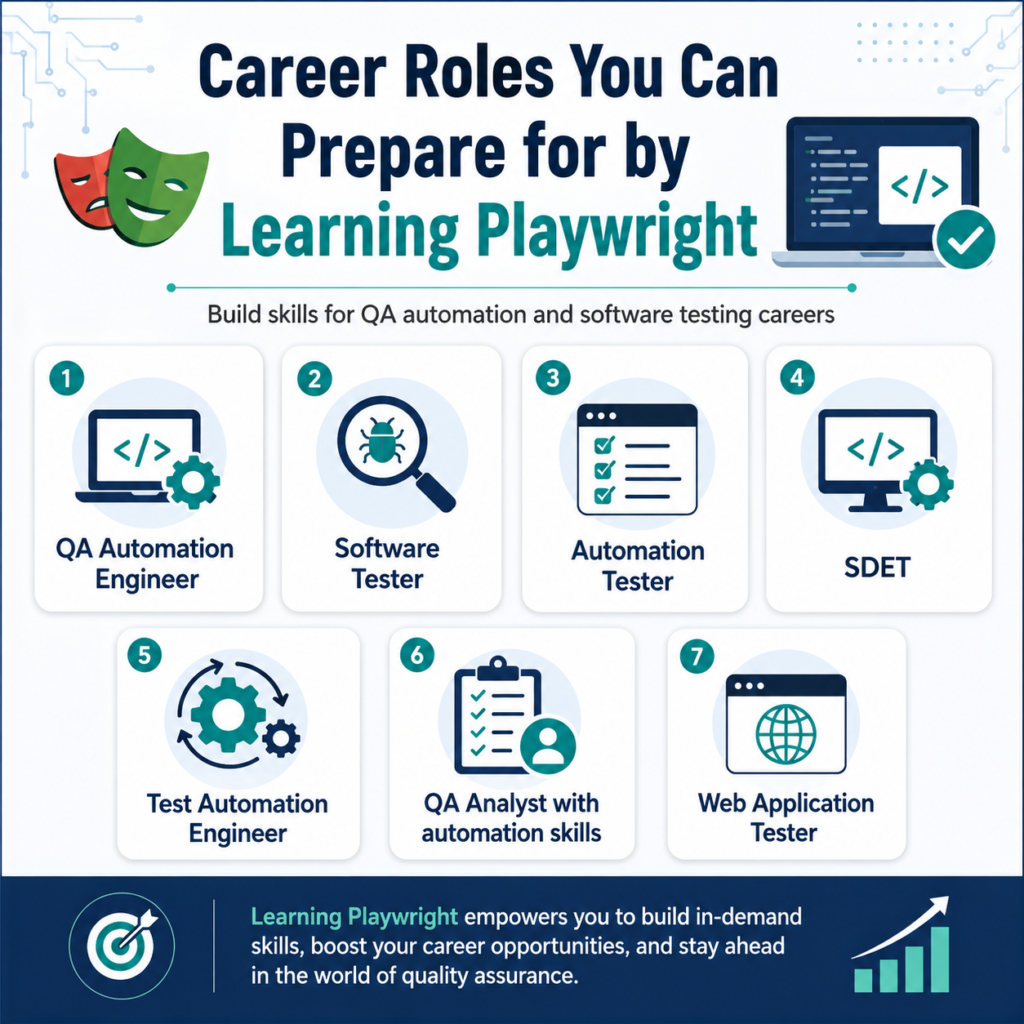
Learning best Playwright course online can help you prepare for roles such as:
- QA Automation Engineer
- Software Tester
- Automation Tester
- SDET
- Test Automation Engineer
- QA Analyst with automation skills
- Web Application Tester
The U.S. Bureau of Labor Statistics reported that software quality assurance analysts and testers had a median annual wage of $102,610 in May 2024. Salary always depends on experience, location, company, domain, and skill level, but the broader point is clear: QA is not just a “testing button” job anymore. Automation skills can move you into stronger career territory.
And best Playwright course online is one of those skills that looks good when you can actually demonstrate it.
Not just list it on a resume.
Actually demonstrate it.
That is why project-based learning is important.
How to choose the best Playwright course online for beginners
Before enrolling in any course, check these things carefully.
Does it offer live training?
For beginners, live training is usually better than only recorded content. You get structure, accountability, and support.
Does it include projects?
A course without projects is weak for job preparation. You need something you can discuss during interviews.
Does it teach framework development?
Learning commands is not enough. You should be able to create a test automation framework from scratch.
Does it include interview preparation?
This is especially important for career changers and beginners entering the U.S. QA job market.
Does it connect Playwright with real QA work?
A strong course should connect best Playwright course online with Agile, CI/CD basics, defect reporting, test planning, and regression testing.
This is where H2K Infosys is a good fit. Its course approach is more career-oriented, and its platform already focuses on QA Testing, Selenium Automation, AI-related testing, and other IT training paths that support a full QA career cluster.
Common mistakes beginners should avoid
Here are a few mistakes I see beginners make again and again.
Mistake 1: Learning only from random YouTube videos
Free videos are helpful, but they are scattered. You may learn locators from one person, framework structure from another, and interview answers from somewhere else. The problem is that none of it connects cleanly.
Mistake 2: Ignoring Java basics
If your course uses Java with best Playwright course online, do not skip Java fundamentals. You do not need to become a senior Java developer, but you should understand variables, methods, classes, loops, conditions, and basic object-oriented programming.
Mistake 3: Not practicing enough
Automation testing is learned by doing. Watching someone write best Playwright course online code is not the same as writing it yourself.
Mistake 4: Not preparing for interview questions
You should be ready to explain:
- Why you used Playwright
- How your framework is structured
- How you handle failed tests
- How you manage test data
- How you run regression tests
- How you report bugs
- How Playwright compares with Selenium
Mistake 5: Thinking one tool is enough
Playwright is powerful, but QA automation also needs Git, basic SQL, API awareness, Agile process knowledge, and communication skills. The more complete your profile, the better your chances.
Who should take a Playwright testing course?
A playwright testing course is useful for:
- Manual testers who want to move into automation
- Beginners who want to enter QA
- QA analysts who want modern web automation skills
- Selenium testers who want to add Playwright
- Career changers targeting IT roles in the USA
- Students who want hands-on testing project experience
- Professionals interested in AI-assisted QA workflows
If you already know Selenium, you may pick up best Playwright course online faster. If you are completely new, you may need a little more patience in the beginning. That is fine. The first two weeks are usually the hardest because everything feels unfamiliar.
Then slowly, things start clicking.
Why structured training helps more than self-learning
Self-learning works for some people. But for most beginners, especially people balancing work, family, and career change pressure, structure helps.
A structured Playwright training course gives you:
- A clear learning path
- Regular practice
- Trainer support
- Real-time doubt clarification
- Project-based assignments
- Resume guidance
- Mock interview preparation
- Confidence to explain your work
That last point is underrated. Confidence comes from doing the work repeatedly and getting feedback.
If you are serious about building a career in QA automation, structured training can really help. H2K Infosys is worth considering because it combines best Playwright course online, Java, Gen AI Testing, live instruction, and career support in one learning path.
Internal linking topics to build a content cluster
You can also explore topics like:
- Playwright vs Selenium: Which automation tool is better for QA testers?
- How to become a QA Automation Engineer in the USA
- Playwright interview questions and answers for beginners
- Manual testing to automation testing career roadmap
- QA Testing with AI: How Gen AI is changing software testing
These related topics can support your best Playwright course onlinecontent cluster and help users move naturally from awareness to enrollment.
FAQs about Playwright course online
1. What is the best Playwright course online for beginners?
The best Playwright course online for beginners is one that includes live training, hands-on projects, framework development, debugging practice, and interview preparation. H2K Infosys is a strong option for learners who want career-focused QA automation training.
2. Is Playwright easy to learn for beginners?
Playwright is beginner-friendly compared with many older automation tools, but you still need practice. Locators, waits, assertions, and framework structure take time to understand properly.
3. Do I need Java before joining a Playwright training course?
Basic Java knowledge helps, especially if the course teaches best Playwright course onlinewith Java. A good beginner course should also explain the Java concepts needed for automation testing.
4. How to get a QA automation job after learning Playwright?
If you want to become a QA Automation Engineer, Automation Tester, or SDET, learning Playwright can get you on the right path. Your project practice, interview prep, resume quality and overall testing knowledge plays a lot in your job success.
5. Why choose H2K Infosys for Playwright training?
H2K Infosys offers career-focused IT online training with live virtual classes, hands-on projects, instructor guidance, mock interview support, and training designed for learners targeting USA tech roles. Its Playwright with Java + Gen AI Testing course fits current QA automation trends.
Final takeaway
So, what is the best Playwright course online for beginners?
Take the course that teaches real skills, not just finishes videos. Java support, framework practice, debugging, real time projects, exposure to Gen AI testing, interview prep, Playwright fundamentals.
H2K Infosys is a great option for freshers who want to pursue a career-oriented path with proper guidance. Take a demo, ask them about the project work, know the roadmap of the course and make sure that you are ready to practise regularly.