
Choosing the right Online Playwright Training in USA in 2026 comes down to one simple thing: pick a course that teaches real automation work, not just tool theory. A good playwright testing course should help you write stable tests, build automation frameworks, use CI/CD basics, understand real QA scenarios, and prepare for actual job interviews.
That sounds obvious, but honestly, many learners realize it only after spending money on a course that shows a few recorded videos and calls it “hands-on.” Online Playwright Training in USA is not something you learn well by just watching someone type code. You need practice, debugging, real project structure, and a trainer who explains why tests fail in real applications.
And yes, this matters even more in 2026.
Playwright has moved from being “that newer automation tool” to a serious skill for QA automation engineers, SDETs, and manual testers trying to upgrade their careers. Microsoft’s Online Playwright Training in USA documentation describes it as a tool for reliable web automation across Chromium, Firefox, and WebKit, and it is now also positioned for testing, scripting, and AI agent workflows. That is a pretty good hint about where the industry is heading.
So, how do you choose the right Online Playwright Training in USA without getting lost in the noise? Let’s break it down like a real person would when comparing training options.
Why Playwright Training Matters in 2026
A few years ago, Selenium was the default answer for almost every automation testing conversation. It still matters, of course. But modern web apps have changed. They are faster, heavier, more dynamic, and full of authentication flows, iframes, APIs, dashboards, popups, and flaky timing issues.
That is where Online Playwright Training in USA started getting attention.
It handles many modern browser automation problems more cleanly, especially with auto-waiting, browser context handling, test tracing, parallel execution, and cross-browser testing. If you have ever dealt with flaky Selenium waits at 1 a.m. before a release, you know exactly why testers started paying attention.
In 2026, the bigger trend is not just “automation.” It is automation plus AI, CI/CD, cloud testing, and faster release cycles. The U.S. Bureau of Labor Statistics projects strong demand for software developers, QA analysts, and testers, with overall employment in that combined category projected to grow 15% from 2024 to 2034. The same BLS page lists the median annual wage for software quality assurance analysts and testers at $102,610 as of May 2024, with higher earnings possible depending on experience, domain, and technical skill depth.
That is why structured Online Playwright Training in USA is no longer just a “nice extra.” For many QA professionals, it is becoming a career upgrade.
What Should a Good Playwright Testing Course Include?
A strong Online Playwright Training in USA should not rush straight into scripts. That is one mistake I see a lot. Students are shown in the first hour, but nobody explains test design, locators, assertions, framework structure, or debugging.
A practical course should cover:
- Playwright setup and project structure
- Locators, assertions, waits, and browser contexts
- End-to-end testing for real web applications
- Page Object Model or modern framework design
- API testing basics
- Test data handling
- Reports, screenshots, videos, and trace viewer
- Git and CI/CD pipeline basics
- Cross-browser and parallel execution
- Interview preparation with real QA scenarios
One small thing I always look for: does the course teach debugging? Not just “write the happy path test,” but what to do when a test fails randomly, when a locator breaks, when an element is hidden, or when a login session expires.
That is the real work.
Choose Training That Connects Playwright With Real QA Jobs
The Online Playwright Training in USA should connect the tool to the job market. A course may be technically correct but still not career-focused.
For example, imagine you are applying for a QA automation engineer role in a healthcare, banking, insurance, retail, or SaaS company. The interviewer may not only ask, “What is Playwright?” They may ask:
- How do you handle flaky tests?
- How do you test login workflows?
- How do you run tests in parallel?
- How do you build reusable test components?
- How do you integrate automation into a CI/CD pipeline?
- How do you decide what should and should not be automated?
That last one is important. A good automation tester does not automate everything blindly. They know where automation saves time and where manual testing still gives better value.
This is where H2K Infosys has a practical advantage. H2K Infosys lists Online Playwright Training in USA with Java + Gen AITesting among its course offerings, along with QA Testing, Selenium Automation, QA Testing with AI, and related career-oriented IT training programs. Their course positioning fits what many learners in 2026 are actually looking for: not just a tool demo, but a path into QA automation work.
Why H2K Infosys Is Worth Considering for Playwright Automation Course
If you are serious about choosing a playwright automation course, H2K Infosys is a strong option because it leans toward practical, career-focused training rather than casual self-study.
The company’s course catalog includes Online Playwright Training in USA with Java + Gen AI Testing, and its broader training model emphasizes expert-led learning, real-time projects, flexible online training, career coaching, and job placement support. That combination matters, especially for learners who are switching careers, coming from manual QA, or returning to the IT job market after a break.
Here is the real-life difference.
A free YouTube playlist may teach you syntax. A structured course can help you understand how automation fits inside a QA team, how to answer interview questions, how to build a project for your resume, and how to talk about your work confidently.
That does not mean every learner needs hand-holding. Some people can self-learn very well. But most students I have seen benefit from structure, deadlines, instructor feedback, and project-based practice. It keeps you from drifting.
And let’s be honest, Online Playwright Training in USA is easy to start but not always easy to master.
Look for Java, Gen AI, and Real-Time Project Exposure
In 2026, Online Playwright Training in USA alone is useful. Online Playwright Training in USA with Java, test automation design, and Gen AI awareness is more marketable.
Why?
Because many enterprise QA teams still use Java-heavy automation ecosystems. Even if Online Playwright Training in USA is often discussed with TypeScript or JavaScript, Java remains familiar in corporate QA environments. A learner who understands Java automation concepts, test frameworks, assertions, and reusable code structure has a stronger foundation.
The Gen AI angle also matters. QA teams are increasingly using AI tools to create test ideas, generate test data, review requirements, summarize defects, and speed up repetitive tasks. Research and industry discussions around AI-assisted testing have grown quickly, especially around reducing manual effort and improving test generation from requirements.
But here is the catch: AI does not replace testing judgment. It helps testers move faster when they already understand what good testing looks like.
That is why a course like H2K Infosys’ Online Playwright Training in USA with Java + Gen AI Testing is positioned well for 2026 learners. It connects modern automation with the AI-assisted direction QA teams are moving toward.
Avoid These Common Mistakes When Choosing Playwright Training
This part is worth slowing down for. Many learners choose the wrong course because they only compare price or video length.
Mistake 1: Choosing a course with only recorded videos
Recorded content is fine as a supplement. But if you are new to automation, live guidance or instructor support helps a lot. When your test fails and you do not know why, a recorded video will not debug your code.
Mistake 2: Ignoring framework design
Writing one Online Playwright Training in USA script is easy. Building a clean automation framework is the real skill. Your course should show reusable structure, naming conventions, reports, test data, and maintenance strategy.
Mistake 3: Skipping Java or programming basics
Automation testing is coding. You do not need to become a full-stack developer, but you do need logic, loops, classes, methods, error handling, and basic debugging confidence.
Mistake 4: Not checking career support
If your goal is a job, ask about resume help, mock interviews, project work, and placement support. H2K Infosys highlights career coaching and job placement support as part of its training approach. That can be useful if you are trying to move from learning to interviews.
Mistake 5: Learning tools without understanding testing
A tester is not just a script writer. You need test case thinking, defect reporting, requirement analysis, risk-based testing, and communication skills. These are the things that show up in real QA work.
Practical Scenario: What You Should Be Able to Do After Training
By the end of a strong Playwright Training, you should be able to handle a scenario like this:
A company has an e-commerce application. Users can register, log in, search products, add items to a cart, apply coupons, make payments in a test environment, and check order history.
A job-ready learner should be able to automate:
- Login and logout flows
- Product search and filter validation
- Add-to-cart and checkout scenarios
- Negative tests for invalid coupon codes
- API checks for order status
- Screenshots and trace collection for failures
- Cross-browser execution
- Reports for the QA lead or DevOps team
That is the level of confidence you want from training. Not just “I completed a course,” but “I can explain and demonstrate a working automation project.”
Career Outcomes After Playwright Training
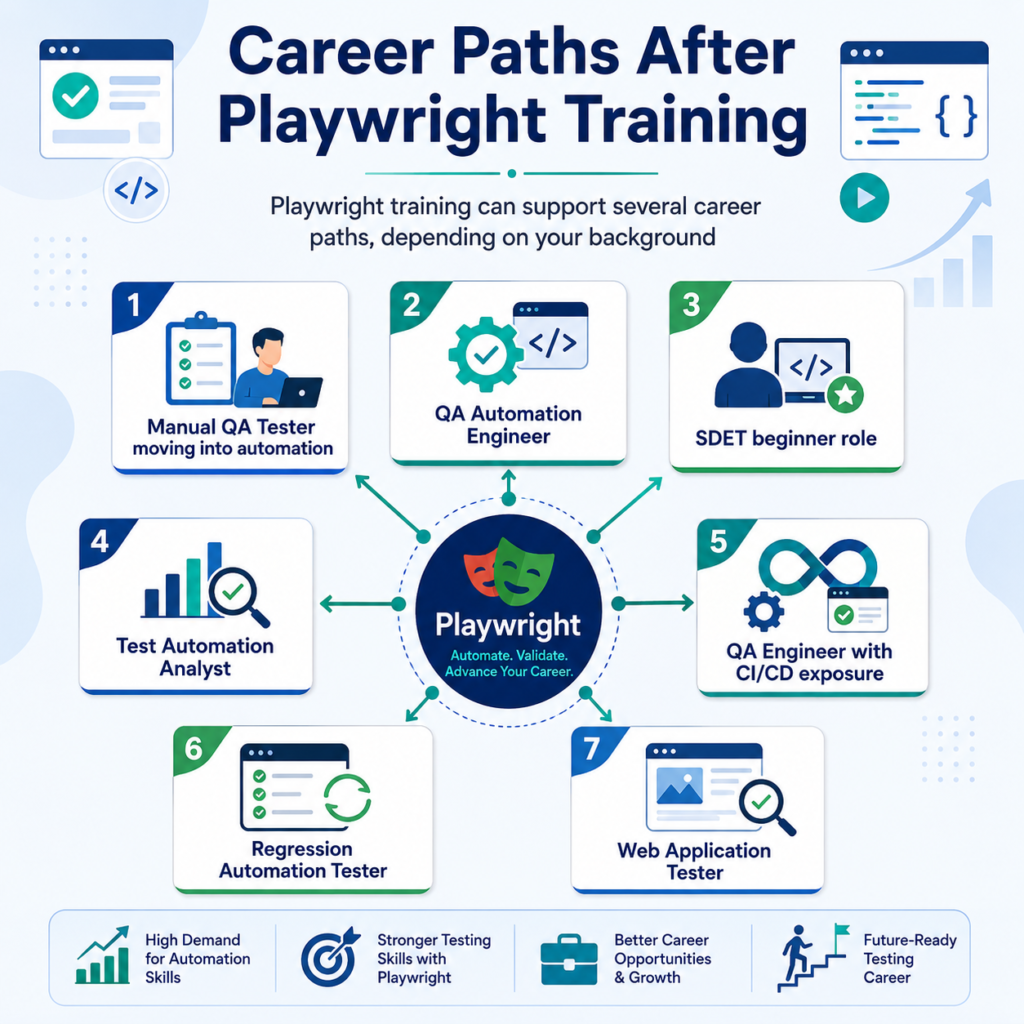
Playwright training can support several career paths, depending on your background:
- Manual QA Tester moving into automation
- QA Automation Engineer
- SDET beginner role
- Test Automation Analyst
- QA Engineer with CI/CD exposure
- Regression Automation Tester
- Web Application Tester
The salary depends on location, experience, domain, and coding strength. Still, QA automation skills tend to improve earning potential because companies value testers who can reduce repetitive manual testing and support faster releases.
In the U.S., BLS data shows software QA analysts and testers had a median annual wage of $102,610 in May 2024. That does not mean a beginner starts there, but it does show that QA is a serious career track, not a side role.
How to Compare Online Playwright Training in USA
Before enrolling, use this simple checklist:
1. Does the course include hands-on projects?
Avoid training that only explains theory. You need actual browser automation practice.
2. Does it cover Java or another programming language properly?
Tool knowledge without coding confidence becomes limiting.
3. Does it teach framework-level automation?
Look for Page Object Model, reusable utilities, reports, and CI/CD basics.
4. Does it include AI or modern QA trends?
In 2026, AI-assisted testing is becoming part of the workflow. You do not need hype. You need practical usage.
5. Is there instructor support?
This matters when you get stuck, especially during setup, debugging, or project building.
6. Does it offer career support?
Resume preparation, interview practice, and job placement support can make the course more useful.
This is where H2K Infosys fits well for learners who want structured online training in the USA. Their Online Playwright Training in USA offering sits inside a larger QA and IT training ecosystem, which is helpful if you want to build related skills over time.
Related Topics You Can Explore
You can also explore topics like:
- QA Testing with AI Online Training
- Selenium Automation with Java vs Playwright with Java
- How to Become a QA Automation Engineer in USA
These topics work well as internal links if this blog is part of a larger QA automation content cluster.
FAQs About Playwright Training in USA
1. Is Playwright good for beginners in 2026?
Yes, Online Playwright Training in USA is beginner-friendly if you learn it with proper guidance. New learners should start with testing basics, Java or JavaScript fundamentals, locators, assertions, and real project practice.
2. What is the best playwright testing course for job seekers?
The best course is one that includes hands-on projects, framework design, debugging, CI/CD basics, interview preparation, and career support. H2K Infosys is a good option because its training is structured around practical QA career outcomes.
3. Do I need Java for Playwright automation?
Not always, but Java is useful for many QA automation roles, especially in enterprise environments. A Online Playwright Training in USA with Java course can help learners connect modern automation with familiar corporate QA frameworks.
4. Can manual testers learn Playwright?
Yes. Manual testers often make strong automation testers because they already understand test scenarios, defects, and user behavior. They usually need to add coding, automation framework design, and tool practice.
5. Is Playwright better than Selenium?
It depends on the project. Selenium is still widely used, but Online Playwright Training in USA is popular for modern web apps because of its auto-waiting, browser context handling, tracing, and fast execution. Many QA professionals benefit from knowing both.
Final Takeaway
Choosing online Online Playwright Training in USA in the USA in 2026 is really about choosing the right learning path. Do not pick a course only because it is cheap, fast, or full of buzzwords. Pick one that helps you build real automation skills, understand QA work, create a project, and prepare for interviews.
If you are serious about building a career in QA automation, structured training can really help. H2K Infosys is worth considering because its Online Playwright Training in USA direction combines Playwright, Java, Gen AI testing, real-time learning, and career-focused support.
Start with the right course, practice consistently, and build one strong project you can confidently explain. That one project can do more for your career than ten unfinished tutorials sitting in your browser bookmarks.