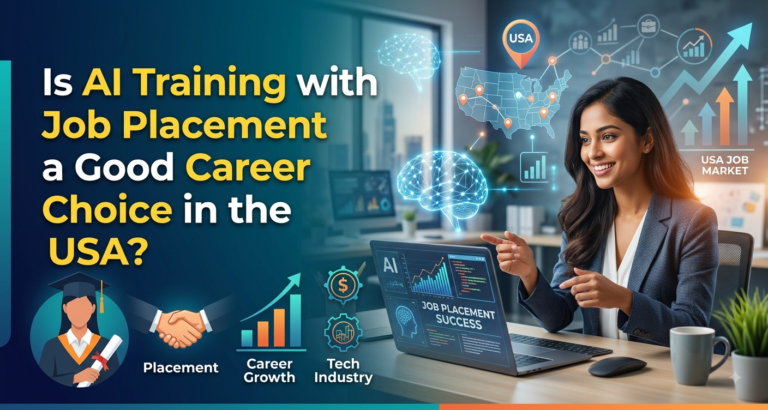
Yes, AI training with job placement can be a good career move in the USA in 2026, especially if the program includes hands-on projects, latest AI tools, and real career assistance. The trick is to select training that makes you job-ready, not just another piece of paper.
And there’s a good reason this route is getting some attention at the moment. U.S. Bureau of Labour Statistics data shows data scientist employment is expected to grow by about 33.5% from 2024 to 2034. Software developer employment is expected to grow 15.8%, adding about 267,700 jobs.
So if you are looking for AI Training with Job Placement in USA, then the opportunity is real. But and this is where people sometimes get tripped up AI is not a shortcut to a job.
The Reasons Why AI Careers Are So Hyped in 2026
Artificial intelligence is now far beyond research labs and flashy demos.
Businesses are using AI for customer support, document processing, fraud detection, recommendation systems, software development, predictive analytics, automation, and more recently, internal business workflows.
The broader trend is supported by recent US labour-market data. BLS says increased use of AI and generative AI is projected to help support growth in computer and mathematical occupations. Jobs such as information security analysts, computer and information research scientists, data scientists, and software developers are projected to see substantial growth by 2034.
Another interesting signal: A 2026 analysis by the Bipartisan Policy Center, using Lightcast data, found that U.S. job postings mentioning AI skills had more than doubled compared with the previous year, and that demand went beyond traditional technology companies.
And that’s important.
You don’t have to picture yourself working for a Silicon Valley AI research lab. AI skills have become more and more important in finance, healthcare, retail, manufacturing, cybersecurity and other industries.
But Is AI Training Good Enough to Land a Job?
Not all by itself.
This is where I would be suspicious of any training provider who would offer a career change for no effort.
One thing is to learn Python, machine learning, neural networks or generative AI. Sitting in front of an interviewer and describing what you built and why you built it, and what went wrong and how you fixed it is another story.
Suppose there are two candidates.
Candidate A: states
“I earned an AI certification.
Candidate B says:
“I developed a customer churn prediction model, compared various algorithms, evaluated the results and explained how a business can use the predictions.
The second candidate has something to say.
That’s why good AI Training courses should include practical work, not be all lectures and quizzes.
What to Look for in Job Placement with AI Training
If you’re comparing programs, I’d look past the words “placement assistance.”
See what happens in the program.
The best AI programs for career orientation should have:
- Data fundamentals & python
- Machine learning
- Deep-learning
- Natural language processing (NLP)
- Ideas for generative AI and LLMs
- Model assessment
- Proper AI frameworks and tools
- Practical projects
- Real-world business scenarios
- Resume Writing
- LinkedIn/profile advice
- Tech interview preparation
- Interview role play
- Job search and application tips
The project part is very important.
A learner has something tangible to discuss in an interview if they can show an AI chatbot, recommendation system, prediction model or automation workflow.
The Importance of Job Placement Assistance
Here’s the thing that a lot of self-paced courses don’t cover.
You stop learning.
And then what?
You open up LinkedIn. Find jobs for “AI Engineer.” View hundreds of listings. Read requirements such as Python, SQL, cloud, machine learning, LLMs, APIs, deployment, MLOps…
Suddenly that certificate doesn’t look so powerful.
Here is where assistance with structured placement can help.
A good program can help you learn which roles fit your experience, strengthen your resume, prepare for interviews, and approach the U.S. job market more strategically.
That does not mean someone gives you a job.
It means you have a better bridge between learning AI and actually applying to AI related positions.
Reasons to Consider H2K Infosys
If AI Training with Job Placement in USA is your priority particularly, H2K Infosys is one provider worth including in your comparison.
Its current Artificial Intelligence program is a job-oriented course that includes AI training, hands-on projects, certification and career assistance. The published curriculum covers areas like machine learning, deep learning, neural networks, NLP, NumPy, MLOps and LLMOps. Course page updated July 2026.
H2K Infosys also provides career support, including help with your resume, mock interviews and help with placement.
The interesting part is that combination.
You’re learning the tech but you’re also … And then you’re also working on student → project builder → interview candidate.
Certificate chasing vs hands-on learning
One of the better reasons to look at a structured program is just that it gives you a roadmap.
You don’t have to spend Monday learning Python from one YouTube channel, Wednesday watching some random LLM tutorial and Friday wondering what to build, you have a sequence to follow.
H2K Infosys says its AI training is backed by real-time project work and a cloud test lab for hands-on exposure.
That structure is good for someone changing careers.
What jobs can you aim for after AI training?
The exact role is very dependent on your previous experience and technical ability.
Possible career routes include:
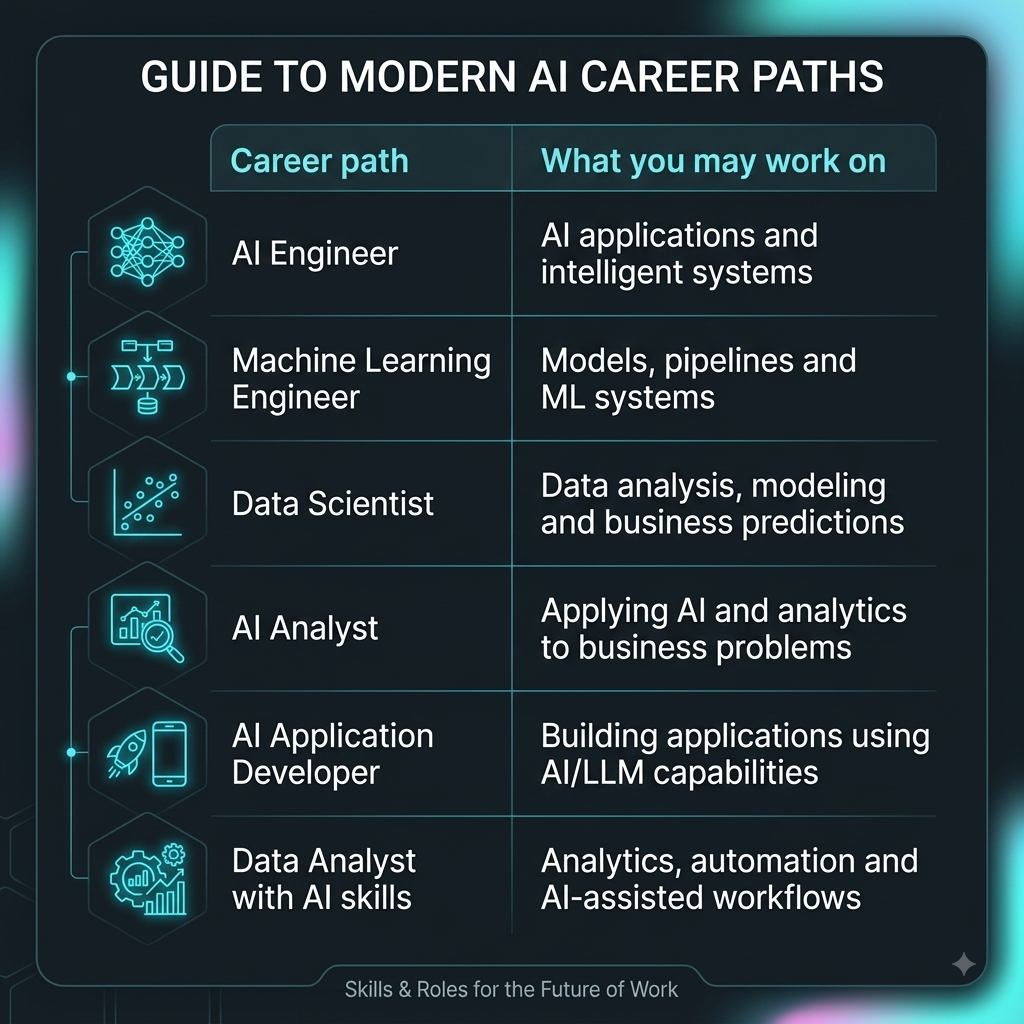
H2K Infosys offers a similar list of potential career paths, including AI Engineer, Machine Learning Engineer, Data Scientist, AI Analyst and AI Application Developer, based on a learner’s background and training.
One important reality check: don’t assume that doing an AI course will make you suitable for all of these roles.
For example, a senior Machine Learning Engineer position might require significantly more software engineering, system design, and production experience than an entry-level AI position.
This is normal.
This Is What the U.S. Job Market Will Look Like in 2026
The picture is promising, but it isn’t all rosy.
AI is creating demand for new skills, while changing or reducing demand for some tasks. The BLS sees strong growth for data scientists and software developers, but also expects employment to decline in several occupations where productivity gains from artificial intelligence may reduce labour needs.
So “AI is creating jobs” and “AI is changing jobs” can both be true.
And that’s why training really matters.
It shouldn’t be about learning one AI tool and hoping it stays popular forever. Develop core skills that stand the test of tool evolution: programming, data management, statistics, model evaluation, problem solving, communication and ability to work with modern artificial intelligence (AI) systems.
A Practical Example
Imagine a business operations professional looking to move into tech.
They already know the business processes and the customer problems, but they don’t have much experience with AI.
If I were to make a sensible transition, it might be:
Step 1: Learn the basics of data and python.
Step 2: Learn machine learning and understand how models really work.
Step 3: Design multiple projects around real world business problems.
Step 4: Incorporate current generative AI and LLM capabilities.
Step 5: Learn how to explain those projects well.
Step 6: Reframe the resume around transferable experience and new AI skills.
Step 7: Practice technical and behavioural interviews.
Step 8: Always apply for jobs that match the person’s experience in their current business.
That’s a lot more realistic than “take a six-week course, be an AI engineer.”
Who is a Candidate for AI Training with Employment Assistance?
This route can be appropriate for:
- New graduates
- AI skills for software developers
- QA pros moving to AI/automation
- Analyst
- Business Analysts IT Professionals Engineers
- Professionals seeking career change
- Technically orientated people who need a structured AI roadmap
You don’t need to be an AI researcher, necessarily.
People coming from another industry sometimes have an advantage in fact, they already understand a particular business domain.
Finance experts that learn AI are able to build up his finance skills with tech. Healthcare workflows can be understood by health professionals. A marketing person may have a better sense of customer behaviour than a pure tech newbie would.
That combination can be worth something.
What About Beginners?
For beginners the choice of a program is especially important.
AI terminology can get pretty overwhelming pretty quickly.
Python. ML. Deep learning. Transfurnium. Neural networks. LLMs. RAG. MLOps. Agents.
That’s a lot . And honestly it is .
A structured AI Training with Job Placement program can ease the learning curve by providing you a progression instead of asking you to figure things out yourself.
H2K Infosys said its AI program is suitable for learners who want structured training, hands-on projects and career assistance, with its course curriculum covering a variety of machine learning and artificial intelligence concepts.
The “Job Placement” Part You Can’t Ignore
Let’s clear up one common misconception.
Job placement assistance is not a promise of a job.
Even H2K Infosys’ own recent material recognises this distinction: placement support can help with interview-readiness, resumes, projects and job searching, but no training provider can realistically control every hiring decision.
And that’s actually the more credible way to look at it.
Your result still depends on:
- Your current experience
- Technical Skills Projects Communication
- Results of interview
- Location and work permit
- The roles you are targeting
- The market at the time for hiring
- The consistency you use
So, do not choose a course just because it has “100% placement” written in big letters.
Ask what support for placement actually means.
H2K Infosys – Why is it a Practical Option
This takes us back to the question of H2K Infosys, especially because it is a combination of training and career preparation.
Its current AI curriculum focuses on:
Hands-on AI training: Machine Learning, Deep Learning, NLP, Neural Networks and modern AI tools.
Projects: Apply principles thru practical, real-world-oriented work
Certification: Receive a course certification upon completion of training.
Resume help: Receive assistance presenting your AI skills and projects in a professional manner.
Mock interviews – Practice technical and behavioural interview scenarios.
Placement support: Receive career support to help qualified learners find opportunities.
If you are the type of person who can teach yourself, then maybe a single AI course is all you need.
If you’re the kind of person who’s always asking yourself, “Okay, but how do I get a job out of this?” the added career support can be a game-changer.
Is AI Training with Job Placement Worth It 2026?
Yes, for the right student.
The U.S. employment outlook provides a strong foundation for technical careers related to AI. BLS projects data scientist jobs to increase by 34% between 2024 and 2034 and software developer jobs to increase by approximately 15%.
At the same time, the market is getting more demanding. The most recent reporting indicates that employers are emphasising AI skills more, and job seekers are scrambling to have AI experience on their resumes too.
So the winning strategy is not just:
“Study AI.”
It’s:
Learn AI → work on projects → understand business use cases → build a strong resume → prepare for interviews → apply strategically.
This can be logical here with AI Training with Job Placement in USA.
Is AI Training with Job Placement a good career choice in the USA?
Yes. AI Training with Job Placement in USA can be a good career path for people who want to build practical AI skills and receive career support at the same time. AI is being adopted across software, finance, healthcare, retail, cybersecurity, and other industries, creating demand for professionals who understand modern AI technologies.
Are AI Training courses suitable for beginners?
Yes, many AI Training courses are designed for beginners, although having basic programming or IT knowledge can make the learning process easier. A structured course can help beginners progress from Python and data fundamentals into machine learning, deep learning, NLP, and generative AI.
What is AI Training with Job Placement?
AI Training with Job Placement combines technical education with career assistance. Depending on the provider, this may include AI and machine-learning lessons, hands-on projects, resume preparation, mock interviews, interview coaching, and job-search or placement assistance.
Does H2K Infosys provide job placement assistance after AI training?
Yes. H2K Infosys promotes its AI training as a career-oriented program that includes placement assistance along with resume support, mock interviews, practical projects, and technical training. Learners should review the current program terms and placement process before enrolling.
Is H2K Infosys AI training useful for career changers?
It can be particularly useful for professionals who want a structured path into AI. People coming from IT, software, QA, data, business analysis, engineering, or other technical backgrounds may be able to combine their existing experience with newly acquired AI skills.
Is an AI certification enough to get an AI job?
Usually, no. A certification can demonstrate that you’ve completed training, but employers may also look at your practical skills, projects, programming ability, problem-solving skills, communication, and previous experience. Think of certification as one part of your profile not the entire profile.
Is AI still a good career option in 2026?
Yes, although the market is becoming more competitive. AI skills are increasingly being incorporated into existing technology and business roles, so professionals who combine AI knowledge with strong fundamentals and domain expertise can have an advantage.
What should I look for when choosing AI Training with Job Placement?
Look beyond the phrase “job placement.” Check whether the program offers hands-on projects, an up-to-date curriculum, experienced instructors, interview preparation, resume assistance, mock interviews, career guidance, and transparent placement terms.
Can I learn AI online and work in the USA?
Yes, online AI training can prepare you for U.S. opportunities. However, training itself doesn’t determine whether you are legally eligible to work in the United States. Work authorization, visa status, location, and employer requirements are separate considerations.
Final Thoughts
If you really want to go in the U.S. AI job market, don’t go for a course just because it has a fancy certificate or it promises a quick career change.
Find hands-on training, current technology, real projects and career support.
This is the reason why H2K Infosys’ Artificial Intelligence Training program is worth considering for learners who want training and placement support in one career-oriented path. Its current program blends AI instruction with hands-on work and job-search support.
But the larger lesson is simple: AI isn’t a magic ticket to jobs. It’s a skill set.” The people who truly benefit from AI training are those who take that skill set and turn it into things they can demonstrate, explain, and use to solve real problems.
And that puts you in a much stronger position in the 2026 job market than just having another certificate on your resume.