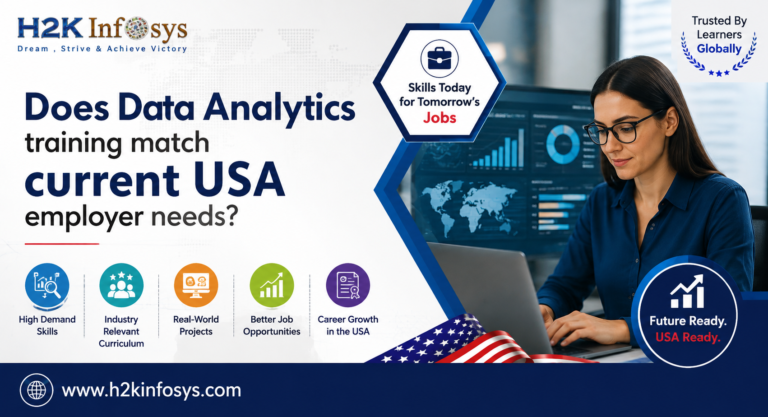
The best Data Analytics training programs usually mix technical tools, hands-on projects, business communication, statistics and the newer AI capabilities.
This trajectory is confirmed by current labour market data. O*NET’s employer demand data for Business Intelligence Analysts shows SQL in 35% of job postings, Power BI and Python in 20%, Tableau in 19% and Excel in 17%.
Separately, in 2026, an analysis of 2,585 Data Analyst postings found data visualization/business intelligence and SQL were requested in about three-quarters of postings, while programming, data-engineering fundamentals, statistics and experimentation were also in strong demand.
Therefore, a Data Analytics training course needs to be structured like the work analysts do, not a series of software tutorials.
5 Best Ways How Data Analytics Training Fulfils USA Employer Needs
| Position | Training Area | Employer Expectations | Why It Matters |
| #1 | SQL & Data Handling | Queries, joins, filtering, aggregation | Business analysts must be able to work with business databases |
| #2 | BI & Visualisation | Power BI, Tableau, dashboards | Insights need to be communicated clearly |
| #3 | H2K Infosys Data Analytics with AI Training | SQL, Python, BI, projects and Gen AI | Combine Tech learning with Career Readiness |
| #4 | Python, Statistics & AI | Python, analysis, statistics, AI-assisted workflows | Enables deeper analysis and modern productivity |
| #5 | Business & Career Skills | Communication, portfolio, interviews | Helps to translate technical knowledge into employability |
The ranking is not designed to imply that one skill is always more valuable than another. A financial analyst may live in Excel, while a product analyst may be in SQL and Python all day. The mix changes the role.
That is exactly why good Data Analytics training needs starting from a broad base.
1. Core requirement is still SQL & data handling
If there is one aspect of Data Analytics training that trainees should take seriously, it is SQL.
SQL is used by analysts to pull information from relational databases. Data you need for a real company does not come to you in a nice spreadsheet ready for analysis.
You might need to join customer records with transactions, filter thousands of rows, calculate monthly revenue, find inactive users or compare performance across regions.
This is where SQL becomes practical rather than theoretical .
In O*NET’s current employer-demand data for Business Intelligence Analysts in the 2025 U.S. posting dataset, SQL is the most commonly cited software skill, followed closely by Power BI, Python, Tableau, and Excel.
A good Data Analytics training program should therefore include:
- SELECT statements
- HAVING and WHERE
- GROUP BY
- JOINs
- Sub-queries
- Common Table Expressions (CTE’s)
- Windowed functions
- Aggregation of Data
- Databases 101
You don’t need to remember SQL syntax.
Answer business questions with data is the objective.
2. The Importance of Power BI, Tableau and Visualisation of Data
Being able to analyse information is only half of it.
And you have to explain it.
This is where visualisation comes into play. Companies want analysts who can build dashboards that allow managers to quickly visualise revenue, customer behaviour, operational performance, marketing results, or other business metrics.
The latest O*NET employer demand data shows Power BI and Tableau are showing up a lot in Business Intelligence Analyst jobs.
This makes visualisation an important part of modern Data Analytics training.
For example, a retail company has seen quarterly sales fall 12 percent.
A novice would simply draw a chart of the decline.
A good analyst goes deeper.
What products went down?
The locations that were hit are:
Did foot traffic change?
Was the decline concentrated in a specific customer segment?
Was it seasonal?
A good dashboard should help you answer these questions more easily.
That’s why portfolio projects are important too. A dashboard with a thoughtful business analysis can do a lot more talking to an employer than a certificate sitting on a resume.
3. H2K Infosys Data Analytics With AI Training Bridges Tools To Real Work
This combination has been structured around a case in point, the H2K Infosys Data Analytics with AI Training program.
As per the latest course information from H2K Infosys, its course covers SQL, Power BI, Tableau, Python, Pandas, NumPy, Matplotlib, statistics, machine-learning basics, Gen AI, and hands-on projects. In terms of features, the program also offers live training, resume prep, mock interviews, career guidance, and job placement support.
The number of tools is not the only thing that stands out here.
It’s the blend.
For example, an analyst might receive sales data and clean it using Python or Excel, query more information using SQL, build a Power BI dashboard and then use AI tools to automate repetitive tasks.
This is a lot more like a real analytics workflow.
The H2K Infosys Data Analytics with AI course includes retail and finance capstone style projects. You will go thru the whole process from data cleaning to visualisation and insights.
This is an important distinction for someone comparing training options.
Learners in Data Analytics training shouldn’t finish the course thinking, “I did the course, what do I actually build?”
Projects should answer that question.
What H2K Infosys brings together
| Area | H2K Infosys Approach |
| Live learning | Instructor-led online classes |
| Analytics tools | SQL, Excel, Power BI, Tableau and Python |
| AI | Generative AI and AI-supported analytics |
| Practice | Real-world and capstone projects |
| Career preparation | Resume and LinkedIn guidance |
| Interview preparation | Mock interviews |
| Career support | Job placement assistance |
H2K Infosys describes its classes as live and instructor-led, with flexible schedules, practical projects and career assistance.
That makes H2K Infosys Job Placement and H2K Infosys Career Support useful considerations for learners who want training to include an employment-preparation component not just technical lessons.
Still, placement support should never be treated as a substitute for developing actual skills. Employers make their own hiring decisions.
4. Python, Statistics and Generative AI Are Changing the Skill Mix
Python has become increasingly relevant across data-related jobs.
O*NET’s 2025 U.S. employer-demand data for data scientists lists Python in 66% of postings, SQL in 51%, Tableau in 22%, Power BI in 19%, and Excel in 8%.
Data analysts do not necessarily need the same level of Python expertise as data scientists. But understanding Python for data cleaning, exploration, automation, and visualization can make an analyst more versatile.
Statistics matters too.
You should understand concepts such as:
- Mean and median
- Standard deviation
- Correlation
- Probability
- Sampling
- Hypothesis testing
- Confidence intervals
- Regression basics
- A/B testing
Then there is Gen AI.
Modern Data Analytics training increasingly needs to explain how AI can assist analysts without replacing analytical judgment.
For instance, Gen AI can help generate a first draft of a SQL query, explain Python code, suggest visualization ideas, summarize patterns, or help document analysis.
But the analyst still has to verify the result.
AI can confidently produce a wrong SQL query. It can misunderstand a business definition. It can identify a correlation that has no meaningful business explanation.
So the useful skill isn’t simply “knowing ChatGPT.”
It is knowing when AI can help, how to prompt it, and how to validate its output.
That is where a Data Analytics Certification with Gen AI can become more relevant to modern learners—provided the certification is supported by genuine practice.
5. Business Communication and Career Skills Complete the Picture
Here’s something that gets overlooked in many technical courses: analysts work with people.
A manager may not care that you used a complicated SQL statement.
They care that you found that customer churn increased 8%, determined the cause, and can articulate the next steps for the company.
That takes communication.
Hence strong Data Analytics training should include:
- Data Story
- Business problem-solving
- Presentation skills
- Interpreting the Dashboard
- Resume Writing
- Interview practise
- Portfolio development
- Stakeholder involvement
Structured support with career is one area where this can be useful.
The H2K Infosys Career Support offering, according to its current course information, includes resume preparation, LinkedIn optimisation, mock interviews and guidance on portfolios.
The larger idea is simple: technical skills can get you thru the interview process but communication skills demonstrate that you can actually work in an analytics role.
Is Data Analytics Training in Sync with the Current USA Job Market?
Yes-but the quality of the curriculum does matter.
A course that only covers Excel and basic charts may not be enough for many analytics positions today.
Something like this would be a stronger Data Analytics training route:
Excel, SQL, Statistics, Power BI/Tableau, Python, Projects, Gen AI, Business Communication, Interview Preparation
The precise order may depend on your background.
If you’re a complete beginner, Excel and SQL are probably the easiest places to start. Someone who knows SQL might move into python and BI development more quickly.
It’s about building skills that complement each other.”
Career Results After Data Analytics Training
Learners may be targeting a range of roles based on experience, portfolio quality, education and employer requirements such as:
- Data Analyst
- Business Intelligence Analyst at [Company]
- Reporting Analyst
- Marketing Analyst,
- Operations Analyst, M.P. & L. Co., U.S. Army
- Finance Analyst
- Product Analyst
- The Business Analyst Profile
- Junior Analyst
The overall picture for data and technology jobs is still positive. Data scientist jobs are expected to grow 33.5 percent from 2024 to 2034, according to the U.S. Bureau of Labour Statistics, adding about 82,500 positions.
BLS reports median annual wages for data scientists were $112,590 in May 2024. This is not a Data Analyst salary benchmark and should not be used to promise what an entry-level analyst would make.
This difference is important when you’re researching salaries. Always check the exact occupation, location, experience level, industry and job description, not just one attractive salary number.
Modern Data Analytics Training – Real World Project Ideas
If you are considering a Data analytics training, ask to see the sorts of projects students actually do.
Useful ones are:
- Retail Sales Report DashboardsUse SQL and Power BI to analyse revenue, product performance, and regional sales.
- Customer Attrition AnalysisIdentify customer behaviour related to cancellations and recommend strategies for retention.
- Marketing Campaign EvaluationCompare performance, conversion rates and customer acquisition costs
- Automating Financial ReportingOrganising recurring reports with Python and SQL
- SQL Analysis with AI HelpCreate queries with Gen AI and then validate and optimise them manually.
These projects make Data Analytics training more concrete by relating tools to real business questions.
H2K Infosys Data Analytics With AI Training Vs. Normal Self Paced Course
| Feature | Typical Self-Paced Course | H2K Infosys |
| Live instructor interaction | None or little | Yes |
| SQL | Frequently included | Included |
| Power BI/Tableau | Included | Depends on program |
| Python | program dependent | Included |
| Gen AI | Yes | Varies |
| Hands-on projects | Varies | Project-based learning |
| Resume support | No | Yes |
| Mock interviews | Not always available | Available |
| Career Mentoring | Varies | Available |
| Placement support | Limited, typically | Available |
The important thing is not that every learner needs a live program.
Disciplined learners can do very well with self-paced learning.
However, if you are a more active learner and like to ask questions, get feedback and work thru projects with an instructor, then live Data Analytics training can offer a more structured learning experience.
What to Look for in Data Analytics Training?
5 Questions to Ask Before You Pay for any Course:
- Is SQL part of the curriculum?
- Will I be building projects with real-life or realistic datasets?
- Does it have Tableau or Power BI?
- Does it contain Python at the right level?
- How does the program teach AI and Gen AI to be responsible?
Then take it a step further.
- Ask to review the assignments.
- Ask if the projects can be used as portfolio pieces.
- Ask about interview preparation process.
- And ask, what exactly is “placement assistance”?
Those questions can help you avoid selecting a course based solely on marketing language.
FAQs
How aligned Data Analytics training is with USA employer needs in 2026?
Yes. Based on current U.S. employer-demand data, demand for SQL, Python, Power BI, Tableau and Excel across analytics-related occupations continues.
What to put in Data Analytics training?
A practical program should include SQL, Excel, visualisation of data, Power BI or Tableau, statistics, Python, projects, business communication and increasingly AI assisted analytics.
Can I get a Job with a Data Analytics Certification with Gen AI?
Certification alone does not guarantee employment. It works best in conjunction with practical projects, technical skills, a strong portfolio, interview prep and the ability to solve business problems.
Does H2K Infosys Data Analytics with AI Training Offer Real Time Projects?
Yes. H2K Infosys current course page has hands-on real world projects and a capstone workflow that covers data cleaning, visualisation and insights.
Final Thoughts
The USA analytics job market is not looking for candidates to be an expert in every technology overnight.
It’s asking for something more practical: people who can take messy data, analyse it with the right tools, use AI intelligently, communicate the findings and connect those findings to business decisions.
That’s what modern Data Analytics training should get you prepared for.
One training model that combines live instruction, analytical tools, Gen AI, practical projects and career preparation for learners comparing providers is H2K Infosys. Its current H2K Infosys Generative AI Data analytics Course and H2K Infosys Data Analytics with AI Training methodology reflects the growing connection between traditional analytics and AI-assisted workflows.
This certificate can help you document what you have learned.
The projects show what you can really do.
And that is what makes Data Analytics training far more relevant to the way employers hire today.