Yes, you can learn artificial intelligence course online without starting with a technical background. The key is choosing a beginner-friendly learning path that builds fundamentals gradually, gives you hands-on practice, and if your goal is employment connects training with resume, interview, and job-search support.
If you’ve ever opened an AI course page and thought, “Python, machine learning, neural networks… maybe this isn’t for me,” you’re definitely not alone.
The good news is that you don’t need to arrive as an AI expert. You need a sensible roadmap and the willingness to practice.
For learners specifically looking for a career-focused option, H2K Infosys’ Artificial Intelligence Online Training is worth examining because its current program combines Python, machine learning, deep learning, NLP, hands-on projects, cloud-lab practice, certification, resume assistance, mock interviews, and placement support.
So, Can a Non-Technical Person Really Learn AI?
Yes, but there’s an important distinction.
You can start learning AI without a computer science degree or previous AI experience. That doesn’t mean you’ll become a machine learning engineer after watching a few lessons.
AI is a broad field.
Someone can use AI tools without knowing how a neural network works. Another person might build an LLM-powered application. Someone else might train and deploy machine-learning models.
These are very different skill levels.
For a beginner, the realistic path looks more like:
Python basics → data fundamentals → machine learning → deep learning → generative AI → projects → portfolio → interview preparation
Trying to jump directly into advanced AI systems is where many beginners get stuck.
And honestly, there’s no prize for making the learning process unnecessarily painful.
Why Learning AI Online Makes Sense in 2026
The timing is interesting.
AI isn’t limited to technology companies anymore. Businesses are incorporating AI into software, finance, healthcare, retail, cybersecurity, manufacturing, and other areas.
The World Economic Forum’s Future of Jobs Report 2025 identifies AI and big data as the fastest-growing skill area, while also highlighting analytical thinking, creative thinking, resilience, flexibility, and lifelong learning as important skills.
The U.S. employment outlook also reflects growing demand for several technology-related occupations. The Bureau of Labor Statistics projects data-scientist employment to grow 33.5% from 2024 to 2034, while noting that AI adoption is expected to contribute to demand for workers in computer and mathematical occupations.
That doesn’t mean every person who takes an AI course will automatically get an AI job.
It does mean the underlying skills are becoming increasingly relevant.
What Should You Learn First If You’re Starting From Zero?
Don’t start by memorizing complicated algorithms.
Start with the pieces underneath them.
1. Python
Python is one of the most useful starting points for AI and data work.
You don’t need to become a Python software architect on day one. Focus on:
- Variables and data types
- Conditions and loops
- Functions
- Lists and dictionaries
- Basic object-oriented concepts
- Working with files
- Libraries used in data and AI
Once you can read and write simple Python programs, AI concepts become much less intimidating.
2. Statistics and Data Fundamentals
This part is easy to underestimate.
You’ll eventually encounter concepts such as:
- Mean and median
- Probability
- Distributions
- Correlation
- Data cleaning
- Data visualization
- Model evaluation
You don’t necessarily need advanced mathematics to begin, but you do need enough statistical thinking to understand what a model is actually doing.
3. Machine Learning
Then you can move into concepts such as:
- Supervised learning
- Unsupervised learning
- Classification
- Regression
- Clustering
- Feature engineering
- Model evaluation
This is where AI starts feeling less theoretical because you can actually build something.
4. Deep Learning
Once the fundamentals make sense, neural networks and deep learning become easier to understand.
Topics can include:
- Neural networks
- Deep neural networks
- Model training
- Computer vision
- Natural language processing
5. Generative AI and LLMs
And this is where the field has changed dramatically.
Modern AI learning paths increasingly need to address technologies around large language models, retrieval-augmented generation (RAG), AI applications, automation, and deployment not just traditional machine learning.
That’s also why I would be cautious about choosing a course simply because it says “AI certification” on the front page.
Look inside the curriculum.
What Makes Online AI Courses for Beginners Actually Useful?
Here’s the thing: there are plenty of ways to learn about AI.
The harder part is learning how to use it in a project.
A useful beginner program should ideally give you:
A structured curriculum
You shouldn’t have to figure out the sequence yourself.
Python before machine learning makes sense. Machine learning before advanced AI applications makes sense.
Instructor support
When your code throws an error at 11 p.m. and the error message looks like ancient Greek, being able to ask someone can save hours.
Hands-on projects
This is a big one.
A project gives you something to discuss in an interview:
- What problem were you solving?
- What data did you use?
- Which approach did you choose?
- What went wrong?
- How did you evaluate the result?
That’s a much better conversation than simply saying, “I completed an AI course.”
Career preparation
If employment is your goal, training shouldn’t necessarily stop at the final lesson.
Resume preparation, mock interviews, project presentation, LinkedIn guidance, and job-search support can all be useful pieces of the transition.
Why H2K Infosys May Be Interesting for Beginners
If your goal is specifically to learn AI online with a career-oriented path, H2K Infosys takes a somewhat different approach from a purely self-paced video library.
Its current Artificial Intelligence Online Training page describes a 75-hour program covering areas including statistics fundamentals, Python, machine learning, deep learning, and test analytics. It also lists projects, cloud test-lab practice, resume assistance, mock interviews, and placement support.
The career-support side is particularly relevant for someone searching for learn AI course with job placement in USA.
H2K Infosys states that its AI training includes resume-building assistance, AI-focused mock interviews, and placement support.
There’s an important caveat, though.
Placement assistance is not the same thing as a guaranteed job.
Your results still depend on your technical skills, projects, interview performance, previous experience, location, work authorization, communication skills, and the jobs available when you’re applying. H2K’s own recent material makes this distinction as well.
That’s actually a useful question to ask any training provider:
“What exactly does job placement support include?”
Don’t just ask whether they offer it.
What Does H2K Infosys’ AI Training Cover?
According to its current course information, the program includes areas such as:
- Python programming
- Statistics fundamentals
- Machine learning
- Deep learning
- Neural networks
- Natural language processing
- NumPy
- MLOps
- LLMOps
- TensorFlow and Keras
- Hands-on project work
- Cloud test-lab practice
- Resume preparation
- Mock interviews
- Placement assistance
That combination matters because AI careers aren’t built from one skill.
You might know how to write Python, but not know how to explain your project.
You might understand machine learning, but struggle in a technical interview.
Or you might have a decent resume but no practical project experience.
A career-oriented learning path attempts to connect those pieces.
What If You Have Absolutely No Technical Background?
This is probably the question behind the question.
Let’s say you’ve worked in business operations, customer support, administration, QA, analytics, or another non-AI field.
Do you have to start over?
Not necessarily.
Your previous industry experience can actually help you identify useful AI applications.
Imagine someone with a finance background learning AI.
They already understand financial workflows and terminology. Once they learn the technology, they can start thinking about fraud detection, forecasting, document processing, customer-service automation, or financial analytics.
A healthcare professional might understand healthcare workflows better than a newcomer.
A business analyst may already understand requirements, stakeholders, and business processes.
So don’t automatically think:
“I don’t have a technical background, therefore I have nothing to bring to AI.”
You may simply be adding a new technical layer to experience you already have.
How Long Does It Take to Learn AI?
There isn’t one honest answer.
It depends on where you’re starting and what role you’re targeting.
Someone learning AI for general workplace use has a very different goal from someone trying to become a machine learning engineer.
A practical progression might look like this:
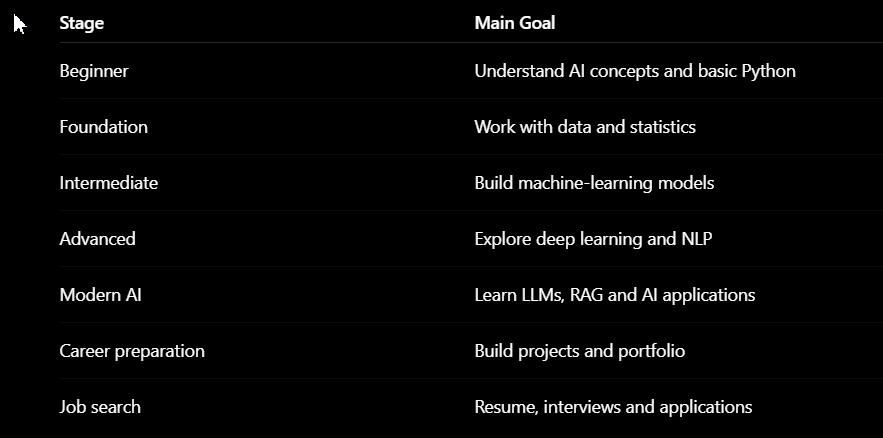
The mistake is treating “learning AI” as one giant subject you have to master before you can do anything useful.
You don’t.
What AI Jobs Can You Target After Online Training?
This depends heavily on your previous experience and how deeply you develop your skills.
Potential career directions include:
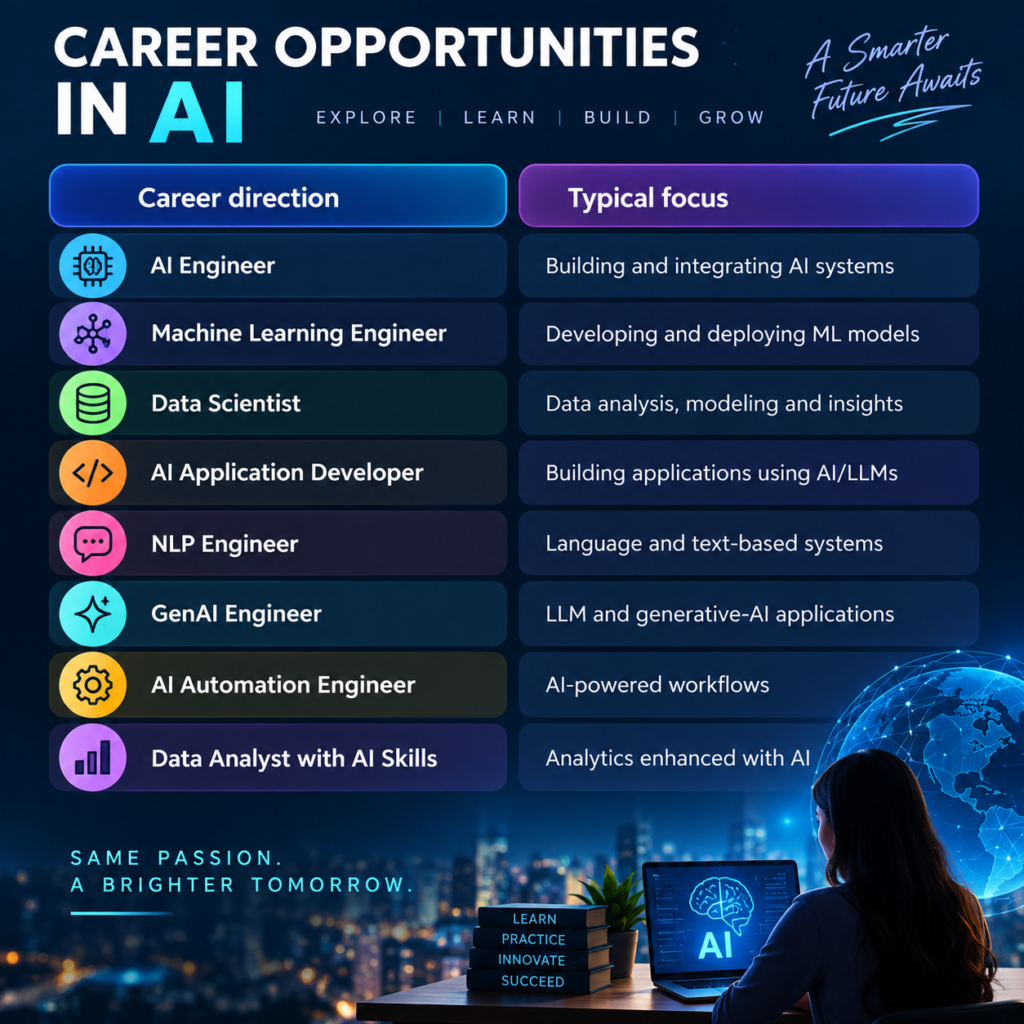
H2K Infosys’ current AI-related material also discusses roles such as AI Engineer, Machine Learning Engineer, Data Scientist, AI Analyst and AI Application Developer, while its Generative AI material lists newer paths involving RAG, LLM applications and AI automation.
But don’t read that table as a promise.
A course doesn’t automatically qualify someone for a senior ML engineering position. Employers can expect very different levels of software engineering, system design, mathematics, cloud, and production experience.
That’s normal.
What About AI Jobs in the USA?
There are encouraging signals, but the market isn’t a shortcut.
The U.S. Bureau of Labor Statistics projects continued growth across several technology occupations. For example, its latest data projects data-scientist employment to grow 33.5% between 2024 and 2034, while software developers are projected to grow 16% over the same period in the relevant BLS projections.
The BLS also specifically notes that increasing adoption of AI technologies including generative AI is expected to contribute to demand for workers with computer science, programming, software-development, and data-analysis expertise.
At the same time, employers are looking beyond technical knowledge.
The World Economic Forum’s research points to growing importance for analytical thinking, creative thinking, resilience, flexibility, collaboration, and lifelong learning alongside AI and big-data skills.
So the useful combination isn’t simply:
AI skills + certificate
It’s closer to:
AI skills + practical projects + communication + business understanding + interview readiness
Is an AI Course With Job Placement in the USA Worth Considering?
If your main objective is employment, I’d look at the whole learning-to-employment journey, not just the course certificate.
For example:
Learn → Practice → Build → Explain → Interview → Apply
A provider that supports several of those stages may be more relevant to a career changer than a course that simply gives you video lessons and a certificate.
This is where H2K Infosys’ model is worth investigating. Its published AI program combines technical training with project work and career assistance, including resume preparation and mock interviews.
And its current 2026 material specifically positions the program toward beginners, career changers and professionals looking for practical AI training and U.S.-oriented career support.
A Realistic Beginner Scenario
Imagine you’re working in QA.
You’ve heard about AI everywhere, but you don’t want to throw away the experience you’ve already accumulated.
Instead of trying to become a research scientist, you could build toward AI-enabled testing and automation.
You learn Python.
Then machine-learning basics.
Then generative AI concepts.
Then you build projects showing how AI can support testing workflows.
Now your story in an interview isn’t:
“I took an AI course.”
It’s:
“I already had QA experience, learned Python and AI technologies, and built projects showing how I could apply those skills to testing.”
That’s a much more concrete career story.
The same idea can work for analysts, developers, business analysts and other professionals.
What Should You Ask Before Enrolling in Any Online AI Course?
Before paying for a program, ask these questions.
1. Is it live or purely recorded?
Some people learn perfectly well from recorded material. Others need an instructor.
Know which type you are.
2. Are there real projects?
Ask for examples.
Not just “project-based learning” written on a webpage.
Ask what you’ll actually build.
3. How much Python is included?
If you’re a beginner, this matters.
4. Does the curriculum include modern AI?
Look for relevant coverage of generative AI, LLMs, RAG, APIs, deployment and related concepts alongside traditional machine learning.
5. What does placement assistance actually mean?
Ask specifically about:
- Resume preparation
- Mock interviews
- Job-search guidance
- Project presentation
- Interview preparation
- Employer connections
- Application support
6. Is there a job guarantee?
Be careful with this phrase.
Training providers don’t control hiring decisions.
A more useful question is:
“What career support will I actually receive after training?”
Why H2K Infosys Is Worth a Look for This Particular Goal
For someone searching specifically for online AI courses for beginners and wanting career support, H2K Infosys brings several pieces together:
- Live online instruction
- AI fundamentals
- Python and machine learning
- Deep learning and NLP
- Modern AI topics
- Hands-on projects
- Cloud-lab practice
- Certification
- Resume assistance
- Mock interviews
- Job-placement assistance
H2K Infosys also describes itself as a U.S.-based IT training provider offering instructor-led online courses and career-oriented training for professionals and career changers.
That doesn’t mean it’s automatically the right program for everyone.
A self-directed learner who already knows Python and machine learning may want something very different.
But if you’re thinking, “I need someone to give me a roadmap, help me practice, and then help me prepare for the job search,” that is exactly the type of learner for whom a structured program can make sense.
Can I learn AI online without a technical background?
Yes, You can start with AI fundamentals and gradually learn Python, data concepts, machine learning, deep learning and generative AI. You don’t need to know everything before you begin.
Are online AI courses suitable for beginners?
They can be, provided the curriculum starts with fundamentals and offers enough instructor or learning support. H2K Infosys says its AI-related programs are designed to support beginners and career changers.
Can I learn AI online and get a job in the USA?
Online training can help you build relevant skills, but completing a course does not guarantee employment. Your previous experience, portfolio, technical ability, interviews, work authorization, location and the hiring market all matter.
Does H2K Infosys provide AI job placement assistance?
Yes. H2K Infosys states that its AI program includes placement assistance, along with resume preparation, mock interviews and practical project experience.
What should a beginner learn before AI?
Start with basic Python, data concepts and statistics. From there, move into machine learning, deep learning, NLP and modern generative-AI technologies.
Is certification enough to get an AI job?
Usually, a certificate by itself isn’t enough to demonstrate practical ability. Projects, technical understanding, communication, interview performance and relevant previous experience can all matter.
Final Thoughts: You Don’t Have to Be Technical to Start
If you’ve been avoiding AI because you don’t come from a technical background, don’t let the terminology scare you off.
You don’t need to understand neural networks on day one.
Start small.
Learn Python. Understand data. Build something simple. Break it. Fix it. Build another project. Eventually, concepts that initially sounded complicated start becoming ordinary.
And if your goal isn’t simply “learn AI” but learn AI and move toward a job in the U.S. market, then look for a program that covers both sides of the equation: technical training and career preparation.
That’s where H2K Infosys’ AI training deserves a closer look. Its current program combines AI instruction, practical project work, certification, resume support, mock interviews and placement assistance.
The certificate is only one piece.
The real goal is becoming someone who can explain what they built, demonstrate what they know, and confidently walk into an interview and talk about it.