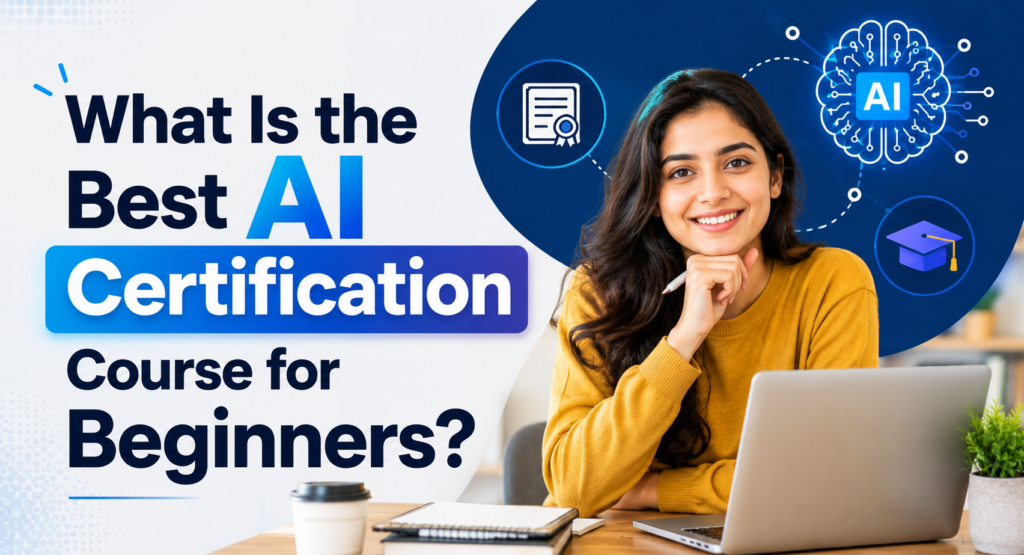
An effective AI Learning Path for Beginners should balance theoretical knowledge with practical, hands-on experience. The best Artificial Intelligence online course for beginners is usually one that follows this approach. H2K Infosys focuses on both foundational learning and practical implementation. While many learners jump directly into advanced AI tools, stronger programs begin with essential topics such as Python, machine learning fundamentals, data handling, and neural networks. They then gradually progress toward real-world AI workflows used in corporate and enterprise environments.
What really makes an AI Learning Path for Beginners useful, especially for beginners, is practical exposure. The better online AI certification programs don’t just explain concepts and leave it there. They include guided labs, cloud-based practice environments, portfolio projects, and experience with tools professionals actually use every day—things like TensorFlow, PyTorch, Scikit-learn, and even OpenAI APIs. That part matters more than people sometimes realize.
For most beginners, the ideal learning path is gradual. You don’t need to understand every advanced mathematical formula on day one. In fact, trying to learn everything at once usually backfires. It’s easier and honestly more realistic to move from core concepts into applied AI implementation step by step.
What Is AI Learning Path for Beginners?
Artificial Intelligence, or AI, refers to computer systems that can perform tasks normally associated with human intelligence. That can mean recognizing patterns, understanding language, analyzing images, making predictions, or even helping automate decisions.
A few common examples include:
- Pattern recognition
- Natural language processing
- Image analysis
- Predictive analytics
- Decision support systems
- Workflow automation
At the center of AI is data. AI systems learn from data using algorithms and computational models, gradually improving their performance over time. Sometimes people imagine AI as one single technology, but it’s really a combination of several areas working together.
| Discipline | Purpose |
|---|---|
| Machine Learning | Helps systems learn from data |
| Deep Learning | Uses neural networks for advanced modeling |
| Natural Language Processing (NLP) | Works with human language |
| Computer Vision | Interprets visual information |
| Data Engineering | Organizes and prepares datasets |
| Cloud Computing | Supports scalable deployment |
AI Learning Path for Beginners understanding how these parts connect is usually more important than mastering heavy theory immediately. That comes later with practice.
Why Online AI Programs Appeal to Beginners
One reason Online AI Programs have become so popular is flexibility. A lot of AI Learning Path for Beginners are already working full-time and can’t realistically go back for another traditional degree just to explore AI.
Online learning makes it possible to:
- Study while keeping a job
- Access labs remotely
- Practice with enterprise tools
- Build projects at your own pace
- Transition toward AI-focused careers gradually
Many AI Learning Path for Beginners certification programs also break learning into modules, which helps avoid getting overwhelmed. That structure matters more than people think. AI can feel huge at first.
A solid beginner course usually covers:
- Python basics
- Introductory data analysis
- Machine learning workflows
- Neural networks
- Model training concepts
- AI deployment basics
- Responsible AI practices
Not every AI Learning Path for Beginners course covers these well, though. Some focus too much on theory, while others rush into tools without explaining why things work.
What Beginners Should Actually Look For in an AI Course
An AI Learning Path for Beginners AI course should feel structured, practical, and connected to real-world usage not just academic examples copied from slides.
Here are some features worth paying attention to:
| Feature | Why It Matters |
|---|---|
| Structured curriculum | Prevents scattered learning |
| Hands-on labs | Reinforces understanding |
| Python exercises | Matches industry workflows |
| Real datasets | Simulates actual environments |
| Capstone projects | Helps demonstrate skills |
| Mentor support | Reduces technical confusion |
| Cloud exposure | Reflects enterprise systems |
The hands-on part is especially important. Watching videos alone rarely builds confidence. Most people only start understanding AI after they break things, debug models, and experiment a bit.
Technologies Beginners Commonly Learn
Most AI environments rely on a familiar stack of tools.
| Technology | Common Usage |
|---|---|
| Python | Primary AI language |
| Pandas | Data manipulation |
| NumPy | Numerical computing |
| Scikit-learn | Machine learning workflows |
| TensorFlow | Deep learning |
| PyTorch | Neural network development |
| Jupyter Notebook | Experimentation |
| SQL | Data querying |
| Git | Version control |
Courses that skip implementation often leave learners stuck in “tutorial mode.” They understand the words, maybe, but not how to apply them in actual projects.
A Practical Learning Path for AI Beginners
The most effective AI Learning Path for Beginners are usually progressive. Trying to master everything at once tends to create frustration pretty quickly.
Step 1: Learn Python Fundamentals
Before anything else, beginners should get comfortable with:
- Variables
- Functions
- Loops
- Data structures
- File handling
- Libraries
Python remains the standard language for AI because it’s readable and has a huge ecosystem.
Step 2: Understand Data Analysis
This part gets overlooked a lot, oddly enough. But real AI projects spend enormous amounts of time preparing data.
Learners should practice:
- Data cleaning
- Handling missing values
- Visualization
- Statistical summaries
- Feature engineering
Messy data is normal in real environments. Very normal.
Step 3: Learn Machine Learning Basics
Core machine learning topics usually include:
- Supervised learning
- Unsupervised learning
- Regression
- Classification
- Clustering
- Model evaluation
This is where AI Learning Path for Beginners often start using Scikit-learn for practical experimentation.
Step 4: Study Deep Learning and Neural Networks
Deep learning introduces concepts like:
- Neural network architecture
- Activation functions
- Backpropagation
- CNNs
- RNNs
- Transformers
These systems power many modern AI applications today.
Step 5: Build Real Projects
This is where things finally start feeling real.
Common beginner projects include:
- Spam detection
- Customer churn prediction
- Sentiment analysis
- Basic chatbot systems
- Image classification
Projects teach lessons tutorials usually skip debugging, deployment constraints, optimization issues, and model behavior under imperfect conditions.
How AI Works in Real Enterprise Projects
In enterprise environments, AI rarely exists on its own. It usually connects with larger systems and workflows.
That often includes:
- Databases
- APIs
- Cloud platforms
- Business software
- Security systems
- Monitoring infrastructure
A typical enterprise AI workflow looks something like this:
| Stage | Description |
|---|---|
| Data Collection | Gather structured or unstructured data |
| Data Preparation | Clean and transform datasets |
| Model Training | Train algorithms |
| Validation | Measure accuracy and reliability |
| Deployment | Integrate into applications |
| Monitoring | Track drift and performance |
Take customer support AI, for example. A real-world workflow may collect chat transcripts, process text using NLP, identify customer intent, suggest responses, and escalate complicated cases to human agents.
It sounds simple at a high level. Underneath, there’s usually a lot happening.
Why AI Skills Matter for Working Professionals
AI is now deeply integrated into business platforms, analytics systems, and automation workflows across industries. Even professionals who never build models directly are expected to understand how AI systems operate.
Industries using AI heavily include:
| Industry | Common AI Usage |
|---|---|
| Healthcare | Diagnostic analysis |
| Finance | Fraud detection |
| Retail | Recommendation systems |
| Manufacturing | Predictive maintenance |
| Cybersecurity | Threat detection |
| HR | Resume screening |
| Logistics | Route optimization |
For IT professionals especially, AI knowledge can help with:
- Automating repetitive tasks
- Improving analytics workflows
- Understanding modern architectures
- Collaborating with AI teams
- Supporting cloud-based deployments
Practical AI literacy is slowly becoming part of general technical literacy.
Skills Needed to Learn AI
You don’t need a research background to begin learning AI. That misconception scares off a lot of people unnecessarily.
Still, some foundational skills help:
| Skill | Importance |
|---|---|
| Python programming | Essential |
| Data analysis | Essential |
| Problem-solving | Critical |
| Logical thinking | Critical |
| Statistics basics | Important |
| Basic mathematics | Helpful |
Relevant math topics often include:
- Linear algebra
- Probability
- Basic calculus
- Statistics
Most beginner programs introduce these gradually through application rather than abstract theory, which tends to work better for working professionals anyway.
Challenges Beginners Often Face
AI Learning Path for Beginners can definitely feel overwhelming at first. There are multiple layers happening simultaneously programming, statistics, tooling, deployment concepts.
Common beginner challenges include:
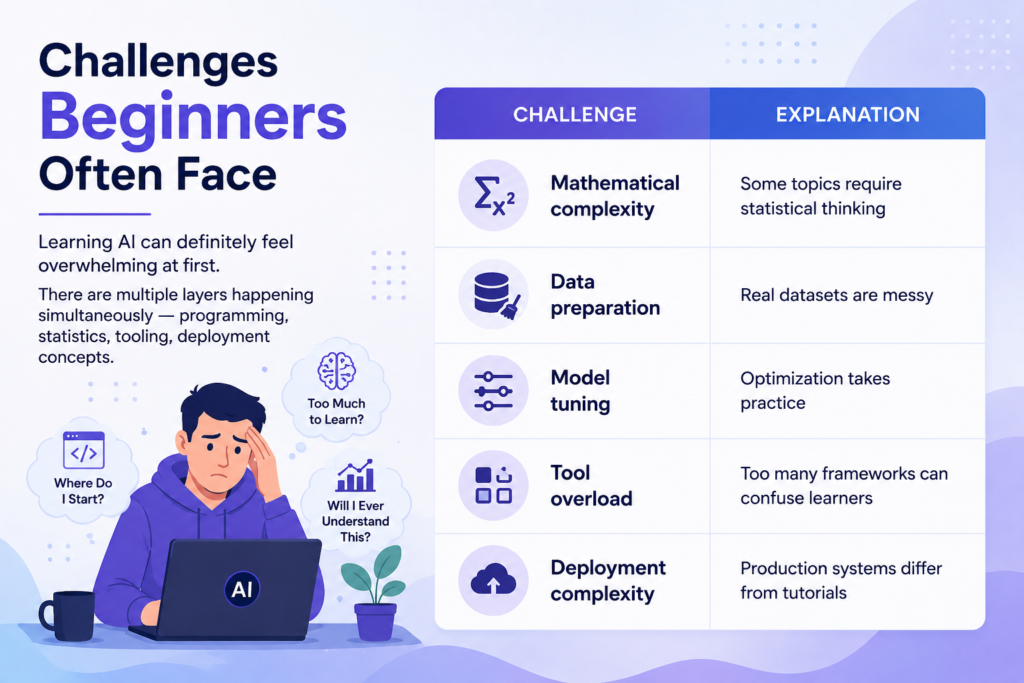
| Challenge | Explanation |
|---|---|
| Mathematical complexity | Some topics require statistical thinking |
| Data preparation | Real datasets are messy |
| Model tuning | Optimization takes practice |
| Tool overload | Too many frameworks can confuse learners |
| Deployment complexity | Production systems differ from tutorials |
A few practices make the process easier:
- Focus on one framework first
- Build smaller projects before bigger ones
- Learn workflows before optimization
- Practice consistently instead of cramming
- Learn Git early
Honestly, repetition matters more than memorization.
Practicing AI Skills Effectively
The strongest learners usually combine guided instruction with independent experimentation.
Good beginner exercises include:
- Spam filters
- Recommendation systems
- Sentiment analysis projects
- Basic chatbots
Public datasets help a lot too:
- Titanic dataset
- MNIST dataset
- IMDB sentiment dataset
- Housing price datasets
Many learners also benefit from practicing with cloud services like:
- AWS
- Microsoft Azure
- Google Cloud Platform
That exposure helps bridge the gap between AI Learning Path for Beginners and enterprise deployment.
Different Types of Online AI Programs
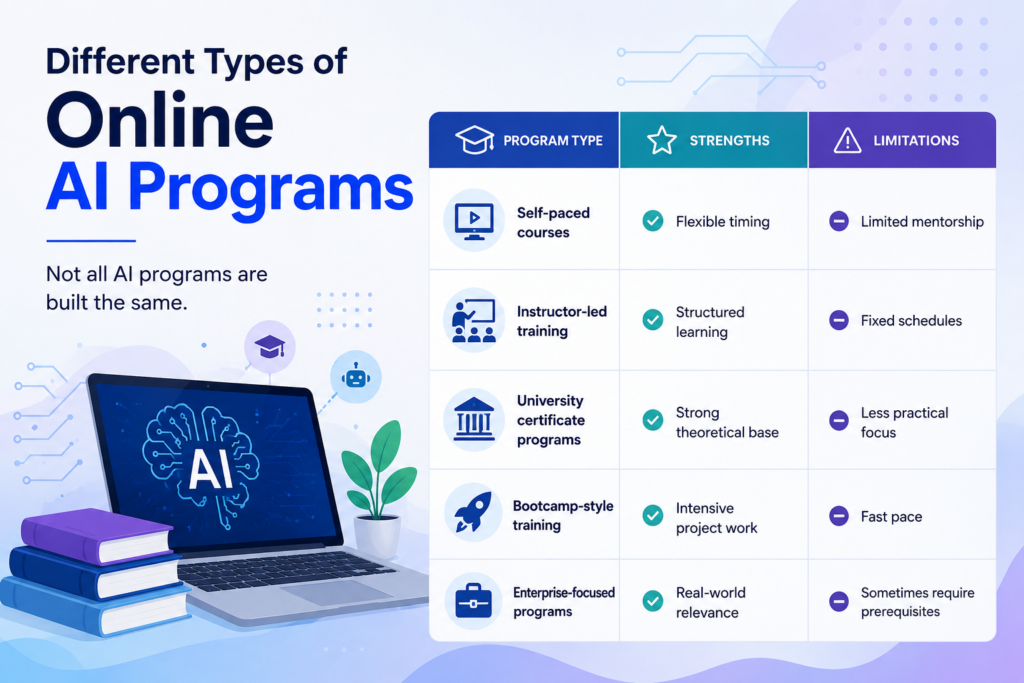
Not all AI programs are built the same.
| Program Type | Strengths | Limitations |
|---|---|---|
| Self-paced courses | Flexible timing | Limited mentorship |
| Instructor-led training | Structured learning | Fixed schedules |
| University certificate programs | Strong theoretical base | Less practical focus |
| Bootcamp-style training | Intensive project work | Fast pace |
| Enterprise-focused programs | Real-world relevance | Sometimes require prerequisites |
Many beginners do better with instructor-led or project-oriented programs because they provide accountability and clearer progression.
What Makes an AI Course Enterprise-Relevant?
Enterprise-focused AI Learning Path for Beginners usually reflects real production environments rather than isolated classroom examples.
Strong programs often include:
Real Data Pipelines
Learners practice:
- Data ingestion
- Cleaning workflows
- Transformation pipelines
Deployment Concepts
Topics may include:
- API integration
- Monitoring
- Scalability
- Security considerations
Collaboration Tools
Professional teams commonly use:
- GitHub
- Jira
- CI/CD pipelines
- Cloud repositories
Understanding collaborative workflows improves workplace readiness significantly.
Frequently Asked Questions
Do beginners need coding experience?
Not necessarily. Many beginner AI Learning Path for Beginners start with Python fundamentals before introducing machine learning concepts.
How long does it take to learn AI?
For part-time AI Learning Path for Beginners, foundational skills often take several months. Advanced proficiency usually develops through long-term project experience.
Which language is best for AI?
Python is still the dominant language because of its readability and massive ecosystem.
Do employers care about AI certificates?
Most employers care more about practical skills, project portfolios, and real implementation experience than certificates alone.
Is mathematics mandatory?
Some math is important especially statistics and probability but AI Learning Path for Beginners programs usually introduce concepts gradually.
What industries hire AI professionals?
Healthcare, finance, cybersecurity, retail, manufacturing, logistics, and cloud computing all actively use AI systems.
Final Thoughts
AI Learning Path for Beginners works best when theory and practice grow together. The strongest Artificial Intelligence Online Programs focus on structured progression, real-world projects, cloud-based experimentation, and enterprise-style workflows not just isolated tutorials.
People AI Learning Path for Beginners are often balancing jobs, responsibilities, and skill transitions at the same time. Because of that, practical learning paths usually outperform purely academic approaches.
A few key takeaways stand out:
- Start with Python and data analysis fundamentals
- Build projects early and consistently
- Learn workflows, not just algorithms
- Practice with industry-standard tools
- Understand deployment and scalability concepts
- Keep experimenting, even when projects fail
That last part matters more than most people expect.
Explore AI Learning Path for Beginners from H2K Infosys to gain practical, hands-on experience with modern AI tools, workflows, and enterprise-focused training designed for working professionals and beginners entering the field.