The best artificial intelligence courses are not necessarily the ones with the longest syllabus or the most impressive certificate. The right course is the one that matches your career goal, teaches skills you can actually use, gives you hands-on project experience, and if getting hired is the goal provides meaningful career and placement support.
That last point matters more in 2026 than it did a few years ago.
AI hiring in India is moving beyond traditional machine-learning roles. Companies are increasingly looking for people who can build AI agents, work with generative AI, integrate LLMs into business workflows, and actually deploy AI solutions. At the same time, companies are reporting difficulty finding professionals with advanced AI, data, cloud and related skills.
So, if you’re comparing dozens of AI programs right now, don’t just ask, “What will I learn?”
Ask, “What will I be able to do with these skills when the course is over?”
Start With Your Career Goal, Not the Course
This sounds obvious, but it is probably the mistake I see most often when people start researching AI training.
Someone searches for an AI course, finds a program covering Python, machine learning, deep learning, NLP, generative AI and a dozen other topics, and thinks, “This must be good.”
Not necessarily.
AI is a huge field. A person trying to become a Machine Learning Engineer needs a different learning path from someone who wants to move from QA into AI or a business analyst who wants to work with GenAI tools.
Before choosing a course, identify your target.
For example:
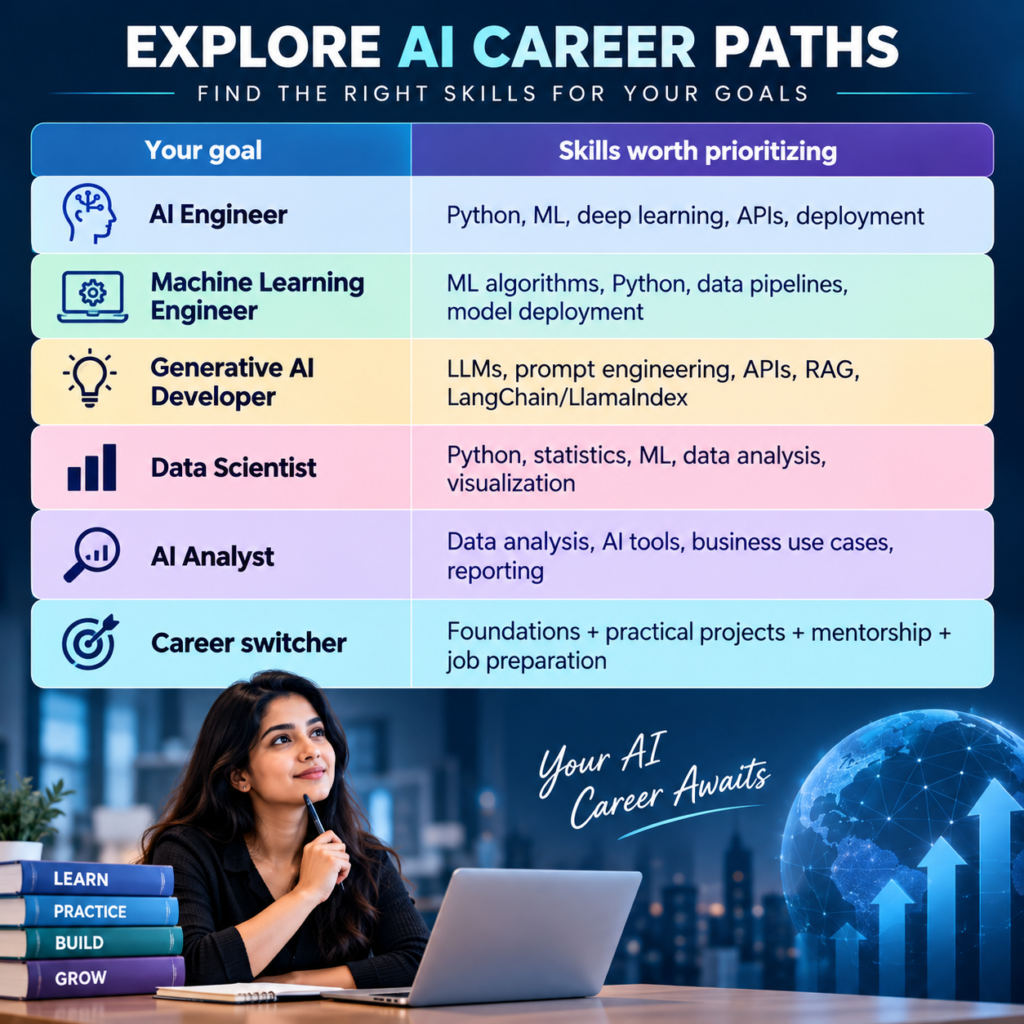
This is one reason a structured program can be useful. Instead of collecting random tutorials from five different platforms, you have a sequence to follow.
Look for Practical AI Training, Not Just Theory
Here’s a simple test.
Suppose you’ve completed six months of AI learning. A recruiter asks:
“Tell me about an AI project you’ve worked on.”
If your answer is, “I completed a course and learned neural networks,” you’re probably not ready yet.
A stronger answer sounds more like:
“I worked on a customer-churn prediction project, prepared the data, trained and evaluated different models, and explained why I selected the final approach.”
Or:
“I built an LLM application using retrieval-augmented generation and worked through how the system retrieves relevant information before generating an answer.”
That difference knowing a concept versus being able to apply it is huge.
Current AI education is moving in exactly this direction. For example, IIT Hyderabad’s 2026 Applied AI Professional Certification program emphasizes building, evaluating and deploying a production-style AI agent, with topics including RAG, multi-agent systems, evaluation, observability and guardrails.
That’s a useful signal when evaluating any course: does it make you build things, or simply watch someone else build them?
Check Whether the Curriculum Matches the 2026 AI Job Market
AI changes ridiculously fast. A course that looked comprehensive a few years ago can feel incomplete today.
You don’t necessarily need every trendy tool, though. That’s another trap.
A good curriculum should have solid foundations while also covering technologies that employers are actually using.
Depending on your career goal, look for areas such as:
- Python and data fundamentals
- Machine learning
- Deep learning and neural networks
- Natural language processing
- Generative AI
- Large language models
- Prompt engineering
- APIs and AI application development
- RAG
- Model evaluation
- AI deployment and MLOps/LLMOps
- Responsible AI and security
For instance, H2K Infosys’s current Artificial Intelligence Online Training curriculum includes machine learning, deep learning, NLP, neural networks, TensorFlow, Keras, NumPy, MLOps and LLMOps, along with practical project work.
Its separate Generative AI program also covers prompt engineering, LangChain, API integration and GenAI application deployment.
The important thing isn’t simply that these words appear on a syllabus. Ask how deeply you’ll actually work with them.
Don’t Underestimate Real-Time Project Experience
This is where online courses can differ dramatically.
A project doesn’t have to be a giant research project. In fact, I’d rather see a learner complete three sensible business-oriented projects than download ten GitHub projects and struggle to explain any of them.
Good project examples could include:
- Customer churn prediction
- Fraud detection
- Recommendation systems
- Sentiment analysis
- Document classification
- Customer-support chatbots
- RAG-based knowledge assistants
- AI-powered data analysis
- Predictive business models
The project should ideally force you to deal with the slightly annoying parts of AI messy data, model selection, evaluation, debugging and explaining your decisions.
That’s where learning becomes real.
H2K Infosys positions its AI training around hands-on projects, real-world applications and a cloud-based test lab, rather than purely theoretical learning.
What About AI Training and Placement?
This is probably the question career switchers care about most.
And honestly, it’s a fair question.
Learning AI and finding an AI job are two different problems.
You can finish a technically strong course and still struggle because your resume isn’t positioned properly, you can’t explain your projects, or you haven’t practiced technical interviews.
That’s why AI training and placement should be evaluated as a complete process rather than treated as a marketing phrase.
Look for support such as:
- Resume building
- LinkedIn/profile guidance
- Technical interview preparation
- Mock interviews
- Project presentation practice
- Job application guidance
- Career mentoring
- Employer/recruiter connections where available
H2K Infosys says its AI program includes resume assistance, AI-focused mock interviews and job-placement support. Its recent career-focused material also describes support around resume preparation, mock interviews, project presentation and job applications.
One important reality check, though: placement support isn’t the same thing as a guaranteed job.
No course can replace your effort, interview performance, communication skills or ability to demonstrate competence. Be suspicious of any program that makes employment sound automatic.
Are AI Courses Online With Job Support Worth It?
They can be especially if you’re a beginner or career switcher who doesn’t know how to connect learning with an actual job search.
Think about the alternative.
You could spend months watching free videos:
Python tutorial → machine learning tutorial → ChatGPT tutorial → random Kaggle project → another GenAI course.
Six months later, you may know quite a bit.
But you might still be asking:
“Okay… what job should I apply for?”
That is where structured AI courses online with job support can have an advantage.
You get a defined learning path, projects, feedback and career preparation in one place.
H2K Infosys, for example, describes its AI pathway as combining training, real-world projects, mentorship, certification and placement assistance.
For someone changing careers, that structure can save a surprising amount of time.
Consider Your Background Before Picking a Course
You don’t necessarily need to be a computer science graduate to begin learning AI.
But your starting point matters.
If you’re a software developer
You may be able to move faster through Python and programming fundamentals and spend more time on ML, GenAI, APIs and deployment.
If you’re from QA/testing
AI automation, data, Python and machine learning can create an interesting bridge into AI-focused roles. You may already have an advantage in testing AI systems and thinking about edge cases.
If you’re a data analyst
You’re already working with data, which gives you a useful foundation. Your next step might be statistics, machine learning, predictive modeling and GenAI.
If you’re a complete beginner
Don’t rush straight into advanced LLM architecture.
Start with Python, data concepts and basic machine learning. Build confidence first. It may feel slower during the first few weeks, but you’ll thank yourself later.
H2K Infosys says its AI training is intended for beginners as well as career changers and focuses on progressing from foundational concepts toward practical skills.
Certification Is Useful, But It Isn’t the Finish Line
Let’s be honest: certificates look nice on a resume.
But recruiters aren’t hiring a PDF.
They’re hiring someone who can solve problems.
A certification becomes much more valuable when it’s backed by:
skills + projects + practical experience + communication + interview readiness.
So when comparing the best artificial intelligence courses, don’t rank programs solely by the name of the certificate.
Ask:
- What projects will I complete?
- Can I explain those projects?
- Will I receive feedback?
- Will I work with current AI tools?
- Does the program teach deployment?
- Is there mentorship?
- What career support is included?
That’s a much better checklist.
Pay Attention to What’s Happening in the Real AI Market
The employment landscape makes this even more important.
Wipro recently said its AI initiatives had freed capacity equivalent to about 20,000 employees, while the company had trained more than 100,000 employees in advanced AI skills. The broader shift is toward a human-AI operating model rather than simply replacing every worker with automation.
Meanwhile, India’s enterprise AI investment continues to rise, with ServiceNow’s 2026 research indicating that AI’s share of Indian IT budgets is expected to grow further through 2027.
And there is a catch.
More AI adoption doesn’t automatically mean everyone who completes an AI course gets hired. Employers increasingly want people who can connect AI with actual business outcomes.
That’s why practical training matters.
Why H2K Infosys Can Be a Practical Option
If your goal is specifically to move from learning AI to becoming job-ready, H2K Infosys is worth considering.
Its current AI program combines foundational AI concepts with machine learning, deep learning, NLP and newer AI technologies, alongside hands-on projects and career assistance.
The approach is particularly relevant for learners who don’t want to figure everything out alone.
You can learn the technology, work through projects, practice explaining what you’ve built, prepare your resume and work on interviews as part of the same career journey.
And if your interest is specifically Generative AI, H2K Infosys also has a dedicated program covering LLM fundamentals, prompt engineering, APIs, LangChain, LlamaIndex and GenAI application development.
That makes it easier to choose a path based on where you want to go rather than trying to squeeze every AI topic into one course.
A Simple Checklist Before You Enroll
Before paying for any AI program, ask these 10 questions:
- Does the course match my target job?
- Is the curriculum current for 2026?
- How much is hands-on versus theoretical?
- Will I build portfolio-worthy projects?
- Will I work with current AI/GenAI tools?
- Is there instructor or mentor support?
- Are mock interviews included?
- Will someone help improve my resume?
- What exactly does “placement support” mean?
- Can I attend a demo session before enrolling?
That last question is underrated.
If a training provider offers a demo, use it. Pay attention to how the instructor explains difficult concepts. Ask questions. See whether the teaching style works for you.
A flashy website can’t tell you that.
What are the best artificial intelligence courses for beginners?
The best artificial intelligence courses for beginners should start with Python, data fundamentals, machine learning basics and gradually move into deep learning and generative AI. Look for a program that combines theory with hands-on projects, mentorship and career guidance rather than focusing only on certification.
How do I choose the right AI course for my career goals?
Start by identifying the role you want such as AI Engineer, Machine Learning Engineer, Data Scientist or Generative AI Developer. Then compare the course curriculum, practical projects, tools covered, instructor support and career services against the skills required for that role.
Are AI courses online with job support worth it?
They can be particularly useful for beginners and career switchers. Along with technical training, good programs can provide resume assistance, mock interviews, project guidance and job-search support, helping learners connect their training with the hiring process.
What is the difference between AI and Generative AI courses?
A broader AI course may cover machine learning, deep learning, NLP and related AI foundations. A Generative AI course focuses more specifically on technologies such as large language models, prompt engineering, RAG, AI APIs and building applications around generative models.
Can I learn AI online and prepare for AI jobs at the same time?
Yes. Online learning can work well when the program includes instructor guidance, practical assignments, portfolio projects and career preparation. The key is to consistently apply what you learn instead of treating the course as a series of videos to complete.
What should I check before enrolling in an AI course?
Check the curriculum, instructor experience, project work, tools and technologies covered, mentorship, learning format, certification, interview preparation and exactly what the provider means by placement assistance. If possible, attend a demo class before making your decision.
Final Thoughts
Choosing among the best artificial intelligence courses isn’t really about finding the course with the biggest syllabus. It’s about finding the shortest realistic path between where you are now and the AI role you want next.
In 2026, that usually means combining fundamentals with practical projects, modern GenAI skills, deployment knowledge and career preparation.
If you’re specifically looking for AI training and placement, H2K Infosys is worth a closer look because its current offering brings training, hands-on projects, certification and career/placement assistance into one pathway.
And if you prefer learning remotely while still having structured guidance, AI courses online with job support can be a much more practical choice than trying to piece together your entire career transition from disconnected tutorials.
The goal isn’t simply to say, “I learned AI.”
The better goal is to reach the point where you can confidently say:
“Here is what I built, here is the problem it solves, here is how I built it and here’s why I’d be useful to your team.”
That’s the kind of AI learning that can actually move a career forward.