

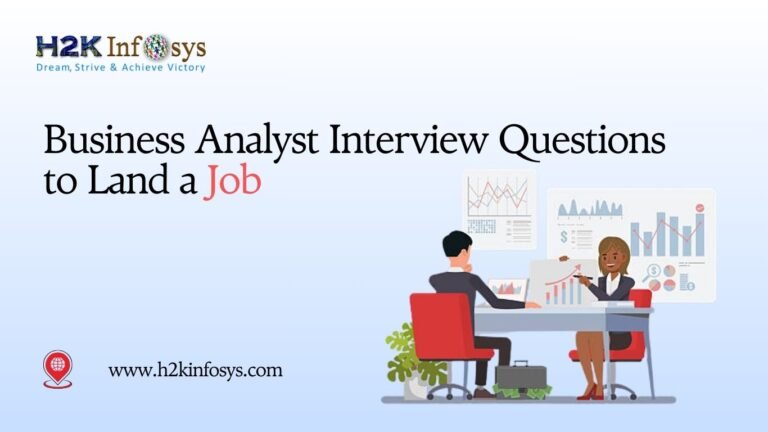
In today’s data-driven and customer-focused business environment, the role of a Business Analyst (BA) has become mission-critical across industries such as IT, finance, healthcare, e-commerce, and consulting. Companies are actively hiring skilled professionals who can bridge the gap between business needs and technology solutions. However, landing a Business Analyst role requires more than just theoretical knowledge it demands practical skills, domain understanding, and strong interview performance.
This comprehensive guide on Business Analyst Interview Questions is designed to help you confidently prepare for interviews and secure a high-paying BA role. Whether you are a fresher, career switcher, or working professional upskilling through a business analyst course, this article will walk you through commonly asked questions, real-world scenarios, and expert tips used by hiring managers.
Why Business Analyst Interview Preparation Matters
Business Analyst interviews are known for being multi-layered. Employers evaluate candidates on:
- Analytical and critical thinking
- Requirement gathering and documentation
- Communication and stakeholder management
- Knowledge of tools, methodologies, and frameworks
- Problem-solving using real-world scenarios
Unlike purely technical roles, BA interviews test how you think, not just what you know. This is why structured preparation through business analyst classes and mock interviews plays a crucial role in success.
Core Categories of Business Analyst Interview Questions
Business Analyst Interview Questions typically fall into the following categories:
- General Business Analyst Questions
- Requirement Gathering & Documentation
- Business Analysis Techniques & Methodologies
- Agile & Scrum-Based Questions
- Technical & Tool-Based Questions
- Scenario-Based and Behavioral Questions
- Advanced & Role-Specific Questions
Let’s explore each category in detail.
1. General Business Analyst Interview Questions
1. What is the role of a Business Analyst?
A Business Analyst acts as a liaison between stakeholders and technical teams. The BA identifies business problems, gathers and analyzes requirements, proposes solutions, and ensures that delivered solutions align with business objectives.
Interview Tip: Emphasize communication, analysis, and value delivery not just documentation.
2. What skills are required to be a successful Business Analyst?
Key skills include:
- Requirement elicitation and analysis
- Stakeholder management
- Data analysis (Excel, SQL, Power BI)
- Communication and presentation
- Problem-solving
- Knowledge of Agile/Scrum
- Documentation skills (BRD, FRD, User Stories)
These skills are covered extensively in a professional business analyst certification online program.
3. Why do you want to become a Business Analyst?
Employers want to understand your motivation. A strong answer should include:
- Interest in solving business problems
- Passion for data-driven decision-making
- Enjoyment in working across teams
- Career growth opportunities in BA roles
2. Requirement Gathering & Documentation Questions
4. What are requirements in business analysis?
Requirements define what a system or process must do to meet business needs. They can be:
- Business requirements
- Stakeholder requirements
- Functional requirements
- Non-functional requirements
5. What techniques do you use for requirement elicitation?
Common techniques include:
- Interviews
- Workshops
- Brainstorming sessions
- Surveys and questionnaires
- Observation
- Document analysis
- Prototyping
In business analysis training, learners practice these techniques using real-time case studies.
6. What documents does a Business Analyst create?
Key BA documents include:
- Business Requirement Document (BRD)
- Functional Requirement Document (FRD)
- Software Requirement Specification (SRS)
- User Stories
- Use Case Diagrams
- Process Flow Diagrams
- Gap Analysis Documents
7. What is the difference between BRD and FRD?
| BRD | FRD |
|---|---|
| Focuses on business needs | Focuses on functional system details |
| High-level | Detailed and technical |
| Written for stakeholders | Written for developers |
3. Business Analysis Techniques & Methodologies
8. What is SWOT analysis?
SWOT stands for:
- Strengths
- Weaknesses
- Opportunities
- Threats
It is used to evaluate internal and external factors affecting a business.
9. What is GAP analysis?
GAP analysis identifies the difference between the current state and desired future state, helping organizations plan improvements effectively.
10. What is MoSCoW prioritization?
MoSCoW is a prioritization technique:
- Must have
- Should have
- Could have
- Won’t have (for now)
11. What methodologies are you familiar with?
Most Business Analysts work with:
- Waterfall
- Agile
- Scrum
- Kanban
- Hybrid models
Modern business analyst classes emphasize Agile-based BA roles due to market demand.
4. Agile & Scrum Business Analyst Interview Questions
12. What is the role of a Business Analyst in Agile?
In Agile, a BA:
- Works closely with Product Owner
- Writes and refines user stories
- Grooms the backlog
- Participates in sprint planning
- Clarifies requirements for developers
- Accepts completed features
13. What is a user story?
A user story describes a feature from the user’s perspective:
As a [user], I want [feature] so that [benefit].
14. What are acceptance criteria?
Acceptance criteria define conditions that must be met for a user story to be considered complete.
15. Difference between Agile and Waterfall?
| Agile | Waterfall |
|---|---|
| Iterative | Sequential |
| Flexible | Rigid |
| Continuous feedback | Limited feedback |
| Faster delivery | Slower delivery |
5. Technical & Tool-Based Interview Questions
16. What tools do Business Analysts use?
Popular BA tools include:
- Jira
- Confluence
- MS Excel
- SQL
- Power BI / Tableau
- Visio
- Balsamiq
- Lucidchart
Hands-on exposure to these tools is a key focus of ba training and placement programs at H2K Infosys.
17. How do you use SQL as a Business Analyst?
SQL is used to:
- Extract data
- Validate reports
- Identify trends
- Support data-driven decisions
18. What is UML?
Unified Modeling Language (UML) helps visualize system design using:
- Use case diagrams
- Activity diagrams
- Sequence diagrams
- Class diagrams
6. Scenario-Based Business Analyst Interview Questions
19. How do you handle conflicting stakeholder requirements?
Steps:
- Understand each stakeholder’s priority
- Analyze business impact
- Facilitate discussions
- Propose data-backed solutions
- Get consensus and approval
20. What would you do if requirements change mid-project?
- Perform impact analysis
- Update documentation
- Communicate changes
- Re-prioritize scope
- Work with project managers and stakeholders
21. How do you ensure requirements are correctly implemented?
- Requirement traceability matrix (RTM)
- Regular walkthroughs
- UAT participation
- Continuous communication with developers
7. Behavioral Business Analyst Interview Questions
22. Describe a challenging project you worked on.
Use the STAR method:
- Situation
- Task
- Action
- Result
23. How do you manage tight deadlines?
- Prioritize tasks
- Communicate clearly
- Break work into milestones
- Collaborate effectively
24. How do you deal with ambiguity?
Strong BAs:
- Ask the right questions
- Analyze available data
- Validate assumptions
- Document clarity progressively
Advanced Business Analyst Interview Questions
25. What is a Requirement Traceability Matrix (RTM)?
RTM maps requirements to test cases, ensuring complete coverage and preventing scope creep.
26. What KPIs do Business Analysts track?
- Process efficiency
- Cost reduction
- Customer satisfaction
- Time-to-market
- Defect leakage
27. Difference between Business Analyst and Data Analyst?
| Business Analyst | Data Analyst |
|---|---|
| Focus on business processes | Focus on data patterns |
| Requirement gathering | Data modeling & analytics |
| Stakeholder interaction | Technical data work |
How H2K Infosys Prepares You for BA Interviews
At H2K Infosys, our business analyst course is designed with job placement as the primary goal.
Program Highlights:
- Live instructor-led sessions
- Real-time projects
- Agile & Scrum-focused curriculum
- Hands-on tools training (Jira, SQL, Power BI)
- Resume building workshops
- Mock interviews with real feedback
- Dedicated ba training and placement support
Our business analyst certification online is trusted by professionals transitioning into BA roles globally.
Tips to Crack Business Analyst Interviews
- Understand the business context, not just tools
- Practice scenario-based questions
- Learn to explain concepts clearly
- Showcase real-world problem-solving
- Prepare project-based examples
- Attend mock interviews
Enrolling in structured business analysis training significantly improves confidence and success rates.
Conclusion
Preparing for Business Analyst Interview Questions is not about memorizing answers it’s about developing the mindset of a problem solver, communicator, and strategist. With the right training, hands-on experience, and interview guidance, landing a Business Analyst role becomes achievable and sustainable.
If you’re serious about building a successful BA career, investing in professional business analyst classes with placement support can be a game-changer.
Start your journey with H2K Infosys today where learning meets real-world success.



















One Response
The emphasis on practical skills in this post is spot on! I’ve found that many interviewers for BA roles focus on your ability to solve real-world problems, not just recite textbook definitions. It’s about demonstrating your problem-solving abilities, not just your knowledge.