
Introduction
The role of a Business Analyst is changing fast in 2026. Companies now expect more than just documentation and requirement gathering. They expect data-driven decisions, AI awareness, and strong business impact. If you plan to build a career in this field, you must understand the latest business analyst job trends shaping the industry.
Organizations across industries such as banking, healthcare, retail, and technology now rely on Business Analysts to guide digital transformation. This shift creates new opportunities but also demands new skills. Many professionals now explore business analyst courses, pursue a Business analyst certification, or enroll in business analyst training with placement to stay competitive.
In this guide, you will learn the most important business analyst job trends for 2026. You will also learn how to prepare, what skills to focus on, and how to apply these trends in real-world projects.
Why Business Analyst Roles Are Growing in 2026
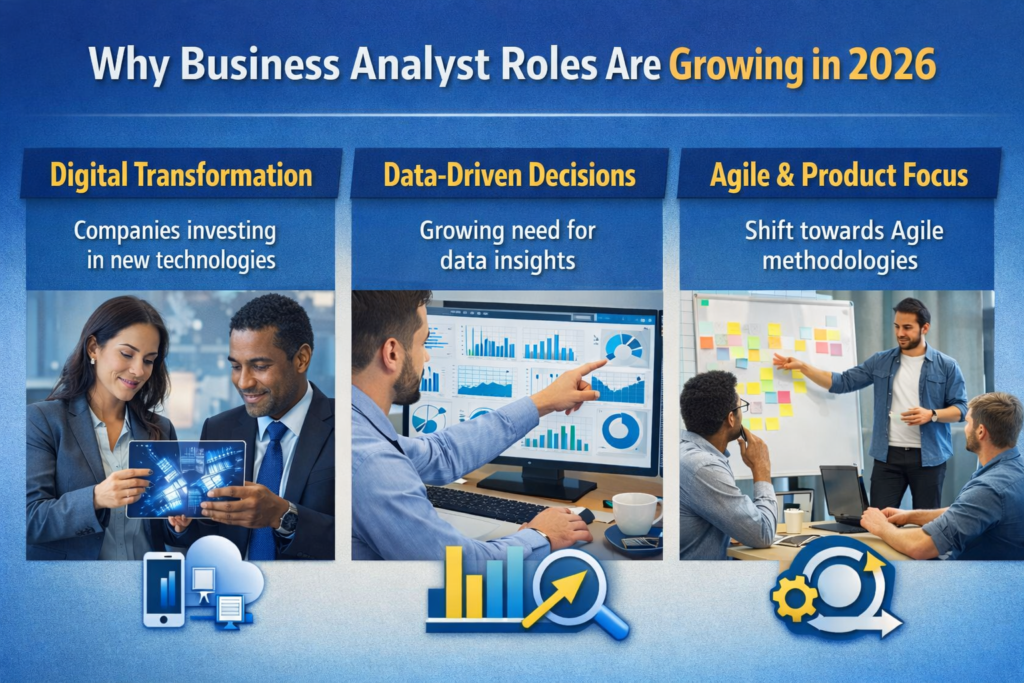
The demand for Business Analysts continues to grow due to several key factors:
Digital Transformation Across Industries
Companies invest heavily in digital systems. They need professionals who can translate business needs into technical solutions.
Rise of Data-Driven Decisions
Organizations now rely on data insights. Business Analysts help convert raw data into meaningful strategies.
Agile and Product-Based Work
Teams now follow Agile frameworks. Business Analysts work closely with developers, testers, and product owners.
These factors directly influence business analyst job trends and shape how professionals work in 2026.
Top Business Analyst Job Trends in 2026
1. Strong Demand for Data Analytics Skills
Data is central to decision-making. Business Analysts now work with tools like:
- SQL
- Excel
- Power BI
- Tableau
- Python basics
Companies expect analysts to interpret data, create dashboards, and present insights.
Example:
A retail company tracks customer behavior. A Business Analyst uses SQL to extract data and Power BI to create reports. The company uses this data to improve sales strategy.
This shift is one of the most important business analyst job trends today.
2. Integration of AI and Machine Learning
AI is changing how businesses operate. Business Analysts do not build AI models, but they must understand:
- AI use cases
- Data requirements
- Business impact
Example:
A banking system uses AI to detect fraud. A Business Analyst defines requirements, validates outputs, and ensures the system meets business goals.
Understanding AI is now a key part of business analyst job trends.
3. Agile and Scrum Are Standard Practices
Most companies now use Agile methods. Business Analysts must:
- Write user stories
- Participate in sprint planning
- Work with Scrum teams
Sample User Story:
As a customer,
I want to view my transaction history,
So that I can track my expenses.
This hands-on Agile work is a major shift in business analyst job trends.
4. Focus on Domain Knowledge
Companies prefer analysts with domain expertise such as:
- Banking and finance
- Healthcare
- Insurance
- E-commerce
Domain knowledge helps analysts understand business problems faster.
This specialization is shaping business analyst job trends across industries.
5. Increased Use of Business Analysis Tools
Modern tools improve efficiency and collaboration. Common tools include:
- JIRA
- Confluence
- Microsoft Visio
- Lucidchart
Example:
A Business Analyst uses JIRA to track tasks and Confluence to document requirements.
Tool proficiency is now a key factor in business analyst job trends.
6. Remote and Hybrid Work Opportunities
Remote work is now common. Business Analysts collaborate using:
- Zoom
- Microsoft Teams
- Slack
This flexibility allows companies to hire talent globally.
Remote work continues to influence business analyst job trends.
7. Emphasis on Communication Skills
Communication is critical. Analysts must:
- Explain technical concepts in simple terms
- Conduct stakeholder meetings
- Write clear documentation
Strong communication directly impacts project success and reflects evolving business analyst job trends.
8. Shift Toward Product Ownership
Some Business Analysts now take on product roles. They:
- Define product vision
- Prioritize features
- Work with stakeholders
This trend expands career growth and reflects modern business analyst job trends.
9. Cybersecurity Awareness
Security is now a priority. Business Analysts must understand:
- Data protection rules
- Risk assessment
- Compliance requirements
This knowledge supports secure system design and aligns with business analyst job trends.
10. Demand for Certification and Structured Learning
Employers value structured learning paths. Many professionals pursue:
- Business analyst courses
- Business analyst certification
- business analyst training with placement
These programs help candidates gain practical skills and industry knowledge.
This learning focus is a strong indicator of business analyst job trends.
Skills You Need to Succeed in 2026
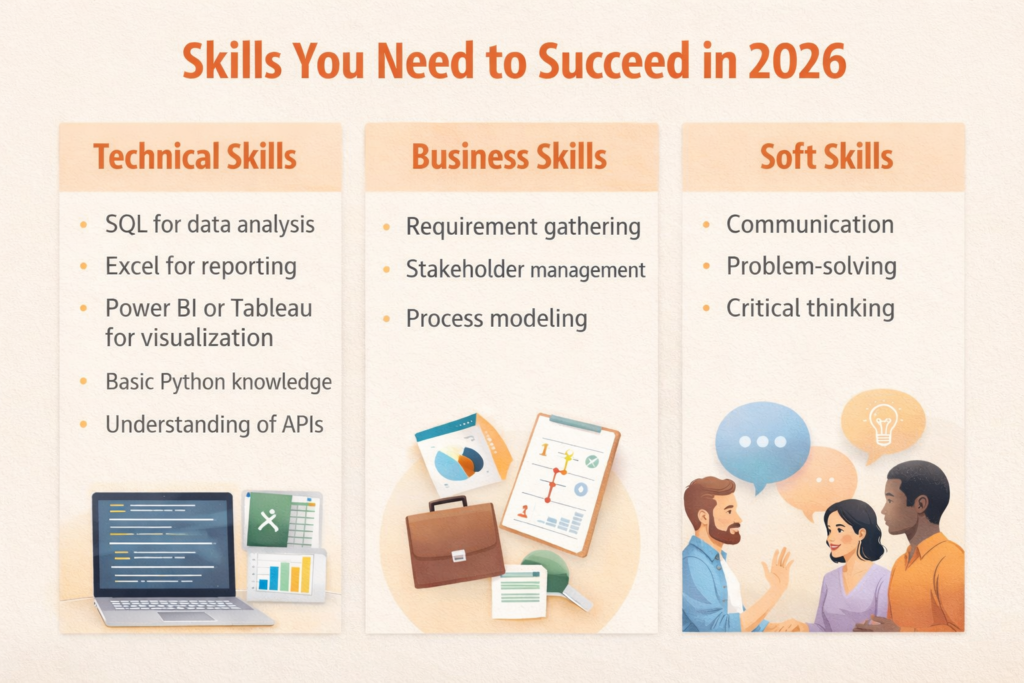
To match current business analyst job trends, you must build both technical and soft skills.
Technical Skills
- SQL for data analysis
- Excel for reporting
- Power BI or Tableau for visualization
- Basic Python knowledge
- Understanding of APIs
Business Skills
- Requirement gathering
- Stakeholder management
- Process modeling
Soft Skills
- Communication
- Problem-solving
- Critical thinking
Step-by-Step Guide to Becoming a Business Analyst
Step 1: Learn the Basics
Start with fundamentals:
- Business analysis concepts
- SDLC and Agile
- Documentation techniques
Many learners begin with business analyst courses to build a strong foundation.
Step 2: Build Technical Skills
Focus on tools and technologies:
- Learn SQL queries
- Practice Excel dashboards
- Create sample reports
Step 3: Work on Real Projects
Practice real-world scenarios:
- Create mock business requirements
- Build dashboards
- Write user stories
This hands-on learning aligns with business analyst job trends.
Step 4: Get Certified
A Business analyst certification helps validate your skills. It improves your credibility and job prospects.
Step 5: Apply for Jobs
Prepare for roles by:
- Building a strong resume
- Practicing interview questions
- Applying for roles with practical experience
Many candidates choose business analyst training with placement to gain support during this phase.
Real-World Case Study
Case Study: E-commerce Platform Improvement
A company wants to improve its online sales.
Problem:
Low conversion rate.
Solution:
A Business Analyst performs the following:
- Collects website data
- Identifies user drop-off points
- Suggests UI improvements
- Works with developers to implement changes
Result:
Sales increase by 25 percent.
This example shows how modern business analyst job trends focus on data-driven decisions and measurable results.
Tools and Technologies in Demand
Here are tools aligned with current business analyst job trends:
Data Tools
- SQL
- Excel
- Power BI
Collaboration Tools
- JIRA
- Confluence
Modeling Tools
- Lucidchart
- Visio
Challenges Business Analysts Face in 2026
Even with growth, challenges exist:
Rapid Technology Changes
New tools require continuous learning.
High Expectations
Companies expect quick and accurate results.
Complex Stakeholder Needs
Different stakeholders have different priorities.
Understanding these challenges helps you stay aligned with business analyst job trends.
Future Outlook for Business Analysts
The future looks strong. Key predictions include:
- More AI integration
- Increased demand for data skills
- Greater focus on business value
These predictions reinforce the importance of following business analyst job trends.
Key Takeaways
- Business Analysts play a key role in digital transformation
- Data and AI skills are essential
- Agile and product roles are increasing
- Communication and domain knowledge are critical
- Continuous learning is necessary
Understanding these business analyst job trends will help you build a strong and future-ready career.
Conclusion
The role of a Business Analyst is evolving quickly. You must adapt to new tools, technologies, and business needs to stay relevant.
Start learning today, build practical skills, and align your career with the latest business analyst job trends to succeed in 2026.