Yes, it is possible to switch careers into Artificial Intelligence (AI) from QA, support, sales, or non-IT backgrounds if you build foundational technical skills, understand data workflows, and learn how AI models are applied in real business environments. At H2K Infosys, structured AI Certified Courses are designed to support learners transitioning from diverse professional backgrounds into AI-focused roles. Many AI roles require a mix of domain knowledge, data literacy, and problem-solving skills rather than only advanced programming expertise.
What is Switching Careers into AI?
Switching careers into AI means moving from an existing professional domain into roles that involve building, testing, deploying, or supporting artificial intelligence systems. This transition typically requires learning data fundamentals, machine learning concepts, and practical AI tool usage rather than immediately becoming a research scientist.
AI careers include multiple layers:
- Data handling and preparation
- Model development and evaluation
- AI system testing and monitoring
- AI product implementation
- AI business integration
For professionals coming from QA, support, sales, or non-IT roles, the transition usually happens through applied AI roles rather than deep research roles.
Why Is AI Career Transition Important for Working Professionals?
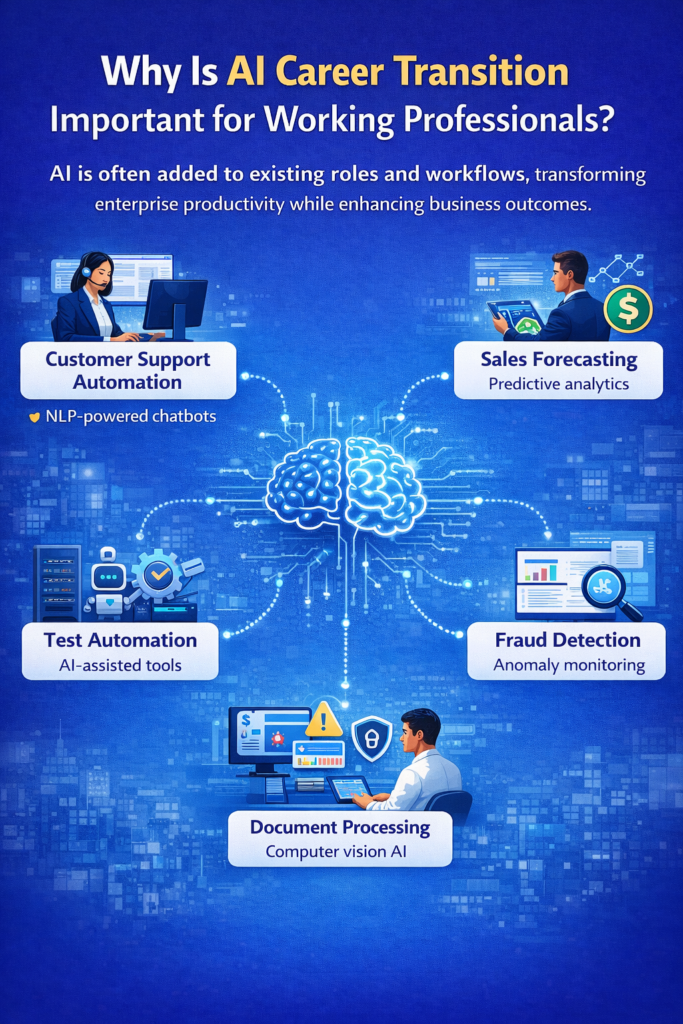
AI is becoming part of mainstream enterprise technology stacks. Online AI programs at H2K Infosys help professionals understand how AI integrates into real business workflows and enterprise systems. Instead of replacing existing roles entirely, AI is often integrated into existing workflows.
Common Enterprise AI Adoption Areas
- Customer support automation using NLP
- Sales forecasting using predictive analytics
- Test automation using AI-assisted tools
- Fraud detection and anomaly monitoring
- Document processing using computer vision
Working professionals often transition successfully because they already understand business workflows.
How Does AI Work in Real-World IT Projects?
AI projects follow structured enterprise workflows rather than isolated model development.
Typical Enterprise AI Workflow
| Stage | Description | Tools Commonly Used |
|---|---|---|
| Data Collection | Collect structured or unstructured data | SQL, APIs, Data Lakes |
| Data Cleaning | Remove inconsistencies | Python, Pandas |
| Feature Engineering | Prepare input variables | Python, Feature Stores |
| Model Training | Train AI models | TensorFlow, PyTorch, Scikit-Learn |
| Model Testing | Validate accuracy and bias | MLflow, Weights & Biases |
| Deployment | Push to production | Docker, Kubernetes |
| Monitoring | Track model performance | Prometheus, Grafana |
How Do Different Backgrounds Transition into AI?
Transition from QA to AI
QA professionals often move into:
- AI Testing Engineer
- ML Validation Specialist
- Data Quality Analyst
- Automation Engineer (AI-assisted testing)
Transferable Skills from QA
- Test case design → Model validation testing
- Bug tracking → Model failure monitoring
- Automation frameworks → AI testing pipelines
Transition from Support Roles to AI
Support professionals often transition into:
- AI Operations (AIOps) roles
- AI Product Support Specialist
- Data Operations Analyst
Transferable Skills from Support
- Log analysis → Model output monitoring
- Incident handling → AI failure triaging
- Customer troubleshooting → AI product debugging
Transition from Sales or Business Roles to AI
Sales professionals often move into:
- AI Business Analyst
- AI Product Consultant
- AI Solutions Specialist
Transferable Skills from Sales
- Customer needs mapping → AI use case identification
- CRM workflows → AI integration understanding
- Business metrics → AI ROI measurement
Transition from Non-IT Backgrounds
Non-IT professionals often begin with:
- Data fundamentals
- Basic Python
- AI tool usage (low-code platforms)
Many enterprise AI roles require strong business context knowledge rather than deep coding.
What Skills Are Required to Learn AI?
Core Technical Skills
Programming Basics
- Python fundamentals
- Data structures basics
- API integration basics
Data Skills
- SQL querying
- Data visualization basics
- Data cleaning techniques
AI Fundamentals
- Machine learning concepts
- Supervised vs unsupervised learning
- Model evaluation basics
Supporting Skills
Business Skills
- Process understanding
- Requirement analysis
- Stakeholder communication
Soft Skills
- Analytical thinking
- Problem breakdown ability
- Documentation and reporting
AI Learning Path for Career Switchers
Beginner Phase (0–3 Months)
Focus Areas:
- Python basics
- SQL basics
- Data fundamentals
- AI concepts overview
Tools:
- Python
- Jupyter Notebook
- Excel / Power BI
Intermediate Phase (3–6 Months)
Focus Areas:
- Machine learning models
- Data preprocessing
- Model evaluation
- Basic deployment concepts
Tools:
- Scikit-Learn
- Pandas
- NumPy
- Git
Advanced Applied Phase (6–12 Months)
Focus Areas:
- Model deployment
- AI system integration
- Real dataset projects
- Enterprise workflow exposure
Tools:
- Docker
- Cloud AI services
- ML monitoring tools
How Is AI Used in Enterprise Environments?
Example: AI in Customer Support Automation
Workflow:
- Customer sends support ticket
- NLP model classifies ticket type
- AI suggests response
- Human validates or modifies
Tools Used:
- NLP APIs
- Chatbot frameworks
- CRM integration
Example: AI in Sales Forecasting
Workflow:
- Historical sales data collected
- Predictive model trained
- Forecast dashboard generated
Tools Used:
- Python ML libraries
- BI dashboards
- Cloud ML services
What Job Roles Use AI Daily?
| Role | AI Usage |
|---|---|
| AI Tester | Tests model accuracy and bias |
| Data Analyst | Uses predictive insights |
| ML Engineer | Builds and deploys models |
| AI Business Analyst | Maps AI solutions to business |
| AI Product Specialist | Supports AI products |
What Careers Are Possible After Learning AI?
Entry Level
- AI Support Analyst
- Junior Data Analyst
- AI Testing Engineer
Mid Level
- ML Engineer
- AI Business Analyst
- Data Scientist (applied roles)
Specialized Roles
- NLP Specialist
- Computer Vision Engineer
- AI Cloud Engineer
Role vs Skill Mapping Table
| Background | Starting AI Role | Skills to Add |
|---|---|---|
| QA | AI Testing | Python, ML basics |
| Support | AI Ops | Monitoring tools, Data basics |
| Sales | AI BA | Data interpretation, AI concepts |
| Non-IT | Data Analyst | Python, SQL, Statistics basics |
Common Challenges During AI Career Transition
Technical Challenges
- Learning programming from scratch
- Understanding math concepts
- Working with real datasets
Professional Challenges
- Building project portfolio
- Explaining career transition to recruiters
- Gaining practical experience
Best Practices for Career Switchers
Start With Applied Learning
Focus on business use cases rather than theory.
Build Real Projects
Examples:
- Customer churn prediction
- Ticket classification
- Sales forecast dashboard
Document Your Learning
Maintain GitHub portfolio and project documentation.
Practical Example: Simple AI Workflow (Conceptual)
Step 1: Load dataset
Step 2: Clean missing values
Step 3: Split training and testing data
Step 4: Train ML model
Step 5: Evaluate accuracy
Step 6: Deploy model API
This workflow reflects typical beginner enterprise AI project structure.
Frequently Asked Questions (FAQ)
Can I learn AI without coding background?
Yes. Many professionals start with low-code tools and gradually learn Python.
How long does AI career transition take?
Typically 6–12 months with consistent learning and project practice.
Is math mandatory for AI?
Basic statistics and logic are usually sufficient for applied AI roles.
Is AI only for developers?
No. Many AI roles exist in analysis, testing, and operations.
Do companies hire career switchers into AI?
Yes, especially when candidates show practical project experience.
Key Takeaways
- AI career transition is possible from QA, support, sales, and non-IT roles
- Applied AI roles often value business understanding plus technical basics
- Python, SQL, and AI fundamentals form the core learning foundation
- Enterprise AI workflows involve data, models, deployment, and monitoring
- Real projects and portfolio development are critical for career transition