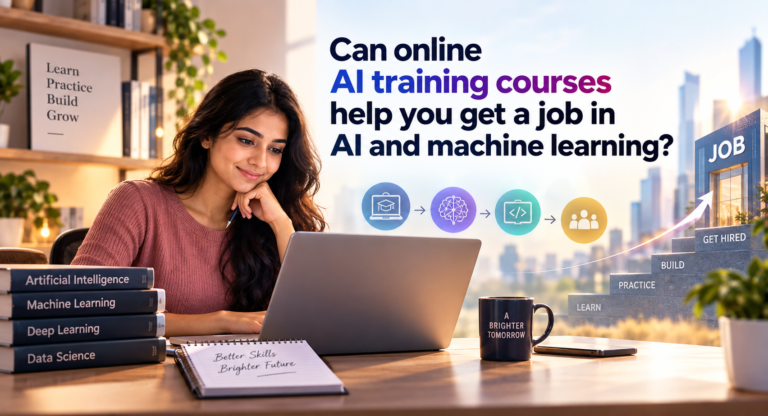
Yes, online AI training courses can absolutely help you move into an AI or machine learning job but a course alone won’t get you hired. The strongest candidates combine structured training with hands-on projects, practical tools, interview preparation, and a portfolio that shows they can actually solve business problems with AI.
And that distinction matters more in 2026 than it did a few years ago.
India’s AI hiring market is moving beyond the traditional “data scientist” role. Employers are increasingly looking for people who can build AI applications, work with LLMs, deploy models, connect AI to business systems, and manage AI in production.
So, if you’re wondering whether spending time on online AI training courses is worthwhile, the short answer is yes, but you need to choose the right kind of training.
Why AI Skills Are Becoming More Valuable in 2026
AI isn’t sitting in a research lab anymore. It’s being built into customer service, software development, finance, healthcare, manufacturing, analytics, cybersecurity and everyday business applications.
That’s changing what employers expect from candidates.
The World Economic Forum’s Future of Jobs Report identified AI and big data as the fastest-growing technology skills, while analytical thinking, creativity, resilience and lifelong learning are also becoming increasingly important.
There’s another interesting shift happening in India.
Recent hiring data shows strong growth in roles such as Agentic AI Developer, GenAI Engineer, AI Architect, AI Platform Engineer and AI Product Manager. One 2026 analysis of India’s AI hiring market found year-over-year growth of 260% for Agentic AI Developer roles and 205% for GenAI/Agentic AI Engineer positions.
In other words, companies aren’t simply asking:
“Can you build a machine-learning model?”
They’re increasingly asking:
“Can you make AI useful in a real product or business environment?”
That’s a very different skill set.
What Can You Actually Learn Through Online AI Courses?
A good online course can give you a structured path through a field that otherwise feels enormous.
Think about what a beginner has to learn:
- Python
- Statistics and data analysis
- Machine learning
- Deep learning
- Natural language processing
- Generative AI
- Large language models
- Prompt engineering
- RAG
- Vector databases
- APIs
- Cloud platforms
- MLOps
- AI deployment
- Model evaluation
Trying to learn all of that randomly through YouTube videos can become exhausting pretty quickly.
This is where online ai courses can make sense. A well-designed program gives you an order to follow rather than leaving you wondering what to learn next.
For example, H2K Infosys’s current Artificial Intelligence training covers areas including NumPy, deep learning, neural networks, MLOps and LLMOps, alongside hands-on project work.
Its Data Science and Machine Learning program also covers Python, TensorFlow, Scikit-Learn, model training, data analysis, visualization and core machine-learning algorithms.
That’s the kind of progression beginners generally need.
But Will an Online Course Guarantee You a Job?
No and it’s important to be honest about that.
No legitimate AI course should be treated as a magic job ticket.
A certificate can show that you completed training. It doesn’t automatically prove that you can build an AI solution, debug Python code, explain a model to an interviewer or work with messy real-world data.
Hiring managers ultimately want evidence.
That’s why practical projects matter so much.
Imagine two candidates applying for a junior AI role.
Candidate A has completed five certificates but has never built anything outside course exercises.
Candidate B has completed one solid training program and built:
- a customer-support chatbot using an LLM,
- a RAG application connected to company documents,
- a machine-learning model for predicting customer churn,
- and a small deployed AI application.
Even without knowing anything else about them, Candidate B has something concrete to discuss during an interview.
That’s the advantage of project-based learning.
What Employers Are Looking for Right Now
The skills employers want are evolving quickly.
For example, current Indian AI job listings increasingly mention technologies such as Python, LLM APIs, RAG, vector databases, LangChain, cloud deployment, Kubernetes and AI-agent frameworks.
At the same time, employers still value fundamentals.
You don’t want to become someone who knows how to write a clever prompt but doesn’t understand data, APIs, Python or model evaluation.
A stronger learning path looks more like this:
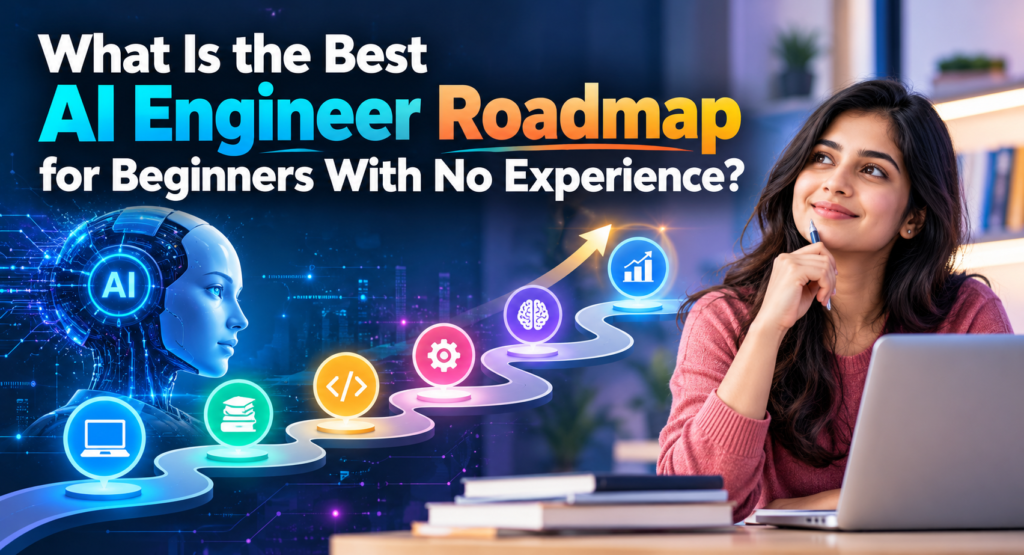
Programming → Data → Machine Learning → Deep Learning → Generative AI → Deployment → Real Projects
Then you can add newer areas such as AI agents, RAG, LLMOps and AI governance.
That foundation becomes especially useful when tools change which they do constantly.
A Realistic Example: From Beginner to AI Job Candidate
Suppose you’re a software tester with several years of experience.
You don’t necessarily need to throw away your existing career and start from zero.
You could learn Python and data fundamentals, then move into machine learning and Generative AI. After that, you could build projects around testing for example, an AI-assisted test-case generator or a system that analyzes software defects.
Suddenly, you’re not just saying:
“I completed an AI course.”
You’re saying:
“I understand software testing, and I’ve built AI solutions that improve testing workflows.”
That’s much more compelling.
The same principle works for business analysts, developers, data analysts and other technology professionals.
Your existing domain knowledge can actually become an advantage.
Why Hands-On Training Matters
One thing I’ve noticed about learning AI is that the gap between understanding something and being able to build something can be surprisingly large.
You can watch a two-hour explanation of neural networks and feel like everything makes sense.
Then you open a notebook and get an error you’ve never seen before.
That’s where real learning begins.
Hands-on exercises force you to deal with:
- imperfect datasets,
- coding errors,
- model performance,
- APIs,
- deployment problems,
- changing libraries,
- debugging,
- and questions that tutorials don’t anticipate.
That’s also why H2K Infosys positions its AI training around live instruction, hands-on projects and job-oriented preparation rather than simply providing recorded lessons.
Its Generative AI certification program, for example, includes LLM application development, OpenAI APIs, Hugging Face, LangChain, LlamaIndex, RAG and vector databases.
For someone specifically trying to become job-ready, that practical component is worth paying attention to.
Why H2K Infosys Can Be Worth Considering
If your goal isn’t simply to learn about AI but to become employable in the field, H2K Infosys is worth looking at as one option.
Its current AI training offering combines structured instruction with hands-on projects and career-oriented support. The company also offers separate tracks covering AI, Generative AI, Data Science and Machine Learning.
That can be useful if you’re the kind of learner who benefits from having an instructor, a curriculum and a defined learning schedule instead of trying to piece everything together independently.
The important part is to evaluate the actual curriculum and project work, not just the words “AI certification” on a course page.
A good question to ask before enrolling is:
“What will I be able to build by the end of this course?”
That’s a much better question than:
“Will I receive a certificate?”
AI Training Is Also Changing Inside Companies
There’s a bigger reason practical AI skills matter.
Companies themselves are now spending heavily on AI upskilling.
Wipro, for example, said in September 2026 that it had trained more than 100,000 employees in advanced AI skills as it restructures work around a human-AI operating model.
India’s Global Capability Centres are experiencing a similar skills shift, with demand increasing for areas such as AI governance, prompt engineering, MLOps and cloud architecture.
So this isn’t only about getting your first AI job.
It can also be about making yourself more valuable in the job you already have.
What Jobs Can You Target After AI Training?
Your eventual role depends on your background and how deeply you study.
Some possible paths include:
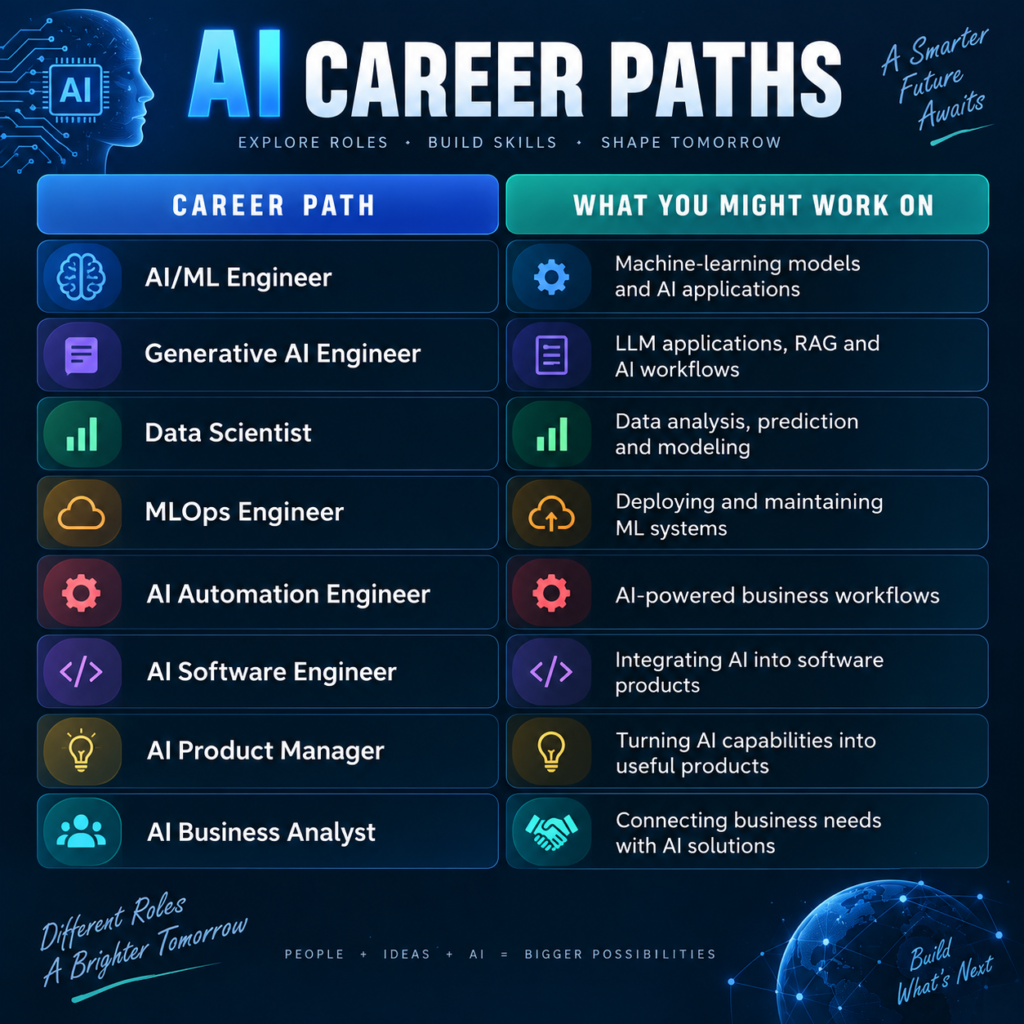
That is one reason I wouldn’t recommend choosing a course purely because it promises to make you a “machine learning engineer.” The market is becoming much broader than that.
What Should You Look for in Online AI Training Courses?
Before enrolling, check whether the program includes these areas.
1. Strong fundamentals
Make sure you understand Python, statistics, data handling and machine-learning concepts.
2. Generative AI
In 2026, understanding LLMs, RAG and AI application development can be highly valuable.
3. Real projects
Look for projects that resemble things businesses actually build.
4. Deployment
Building a model inside a notebook is useful. Knowing how to turn it into a usable application is even better.
5. Interview preparation
Technical knowledge isn’t enough if you can’t explain your projects clearly.
6. Career guidance
Resume preparation, mock interviews and job-search guidance can be useful, particularly for career changers and freshers.
7. Current tools
AI changes fast. A curriculum that hasn’t been updated in years is a warning sign.
This last point matters more than people realize.
A course can be excellent technically and still become less useful if it doesn’t evolve with the industry.
Can Beginners Take AI Training?
Yes.
But beginners should resist the temptation to jump straight into advanced AI agents because they’re currently popular.
Start with the basics.
If you don’t understand Python, data structures, basic statistics or how machine-learning models work, advanced frameworks can feel like memorizing recipes without understanding the kitchen.
On the other hand, experienced developers may be able to move much faster because they already understand programming, APIs, databases and software development.
Your starting point should determine your learning path.
The Bigger Picture: AI Isn’t Replacing the Need for Skilled People
There’s plenty of anxiety around AI and employment, and honestly, some of it is justified.
Companies are automating tasks. Productivity is increasing. Some traditional roles are changing.
But we’re also seeing new types of work appear.
Microsoft India & South Asia’s leadership recently described India as moving from AI experimentation toward production use, with emerging roles including forward-deployed engineers and enterprise AI specialists.
That tells us something important.
The opportunity isn’t necessarily to compete against AI.
It’s to become someone who knows how to work with AI and make it useful.
That might mean building an AI application, deploying a model, automating a workflow, evaluating AI output or helping a business decide where AI actually makes sense.
So, Are Online AI Training Courses Worth It?
Yes if you choose one that helps you build real skills rather than simply collect certificates.
An online AI training courses can provide structure, instructor guidance, practical exercises and a faster route through a complicated subject. But your employability will ultimately come from what you can demonstrate.
If you’re considering H2K Infosys, its current AI, Generative AI and Data Science/Machine Learning programs are specifically positioned around job-oriented learning, hands-on projects and career support.
Explore H2K Infosys AI Training
Before you enroll, look closely at the curriculum, project work, instructor-led sessions and career-support components. Then ask yourself one simple question:
“Will this training leave me with skills and projects I can confidently discuss in an interview?”
If the answer is yes, an online AI training program can be a very practical step toward an AI or machine-learning career in 2026.
Can online AI training courses help me get a job in AI?
Yes. Online AI training courses can help you build the technical skills employers look for, especially when they include hands-on projects, real-world applications, and interview preparation. However, completing a course alone doesn’t guarantee a job.
Are online AI training courses suitable for beginners?
Yes. Beginners can start with foundational topics such as Python, statistics, data analysis, and machine learning before moving into advanced areas like deep learning and Generative AI. A structured program can make the learning process much easier.
What jobs can I get after completing an AI course?
Depending on your skills and previous experience, you can target roles such as AI/ML Engineer, Generative AI Engineer, Data Scientist, MLOps Engineer, AI Automation Engineer, or AI Software Engineer. Your projects and practical skills will play an important role in determining which roles you qualify for.
What should I look for in online AI training courses?
Look for a course that combines AI fundamentals, Generative AI, hands-on projects, current tools, deployment concepts, and career support. Programs such as H2K Infosys’ AI training are designed with practical learning and job-oriented preparation in mind.
Is an AI certification enough to get hired?
Not by itself. A certification can demonstrate that you’ve completed structured training, but employers also want to see what you can actually do. Building practical AI projects, maintaining a strong portfolio, and preparing for technical interviews can significantly strengthen your chances of getting an AI job.