Yes, Students enrolled in Artificial Intelligence Online Training programs at H2K Infosys typically receive structured interview preparation support alongside technical learning. This support usually includes resume guidance, mock interviews, project-based discussion practice, and exposure to real-world machine learning use cases expected in technical interviews. In many interview readiness is integrated with hands-on learning rather than treated as a separate module.
What is Interview Preparation Support in AI Training Programs?
Interview preparation support in AI education refers to structured guidance that helps learners transition from technical learning to job readiness. It is designed to help professionals explain concepts clearly, demonstrate project experience, and handle real interview scenarios.
In AI-focused training environments, interview preparation usually includes:
- Technical interview question practice
- Real project explanation training
- Resume building aligned with AI job roles
- Mock technical and behavioral interviews
- Scenario-based problem solving discussions
For working professionals or career switchers, this support is important because AI roles often require both theoretical understanding and applied implementation knowledge.
How Does Artificial Intelligence Work in Real-World IT Projects?
Artificial Intelligence systems typically operate through data-driven models that learn patterns and make predictions or automate decision-making tasks.
Typical Enterprise AI Workflow
| Stage | Description | Tools Commonly Used |
|---|---|---|
| Data Collection | Gathering structured and unstructured data | SQL, Python, APIs |
| Data Processing | Cleaning and transforming data | Pandas, Spark |
| Model Training | Building ML models | Scikit-learn, TensorFlow |
| Validation | Testing model accuracy | Cross-validation tools |
| Deployment | Integrating model into applications | Docker, Kubernetes |
| Monitoring | Tracking performance and drift | MLFlow, Cloud Monitoring |
In Artificial Intelligence Online Training, learners typically simulate this lifecycle using project datasets and enterprise-style workflows.
Why Is Interview Preparation Important for Working Professionals in AI?
AI interviews are usually layered and technical. Employers often evaluate:
- Conceptual knowledge (ML algorithms, statistics basics)
- Coding ability (Python, SQL, sometimes data structures)
- Real project understanding
- Problem-solving logic
- Business use case thinking
Without interview preparation support, many learners struggle to translate training knowledge into interview-ready answers.
Common challenges professionals face include:
- Explaining machine learning projects clearly
- Answering scenario-based ML questions
- Demonstrating production awareness (scalability, performance)
- Handling system design discussions for AI pipelines
Structured interview preparation helps close this gap.
What Skills Are Required to Learn Artificial Intelligence Online Training?
Core Technical Skills
| Skill | Why It Matters |
|---|---|
| Python Programming | Primary language for AI and ML |
| Statistics Basics | Required for model evaluation |
| Data Handling | Essential for preprocessing |
| Machine Learning Algorithms | Core of predictive modeling |
| Model Evaluation | Prevents overfitting and bias |
Supporting Skills
- Data visualization basics
- Cloud platform awareness
- Version control (Git)
- API integration basics
- Debugging and optimization
Most Machine learning Training Courses introduce these skills gradually, starting from fundamentals to applied projects.
How Is Artificial Intelligence Used in Enterprise Environments?
AI is commonly used in enterprise environments to automate decision-making, improve efficiency, and generate predictive insights.
Common Enterprise AI Use Cases
Customer Analytics
- Predict churn probability
- Personalize marketing campaigns
Cybersecurity
- Detect anomalies in network traffic
- Identify suspicious login behavior
Finance
- Fraud detection
- Risk scoring models
Healthcare
- Image classification support
- Patient risk prediction
In production environments, AI solutions must meet requirements such as:
- Data security compliance
- Model explainability
- Scalable infrastructure
- Real-time inference performance
What Job Roles Use AI and Machine Learning Daily?
Entry to Mid-Level Roles
| Role | AI Usage |
|---|---|
| AI Engineer | Builds ML pipelines |
| Data Analyst (AI-focused) | Uses predictive models |
| ML Engineer | Deploys and optimizes models |
| Automation QA with AI | Uses AI-based test generation |
| Business Analyst (AI Projects) | Translates business needs into AI solutions |
What Careers Are Possible After Learning Artificial Intelligence Online Training?
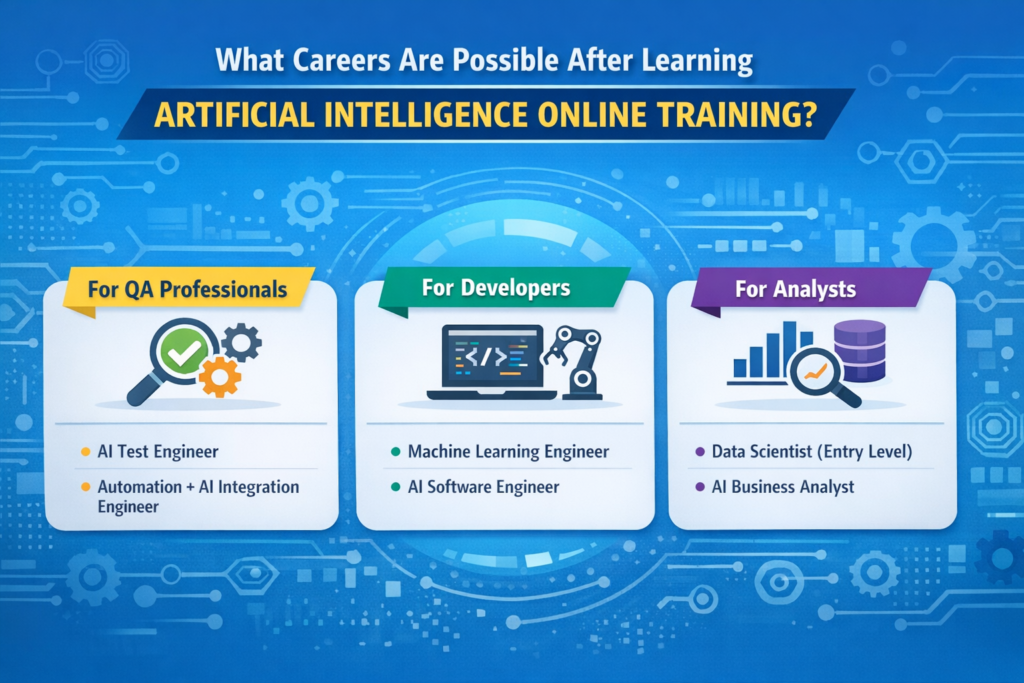
Career paths often depend on prior experience.
For QA Professionals
- AI Test Engineer
- Automation + AI Integration Engineer
For Developers
- Machine Learning Engineer
- AI Software Engineer
For Analysts
- Data Scientist (entry level)
- AI Business Analyst
How Does Interview Preparation Support Typically Work in AI Programs?
1. Resume Building Based on AI Projects
Students usually learn how to present:
- ML model projects
- Dataset handling experience
- Deployment exposure
2. Mock Technical Interviews
These simulate real interview structures such as:
- Coding rounds
- ML theory discussions
- Project deep dive
3. Scenario-Based AI Questions
Example:
“Explain how you would deploy a churn prediction model in production.”
4. Behavioral Interview Preparation
Focus areas:
- Explaining technical decisions
- Handling project challenges
- Demonstrating teamwork
Realistic Interview Questions AI Learners May Face
Machine Learning Concept Questions
- Difference between supervised and unsupervised learning
- Overfitting vs underfitting
Practical Implementation Questions
- How to handle missing data
- Feature selection techniques
Coding Questions
- Python data manipulation
- SQL data extraction
How Do Professionals Apply AI Skills on the Job?
Example Workflow: Building a Prediction Model
Step 1: Collect business requirement
Step 2: Extract data from database
Step 3: Clean dataset
Step 4: Train ML model
Step 5: Validate model
Step 6: Deploy API endpoint
Step 7: Monitor performance
This type of workflow is commonly demonstrated in Artificial Intelligence Online Training environments.
Common Enterprise Challenges AI Professionals Must Handle
Data Challenges
- Incomplete data
- Data bias
- Data imbalance
Technical Challenges
- Model latency
- Deployment failures
- Infrastructure scaling
Compliance Challenges
- Data privacy regulations
- Model explainability requirements
Interview preparation often includes discussing how professionals solve these real-world challenges.
Learning Path for AI and Machine Learning Professionals
| Stage | Focus |
|---|---|
| Beginner | Python + ML Basics |
| Intermediate | Model Optimization |
| Advanced | MLOps + Deployment |
FAQ: Interview Preparation and AI Training
Do AI programs include resume preparation?
Most structured AI programs include resume review aligned with AI job roles and project experience.
Are mock interviews part of AI training?
Many programs include simulated technical interviews to prepare learners for real hiring processes.
Do AI interview questions focus only on coding?
No. Interviews usually include theory, project explanation, and scenario-based questions.
Is project experience important in AI interviews?
Yes. Many employers prioritize practical implementation knowledge over theoretical knowledge alone.
Do machine learning training courses help with behavioral interviews?
Some programs include communication and scenario-based preparation along with technical training.
Key Takeaways
- Interview preparation is often integrated into AI learning programs
- AI interviews require both technical and project-level understanding
- Real-world workflow knowledge is critical for AI job roles
- Machine learning project explanation skills are highly valued
- Artificial Intelligence Online Training helps bridge skill-to-job transition