Einstein AI in Salesforce enables organizations to convert raw customer data into smart and actionable insights in real-time, and H2kinfosys is where most people learn how to use this technology in the most effective way.
What is Einstein AI in Salesforce?
Have you ever looked at a CRM system and thought to yourself, “I know what this data is telling me. but what should I do with it?” Well, Einstein AI is here to bridge that gap.
Essentially, Einstein AI is the artificial intelligence aspect that comes standard in Salesforce. It runs in the background and analyzes data to identify patterns and suggest the next steps you should take. And the best part is that you don’t have to be a data scientist to use it.
From my experience working with teams learning through our Salesforce training programs, the lightbulb moment seems to occur when they witness predictions happening in real-time, such as lead scoring happening automatically or sales forecasts adjusting based on actual behavior.
Why Einstein AI is More Important Than Ever in 2026
Let’s face it – AI is the norm in today’s world. However, not all AI is created equal in terms of its overall usefulness in our daily lives.
What makes Einstein AI stand out is that it is native to the Salesforce platform. This means you are not learning anything new or using another platform to get the job done. Einstein AI is simply… there.
There have been a few key developments in recent times that have increased its overall importance:
- Business decisions need to be made quicker, not necessarily better
- Customer journeys have become infinitely more complex
- There is an explosion in data – and honestly, it’s overwhelming
I’ve watched teams sink under the weight of too many dashboards. Einstein AI turns this on its head with, “Here’s what really matters focus on this.”
Key Features of Einstein AI in Salesforce
Let’s dive into the features that really make a difference not just the ones that sound great on paper.
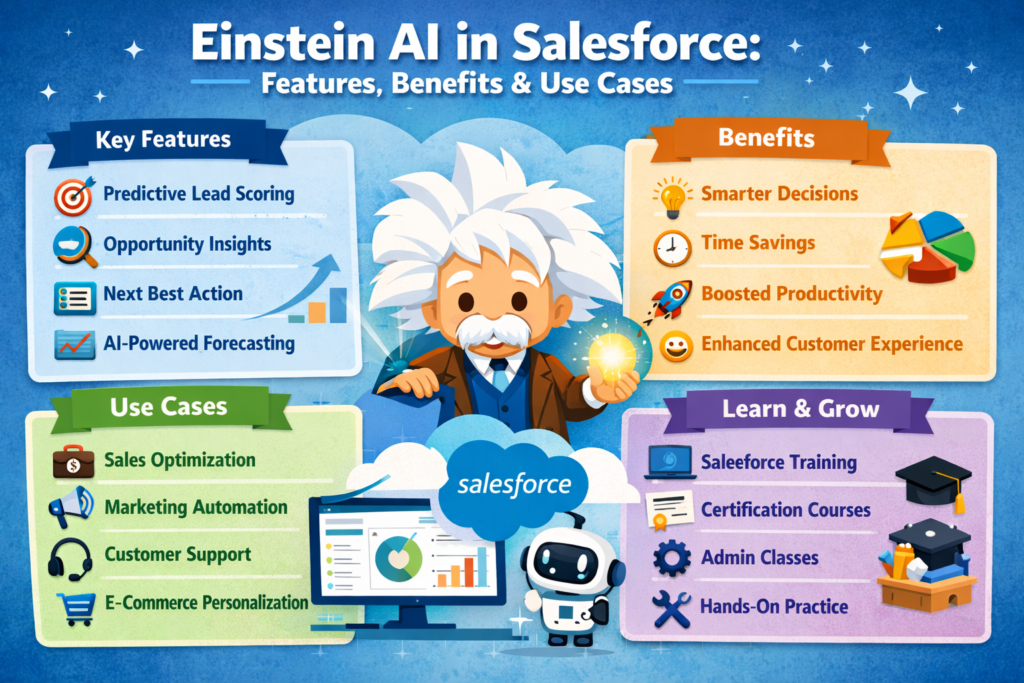
1. Predictive Lead Scoring
This is typically the first feature people fall in love with.
Instead of using guesswork to determine which leads are the best use of your time, Einstein AI uses historical conversions to score your leads automatically.
I recall a sales team I used to work with that was using purely gut feeling as a lead scoring strategy. When they implemented this feature, they saw an increase in conversions not wildly, just steadily. And honestly, that’s just what you want.
2. Opportunity Insights
Have you ever had an opportunity that was going great. until suddenly, it’s not?
Einstein AI helps you catch issues early, like a lack of engagement or response from the lead. It’s like having a second pair of eyes on your pipeline.
And sometimes, yeah, it’s a bit annoyingly accurate.
3. Automated Data Discovery
This feature doesn’t always get the attention it deserves.
Einstein AI automatically analyzes your data and reveals trends you might never notice yourself. For example:
- What customer segment makes the most purchases in certain months
- What leads to churn
- Correlations between products you might have missed
It’s the kind of thing you could figure out yourself… but realistically, you just don’t have the time for.
4. Next Best Action Recommendations
And now, this feature feels like something out of a sci-fi movie.
Einstein AI uses data to tell you exactly what you should be doing next send an email, follow up, offer a discount, etc.
It’s not always perfect (no AI is), but it’s surprisingly helpful, especially for newer team members who are still figuring things out.
5. AI-Powered Forecasting
Forecasting used to feel like guessing. And sometimes guessing based on incomplete information.
But with Einstein AI, forecasting is based on historical data and trends. And with regular updates. It’s not just numbers; it’s the confidence that goes along with those numbers.
6. Natural Language Processing
You can literally ask questions in plain English and get answers.
I’ve seen people in a Salesforce administrator training session go from totally lost and intimidated to totally confident and excited just because they didn’t have to worry about coding.
Real-World Use Cases of Einstein AI
Okay, theory time is over. Let’s talk about how companies are actually using this in the real world.
Sales Teams: Closing Deals Faster
A SaaS company I worked with used Einstein AI to prioritize leads. They didn’t waste time chasing everything; they went after the ones with the highest score.
The result?
- Sales cycles are shorter
- Win rates are higher
- Burnout is lower
Marketing Teams: Smarter Campaigns
Marketing teams use Einstein AI for:
- Predicting the best email campaigns
- Segmenting audiences more effectively
- Determining the best time for a campaign
One campaign we ran saw a significant increase in engagement. Not because the email was more compelling, but just because the timing was more effective.
Customer Support: Faster Resolutions
Einstein AI also helps customer support teams by:
- Suggesting responses
- Predicting the urgency of cases
- Routing cases more intelligently
It’s not replacing human customer support; it’s just making customer support more efficient.
E-commerce: Personalization at Scale
If you’ve ever wondered how some sites seem to ‘know’ what you want – well, that’s AI in action.
What Einstein AI Does Enable
- Product Recommendations
- Personalized Offers
- Behavioral Targeting
Yes, it’s a bit weird, but also rather effective.
Benefits of Using Einstein AI in Salesforce
Now, let’s discuss what you actually get out of all this.
1. Better Decisions
Rather than making educated guesses, you’re using data-driven insights.
And not just data – insights.
2. More Time
This is where Einstein AI really shines.
Automating tasks such as data analysis, reporting, prioritization, etc. – all these take hours, if not days, out of your day.
3. More Productivity
Your teams can focus more on getting things done, rather than spending time figuring out what to do.
This is where Einstein AI really excels – making things simple, yet revolutionary.
4. Better Customer Experience
When you understand your customers better, you serve them better.
Einstein AI is all about anticipating needs, rather than solving problems.
5. Scalability
When you grow, Einstein AI grows with you.
You don’t have to hire a team of data analysts – Einstein AI is smart enough to grow with your business.
How to Learn Einstein AI Without Feeling Confused
This is where most people get stuck.
They think, ‘Oh, AI – I have no idea what that is.’ Well, let me tell you – you don’t have to.
Here’s how you can do it.
Start with the Basics
Understanding Salesforce is step one – many people take certification courses before even touching AI.
Hands-On Experience is Important
Knowing about Einstein AI is one thing – using it is quite another.
I’ve found that people who actually use Einstein AI, even if it’s just a sandbox, have a much better time learning about AI.
Structured Learning is Important
Programs like the Salesforce administrator classes help you break down concepts in a manner that makes the most sense.
Instead of diving headfirst into AI, you build a foundation, which makes everything else easier.
Don’t Try to Learn Everything at Once
I think this is probably the biggest mistake I’m seeing.
One feature, one week, one month, one quarter, one year:
- Start with lead scoring
- Then forecasting
- Then automation
It’s okay to take your time.
Challenges (Because It’s Not All Perfect)
Let’s be real, shall we? Nobody’s perfect, and neither are the tools.
Data Quality Matters
Einstein AI is only as good as the data you put into the tool.
If your data is a mess, your insights are going to be a mess too.
Learning Curve
It’s user-friendly, so you might think there’s no learning curve, right?
Not so fast, friend! There’s still a learning curve, and that’s where proper Salesforce training comes in.
Trust in AI
Some teams are hesitant about using AI recommendations.
And honestly, I don’t blame them.
It’s hard to trust something you don’t fully understand, right?
It’s going to take some time, though, because once you start seeing the results, you’ll be sold on AI.
The Future of Einstein AI in Salesforce
Things are changing quickly in the world of AI, especially with the integration of Salesforce.
Salesforce has invested heavily in AI, especially with the integration of generative AI and deeper automation.
What you’re seeing now is just the beginning.
A few trends I’m seeing in the near future:
- More conversational AI interfaces
- Deeper integration with other Salesforce tools
- Real-time decision-making becoming the new normal
And yes, Einstein AI is right at the center of all this.
Why Professionals Are Investing in Salesforce AI Skills
Something I have observed lately is that there is an increasing requirement for professionals with knowledge of AI and Salesforce.
It is no longer enough for professionals to just know how to use a CRM.
The requirement is for people who are knowledgeable enough to
- interpret AI insights
- configure intelligent workflows
- optimize data-driven strategies.
Salesforce administrator training programs are now including AI training.
A Quick Personal Take
I’ll tell you something. I thought Einstein AI was just another “buzzword feature.”
But after using it, I think it’s more practical than anything else.
It’s not here to replace your jobs. It’s here to make you more efficient at your jobs.
And trust me; that’s exactly what the current work environment needs.
Final Thoughts
Einstein AI is changing the way businesses use Salesforce.
Not by making it more complicated.
But by making decisions and data more simplistic.
If you are already using Salesforce or are planning to use it in the future, knowing how Einstein AI works is no longer optional.
It’s becoming a requirement.
Whether it’s by taking up Salesforce administrator training programs, exploring Salesforce certification programs, or taking up hands-on training programs with Salesforce, the idea is simply to begin.
Because once you begin using Einstein AI for scenarios, everything falls into place much faster than you could imagine.