Artificial intelligence inside Salesforce is no longer a future trend. It’s already changing how businesses sell, support customers, automate workflows, and make decisions every single day. And honestly, if you’ve been working with CRM tools recently, you’ve probably noticed how fast companies are moving toward AI-powered Salesforce environments.
That’s where Einstein AI comes in.
Salesforce Einstein AI combines predictive analytics, generative AI, automation, and machine learning directly inside the Salesforce ecosystem. Instead of forcing businesses to use disconnected AI tools, Einstein brings intelligence into the workflows teams already use. Sales reps get smarter forecasts, support agents get AI-generated replies, marketers auto-personalize campaigns and administrators save hours on repetitive work.
If you are a professional looking for Salesforce certification training or Salesforce training with placement, then knowing Einstein AI has almost become a must now. Recruiters are looking for candidates who are well-versed in Salesforce fundamentals as well as AI-powered CRM automation. The market has changed quickly over the last year, especially as Salesforce introduced Einstein GPT and Agentforce capabilities across its cloud products.
And honestly? This is probably just the beginning.
What Exactly Is Salesforce Einstein AI?
At its core, Einstein AI is Salesforce’s artificial intelligence layer built directly into the Salesforce platform. It uses machine learning, natural language processing (NLP), predictive analytics, and generative AI to help businesses work smarter.
The interesting part is that Einstein doesn’t feel like a separate AI product. It quietly sits inside Sales Cloud, Service Cloud, Marketing Cloud, Commerce Cloud, and even Slack integrations.
A sales manager might use Einstein Lead Scoring without even realizing they’re using machine learning. A support team may rely on AI-generated customer responses every day. That seamless integration is honestly one of Salesforce’s biggest advantages right now.
Salesforce has expanded Einstein dramatically since introducing Einstein GPT and later Agentforce AI agents. The platform now supports:
- Predictive lead scoring
- AI-generated emails
- Automated customer service replies
- Workflow recommendations
- Real-time sales forecasting
- AI-powered analytics dashboards
- Conversational AI assistants
- Natural language query tools
- Intelligent automation for admins
And businesses are adopting it fast because they don’t need to rebuild their entire tech stack to use AI.
Why Einstein AI Matters in 2026
A few years ago, companies experimented with AI carefully. Now? They’re deploying it aggressively because operational efficiency matters more than ever.
Recent enterprise surveys show organizations are prioritizing AI adoption inside CRM systems rather than using standalone AI products. Salesforce recognized this early, which is why Einstein AI became central to their platform strategy.
I was talking with a Salesforce consultant recently who mentioned something interesting clients no longer ask whether they should use AI in Salesforce. The conversation has shifted to how fast they can implement it safely.
That’s a pretty massive change.
Businesses now expect:
- Faster customer support
- Personalized customer experiences
- Automated reporting
- Smarter sales pipelines
- Predictive insights
- Reduced manual workload
Einstein AI helps address all of these.
For professionals considering a Salesforce course online, learning Einstein AI features creates a huge career advantage because organizations increasingly want Salesforce admins and developers who understand AI-driven workflows.
Main Features of Salesforce Einstein AI
Here’s a hands-on overview of the key Einstein AI capabilities.
Because, let’s be honest, Salesforce terminology can be a bit more complicated than it needs to be sometimes.
Einstein Lead Scoring
This feature predicts the most likely leads to convert based on historical CRM data.
Instead of sales teams manually guessing which prospects are worth paying attention to, Einstein looks for patterns like:
- Previous conversion measures
- History of engagement
- Industry Sector
- Frequency of Communication
- Stages of opportunity
Then it assigns scores automatically.
A SaaS company, for example, might discover that leads attending webinars and opening pricing emails convert 3x faster. Einstein identifies those patterns instantly.
Sales teams love this because it reduces wasted effort.
And from an admin perspective, it’s surprisingly manageable once you understand Salesforce data structures properly, which is why many Salesforce administrator training and placement programs now include AI-related modules.
Einstein GPT
This is probably the feature that got the most attention recently.
Einstein GPT combines generative AI with Salesforce CRM data. It can generate:
- Sales emails
- Customer replies
- Knowledge articles
- Case summaries
- Marketing content
- CRM updates
The practical value here is huge.
Imagine a support agent handling hundreds of tickets daily. Einstein GPT instantly writes responses, instead of having agents manually write repetitive responses, pulling context from customer history.
That’s definitely time-saving. But it also makes things more consistent.
One retail company saw support handling times slashed significantly after adding AI-generated case summaries to Service Cloud workflows.
Of course, businesses still need human review for quality control. AI isn’t replacing decision-making completely. Not even close.
But it dramatically accelerates routine tasks.
Einstein Prediction Builder
This feature allows businesses to create custom AI predictions without needing deep coding knowledge.
That’s important because many organizations don’t have dedicated AI engineers.
Using Prediction Builder, companies can forecast things like:
- Customer churn
- Subscription renewals
- Payment risks
- Product demand
- Upsell opportunities
For example, a healthcare organization might predict which patients are likely to miss appointments. A financial company may identify clients likely to cancel services.
The no-code approach makes Einstein accessible even for admins with moderate Salesforce experience.
This honestly explains why AI-focused Salesforce certification training programs have become increasingly popular.
Einstein Bots
These AI-powered chatbots automate customer interactions.
And today’s bots are far more advanced than the frustrating scripted bots people complained about years ago.
Einstein Bots can:
- Answer FAQs
- Route support tickets
- Handle account inquiries
- Schedule appointments
- Escalate complex cases
- Pull CRM data in real time
The best implementations feel surprisingly natural.
One airline support system I interacted with recently used Salesforce AI for baggage tracking. The bot handled almost everything instantly without making me wait for an agent. Five years ago, that experience would’ve been painful.
Now it’s becoming standard.
Einstein Analytics
This feature transforms raw CRM data into visual insights and predictive dashboards.
Executives love this because they can ask questions using natural language instead of building complicated reports manually.
For instance:
“Show me which regions have declining opportunity conversion rates.”
Einstein can generate answers visually and identify trends automatically.
The AI-driven reporting capabilities save enormous time for managers and analysts.
Honestly, traditional reporting dashboards now feel painfully slow compared to AI-assisted analytics.
Einstein for Service Cloud
Customer service teams are seeing some of the biggest productivity gains from Einstein AI.
Features include:
- Case classification
- Sentiment analysis
- AI-generated responses
- Automated routing
- Recommended solutions
A telecom provider, for example, might automatically prioritize angry customer tickets based on sentiment analysis.
That matters because response speed heavily influences customer retention now.
Customers expect immediate support. Businesses that fail to deliver lose loyalty quickly.
Einstein helps service teams keep pace without endlessly expanding headcount.
Real-World Use Cases of Einstein AI
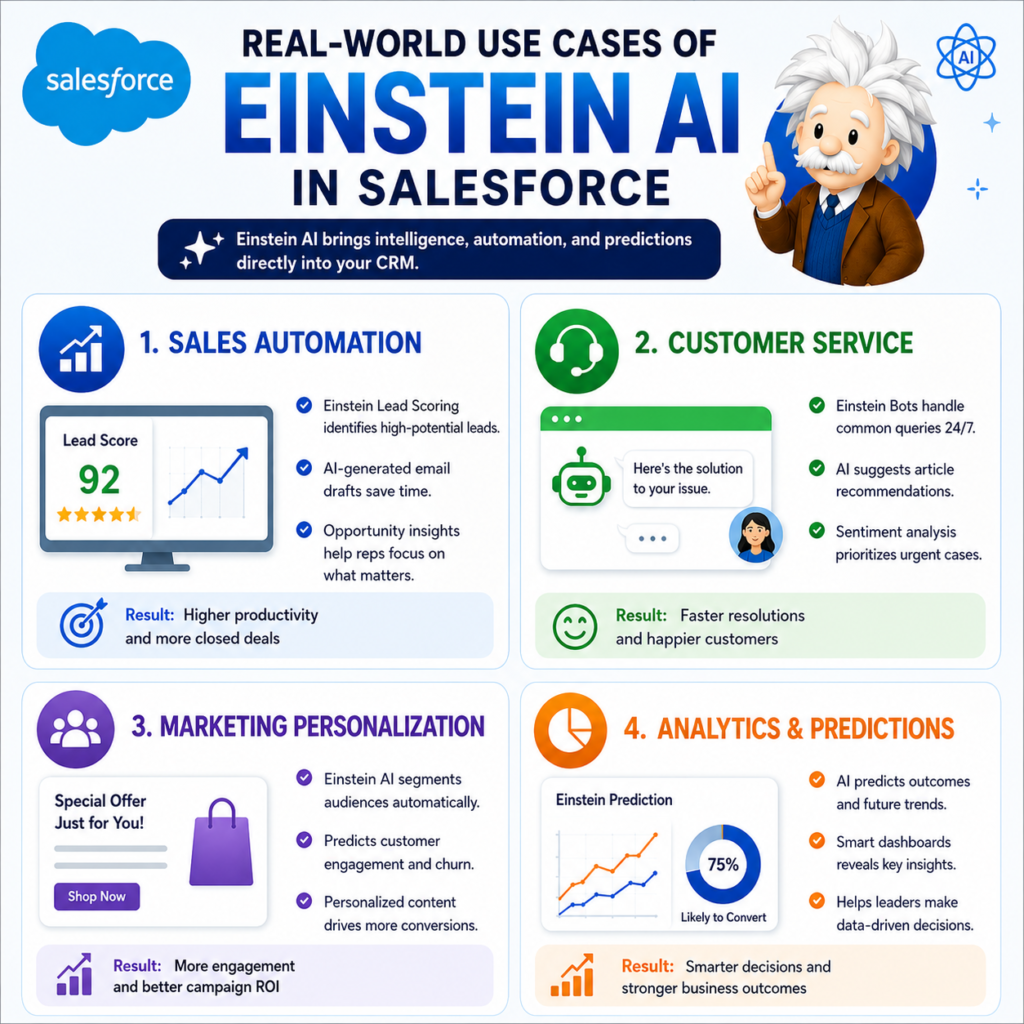
This is where things get interesting because the practical applications are expanding constantly.
Sales Automation
Sales reps spend ridiculous amounts of time on admin work.
Updating CRM notes.
Writing follow-up emails.
Logging calls.
Prioritizing leads.
Einstein AI reduces much of that burden.
A real estate company using Salesforce recently automated follow-up sequences triggered by buyer behaviour. Prospects looking at luxury listings were sent personalised outreach emails automatically generated with Einstein GPT.
The sales team was more interested in closing deals than doing the same CRM tasks over and over again.
That’s a major shift.
Healthcare CRM Intelligence
Healthcare organizations increasingly use Salesforce Health Cloud combined with Einstein AI.
Applications include:
- Predictive patient engagement
- Appointment reminders
- Care management insights
- Personalized communication
- Risk prediction
Hospitals also use AI to reduce administrative overload.
One healthcare administrator mentioned their scheduling efficiency improved noticeably after implementing AI-driven appointment prioritization.
And honestly, healthcare is one of the industries where AI-powered CRM systems may grow fastest over the next few years.
Banking & Financial Services
Financial institutions use Einstein AI for:
- Fraud prediction
- Customer retention analysis
- Loan recommendation systems
- Financial product personalization
- Risk assessment
Because Salesforce already handles massive customer datasets, adding AI-driven predictions becomes incredibly valuable.
Banks especially care about customer churn prediction right now.
Retaining existing customers costs far less than acquiring new ones.
Einstein helps identify warning signs early.
Retail Personalization
Retail brands rely heavily on customer personalization now.
Einstein AI helps businesses:
- Recommend products
- Predict purchasing behavior
- Personalize promotions
- Analyze customer sentiment
- Optimize inventory
If you’ve ever received eerily accurate product recommendations from a retail brand using Salesforce Commerce Cloud, there’s a decent chance Einstein AI played a role behind the scenes.
Sometimes it’s honestly a little creepy how accurate predictive recommendations have become.
But from a business standpoint, it works.
How Einstein AI Is Changing Salesforce Careers
This part deserves attention because the job market is evolving fast.
Traditional Salesforce administration skills are still valuable. Absolutely.
But companies increasingly prefer professionals who also understand:
- AI automation
- Prompt workflows
- Data modeling for AI
- Predictive analytics
- CRM intelligence systems
- AI governance inside Salesforce
Even entry-level job postings now mention Einstein familiarity occasionally.
That’s why professionals enrolling in Salesforce training with placement programs are prioritizing AI modules alongside admin and developer skills.
The demand isn’t limited to developers either.
Roles that can leverage Einstein AI expertise include:
- Salesforce Business Analyst Administrator
- CRM Consultants.
- Marketing Automation Specialists
- Service Cloud Consultants
- Sales Ops Analysts
AI CRM management is becoming a competitive advantage in departments.
Why Now Is the Right Time to Learn Salesforce Einstein AI
Timing is crucial in technology careers.
Usually, a skill is very valuable only for a short window of time until the market becomes saturated.
Salesforce AI expertise feels like it’s in that window right now.
Companies are actively implementing AI but still struggling to find experienced talent.
That creates opportunity.
A strong Salesforce course online that includes Einstein AI, automation, and Agentforce concepts can position candidates ahead of many traditional Salesforce professionals who haven’t adapted yet.
And let’s be honest, Salesforce itself is heavily investing in AI branding and platform expansion. That’s usually a strong signal for long-term ecosystem growth.
Common Challenges Businesses Face with Einstein AI
It’s not all smooth implementation though.
Challenges still facing such businesses include:
Data Quality Issues
AI predictions are as good as the underlying CRM data.
Messy records lead to unreliable outputs.
This becomes fairly clear during implementation.
User Adoption Resistance
Some workers are at first sceptical about what the AI suggests.
Sales reps may resist lead scoring recommendations that don’t match their gut feelings especially with the latter.
Training and slow adoption help.
Governance and Compliance
Organisations have to manage:
- Customer privacy
- Transparency of AI
- Data security
- Compliance with regulations
Especially in the healthcare and finance sectors.
Cost Factors
The new advanced AI capabilities from Salesforce will be costlier to license.
Clear ROI planning is required before large-scale deployment.
However, many companies find that the efficiency gains justify the investment in a pretty short time.
The importance of Salesforce training is growing
I’ve noticed recently how many professionals underestimate the breadth of the Salesforce ecosystem.
It’s more than just CRM administration.
Modern Salesforce environments contain:
- Automation with AI
- data analysis
- Workflow orchestration
- Customer journey mapping
- API Integration
- AI governance
- Cloud architecture
This is the reason why structured learning is more important than random YouTube tutorials.
For professionals who are career-focused, Salesforce certification training programs that offer practical projects, real-world business situations and placement assistance are often advantageous.
And honestly, placement assistance matters a lot in today’s market because experience expectations have increased.
Why Many Learners Choose H2K Infosys
When people search for Salesforce training with placement, they usually want more than theoretical instruction.
They want:
- Real-time project exposure
- Interview preparation
- Resume guidance
- Mock interviews
- Industry-relevant curriculum
- Flexible online learning
That’s one reason many aspiring Salesforce professionals consider H2K Infosys for Salesforce learning programs.
H2K Infosys focuses heavily on practical training rather than just certification theory. Their Salesforce administrator training and placement programs include real-world project experience, which helps learners understand how Salesforce environments actually operate inside companies.
The platform also keeps updating course content to align with current Salesforce ecosystem trends, including AI-focused modules like Einstein AI and automation workflows.
And honestly, that matters because Salesforce changes rapidly. Outdated training becomes useless pretty fast.
For working professionals, the flexibility of Salesforce course online programs also makes a huge difference. Many learners balance jobs, family responsibilities, and certification preparation simultaneously.
The Future of Einstein AI in Salesforce
Salesforce clearly sees AI as the future of its platform.
Recent developments around Agentforce AI agents, autonomous workflow automation, and conversational CRM interfaces suggest we’re heading toward increasingly intelligent enterprise systems.
A few trends likely to grow further include:
- AI-powered autonomous agents
- Conversational CRM interfaces
- Predictive workflow automation
- Hyper-personalized customer journeys
- AI-driven business forecasting
- Natural language Salesforce administration
Honestly, we’re probably moving toward a future where many Salesforce administrative tasks become partially AI-assisted.
That doesn’t eliminate jobs.
It changes the nature of the work.
Professionals who understand both Salesforce architecture and AI collaboration tools will likely remain highly valuable.
Final Thoughts
With Einstein AI, Salesforce is no longer just a traditional CRM platform it is a deeply intelligent business ecosystem. From predictive sales insights to AI-generated customer support responses, the technology is helping organisations automate operations, improve customer experiences and make faster decisions.
And the need for professionals who know these tools is growing fast.
If you’re contemplating Salesforce certification training, now is actually a smart time to learn AI-powered Salesforce capabilities alongside core CRM administration skills. Businesses are increasingly looking for Salesforce professionals who understand automation, analytics and intelligent workflows, not just basic configuration.
Programs such as those provided by H2K Infosys close this gap by combining practical learning of Salesforce with placement-oriented training and real-world project exposure.
Getting your arms around Einstein AI isn’t just about learning another Salesforce feature.
It’s all about getting ready for the obvious next step in enterprise technology.
Because at the end of the day, understanding Einstein AI isn’t just about learning another Salesforce feature.
It’s about preparing for where enterprise technology is clearly headed next.