Cyber security training at H2K Infosys helps students sharpen their technical problem-solving skills by putting them into situations that actually feel close to real security work. Instead of just reading concepts from slides or memorizing definitions for exams, learners spend time investigating alerts, digging through logs, handling simulated incidents, and figuring things out under pressure kind of like what SOC analysts and security engineers deal with every day on the job.
And honestly, that practical exposure changes the whole learning experience.
A lot of people can explain cybersecurity theory in interviews. The harder part is staying calm when a dashboard suddenly fills with suspicious activity and you have to decide what matters first. That’s where hands-on training starts making a real difference. Students begin learning how to think through problems logically rather than waiting for step-by-step instructions.
Employers across the U.S. are hiring people who can troubleshoot cloud threats, identify suspicious network activity, and handle security incidents quickly. Certifications still help, sure but hiring managers increasingly care about whether someone can actually solve problems in live environments. I’ve noticed this especially in cybersecurity interviews lately. Candidates who trained only through videos often struggle with scenario-based questions, while people with hands-on lab exposure tend to answer more confidently and logically.
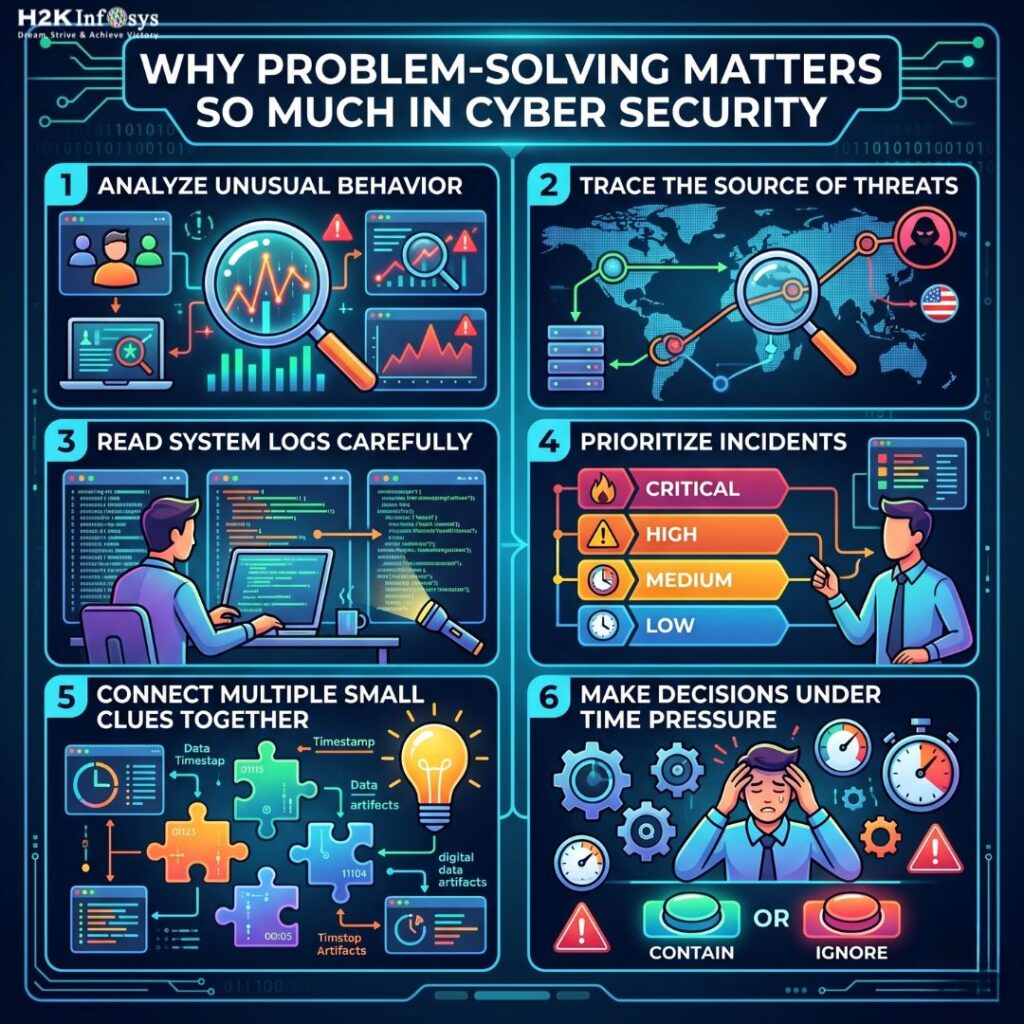
Why Problem-Solving Matters So Much in Cyber Security
Cyber security training is not one of those careers where you follow the same routine every day. One morning you may investigate phishing emails. A few hours later you could be analyzing failed login attempts from multiple countries or figuring out why a SIEM dashboard suddenly exploded with alerts.
That’s why technical problem-solving becomes the core skill behind almost every cyber security role.
Companies now expect entry-level analysts to think like investigators. They want people who can:
- Analyze unusual behavior
- Trace the source of threats
- Read system logs carefully
- Prioritize incidents
- Connect multiple small clues together
- Make decisions under time pressure
This is exactly where strong cyber security training and job placement programs stand out. They simulate these situations before students enter the workforce.
How H2K Infosys Builds Real Technical Thinking
One thing many learners realize after joining H2K Infosys is that technical problem-solving cannot develop through theory alone.
The training structure focuses heavily on practical exposure.
Instead of simply explaining “what phishing is,” instructors may walk students through:
- Investigating suspicious email headers
- Checking IP reputation
- Reviewing endpoint alerts
- Escalating incidents through ticketing systems
- Identifying whether activity is malicious or harmless
That process forces learners to think step-by-step. And honestly, that’s how real cybersecurity jobs work too.
I’ve seen many beginners initially panic when they see SIEM dashboards filled with hundreds of alerts. After repeated lab exercises, though, they begin identifying patterns much faster. You can almost watch their troubleshooting mindset improve week by week.
Hands-On Labs Train the Brain Differently
There’s a huge difference between reading about cyber security training and actually doing it.
Hands-on labs create a kind of “technical muscle memory.” Students stop depending entirely on instructors and start figuring things out independently.
For example, learners in cyber security training with job placement programs often practice:
- Splunk log analysis
- Threat detection workflows
- Linux troubleshooting
- Network traffic monitoring
- Vulnerability assessment
- Incident response simulations
- Cloud security monitoring
- SOC analyst ticket handling
These exercises improve logical reasoning naturally because students must investigate incomplete information.
And that’s realistic. In real companies, analysts rarely get perfect information upfront.
Sometimes you only notice:
- A failed authentication pattern
- An unusual PowerShell command
- Traffic spikes from one endpoint
- Suspicious file hashes
From there, the analyst must piece everything together.
That investigative mindset is what separates passive learners from job-ready professionals.
Real-Time Case Studies Make Learning More Practical
A major advantage of practical cyber security training is exposure to real attack scenarios.
Over the last year, ransomware attacks targeting healthcare systems and cloud misconfigurations have become major discussion points in cyber security training hiring circles. Many training providers still teach outdated examples from years ago, which honestly doesn’t help students much anymore.
At H2K Infosys, learners are often exposed to current industry-style case studies that reflect modern security environments.
That matters because cloud-based infrastructures, hybrid work environments, and AI-assisted attacks changed the way analysts troubleshoot problems in 2025 and 2026.
A modern SOC analyst today may need to:
- Investigate suspicious API calls
- Review cloud IAM permission abuse
- Analyze endpoint telemetry
- Detect AI-generated phishing attempts
Those are very different from the older “basic antivirus alert” examples many outdated courses still rely on.
Problem-Solving Improves Faster Through Mentorship
One thing people underestimate in cyber security training learning is mentorship.
When experienced instructors explain why an alert matters, not just what tool generated it, students begin thinking more analytically.
I’ve noticed that learners improve fastest when mentors ask questions like:
- “What would you investigate first?”
- “Why do you think this behavior looks suspicious?”
- “What log source would help confirm your theory?”
- “Would you escalate this incident immediately?”
That style of learning trains critical thinking instead of memorization.
Good cyber security training and job placement programs create an environment where students learn how security professionals actually reason through problems.
Technical Problem-Solving Helps During Interviews Too
This is something many students discover late.
Cybersecurity interviews in the U.S. increasingly focus on troubleshooting ability rather than textbook definitions.
Recruiters often ask:
- “How would you investigate multiple failed logins?”
- “What steps would you take after detecting malware?”
- “How do you prioritize alerts in a SOC?”
- “How would you analyze suspicious outbound traffic?”
Students who practiced real scenarios during cyber security training with job placement usually perform better because they can explain thought processes clearly.
That confidence becomes a huge advantage.
I’ve personally seen candidates with fewer certifications outperform others simply because they could explain their investigations logically and calmly.
Exposure to Tools Improves Analytical Skills
Technical tools themselves can sharpen problem-solving abilities when used correctly.
At H2K Infosys, students often work with platforms used in enterprise environments, including:
- SIEM systems
- Ticketing platforms
- Monitoring dashboards
- Endpoint security tools
- Linux environments
- Cloud security concepts
When students repeatedly troubleshoot alerts inside these systems, they become better at:
- Pattern recognition
- Root-cause analysis
- Correlation thinking
- Threat prioritization
That’s extremely valuable for cyber security jobs with training because companies want analysts who can adapt quickly to unfamiliar problems.
And honestly, cybersecurity is full of unfamiliar problems.
Learning to Stay Calm Under Pressure
One underrated benefit of cybersecurity labs is psychological.
Repeated exposure to incidents teaches students how to stay calm while solving technical issues.
At first, beginners often feel overwhelmed seeing:
- Multiple alerts
- Complicated logs
- Suspicious traffic patterns
- Linux command outputs
- Threat intelligence data
But over time, learners become more methodical.
Instead of panicking, they start asking:
- What happened first?
- Which systems are affected?
- Is this false positive behavior?
- What evidence confirms compromise?
- What should be escalated?
That structured thinking becomes incredibly useful in real-world security operations.
Why Employers Value This Skill in 2026
Cybersecurity hiring trends in 2026 continue shifting toward practical readiness.
Companies are dealing with:
- AI-assisted cyber attacks
- Cloud security risks
- Identity-based attacks
- Ransomware escalation
- Security automation complexity
Because of that, employers increasingly prioritize candidates who can solve problems independently.
A candidate who understands investigation workflows often has stronger long-term career potential than someone who only memorized certification material.
That’s one reason cyber security jobs with training programs are becoming more popular across the U.S. market. Employers know practical exposure shortens onboarding time significantly.
Final Thoughts
Technical problem-solving is probably the most valuable skill a cybersecurity professional can develop today. It affects incident response, threat detection, cloud security, SOC operations, and even communication during investigations.
What makes H2K Infosys stand out for many learners is the focus on practical labs, real-world investigations, mentorship, and interview-oriented preparation. Students are not just learning cybersecurity concepts, they’re learning how to think like security analysts.
And in the current market, that mindset matters more than ever.
People entering cyber security training and job placement programs today are competing in an industry where employers want real analytical ability, not just certificates. The more experience students gain solving actual security scenarios, the stronger and more employable they become in modern cyber security jobs with training pathways.