Gen AI training and placement programs can make an AI career switch much more practical by combining technical learning, hands-on projects, interview preparation, and career support in one structured path. For someone trying to move into AI without spending months figuring out what to learn next, that structure can make a real difference.
And honestly, the timing is hard to ignore.
Generative AI has moved well beyond the “try ChatGPT and write better emails” phase. In 2026, AI is increasingly about LLMs, RAG, AI agents, automation, APIs, cloud deployment, and building useful applications around AI models. Google, for example, has been pushing its Search products toward agentic experiences and AI-powered development, while AI Overviews now serve more than 2.5 billion monthly active users.
So if you’re considering a career switch, the better question isn’t simply, “Should I learn Gen AI?”
It’s:
“How do I learn the right Gen AI skills and turn them into something employers can actually see?”
That’s where a structured Gen AI Course with Placement Support in USA can become useful.
Why Are So Many Professionals Moving Toward Gen AI Careers?
Think about what has happened in the last couple of years.
AI has gone from being something discussed mostly by machine-learning teams to something product managers, software developers, testers, analysts, marketers, cloud engineers, and business teams are using every day.
The technology is changing quickly, too.
At Google I/O 2026, Google highlighted Gemini 3.5, agentic coding, AI agents, multimodal experiences, and new AI capabilities inside Search.
That creates a different kind of opportunity.
You don’t necessarily need to become a machine-learning researcher to work in AI.
You might instead become an:
- Generative AI Developer
- AI/ML Engineer
- LLM Application Developer
- AI Automation Engineer
- Prompt Engineer
- AI Solutions Developer
- RAG Application Developer
- AI-focused Software Engineer
- AI/ML Data Analyst
- AI QA or automation professional
The exact title varies from company to company. The common thread is the ability to use AI technology to solve actual business problems.
And that’s an important distinction.
Knowing what an LLM is isn’t the same as knowing how to build an application around one.
What Does a Gen AI Course Actually Need to Teach?
This is where you need to be a little careful.
There are plenty of Gen ai courses online. Some are excellent. Others give you a collection of videos, a certificate, and not much else.
If your objective is a career switch, I’d look for training that covers both fundamentals and implementation.
For example, a serious Gen AI curriculum should expose you to areas such as:
1. Generative AI and LLM fundamentals
You should understand how large language models work at a practical level, including concepts such as tokens, context, embeddings, model limitations, prompting, and inference.
You don’t need to memorize research papers.
But you should understand enough to explain why a particular AI approach works or doesn’t.
2. Prompt engineering
Prompting sounds simple until you have to build something reliable.
A good program should go beyond:
“Write a better prompt.”
You should learn techniques such as zero-shot and few-shot prompting, role-based prompting, structured outputs, contextual prompting, and evaluation.
3. Working with AI APIs
This is where learning starts becoming much more interesting.
Instead of simply opening an AI chatbot, you learn how applications communicate with models through APIs.
That’s a completely different skill.
4. RAG and vector databases
Retrieval-Augmented Generation, or RAG, is particularly useful for business applications.
Imagine a company has thousands of internal documents. Rather than expecting an LLM to magically know everything inside them, a RAG system can retrieve relevant information and provide it to the model as context.
H2K Infosys’ current Generative AI certification curriculum, for example, includes LLM application development, OpenAI API, Hugging Face, LangChain, LlamaIndex, RAG, and vector databases including FAISS, Pinecone, and Chroma.
Those are much more meaningful skills to demonstrate in a project than simply saying, “I completed a Gen AI course.”
Why Hands-On Projects Matter So Much
Here’s something I’ve noticed about career changers: the certificate usually isn’t their biggest problem.
The bigger problem is answering this question during an interview:
“What have you actually built?”
Imagine two candidates.
Candidate A says:
“I completed a Generative AI certification.”
Candidate B says:
“I built a RAG-based customer-support assistant that retrieves information from company documents, sends the relevant context to an LLM, and returns a grounded response.”
Which candidate gives the interviewer more to talk about?
Obviously, Candidate B.
That’s why practical projects should be a major part of Gen AI training and placement.
H2K Infosys currently describes its Generative AI program as including hands-on training, live projects, certification, and career support. Its published course duration is 90 hours.
The project doesn’t have to be a moonshot.
A well-built project such as a document Q&A assistant, AI-powered support bot, resume analysis tool, intelligent data assistant, or workflow automation application can demonstrate several skills at once.
And that’s what makes it valuable.
How Does Placement Support Help With an AI Career Switch?
This is probably the most misunderstood part of AI training.
Placement assistance does not mean completing a course automatically guarantees you a job.
No legitimate training provider can remove the interview, hiring, and experience requirements from the equation.
What good placement support can do is help you bridge the awkward gap between:
“I know AI” → “I’m ready to apply for an AI-related role.”
That gap is surprisingly large.
H2K Infosys says its AI career support includes areas such as resume preparation, mock interviews, and job-search/placement assistance.
For a career changer, that can be particularly useful.
Your resume may have been built around your previous career for years. Suddenly, you’re trying to position yourself for an AI role.
How do you describe your transferable experience?
Which projects should go on page one?
What technical keywords matter for the roles you’re targeting?
How should you explain your career transition in an interview?
Those are career questions, not coding questions.
A Gen AI Training and Placement Support in USA can be useful precisely because it addresses both sides.
A Realistic Career-Switch Scenario
Let’s say you’re a software tester with several years of experience.
You don’t necessarily need to throw away your existing experience and start from zero.
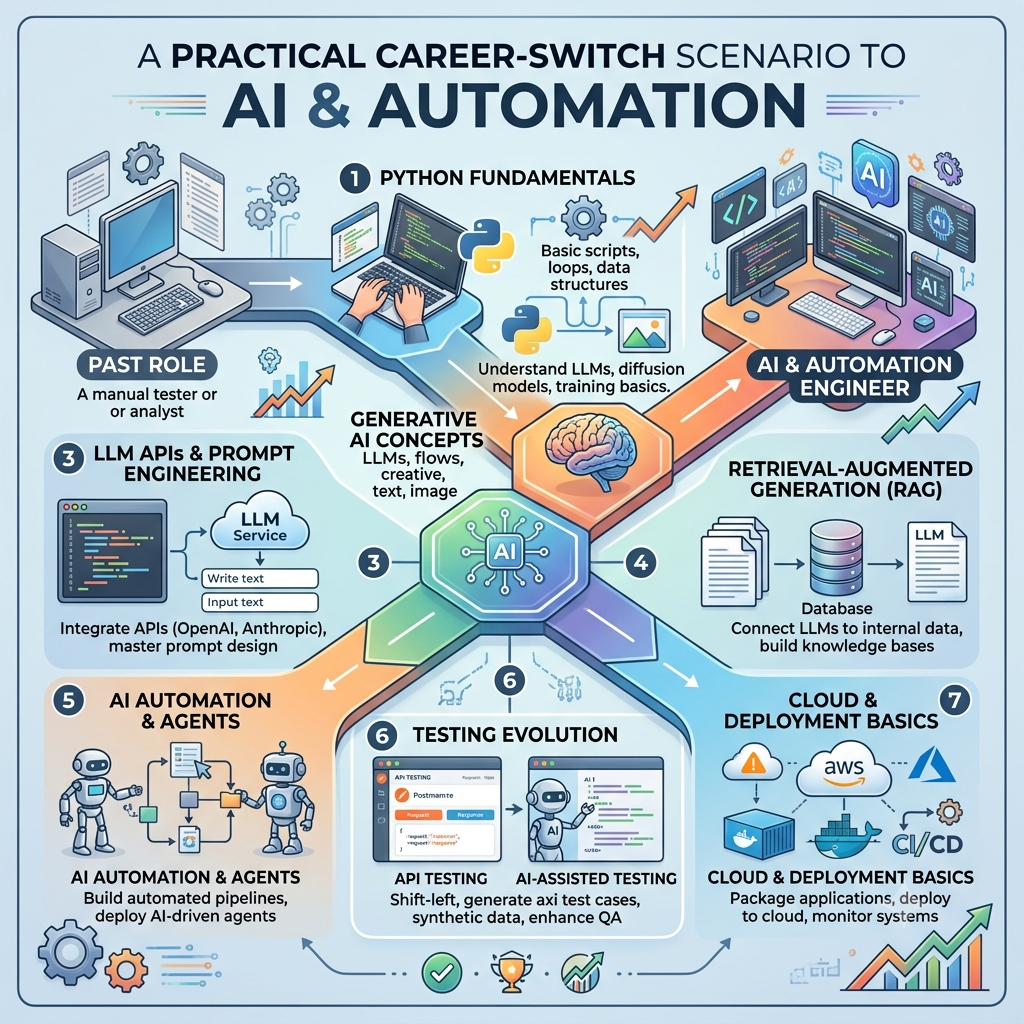
Instead, you could learn:
- Python fundamentals
- Generative AI concepts
- LLM APIs
- Prompt engineering
- RAG
- AI automation
- API testing
- AI-assisted testing
- Cloud and deployment basics
Then build an AI testing or automation project.
Suddenly, your story changes.
You’re no longer:
“A tester trying to enter AI.”
You can position yourself as:
“A QA professional with experience in software testing who has developed practical skills in Generative AI and AI-powered automation.”
That’s a much more believable transition.
The same idea works for developers, data analysts, business analysts, support professionals, and other technology professionals.
Your previous experience doesn’t necessarily become irrelevant.
Gen AI can become the layer you add to it.
Why a Structured Program Can Beat Random YouTube Tutorials
There’s nothing wrong with YouTube.
Actually, it’s fantastic.
The problem starts when your learning path becomes:
Monday: Python tutorial.
Wednesday: “Build a ChatGPT clone.”
Friday: Prompt engineering video.
Next week: LangChain.
Two weeks later: “Wait, what exactly am I supposed to build?”
I’ve seen this happen often enough that it’s worth saying plainly: information isn’t the same thing as a learning path.
A structured program gives you a sequence.
- Learn the fundamentals.
- Practice them.
- Build something.
- Learn the next layer.
- Build again.
- Prepare your resume.
- Practice interviews.
- Start applying.
That’s one of the reasons job-oriented programs can make sense for career changers.
H2K Infosys positions its current AI training around practical projects, certification, cloud-based hands-on work, and career assistance rather than theory alone.
What Makes H2K Infosys Worth Considering?
If your priority is specifically Gen AI training and placement, H2K Infosys is worth putting on your comparison list.
Its current Generative AI certification program is designed for beginners, working professionals, developers, QA professionals, analysts, and career changers. The published curriculum includes LLM fundamentals, major Gen AI tools, prompting, APIs, RAG, vector databases, and frameworks used for LLM applications.
There’s also a broader Artificial Intelligence program covering areas such as machine learning, deep learning, neural networks, NLP, MLOps, and LLMOps, with hands-on project work and career assistance.
That combination is important.
You’re not only learning what AI is.
You’re working toward being able to use it, build with it, explain it, and discuss your projects in an interview.
And if you’re looking specifically at the U.S. market, that job-oriented approach matters. A training program should help you think beyond completing modules and toward the actual hiring process.
Gen AI Skills Are Moving Toward Agentic AI
There’s another reason I’d avoid choosing a course based on an old curriculum.
The field is moving quickly.
In 2026, Google has been emphasizing AI agents and agentic coding rather than AI systems that simply respond to one prompt at a time. Google says AI Mode has surpassed one billion monthly users and is increasingly integrating conversational search, agents, and other AI capabilities.
That doesn’t mean every beginner needs to become an AI-agent specialist tomorrow.
It does mean your learning should leave room for what’s coming next.
A good Gen AI learning path should give you a foundation that can grow into:
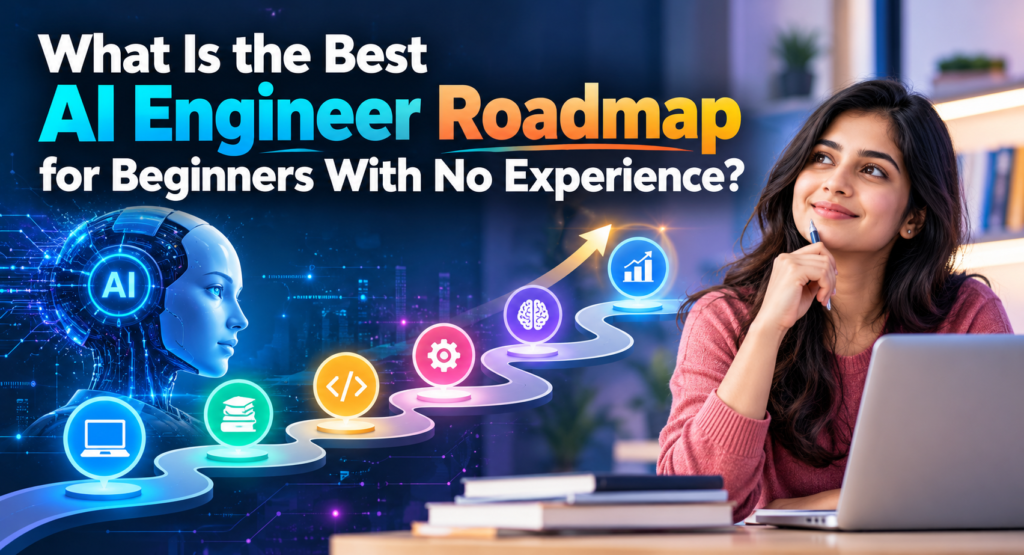
LLMs → RAG → AI applications → automation → agents → production AI systems
rather than locking you into one chatbot tool.
What Should You Look for in Gen AI Courses?
Before enrolling, I’d ask these questions:
Does the curriculum include real projects?
If the answer is only “video lessons + certificate,” look elsewhere.
Will you work with APIs?
Practical AI development goes beyond using a chatbot interface.
Does the course cover RAG?
RAG is an important pattern for building AI applications around private or domain-specific information.
Are modern frameworks included?
Look for relevant technologies rather than a curriculum that hasn’t been updated in years.
Is there interview preparation?
Technical knowledge and interview performance are different skills.
What does “placement support” actually mean?
Ask specifically about resume help, mock interviews, job-search assistance, and the process after training.
Is the curriculum updated?
This matters enormously in AI.
For context, Google was still announcing significant changes to its AI Search and agent capabilities throughout 2026.
An AI course shouldn’t feel frozen in 2023.
Is Gen AI Training Enough to Get a Job?
Not by itself.
That’s probably the most honest answer.
Training gives you knowledge and practice. Projects give you evidence of your skills. Career support can improve how you present yourself. But you’ll still need to put in the work applications, interviews, networking, continued learning, and probably a few uncomfortable moments where an interviewer asks something you don’t know.
That’s normal.
The goal isn’t to find a magic shortcut.
The goal is to shorten the distance between where you are today and being genuinely job-ready.
That’s a much more realistic expectation from Gen AI training and placement.
What is a Gen AI training and placement program?
A Gen AI training and placement program combines technical training in Generative AI with career preparation and job-search support. Instead of learning only theory, students typically work on practical projects, learn tools used to build AI applications, prepare their resumes, practice interviews, and receive guidance during their job search.
Who can join a Gen AI course?
Gen AI courses can be suitable for software developers, QA professionals, data analysts, IT professionals, recent graduates, and people looking to transition into AI. You don’t necessarily need years of AI experience to start, although basic programming and computer knowledge can make the learning process easier.
Can a Gen AI course help me switch careers?
Yes. A structured program can help you build the technical knowledge and project portfolio needed for an AI-focused role. Your existing professional experience can also be valuable—for example, a QA professional could combine testing experience with AI automation skills rather than starting their career completely from scratch.
What is a Gen AI Course with Placement Support in USA?
A Gen AI training and Placement Support in USA generally combines Generative AI training with career services such as resume preparation, mock interviews, job-search guidance, and placement assistance. The exact services vary by provider, so it’s important to check what “placement support” actually includes before enrolling.
Why are hands-on projects important in Gen AI training?
Projects give you something concrete to discuss during interviews. Building a RAG chatbot, document-question-answering application, AI automation workflow, or LLM-powered assistant can demonstrate that you understand how AI technologies are used beyond simply interacting with ChatGPT.
Are online Gen AI courses useful for working professionals?
Yes. Online learning can be particularly convenient for professionals who need to balance training with an existing job. The important thing is to choose a program that provides structured learning, practical assignments, projects, and opportunities to get help when you’re stuck.
What should I check before enrolling in Gen AI courses?
Look beyond the certificate. Check whether the curriculum is current, whether you will build real projects, which AI frameworks and APIs you’ll use, how much hands-on practice is included, and what the provider specifically means by placement support. A course that teaches you how to build, explain, and demonstrate AI solutions is generally more useful for a career switch than one focused mainly on theory.
Final Thoughts: Is a Gen AI Course With Placement Support in USA Worth It?
If you’re serious about switching into AI, a structured program can be a sensible option especially if you’re trying to learn while working or you’re unsure how to connect technical training with an actual job search.
The strongest approach is not:
Course → certificate → job
It’s closer to:
Learn → practice → build projects → strengthen your resume → prepare for interviews → apply → keep learning.
That’s the part people sometimes skip.
And with AI moving so quickly in 2026 from LLM applications to RAG, automation, multimodal systems, and agents having a structured path can save you from bouncing between hundreds of disconnected tutorials.
If you’re comparing Gen ai courses, look beyond the certificate. Look at the projects. Look at the technologies. Look at how recently the curriculum was updated. And most importantly, look at what happens after the training.
For learners specifically looking for a job-oriented path, H2K Infosys currently offers a Generative AI certification program with hands-on projects and career support, alongside broader AI training options.
The technology will keep changing.
Your ability to learn, build, and adapt is what makes the career switch sustainable.