AI courses, including structured AI training programs from H2K Infosys, can help you move closer to opportunities at top companies, but they are not an instant shortcut. DoThey provide the tools and practical foundation how effectively you apply those skills in real-world scenarios is what ultimately impacts your career outcomes.
What these courses really do is help you build skills that companies actually care about. Not just knowing definitions or algorithms, but being able to use them. Build something. Break it. Fix it. Show it. That’s the difference. Saying “I understand machine learning” is one thing having a working project you can walk someone through is something else entirely.
The better Ai training Programs don’t just dump theory on you. They push you into real problems. You’ll deal with messy datasets, models that don’t behave the way you expected (which happens a lot, honestly), and the whole process of turning an idea into something usable. Deployment, debugging, tweaking this is where many people get stuck. And ironically, this is exactly what companies look for.
So, what is an AI training program really?
If we strip away the fancy wording, it’s basically a structured way to learn how AI systems are built and used in real life.
Most programs cover things like:
- Machine learning basics
- Deep learning and neural networks
- Natural language processing (NLP)
- Data cleaning and feature engineering (this part is bigger than people think)
- Model deployment and monitoring
But here’s the important bit good programs don’t stop at explanations. They make you build things. Predictive models, small applications, sometimes even full pipelines. You’ll work with real datasets, not neat, perfect ones. That’s where things start to click.
Why AI training actually matters (especially if you’re already working)
AI isn’t some separate field anymore. It’s quietly everywhere analytics dashboards, customer apps, internal tools. You might already be using AI-powered systems without realizing it.
So yeah, for working professionals, learning AI is slowly moving from “optional” to… kind of necessary.
A few reasons why:
1. Demand is real—and it’s not slowing down
Finance, healthcare, retail, IT almost every industry is using AI in some form.
2. It helps you shift into better roles
If you’re in QA, development, or even data analysis, AI skills can open doors to more advanced roles.
3. You learn how things actually work in production
Not just theory. Real workflows, real constraints.
4. You get hands-on exposure
You’ll deal with things like:
- Messy or missing data
- Model tuning (which can be frustrating at times)
- Deployment pipelines
And honestly, these are the parts that matter most once you’re on the job.
How AI works in real projects (not the simplified version)
In real companies, AI isn’t just “train a model and done.” It’s part of a bigger system.
A typical flow looks like this:
- Collect data (databases, APIs, logs, etc.)
- Clean and process it (this step eats up more time than expected)
- Train models
- Evaluate them
- Deploy into applications
- Monitor performance over time
Take a simple example a recommendation system for a retail app:
- Data engineers prepare the data
- Data scientists build the model
- DevOps teams handle deployment
- Developers integrate it into the app
Courses that walk you through this full cycle? Way more useful than ones that stop at “here’s a model.”
How AI courses actually help with jobs
At the end of the day, it comes down to proof. Companies don’t just want to hear what you know they want to see what you’ve done.
1. You can show real skills
Working with data, building models, explaining results that’s what interviews focus on.
2. You get comfortable with industry tools
Python, TensorFlow, PyTorch, Pandas, Docker, cloud platforms… these aren’t optional anymore.
3. You build a portfolio
This is a big deal. Recruiters often check:
- GitHub projects
- Real-world use cases
- How you approach problems
Projects like fraud detection or recommendation systems speak louder than theory.
4. You start thinking about real-world constraints
Things like:
- Data privacy
- Scalability
- Performance
These aren’t always covered in Artificial intelligence Training Program courses, but they matter a lot in actual jobs.
5. Your problem-solving improves
You start thinking in terms of data, trade-offs, and outcomes. That aligns pretty closely with how interviews are structured.
What do you need to get started?
You don’t need to be an expert, but a few basics help a lot.
Prerequisites:
- Basic programming (Python is the usual choice)
- Some math:
- Linear algebra
- Probability
- Statistics
What you’ll learn along the way:
- Data handling and feature engineering
- Machine learning algorithms
- Deep learning fundamentals
- NLP techniques
- Deployment basics
- Model evaluation
Where is AI used in companies?
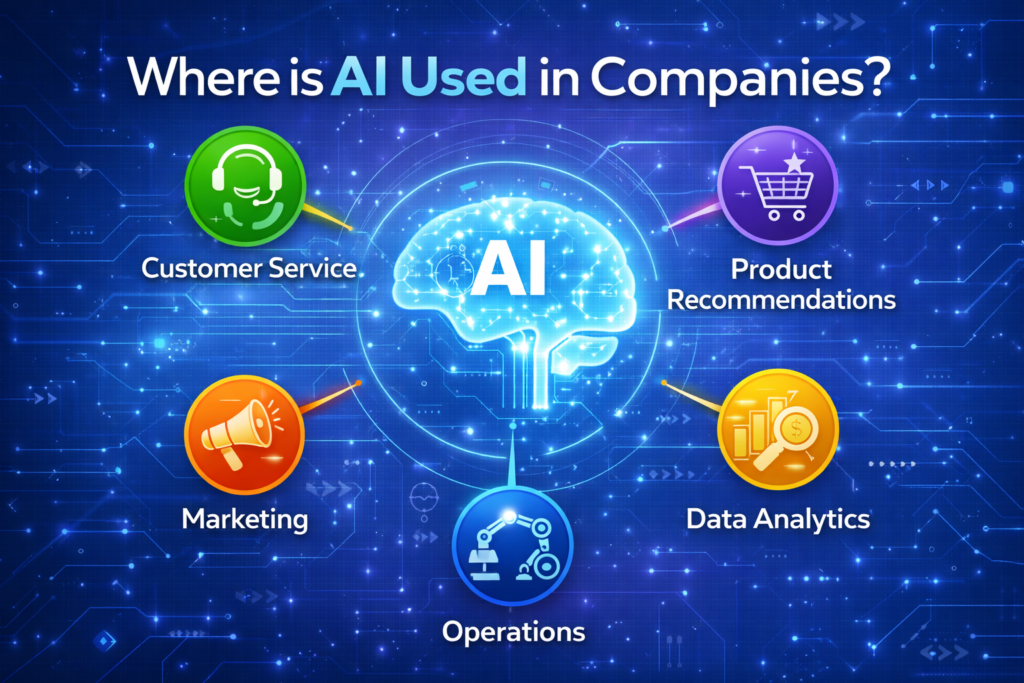
Pretty much everywhere now. Some common areas:
- Predictive analytics (sales, demand forecasting)
- Automation (chatbots, document processing)
- Risk management (fraud detection, anomaly detection)
- Personalization (recommendations, targeted ads)
Behind all this, there’s usually:
- Data pipelines
- Training environments
- Deployment systems
- Monitoring setups
Roles that actually use AI
AI isn’t tied to just one role anymore:
- Data Scientist → builds and analyzes models
- ML Engineer → focuses on deployment and optimization
- AI Engineer → works across the full system
- Data Analyst → extracts insights
- NLP Engineer → works with text
- Computer Vision Engineer → works with images and video
Career paths after learning AI
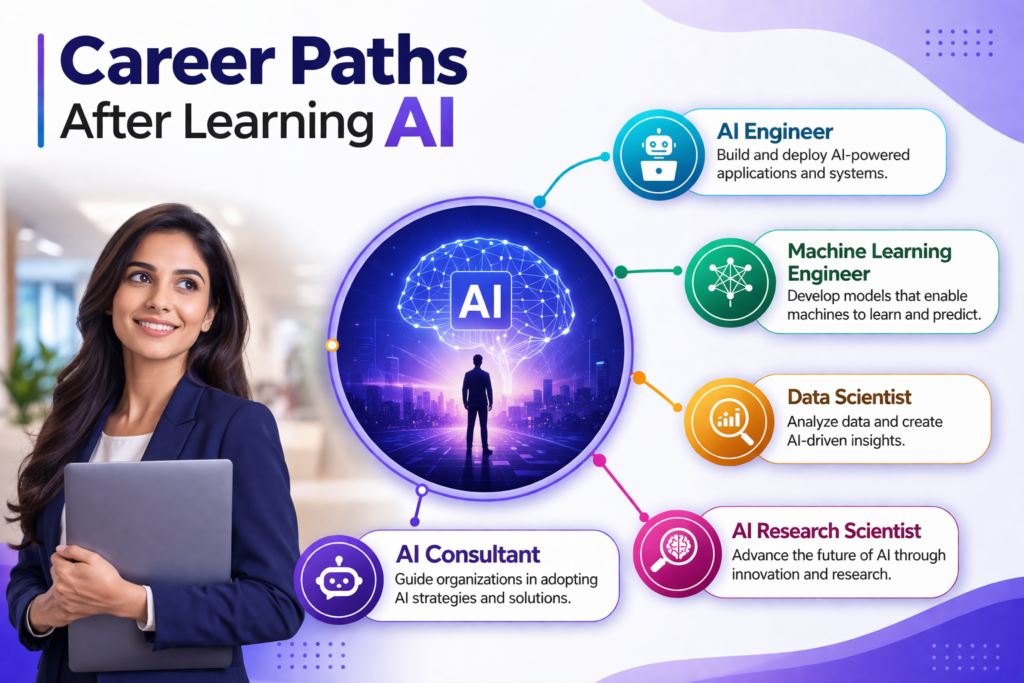
Most people don’t jump straight into senior roles and that’s fine.
Entry-level:
- Junior Data Scientist
- ML Engineer (entry-level)
- AI Analyst
Mid-level:
- Senior Data Scientist
- AI Solutions Architect
- ML Ops Engineer
Specialized:
- NLP Specialist
- Computer Vision Engineer
- AI Research Engineer
How AI training connects to hiring
Hiring usually follows a pattern:
Resume screening
Projects and certifications help you stand out.
Technical rounds
Coding, ML concepts, data handling.
System design
Understanding workflows becomes really useful here.
Behavioral rounds
Your projects become your story what worked, what didn’t, what you learned.
A simple project example
Say you’re predicting customer churn:
- Collect usage data
- Clean and preprocess it
- Create useful features
- Train a model
- Evaluate (precision, recall, etc.)
- Deploy via an API
- Monitor over time
Most solid AI programs include something along these lines.
Common challenges (the not-so-glamorous part)
- The math can feel heavy at times
- Real-world data is messy (almost always)
- Models can overfit
- Deployment is harder than expected
That last one surprises a lot of people.
What good programs usually focus on
- Real datasets
- Reproducibility
- Version control (Git)
- Clean, modular code
- Proper validation
Quick FAQs
Do AI courses guarantee a job?
No. They help—but your projects, consistency, and interview performance matter more.
How long does it take?
Roughly 4–12 months, depending on your pace.
Do you need coding?
Yes, especially Python.
Can non-IT people learn AI?
Yes—but expect a slower start while building basics.
What makes a program good?
Hands-on work, relevant tools, real-world scenarios, and a clear structure.
If you skimmed everything, here’s the gist:
- AI training builds practical, job-ready skills
- Projects matter more than theory
- Tools and workflows are key
- AI skills apply across many roles
- Real problem-solving is what companies care about most