Artificial intelligence (AI) courses in the U.S. are no longer designed solely to teach theoretical concepts. Modern AI Training Courses focus on how automation and intelligent systems are implemented in real-world environments. Instead of emphasizing only theory, these courses of artificial intelligence integrate hands-on learning working with datasets, building models, and understanding end-to-end workflows across data processing, model development, and deployment.
AI courses providers such as H2K Infosys follow a similar applied approach, where learners engage with practical scenarios, tools, and project-based exercises that reflect enterprise use cases. This structure helps working professionals connect AI concepts directly to their day-to-day responsibilities and understand how automation is actually executed in production systems.
You’ll run into topics like machine learning, data pipelines, model deployment and, more recently, generative AI. The goal isn’t complicated: move from “I get the idea” to “I can actually build and run this in a real system.”
What AI courses Really Means for Automation and Future Jobs
At a basic level, Courses of Artificial Intelligence is about learning how to build systems that can handle tasks people used to do manually. In real-world automation, that usually shows up in a few ways:
- Making decisions based on actual data (not gut feeling)
- Predicting outcomes sales trends, risks, customer behavior
- Automating workflows using machine learning models
- Integrating AI into existing enterprise systems
Most courses don’t stop at explaining algorithms anymore. They try to strike a balance between understanding why things work and actually building something useful.
So you’re learning both:
- The concepts (statistics, algorithms, data structures)
- And the execution (coding, deployment, tools, debugging… all of it)
Why AI courses Matters for Working Professionals
AI isn’t limited to data scientists anymore. It’s quietly becoming part of almost every tech role—and even some non-tech ones.
You’ll see it in places you wouldn’t have expected a few years ago:
- Routine tasks like log analysis or fraud detection getting automated
- Forecasting systems helping with planning and decision-making
- DevOps, cybersecurity, and cloud teams using AI-driven tools
- Even traditional roles touching data pipelines or ML models
So learning AI doesn’t mean you’re replacing your job it usually means your job evolves. In most cases, people end up working with automation, not competing against it.
How AI Courses Reflect Real-World Projects
Good programs tend to mirror how things actually happen in a company. Not perfectly, but close enough to make sense.
A typical workflow might look like this:
- Start with a problem (say, predicting customer churn)
- Pull data from databases, APIs, or cloud storage
- Clean it because it’s almost always messy
- Choose a model (classification, regression, etc.)
- Train it using tools like TensorFlow or PyTorch
- Evaluate how well it performs
- Deploy it maybe through an API or cloud platform
- Keep an eye on it over time
The tools you’ll use are pretty standard across the industry:
- Storage: AWS S3, Azure Blob
- Processing: Python, Pandas, NumPy
- Modeling: Scikit-learn, TensorFlow
- Deployment: Docker, Kubernetes
- Monitoring: MLflow, Prometheus
It can feel like a lot in the beginning honestly, it usually does. But once you go through the full cycle a couple of times, it starts to click.
Skills You’ll Need (or Just Pick Up Along the Way)
You don’t need to walk in knowing everything. Most people don’t.
That said, a few basics definitely help:
- Python programming
- Some math (linear algebra, probability nothing extreme, but useful)
- Data handling (SQL, cleaning datasets)
- Machine learning fundamentals
- Version control tools like Git
And then there are the less obvious ones:
- Problem-solving (you’ll use this constantly)
- Curiosity seriously, it matters more than people think
- Being able to connect technical work to business problems
Where AI Shows Up in Enterprises
In actual organizations, AI is less about flashy demos and more about solving practical problems.
Some common use cases:
- Predictive analytics (sales forecasting, demand planning)
- NLP applications like chatbots or document processing
- Computer vision in healthcare or manufacturing
- Process automation, often combined with RPA tools
Of course, real systems come with constraints. They need to scale, stay secure, and respond quickly. That’s why solid courses include case studies that deal with these limitations not just ideal scenarios.
Tools You’ll Likely Work With
Nothing too surprising here you’ll see the usual stack:
- Python, Jupyter Notebook
- TensorFlow, PyTorch
- Pandas, NumPy
- Matplotlib, Seaborn
- Cloud platforms like AWS, Azure, Google Cloud
- GitHub for version control
- Docker and Kubernetes
And yes, you’ll revisit these tools again and again. It’s not a one-time thing.
How AI Courses Actually Teach Automation
Automation isn’t treated like a separate chapter it’s baked into everything.
For example, you might build something like a retail system that:
- Collects sales data
- Uses a model to predict demand
- Automatically updates inventory
It’s the kind of scenario companies deal with every day, which is why it shows up so often in training.
Roles That Use AI Skills Daily
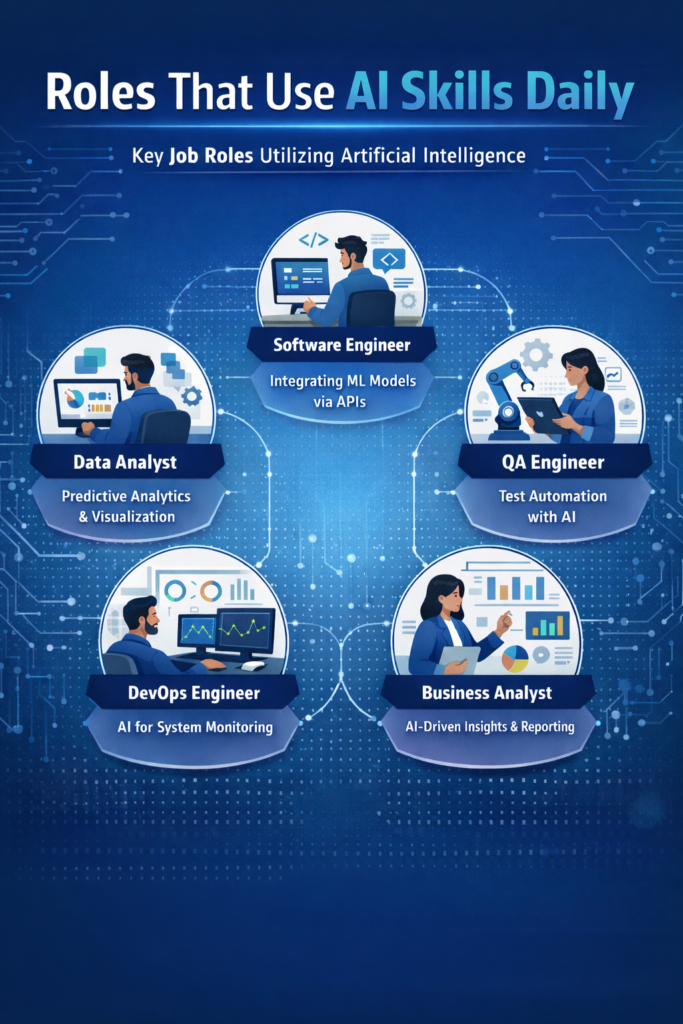
AI skills aren’t tied to just one role anymore. They show up across the board:
- Data Scientists → build and analyze models
- ML Engineers → deploy and optimize them
- Data Analysts → interpret results
- AI Engineers → manage end-to-end systems
- DevOps Engineers → automate pipelines
- Business Analysts → turn AI insights into decisions
So there’s flexibilitynyou’re not locked into a single path.
Career Paths After AI courses
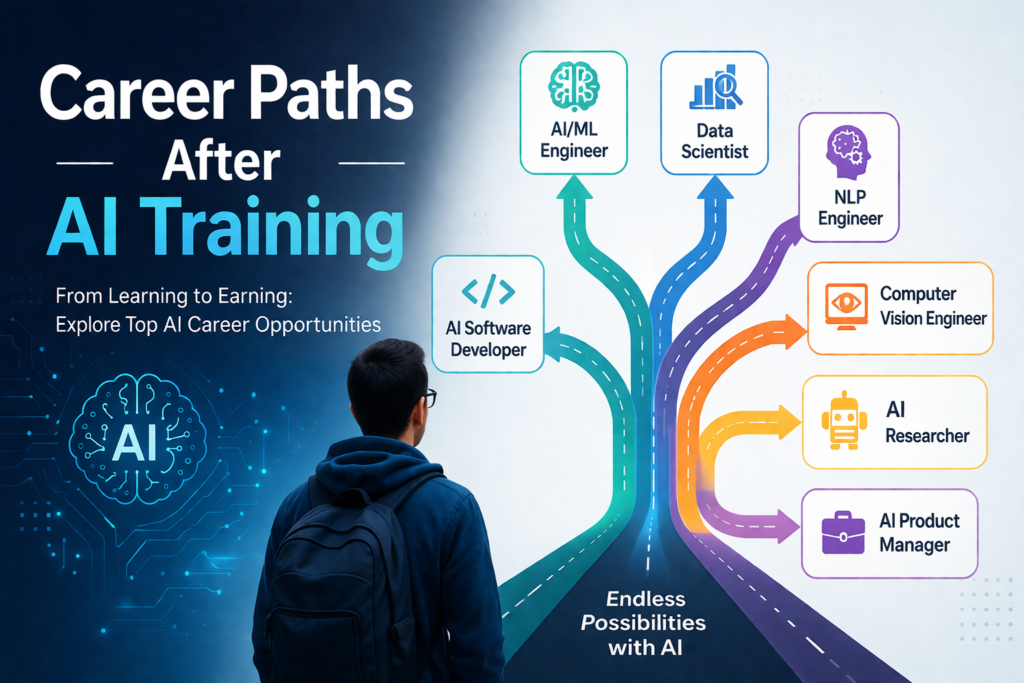
After finishing a structured program, people usually move into roles like:
- Machine Learning Engineer
- Data Scientist
- AI Solutions Architect
- NLP Engineer
- Computer Vision Engineer
At the beginning, you might start as a Data Analyst or Junior ML Engineer. Over time, things shift some move toward architecture, others toward research.
What About Generative AI courses?
Most newer courses include generative AI now it’s hard to avoid.
You’ll likely cover:
- Large Language Models (LLMs)
- Prompt engineering
- AI tools for content or code generation
There’s also a growing focus on ethics, which honestly is overdue.
Challenges People Usually Face
AI learning isn’t always smooth. A few common bumps:
- Math can feel abstract at first
- Datasets are messy (and sometimes frustratingly slow)
- Debugging models takes patience
- Deployment environments can get… complicated
Most courses suggest practical ways to deal with it:
- Start small
- Use pre-built models before building your own
- Keep your code modular
- Track experiments properly
A Typical Learning Path
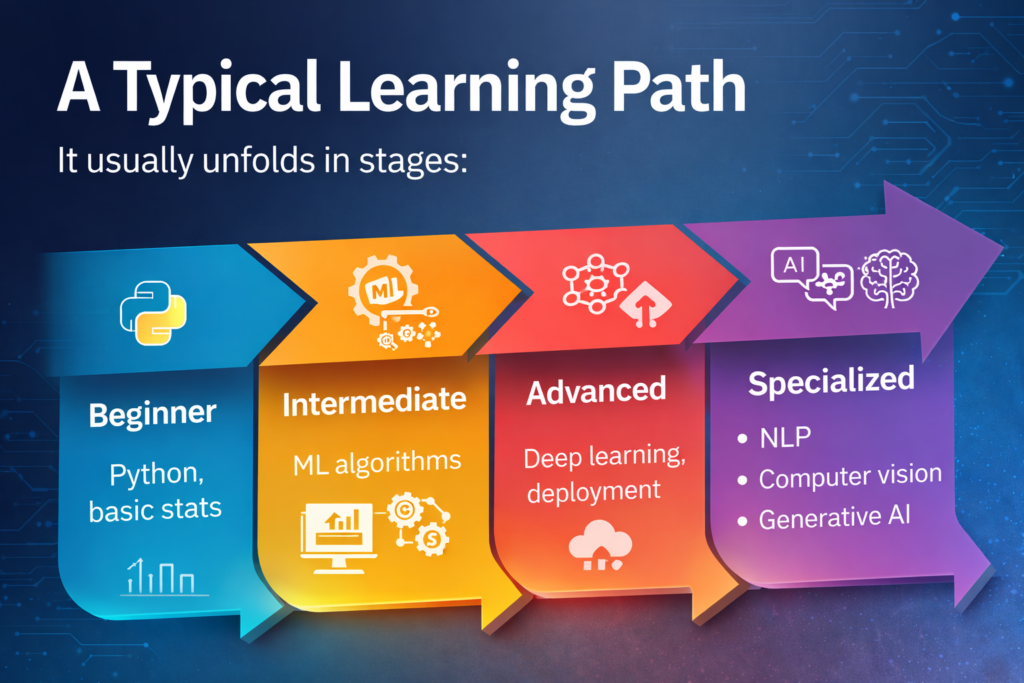
It usually unfolds in stages:
- Beginner → Python, basic stats
- Intermediate → ML algorithms
- Advanced → Deep learning, deployment
- Specialized → NLP, computer vision, generative AI
And no you don’t have to rush. Most people don’t.
FAQs
Do you need programming experience?
Not really. Many courses start with Python basics, though it helps if you’ve seen it before.
How long do courses take?
Usually between 3 to 9 months, depending on how deep you go.
Theory vs practical—what’s the focus?
A mix, but most lean toward hands-on work.
Can AI skills be used outside IT?
Absolutely—finance, healthcare, marketing, operations… pretty much everywhere.
AI vs Machine Learning?
Machine learning is part of AI. AI is the broader concept.
Do courses include cloud platforms?
Yes—AWS, Azure, or Google Cloud are usually part of the curriculum.
Key Takeaways
- AI courses in the U.S. focus on real-world automation, not just theory
- Online programs emphasize practical skills like deployment and data pipelines
- Tools and workflows match what companies actually use
- Automation plays a central role, especially in analytics and optimization
- Career paths are flexible and span multiple industries
Call to Action
If you’re looking for something structured but practical, programs from H2K Infosys are designed to help you build real, job-ready AI courses skills through hands-on projects and industry-focused training.