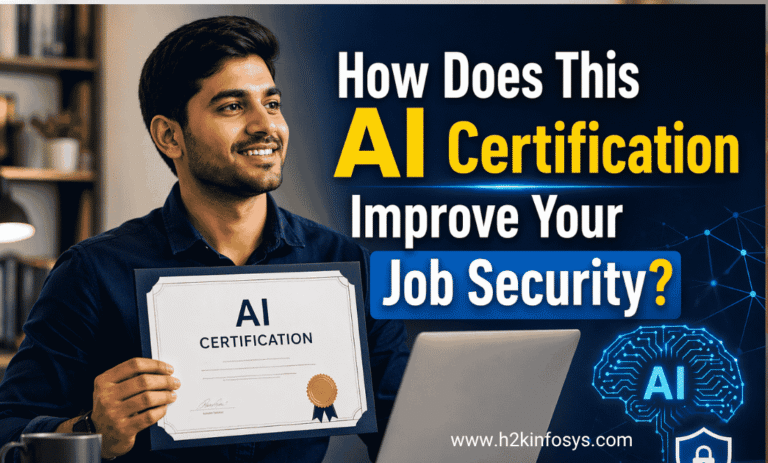
H2K Infosys AI certifications can genuinely make a difference when it comes to job security. Not in some abstract, buzzword-heavy way but in a very practical sense. When you learn AI properly, you’re picking up skills that companies are actively trying to hire for right now. It shows you’re not just keeping up, but actually moving with where the industry is headed.
At its core, an AI certification proves you understand how AI systems work things like machine learning pipelines, handling data, and making decisions based on that data. These aren’t niche skills anymore. They’re showing up everywhere in enterprise IT. So naturally, people who already know this stuff tend to have an edge whether it’s holding onto their current role or stepping into something more advanced.
So, what exactly is AI certification?
Think of it as a structured way to learn and then prove you’ve learned. You go through a program usually part of an Ai learning for Beginners and build up both knowledge and hands-on skills.
It’s not just theory. A decent certification walks you through:
- The basics of AI and machine learning
- Preparing and cleaning data (which, honestly, takes up a lot of real-world time)
- Training models and figuring out if they actually work
- Deploying those models into real systems
- And, increasingly, understanding ethical concerns—bias, fairness, governance
For someone starting from scratch, this kind of structured path helps a lot. Otherwise, AI can feel… overwhelming.
Why working professionals are paying attention to this
AI isn’t sitting in isolation anymore. It’s baked into tools people already use CRMs, cybersecurity platforms, dashboards, automation systems. Even if your role isn’t “AI-focused,” chances are you’re already interacting with it.
That’s where certification helps. It gives you:
- Proof of skill – not just “I’ve heard of machine learning,” but actual capability
- Flexibility – you can shift roles instead of getting stuck
- A bit of an edge – hiring managers notice it, whether they admit it or not
- Relevance – you’re aligned with what companies are building toward
In real work environments, you’re rarely working alone. You’ll run into:
- Data engineers handling pipelines
- DevOps teams pushing models into production
- Analysts trying to make sense of outputs
Knowing how all that fits together makes you way more useful.
How AI certification actually improves job security
1. It lines up your skills with what companies need
AI Certification is already being used for things like:
- Predicting financial trends
- Recommending products in e-commerce
- Detecting fraud
If your skills support these systems, you’re not easily replaceable.
2. It helps you evolve instead of getting replaced
Automation is real. Some tasks will disappear. But people who understand AI don’t get pushed out as easily they just shift.
You might go from:
- Manual reporting → data-driven analysis
- Monitoring systems → automating them intelligently
- Supporting tools → helping build or deploy them
That shift matters.
3. It makes collaboration easier
AI projects are rarely solo efforts. Certification helps you:
- Understand how data flows through systems
- Talk to data scientists without getting lost
- Contribute meaningfully during deployment or evaluation
That kind of cross-team understanding is surprisingly valuable.
4. It sharpens problem-solving
Once you’ve worked with AI tools, you start thinking differently:
- Looking at patterns in large datasets
- Predicting outcomes instead of reacting
- Optimizing processes using models
It’s not magic—but it’s powerful when applied right.
5. It opens up more career options
You’re not stuck in one track anymore. With AI skills, you can move into roles like:
- Machine Learning Engineer
- Data Analyst
- AI Solutions Architect
- Business Intelligence Developer
That flexibility adds a layer of long-term stability.
What AI looks like in real-world IT projects
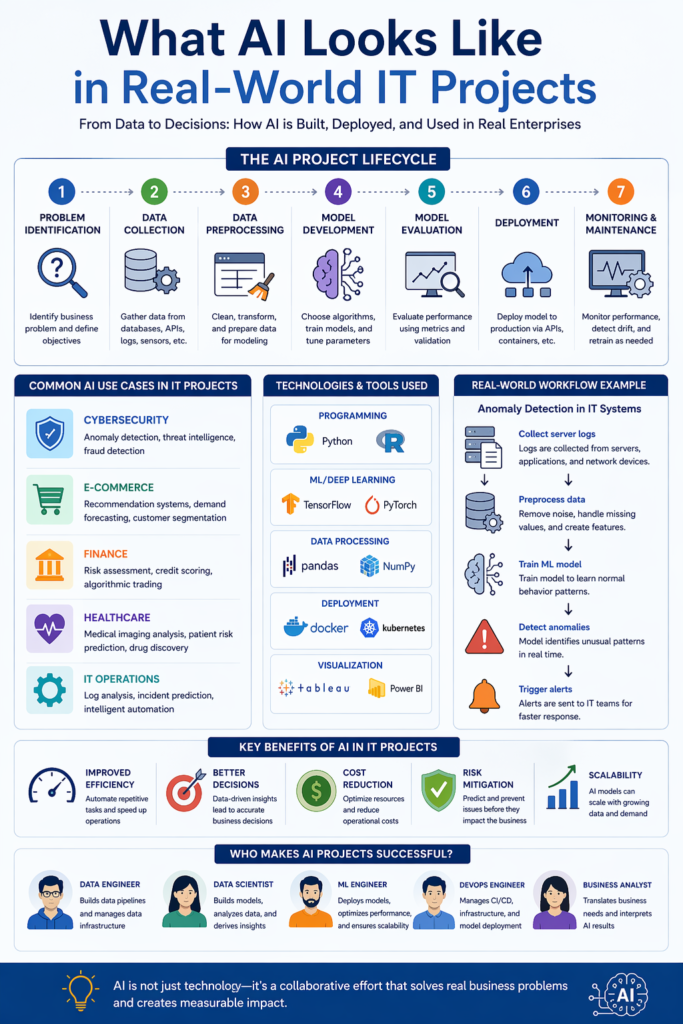
Most AI Certification systems follow a pretty standard flow:
- Data collection – from databases, APIs, logs
- Preprocessing – cleaning and shaping the data
- Model selection – choosing the right algorithm
- Training – using tools like TensorFlow or PyTorch
- Evaluation – checking accuracy, precision, etc.
- Deployment – integrating into apps via APIs
- Monitoring – tracking performance and updating models
A simple example—say, retail:
- Data engineers prepare sales data
- Models predict demand
- DevOps teams deploy those models
- Analysts use predictions to guide decisions
It’s a team effort, always.
Skills you’ll need (or pick up along the way)
Technical side:
- Python (mostly), maybe R
- Basic data structures
- Statistics and probability
- Machine learning algorithms
Tools you’ll run into:
- TensorFlow, PyTorch
- Pandas, NumPy
- Matplotlib, Tableau
- Docker, Kubernetes
And the underrated part—soft skills:
- Thinking analytically
- Solving messy, unclear problems
- Communicating across teams
Where AI is actually used
It’s everywhere, but some common areas include:
- Customer support (chatbots, NLP)
- Cybersecurity (anomaly detection)
- Finance (risk and fraud detection)
- Healthcare (diagnostics)
Of course, there are challenges too:
- Data privacy issues
- Scaling models properly
- Integrating with older systems
- Skill gaps in teams
Good certification programs usually try to address these, at least to some extent.
Career paths after learning AI Certification
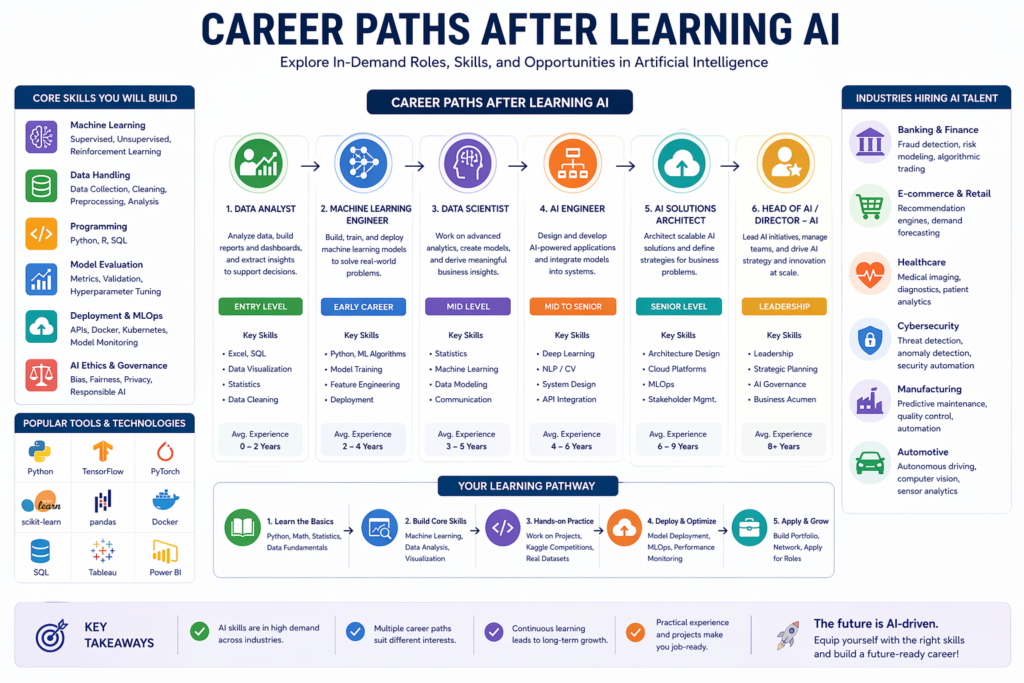
You can enter at different levels:
Entry-level:
- Data Analyst
- Junior ML Engineer
Mid-level:
- AI Developer
- Data Scientist
Advanced:
- AI Architect
- Head of Data Science
If you’re just starting out
A simple path might look like:
- Beginner → Python + basic stats
- Intermediate → ML algorithms + data handling
- Advanced → deep learning + deployment
It’s not a straight line for everyone, but it’s a decent roadmap.
A quick practical example
Say you work in IT operations. With AI skills, you could:
- Collect system logs
- Use ML AI Certification to detect anomalies
- Automate alerts based on predictions
- Improve system uptime
That’s a real, tangible shift from reactive work to proactive systems.
FAQs (quick and honest answers)
What’s the main benefit?
It proves you can actually work with AI tools not just talk about them.
Can beginners learn AI?
Yes. Many courses are designed to start from the basics.
How long does it take?
Anywhere from a few weeks to several months, depending on depth.
Does certification guarantee a job?
No. But it definitely improves your chances and stability.
Which industries use AI the most?
Finance, healthcare, retail, cybersecurity, manufacturing… pretty much all major ones now.
Final thoughts
An Ai Machine learning Courses isn’t a magic ticket but it does something important. It aligns your skills with where things are going.
It helps you adapt instead of getting left behind.
It makes you more useful in real projects.
And it gives you options which, honestly, is what job security really comes down to.
If you’re thinking about getting into AI, starting with a structured course and building hands-on experience is a solid move. Not flashy, not instant but effective.