As a fresher, if you have just started, trying to get a job as a Business Analyst (BA) in the USA, you need to improve skills in SQL, Excel, and Jira, and get certified in one of the following ECBA. For hands-on experience, internships, and Business Analyst Training programs, you may get a chance with H2K Infosys.
To get an added advantage, learn a skill in how to analyze data and get a certification in ECBA. To get practical experience, you need to apply for jobs at the intern level. Make a customized resume that reflects experience with the words “BA Skills”: “Data Analysis”, “Requirement Gathering”, and “Process Modeling”. Use LinkedIn to connect and search for open job posts.
Why the Business Analyst Role Is Growing in the U.S.
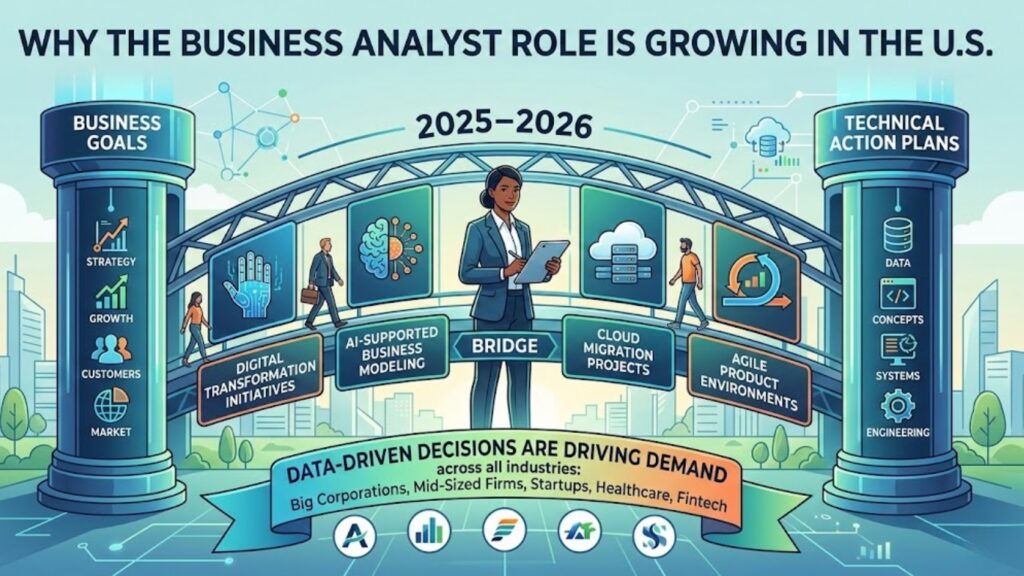
Over the past few years, companies have leaned heavily into data-driven decisions. Not just big corporations, mid-sized firms, startups, healthcare groups, fintech companies, everyone wants clarity from data.
And someone has to translate business goals into technical action plans. That “someone” is usually the Business Analyst.
Right now (2025–2026 especially), hiring trends show demand in areas like:
- Digital transformation initiatives
- AI-supported business modeling
- Cloud migration projects
- Agile product environments
In nearly every one of these efforts, the BA acts as the bridge. Not a coder. Not a project manager. The bridge. And that role isn’t fading it’s evolving.
If you’re stepping into this field now, you’re not late. You’re actually entering at an interesting time.
Step 1: Gain Insight into Recruiter Expectations
Let’s address an issue plaguing many job seekers: recruiting tools won’t actually get you a job.
I’ve seen job seekers include 15 tools on their resumes and still get nothing. Why? Because hiring managers care more about the lens of thinking than the touch points.
For entry-level Business Analyst roles, companies are looking for:
- Excellent communication skills
- Ability and capacity for requirement gathering
- Fundamental understanding of Agile/Scrum
- Fundamental understanding of SQL
- Strong analytical skills
- Comfortable speaking with stakeholders
Most of that is soft skills.
I’ve seen candidates with mediocre technical skills get offers because they were able to explain a business problem clearly and with structure, and thoughtfully during the interview. That clarity sticks.
Step 2: Put Your Money in BA Training (It Worths)
Sure, you can YouTube everything. Sure, it can be done. However, it’s commonly accepted that structured training has a higher chance of getting you there faster.
A good Business Analyst training will teach you how to:
- Document a BRD/FRD
- Write user stories
- Get started with wireframes
- Develop case studies
- Participate in mock interviews
When thinking about which course to choose, among others, consider the following:
- Presence of live case studies
- Mentoring
- Knowledge of what the U.S. market expects
- Assistance with job placement and/or resume distribution
Even recorded online training is good, provided there is enough material to complete the case study assignments.
Step 3: Obtain a BA Certification (Strategically, Not Random)
This part confuses most freshers.
Should you get one before you apply?
If you’re completely new, yes – it shows credibility. It demonstrates seriousness. Recruiters do filter resumes based on certifications – particularly in consulting firms.
Some common options are:
- ECBA (Entry Certificate in Business Analysis)
- PMI-PBA
- Certifications in line with IIBA
Will certifications get you a job? No. Anyone saying otherwise is exaggerating.
But it does strengthen your resume when you’re up against other entry-level candidates.
Consider it leverage – not magic.
Step 4: Create Experience If You Don’t Have It
This is the part people underestimate.
If you don’t have experience, build it.
You can:
- Develop full case studies
- Volunteer for startups
- Take internships (paid or unpaid)
- Document product requirement samples
- Redesign an existing app’s features as a mock project
One student I mentored built a complete mock e-commerce requirements document, including user stories, process flows, and acceptance criteria. That portfolio piece alone became his talking point in interviews. He eventually landed a BA role in Dallas.
Companies care about how you think through problems. Not your job title.
Step 5: Build a Practical Technical Stack
You don’t need to code. But you do need a working knowledge of tools.
At minimum:
- SQL basics
- Advanced Excel (formulas, pivot tables)
- Power BI or Tableau
- JIRA
- Confluence
- Basic API understanding
If your training doesn’t cover actual tool usage, consider upgrading. Theory without tools feels incomplete in interviews.
Step 6: Fix Your Resume for the U.S. Market
This is where many freshers lose opportunities.
A U.S.-style BA resume should:
- Highlight measurable outcomes
- Mention tools clearly
- Show Agile exposure
- Demonstrate stakeholder interaction
Avoid vague statements like:
“Responsible for analyzing data.”
Instead, write something like:
“Gathered and documented 45+ functional requirements for a simulated healthcare CRM system, identifying 30% process gaps.”
Specific beats generic. Every time.
Step 7: Networking is a Necessity
Some job opportunities aren’t advertised, not even on job boards.
If you want to get an actual BA position:
- Network with BAs and PMs
- Talk to recruiters
- Contact alumni
- Engage on LinkedIn
- Post your case studies
- Send individual messages, like “Hi, refer me.” Start a dialogue. Ask them about their work.
In case you didn’t know, referrals are super important.
Step 8: Apply Smart, Not Wide
Applying to 500 jobs sounds productive. It’s not.
Instead, focus on:
- Entry-level Business Analyst roles
- Junior BA positions
- Associate Analyst roles
- Contract opportunities
Contract roles, by the way, are often easier to enter and sometimes convert to full-time positions.
Precision beats volume.
Step 9: Prepare for Interviews Like It’s a Project
Interview prep shouldn’t be passive.
You should practice:
- Mock stakeholder conversations
- Requirement gathering simulations
- Behavioral questions
- SQL hands-on queries
Be ready to explain:
- A project you worked on
- A challenge you faced
- A disagreement with stakeholders
- A missed deadline and how you handled it
Interviewers want to understand your thinking process under pressure. That’s it. Not perfection just structured reasoning.
Step 10: Think About BA Training and Placement Programs (With Caution)
Some of these programs include:
- Real-time client assignments
- Resume distribution
- Practice interviews
- Direct employer access
This BA Training and Placement pathway is more effective for international students or those changing careers.
However, be sure to do your research. Read reviews.
Market Reality in 2026
Let’s not sugarcoat it. The market is competitive.
AI tools are now part of the workflow. They’re assisting analysts, not replacing them. Companies expect BAs to:
- Use AI for drafting requirements
- Interpret predictive analytics
- Collaborate with data engineers
If you’re entering now, develop AI literacy. Learn how to use tools like ChatGPT or Copilot responsibly. The strongest candidates today blend business thinking with tech awareness.
Hybrid thinkers stand out.
Typical Errors Made by Freshers
- Procrastinating until they feel fully prepared
- Shunning networking opportunities
- Not doing certifications
- Using CV templates
- Disregarding mock interviews
Obsession with perfection often postponed progress. It is action that builds momentum.
Constructing a Realistic Timeline
If you’re starting from scratch:
- 2−3 months: Finish BA training
- 1 month: Preparation for your Certification
- 1−3 months: Targeted applications and networking
It’s often the case that the most persistent candidates secure positions within 4−6 months. Not immediately, but gradually.
Conclusion
Getting a Business Analyst job in the USA as a fresher isn’t about luck. It’s about preparation, positioning, and persistence.
Invest in solid training. Build real project experience. Earn a credible BA Certification. Learn the tools. Network intentionally. Apply strategically.
It won’t happen overnight. But it happens again and again for people who stay consistent.
If you’re serious about it, start now. Not when you feel “ready.” Ready usually comes after you begin.