Yes. In most modern business analyst courses, including those offered through H2K Infosys, Agile and Scrum methodology are a core part of formal Business Analyst training. These frameworks are commonly taught because many enterprise IT projects operate in iterative, cross-functional delivery models where Business Analysts collaborate closely with product owners, Scrum Masters, developers, and quality assurance teams. Training typically covers Agile principles, Scrum ceremonies, user story development, backlog management, and stakeholder communication within sprint-based workflows.
From my experience in business analysis, Agile is more than a framework it represents a way of thinking that values adaptability, teamwork, and continuous improvement. Modern business analyst courses usually include Agile and Scrum as essential components of formal training. These approaches are widely used in enterprise IT projects where Business Analysts work closely with product owners, Scrum Masters, developers, and QA teams. Learners explore Agile values, Scrum events, user story creation, backlog refinement, and effective stakeholder communication within sprint-based delivery models. For learners pursuing BA Training, understanding how Agile and Scrum function in real delivery environments is essential to performing daily responsibilities such as requirements prioritization, acceptance criteria validation, and release planning.
What Is Agile and Scrum Methodology in Business Analyst Training?
Agile and Scrum methodology refers to a structured way of delivering software and digital products through short, repeatable development cycles rather than long, linear project phases. In business analysis training, these methods are taught as both theoretical frameworks and practical working models.
Agile Framework Overview
Agile is a set of principles defined by the Agile Manifesto that emphasizes:
- Customer collaboration over contract negotiation
- Working software over comprehensive documentation
- Responding to change over following a fixed plan
In enterprise environments, Agile is typically implemented through structured frameworks such as Scrum, Kanban, or hybrid models.
Scrum Framework Overview
Scrum is a widely used Agile framework that organizes work into time-boxed iterations called sprints, usually lasting two to four weeks. It defines specific roles, artifacts, and events that guide how teams deliver value.
In business analysis online training, Scrum is taught as a practical operating system for how Business Analysts interact with development and testing teams.
Role of Agile in Business Analyst Certification Programs
Most business analyst certification online programs include Agile and Scrum because certification bodies and employers expect Business Analysts to function effectively in Agile project environments. This includes:
- Writing user stories instead of traditional requirement documents
- Supporting sprint planning instead of long-term project planning
- Participating in daily stand-ups and retrospectives
- Managing evolving stakeholder needs throughout development
How Does Business Analyst Training Work in Real-World IT Projects?

In enterprise IT environments, Business Analysts rarely work in isolation. They operate within cross-functional delivery teams responsible for building, maintaining, or enhancing digital systems.
Typical Agile Delivery Workflow
| Phase | Business Analyst Activities |
|---|---|
| Initiation | Identify stakeholders, define high-level business goals |
| Backlog Creation | Break down requirements into epics and user stories |
| Sprint Planning | Help prioritize features and clarify acceptance criteria |
| Development | Answer team questions, refine requirements in real time |
| Testing | Validate requirements against delivered functionality |
| Review | Gather stakeholder feedback |
| Retrospective | Identify process improvements |
In business analysis online training, learners often simulate this workflow using case studies such as:
- E-commerce platform feature development
- Banking application enhancements
- CRM system upgrades
- Healthcare portal compliance updates
Enterprise Constraints Business Analysts Learn to Handle
Real projects include practical limitations such as:
- Security and compliance requirements (data privacy, access control)
- Integration with legacy systems
- Performance and scalability needs
- Regulatory documentation standards
These topics are commonly embedded into business analyst classes that focus on Agile delivery models.
Why Is Agile and Scrum Important for Working Professionals?
For professionals transitioning into business analysis roles, Agile and Scrum knowledge is not optional in most organizations. Many IT departments operate in hybrid or fully Agile environments.
Workplace Relevance
Agile-based roles often require Business Analysts to:
- Communicate requirements in real time
- Adjust priorities based on stakeholder feedback
- Support incremental software releases
- Collaborate with distributed teams
Professionals seeking business analyst training and placement often encounter Agile-based job descriptions that list Scrum knowledge as a preferred or required skill.
Professional Advantages
Understanding Agile frameworks allows Business Analysts to:
- Adapt to changing business needs
- Reduce delivery risk through early validation
- Improve collaboration across departments
- Align business strategy with technical execution
What Skills Are Required to Learn Business Analyst Training with Agile and Scrum?
Learners entering business analysis training typically develop both technical and interpersonal skills.
Core Technical Skills
- Requirements elicitation techniques
- User story writing
- Acceptance criteria definition
- Business process modeling (BPMN, flowcharts)
- Data analysis basics
- Tool usage (Jira, Confluence, Azure DevOps, Trello)
Professional Skills
- Stakeholder communication
- Facilitation and negotiation
- Analytical thinking
- Documentation clarity
- Conflict resolution
Agile-Specific Skills
- Sprint planning participation
- Backlog refinement techniques
- Estimation methods (story points, relative sizing)
- Agile documentation standards
These competencies are often aligned with industry-recognized ba certification pathways.
How Is Agile Scrum Methodology Certification Integrated into Training?
Many training programs align their curriculum with agile scrum methodology certification standards such as:
- Certified Scrum Product Owner (CSPO)
- PMI Agile Certified Practitioner (PMI-ACP)
- ICAgile Business Analysis certifications
Certification Mapping Table
| Skill Area | Certification Alignment |
|---|---|
| User Stories | CSPO, ICAgile |
| Backlog Management | PMI-ACP |
| Agile Metrics | PMI-ACP |
| Stakeholder Collaboration | ICAgile |
| Scrum Events | CSPO |
This structured approach ensures that business analyst certification online learners are prepared for formal assessments and enterprise job expectations.
How Is Agile Used in Enterprise Environments?
Common Enterprise Tools
| Tool | Purpose |
|---|---|
| Jira | Sprint and backlog tracking |
| Confluence | Documentation and knowledge base |
| Azure DevOps | CI/CD and Agile planning |
| Miro | Process modeling and collaboration |
| ServiceNow | IT service management integration |
Realistic Project Scenario
A Business Analyst working on a financial services platform might:
- Gather regulatory requirements from compliance teams
- Convert those into user stories for developers
- Define acceptance criteria aligned with audit standards
- Support QA teams during validation
- Present sprint results to business stakeholders
These workflows are often practiced in business analysis online training labs.
What Job Roles Use Agile and Scrum Daily?
Business Analysts trained in Agile environments commonly work in:
- Business Analyst
- Product Owner
- Systems Analyst
- Functional Analyst
- Agile Business Consultant
- Requirements Analyst
Organizations frequently list Agile knowledge as a key requirement in job postings related to business analyst training and placement programs.
What Careers Are Possible After Learning Business Analyst Training?
Career progression paths often include:
| Experience Level | Typical Roles |
|---|---|
| Entry-Level | Junior Business Analyst, Business Analyst Intern |
| Mid-Level | Business Analyst, Product Analyst |
| Senior | Lead Business Analyst, Product Owner |
| Advanced | Business Consultant, Program Manager |
Professionals completing structured ba training often move into cross-functional leadership roles that bridge business strategy and technical execution.
Learning Path for Agile-Focused Business Analyst Training
| Stage | Learning Focus |
|---|---|
| Foundation | Business analysis fundamentals |
| Agile Basics | Agile principles, Scrum framework |
| Practical Tools | Jira, documentation platforms |
| Project Simulation | Sprint-based case studies |
| Certification Prep | Agile and BA certifications |
| Job Readiness | Resume building, interview scenarios |
This approach is commonly found in business analyst certification online programs.
How Business Analysts Apply Agile Concepts in Real Projects
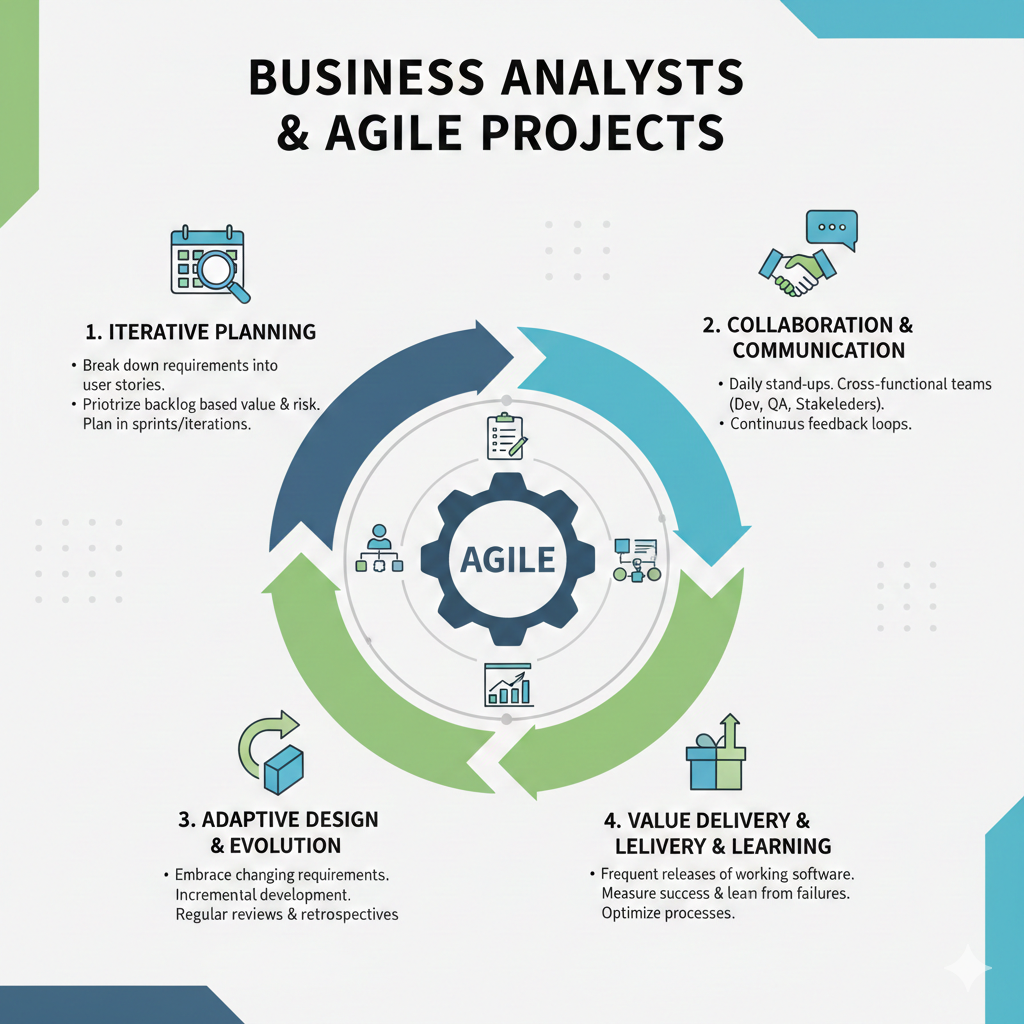
Step-by-Step Example Workflow
- Identify business objective
- Conduct stakeholder interviews
- Define epics and features
- Break into user stories
- Prioritize backlog
- Support sprint planning
- Validate delivered functionality
- Collect feedback and iterate
This workflow is emphasized in professional business analysis training programs.
Challenges Business Analysts Face in Agile Environments
- Changing stakeholder priorities
- Ambiguous requirements
- Limited documentation expectations
- Distributed teams
- Compliance constraints
Training programs often include scenario-based exercises to help learners manage these realities.
FAQ: Agile and Scrum in Business Analyst Training
Is Agile mandatory for Business Analysts?
While not mandatory, Agile knowledge is widely expected in modern IT organizations.
Do I need technical coding skills?
No. Business Analysts focus on requirements, processes, and communication, not programming.
Can beginners learn Agile-based BA training?
Yes. Most business analyst classes start with foundational concepts before advancing.
Is certification required for jobs?
Certification is not always required but can improve credibility and job prospects.
How long does Agile-focused BA training take?
Programs typically range from a few months to structured multi-phase learning paths.
Key Takeaways
- Agile and Scrum methodology are standard components of modern Business Analyst training
- Business Analysts work closely with cross-functional teams in sprint-based delivery models
- Certification pathways align Agile skills with industry job expectations
- Enterprise tools and real-world workflows are commonly part of training programs
- Career paths extend into product ownership, consulting, and leadership roles
For hands-on learning in Agile-based business analysis workflows and real project environments, explore structured Business Analyst programs at H2K Infosys.
Visit H2K Infosys to review course formats, learning paths, and professional development options.