Is Generative AI training worth it for a career in the USA in 2026? Yes, if your training in Generative AI helps you build practical skills, real projects, and job readiness, and not just another certificate. In the U.S., the job market is increasingly rewarding those who can truly leverage AI into software, data, automation, business processes and customer problems.
But there’s a catch taking an AI course doesn’t guarantee you’ll land a job. The real value is in learning how to build things, explain what you built, and connect those skills to the role you want.
That difference will matter a whole lot in 2026.
Why Generative AI Skills Will Be Important in the USA in 2026
AI is well beyond the stage of just a ‘interesting new technology’ now.
For software development, customer support, document processing, marketing, analytics, internal knowledge search, automation and product development, companies are using generative AI. “The adoption of AI, including generative AI, is expected to drive strong job growth in a number of computer and mathematical occupations,” a July 2026 report from the U.S. Bureau of Labour Statistics said. For example, the employment of data scientists is projected to grow by 33.5% over the period 2024-2034.
Software is another strong point. The BLS projects that there will be a 15.8% increase in software developer jobs from 2024 to 2034, with approximately 267,700 new jobs becoming available.
So, no, learning GenAI is not a shortcut to all AI jobs. But it can add a new dimension to an existing technical or business career.
Imagine a QA engineer who learns to use LLMs for test generation and defect analysis.
Or a business analyst who can build an internal RAG assistant for company documentation.
Or a developer who can build an AI-powered app, instead of just calling an API during a demo.
“I got a GenAI certificate” is a much less interesting career story than those.
What’s Really Changing in the AI Labour Market?
One thing I’ve noticed about conversations around AI careers is that they often oscillate between two extremes:
“AI is going to replace everyone.”
and.
“Just learn ChatGPT and you’ll get an AI job.”
Neither is good.
The truth is more complex.
AI and big data was the fastest-growing skill category, along with networks and cybersecurity and technological literacy, according to the World Economic Forum’s Future of Jobs Report 2025. It also found that employers still value analytical thinking, creativity, resilience and adaptability.
That mix is important.
A person who understands AI and business, software, data, testing, finance, healthcare or another domain can potentially add more value than a person who knows AI terminology but can not solve a real business problem.
And that’s where the value of good Generative AI Training comes in.
Generative AI: Is it Worth Training for Beginners?
A beginner can really benefit from structured training.
AI is a confusing field to learn casually as there are so many overlapping terms:
- Python Programming
- Machine Learning
- Deep Learning
- Big Language Models
- Prompting Engineering
- Embeddings
- RAG
- Vector DBs
- AI Agents
- Modification
- APIs
- Model assessment
- Safety in AI
You could spend months hopping from one YouTube video to another without ever acquiring a coherent skill set.
You get a sequence with a structured program.
Understand the basics first. Then find out how LLMs work. Then build apps. Then start on projects. And finally learn how to talk about those projects in interviews.
That’s a much more accurate picture of how people actually become employable.
What Should a Good Generative AI Course Look Like in 2026?
This is where prospective students need to be careful.
Don’t choose a degree just because the curriculum has 40 AI buzzwords.
Look for coverages that are useful such as:
1. Basics of generative AI and LLMs
You need to understand what large language models do, where they excel, where they don’t, and why hallucinations occur.
2. Engineering the prompt
Prompting still matters, but today’s training needs to be more than “write a better prompt.”
You should learn how to do structured prompting, context management, few-shot examples, and ways to make AI outputs more reliable.
3. LLM application building with APIs
This is where it gets more practical.
A learner should know how to integrate models into a real application rather than just interact with the model via a browser.
4. RAG
Enterprise applications can benefit greatly from Retrieval-Augmented Generation.
Suppose a company has thousands of internal documents. Instead of expecting an LLM to magically know everything, a RAG system can retrieve relevant information from a knowledge base and serve it as context.
This is a true engineering challenge.
5. Automation and AI Agents
Agentic workflows have emerged as a key area of experimentation in 2026. Knowing how multiple AI-driven steps can work together can be useful for automation and application development.
6. Implementation
A project that runs on your laptop is not quite the same as something you can show off as a deployable application.
Learning the basics of frameworks, APIs, containers and deployment will make your portfolio more convincing.
7. AI accountability
If you’re serious about enterprise AI, security, privacy, hallucination reduction, prompt injection, bias and human review are not optional topics.
When Does Placement Happen During Gen AI Training?
This might be the single most important thing for career changers.
That’s a big difference between:
Training AI
and
learning AI + getting ready to get hired.
Someone who changes careers may know how to learn technical concepts but still struggle with:
- Building an AI-Focused Resume
- Descriptions of Projects
- Responding to technical interview questions
- Architectural rationale
- Demonstrating value to the business
- Knowing what jobs to apply for
- Behavioural Interviewing
That’s the appeal of Gen AI Training with placement.
You should not confuse placement support with a magical guarantee of employment. No legitimate training program can remove the need for skill, effort, interviewing and job market competition.
What placement support can do is take some of the friction out of the transition between finishing training and actually getting into the hiring process.
Why H2K Infosys?
If you are looking for a career orientated Generative AI program with hands-on training and placement support, then H2K Infosys is one option to explore.
H2K Infosys Generative AI Training Certificate
The existing Generative AI certification program was last refreshed in July 2026 and describes a 90-hour curriculum in areas like prompt engineering, LLMs, OpenAI API, Hugging Face, LangChain, LlamaIndex, RAG, vector databases, AI agents, multimodal AI, safety and deployment concepts.
The interesting thing about that is not the size of the topic list.
The surrounding structure is career orientated.
According to H2K Infosys, the program includes:
- Instructor Led Training (Live)
- Practical projects
- Certification
- Resume writing
- Interview practice
- Preparing for an interview
- Career counselling
- Job placement assistance
The program also covers potential career paths such as GenAI/Prompt Engineer, RAG/NLP Engineer, AI Automation Engineer, LLM Application Developer, AI Application Developer and AI Product Analyst.
That combo can be more useful than taking a collection of unrelated self-paced courses, especially if you’re starting from scratch.
A Real World Example: QA Tester Transitioning to AI
Suppose you are working in the USA as a QA tester, for instance.
You don’t need to give up what you’ve already done and start over as a machine-learning researcher.
You could add to what you already know instead.
Like:
The original text is:
QA Engineer – test, test cases, automation, defect tracking
Once GenAI skills were added :
QA Engineer – AI-assisted test creation, LLM apps, automation workflows, AI-driven documentation, GenAI testing
That’s a different career proposition
The same goes for business analysts.
BA who understands requirements, workflows and stakeholders may learn to leverage GenAI for requirements analysis, documentation, process automation and AI assisted business applications.
Your domain knowledge is not lost.
AI is simply another tool in your tool box.
How About Online Gen AI Classes?
There are now thousands of Gen AI courses out there online.
That’s all well and good, until you try to pick one.
And now you have 100 tabs open.
There is one course on prompting. One more is teaching Python. One language is LangChain. Another teaches agents. Another speaks of a six-figure career in AI in 30 days.
It’s easy to get lost, honestly.
Here are five things I’d think about when comparing online programs:
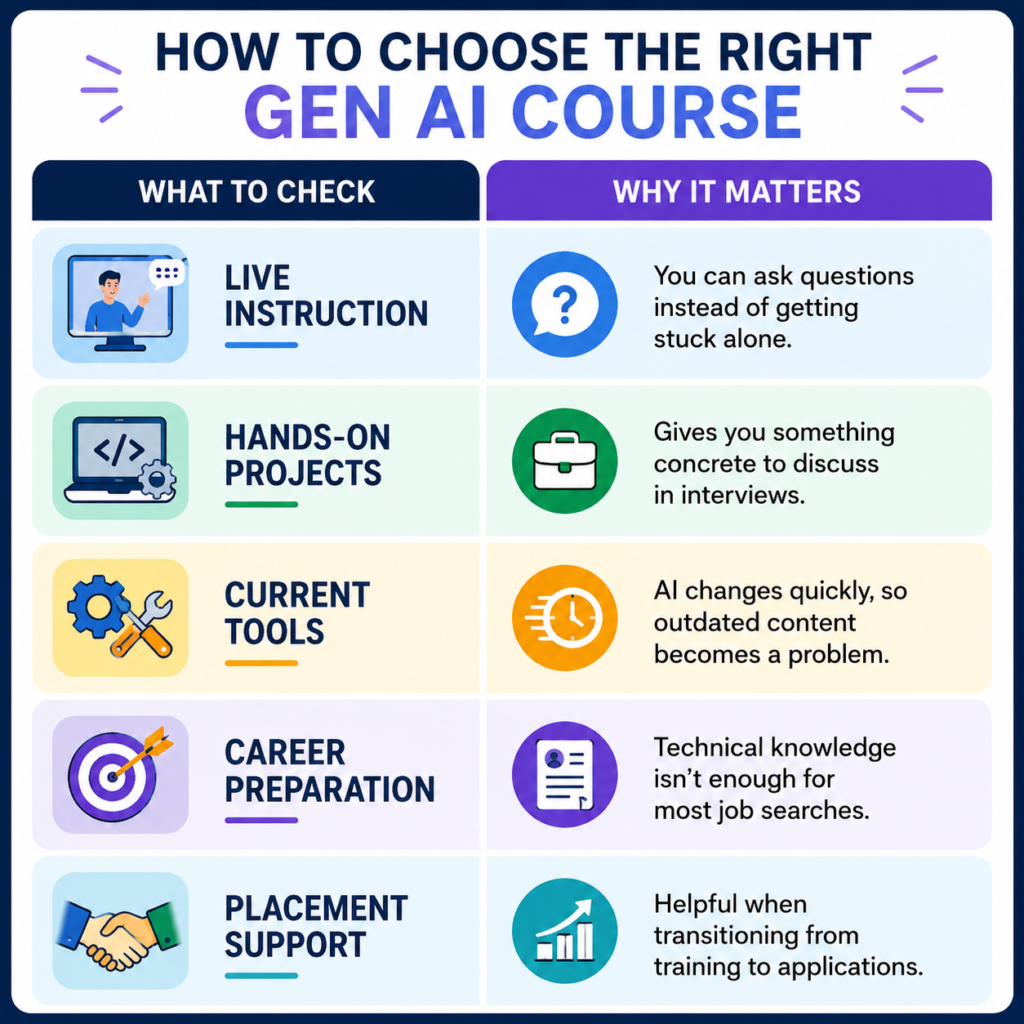
H2K Infosys, for example, differentiates its online GenAI program by emphasising live learning, projects, and job readiness, rather than solely relying on recorded content.
So if you care about career support, that’s a good one to add to your comparison list.
Does Gen AI Training Equal a Job?
No, and you should be suspicious of anyone who makes it sound too easy.
A placement-support program can help you write your résumé, do mock interviews, explain your projects, and give you advice on your job search. However, being hired is still subject to your skills, experience, interview performance, location, work authorisation, role requirements and the employer.
H2K Infosys calls its offering job placement support, including resume preparation, mock interviews and career guidance.
That’s the proper way to think about it.
Placement assistance is help, not a replacement for competence.
Generative AI Training: How Much Can You Earn?
Here again we must not be taken in by flashy promises.
Your salary depends a lot on your previous experience, location, education, technical depth, industry and the exact role you land.
For context, the median annual wage for software developers was $133,080 in May 2024, according to the BLS, and for data scientists, it was $112,590. These are industry averages, not guarantyd salaries for someone who takes a GenAI course.
So if somebody says to you:
You will definitely be making $150K after this course.
Step away.
A far better goal is to build the skills that make you competitive for jobs that pay at those levels.
Is Generative AI Training Better for Experienced IT Pros?
Yes, in many cases.
Existing experience in someone:
- Development of Software
- Q&A
- Data analysis
- Analysis of business
- Cloud
- DevOps
- Cybersecurity;
- Project management
may have an advantage because they know how technology is used within organisations.
For example, a developer learning RAG can apply his software engineering knowledge in developing AI applications.
A data analyst can merge analytics and LLM-powered workflows.
A QA professional can look into AI-assisted testing.
A business analyst can work on process automation and artificial intelligence-driven requirements.
That’s part of the reason I wouldn’t necessarily tell an experienced IT professional to “start over” in AI.
Add intelligence to your AI.
What Projects Should You Work On?
This is when your training starts to pay dividends.
Instead of creating another run-of-the-mill “AI chatbot”, test something that really shows a real business use case.
For instance:
Project 1: Corporate knowledge helper
Create a RAG app to answer questions based on a set of company documents.
You can show:
- Document Import
- Embeddings
- Vector similarity search
- Retrieval
- Answers from LLMs
- Grounding source
Project 2: AI QA Assistant
Create a tool that converts requirements into test scenarios and test cases.
Now you can mention both QA and AI in an interview.
Project 3: Assistant Business Analyst
Create an app that takes meeting notes or requirements and produces:
- Stories of users
- Acceptance criteria
- Summary of requirements
- Possible questions
- Documentation
Suddenly your portfolio has a story to tell.
And that’s the point.
Generative AI Training: Who Needs It in 2026?
If you are then I would seriously consider it:
A newbie
You need a structured road map and a portfolio, not just collecting certificates randomly.
Changing careers
This is where a structured program can help you bridge your past experience to AI skills.
Software Developer
You can add LLM apps, RAG and agentic workflows to your existing development skill set.
A QA Expert
AI-assisted testing and automation can build on your testing background.
Business Analyst
GenAI is able to be leveraged for requirements, documentation, analysis, workflow automation
Data analyst.
The combination of analytics and AI applications may open up additional avenues.
A working professional
Online training means you can learn new skills without having to leave your job.
H2K Infosys says its Generative AI course is for beginners, developers, QA professionals, analysts, career changers and other professionals.
Who Probably Shouldn’t Take a GenAI Course Yet?
Now for the less fun advice.
Don’t join just because everyone on LinkedIn is talking about AI.
If you are unsure of what you want to do with the skill, experiment first.
Build a small application.
Call an LLM API.
Learn basic Python.
Learn about RAG.
If you really like solving such problems, try.
Then, if you need the roadmap and mentorship, invest in structured training.
A course should accelerate your learning, not make you believe you love technology in an instant.
AI Career Reality in 2026
The opportunity is real, but the market is growing more sophisticated.
Employers don’t want people who just know about chatgpt.
They need people who are able to answer questions like:
- “What problem does this AI system try to solve?”
- “Where is the data coming from?”
- How do you get the output?”
- What if the model is incorrect?”
- How would you roll it out?”
- How do you keep sensitive information safe?”
- That’s a much better standard.
And that’s honestly a good thing.
So the value of serious training is not just learning prompts. “It’s learning to think about AI as an engineering and business problem.”
So, Is Training in Generative AI Worth It in USA 2026?
Yes, if you choose the right kind of training and treat it as a career building exercise rather than a certificate collecting exercise.
The employment numbers indicate continued demand for technical skills related to AI. BLS expects to see strong growth in data science, software development and other computer-related jobs. The World Economic Forum includes AI and big data in the list of the fastest-growing skill areas.
But the best candidates won’t necessarily be the ones who know the most AI terminology.
They will be the ones able to say:
“So here was the business issue. This is the AI way I used. Here’s what I made. This is where it all went wrong. Here’s how I looked at it. And here’s what we got.”
That’s the value of Generative AI Training career.
If you’re looking for a structured approach that includes technical learning, projects, and career support, H2K Infosys is worth a look, particularly if you are a beginner, career changer, and IT professional seeking a practical route into GenAI. It currently has programs on LLMs, prompt engineering, RAG, AI agents, APIs, deployment concepts, projects, resume preparation, mock interviews, and placement support.
H2K Infosys Generative AI Training Explore
The smartest move in 2026 is not to blindly pursue “AI jobs.”
Choose a career path, learn the AI skills that enable it, create proof that you can use those skills, then show that proof to employers.
That’s a much more realistic and much more sustainable AI career strategy.
Is Generative AI a good career in the USA ? in 2026
Yeah. Strong growth in several technology and data occupations is projected to be driven by AI adoption. The BLS anticipates employment of data scientists to increase by 33.5% from 2024 to 2034, whereas software developers will grow by 15.8% over the same period.
Is Gen AI training for beginners?
Yes, but only if the course starts from the very basics and then moves to hands-on projects. H2K Infosys says its current Generative AI program is designed for beginners, but also for experienced IT professionals and career changers.
Are online Gen AI courses worth it?
They can be especially so if they include live instruction, hands-on projects, current tools and career preparation. Quality varies widely, so compare curriculum, projects, instructor support and career services before you sign up.
What is Gen AI Training with placement ?
It combines Generative AI education with career services, including resume preparation, mock interviews, job-search guidance and placement help. That does not mean that employment is guarantyd necessarily.
Placement Support for GenAI Training H2K Infosys?
Yes. Currently H2K Infosys has Generative AI training including LLMs , prompt engineering , RAG , AI agents & application development , projects , résumé preparation , mock interviews and job placement support.
Do I need to know how to program?
Not for every learning path necessarily. But if you want to build and deploy AI applications, programming is becoming more and more important. Prior coding experience is helpful but not mandatory for its current Generative AI program, says H2K Infosys.
Can business analysts and QA engineers leverage GenAI training?
Can business analysts and QA engineers leverage GenAI training?
Of course. GenAI may be a useful add-on for skills in QA, business analysis, documentation, automation and workflow design. In many cases, it’s more realistic to combine an existing professional background with AI skills than to try to be a pure AI researcher.
What to look for in an AI course?
Project. A certificate shows an employer you have finished training. A well built project gives you something concrete to talk about, show, and defend in an interview.