If your goal is to build an AI career rather than simply collect another certificate, look for an Online AI Course With Job Placement that combines hands-on projects, current AI skills, mentor guidance, interview preparation, and genuine job-placement assistance. Among the options available today, H2K Infosys is worth considering because its AI training is built around practical learning and career support rather than theory alone.
The important word here is “job-ready.” A course can teach you Python, machine learning, or even generative AI, but that doesn’t automatically mean you’ll be comfortable explaining a project to a recruiter on Monday morning.
And that’s where choosing the right training program gets interesting.
Why Choosing an AI Course Is Different in 2026
Artificial intelligence has moved well beyond the “future technology” label.
Companies are already using AI to automate workflows, analyze data, build software, improve customer experiences, and create new products. In September 2026, for example, Wipro said its AI initiatives had created capacity equivalent to about 20,000 workers, while more than 100,000 employees had been trained in advanced AI skills.
At the same time, India’s Global Capability Centres are reporting shortages in advanced skills such as AI, generative AI and MLOps.
So yes, the opportunity is real.
But there is a catch.
Employers don’t necessarily need another person who can say, “I completed an AI course.”
They need someone who can use AI to solve a problem.
That distinction should shape how you evaluate the Best Artificial Intelligence Courses in 2026.
7 Things to Check Before Choosing an Online AI Course With Job Placement
1. Look Beyond the Certificate
A certificate can help demonstrate that you completed training. It cannot demonstrate that you know how to build an AI solution.
Before enrolling, check whether the curriculum includes practical areas such as:
- Python and data handling
- Machine learning
- Deep learning
- Natural language processing
- Generative AI
- Large language models
- Prompt engineering
- AI APIs
- AI application development
- Model deployment
- Real-world projects
For example, H2K Infosys’ current Generative AI certification curriculum covers AI and ML fundamentals alongside LLMs, prompt engineering, API integration, LangChain, LlamaIndex and application deployment.
That’s the kind of progression I’d look for: fundamentals → application → project → job preparation.
2. Ask One Simple Question: “What Will I Build?”
This is probably my favorite test when comparing courses.
Don’t ask only:
“What topics are included?”
Ask:
“What projects will I be able to show an employer when I finish?”
A good project should give you something meaningful to discuss during an interview.
Imagine you’re asked:
“Tell me about an AI project you’ve worked on.”
If your answer is, “I completed a course project using Python,” that’s not particularly memorable.
But if you can explain the business problem, dataset, preprocessing, model selection, evaluation, challenges and final result, you’ve got an actual conversation going.
H2K Infosys emphasizes real-time project training and business-oriented AI use cases as part of its job-focused approach. That practical exposure is one reason AI courses online with job placement can be more useful than purely self-paced programs.
3. Understand What “Placement Assistance” Actually Means
This one deserves a little attention because “placement assistance” can mean wildly different things depending on the provider.
Before paying for a course, ask:
- Is resume preparation included?
- Are mock interviews provided?
- Will someone review my project presentation?
- Is there career guidance?
- Will I receive help identifying suitable roles?
- Is interview preparation included?
- What happens after I complete the course?
- Are there actual employer or hiring connections?
- Is placement assistance being confused with a guaranteed job?
That last question matters.
No credible training provider can honestly promise that every learner will receive a job regardless of skills, interview performance, experience, or market conditions. H2K Infosys itself distinguishes placement support from a blanket job guarantee.
H2K’s stated support includes resume preparation, mock interviews, project presentation guidance and job-application assistance.
That’s a much more realistic way to think about placement.
Training gets you prepared. Placement assistance helps you navigate the hiring process. You still have to perform in the interview.
4. Make Sure the Course Reflects Modern AI
This is where some older AI courses can become problematic.
AI isn’t standing still.
Learning traditional machine learning is still valuable, but today’s AI roles can also involve:
- Generative AI
- LLM applications
- RAG
- AI agents
- Prompt engineering
- API integration
- Automation
- Cloud AI services
- Responsible AI
- Deployment and monitoring
The goal isn’t to chase every shiny new AI tool that appears on LinkedIn.
Actually, please don’t do that.
The better approach is to learn fundamentals first, then understand how modern AI tools fit into real applications.
H2K Infosys’ current GenAI program, for example, includes LLM concepts, prompt engineering, OpenAI API, Hugging Face, LangChain and LlamaIndex.
That’s much more useful than a course that spends 40 hours teaching prompt tricks without explaining what’s happening underneath.
5. Check Whether Beginners and Career Switchers Are Supported
Not everyone starting AI is a computer science graduate.
You might already work in:
- QA/testing
- Business analysis
- Data analysis
- Software development
- IT support
- Operations
- Administration
Or you might simply be trying to move into technology from another field.
That changes what you need from a course.
A beginner-friendly program should explain concepts progressively instead of assuming you’re already comfortable with machine learning mathematics, Python libraries and model architecture.
H2K Infosys positions its AI training for beginners, working professionals, QA professionals, data analysts, business analysts and career changers.
For a career switcher, that can be particularly important because the challenge isn’t only learning AI. It’s figuring out how to translate your existing experience into an AI-focused resume.
6. Don’t Ignore Resume and Interview Preparation
Here’s a scenario that happens more often than people realize.
Someone completes an AI course.
They know Python. They’ve built a model. They understand basic ML concepts.
Then they update their resume:
“Completed Artificial Intelligence Certification.”
And wait.
Nothing happens.
The problem might not be the course. It could be how their skills are being presented.
A good resume should explain what you actually did.
Instead of:
Learned machine learning algorithms.
You want something closer to:
Developed and evaluated a machine-learning classification model using Python, including data preprocessing, feature engineering and model evaluation.
Now a recruiter has something concrete to work with.
H2K Infosys includes resume-building assistance and AI-focused mock interviews in its career-support approach.
For someone entering AI without years of previous experience, that kind of guidance can be surprisingly valuable.
7. Check the Learning Format Before You Enroll
Online doesn’t automatically mean convenient.
Check:
- Live vs. recorded classes
- Instructor availability
- Hands-on sessions
- Project mentorship
- Class timings
- Doubt-clearing support
- Access to course materials
- Career support after training
For working professionals, flexibility matters. You don’t want a great course that becomes impossible to attend after your second week because the schedule clashes with your job.
This is one area where it makes sense to attend a demo class before committing.
You’ll quickly get a feel for whether the instructor actually explains things clearly or simply races through slides.
Why H2K Infosys Is Worth Considering
If you’re specifically searching for AI training and placement, H2K Infosys has several of the elements I’d put on a comparison checklist.
Its current AI-related training emphasizes:
Practical learning: Learners work with real-world AI use cases and project workflows rather than studying theory exclusively.
Modern AI skills: Its current Generative AI program includes LLMs, prompt engineering, APIs, LangChain, LlamaIndex and deployment concepts.
Career preparation: H2K describes support covering resumes, mock interviews, project presentation and job-search guidance.
Career-switcher focus: The training is positioned for people coming from different professional and educational backgrounds.
And there’s another point worth considering: H2K’s own recent material doesn’t frame placement as “finish the course and automatically get hired.” Instead, it focuses on making learners more prepared for the actual hiring process.
That’s a healthier expectation.
What Should You Learn in an AI Course in 2026?
If you’re comparing the Best Artificial Intelligence Courses, I’d look for a curriculum roughly along these lines:
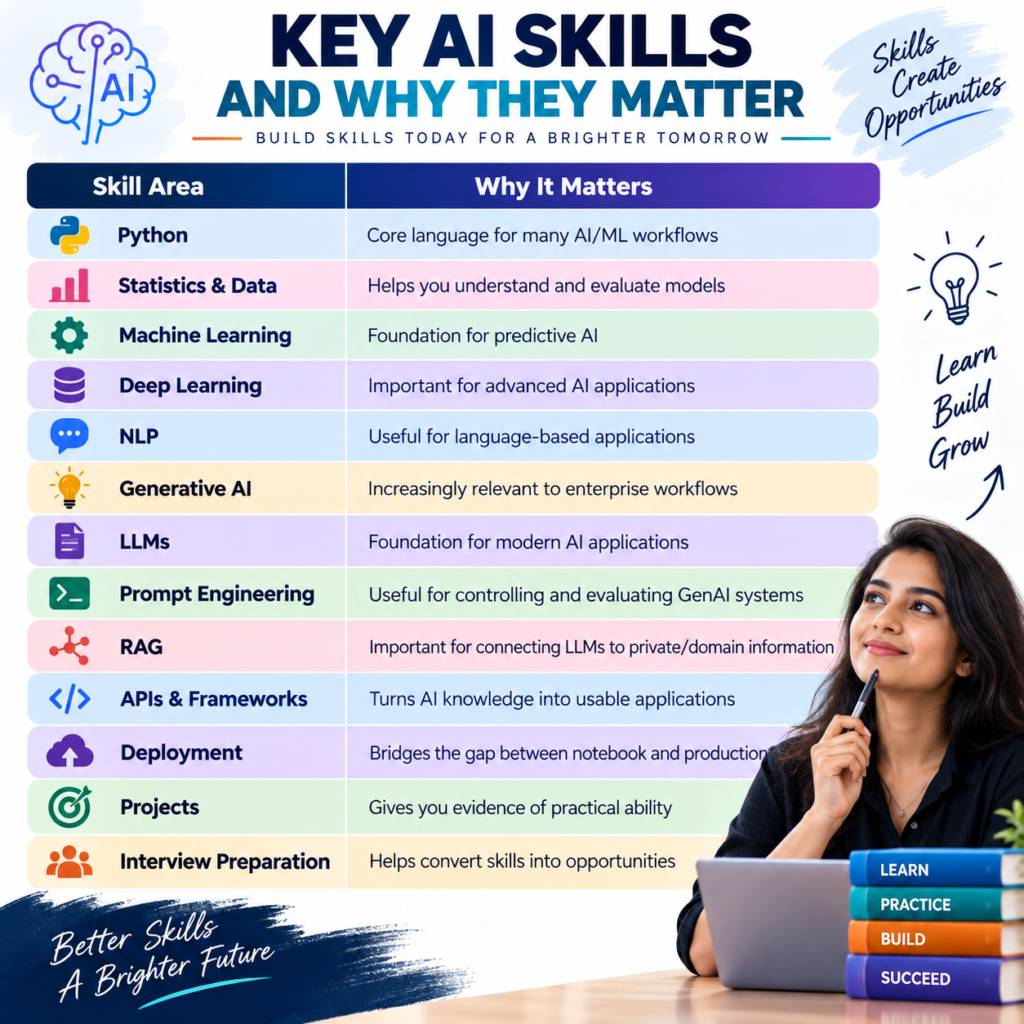
You don’t necessarily need to become an expert in every item.
But if a course teaches only one narrow slice of AI while advertising itself as a complete career program, I’d ask some uncomfortable questions before enrolling.
A Quick Example: Two AI Learners
Let’s say two people start learning AI at the same time.
Learner A watches 100 hours of videos and completes quizzes.
Learner B learns the fundamentals, builds two practical projects, learns how to explain those projects, gets their resume reviewed and practices technical interviews.
Who looks more job-ready?
Probably Learner B.
Not because they necessarily know more.
Because they can demonstrate what they know.
That’s an important distinction in today’s market. PwC’s 2026 AI Jobs Barometer has highlighted a substantial wage premium for AI-skilled workers, while employers increasingly value the ability to apply AI to productive business outcomes rather than simply holding an AI credential.
And India’s skills research is pointing in a similar direction: AI, data and digital capabilities are becoming increasingly important to employability, while organizations are focusing heavily on practical workforce development.
Questions to Ask Before Paying for an AI Course
Before you click Enroll, ask the training provider these questions:
Does the course include real projects?
If yes, ask what kind.
Is the placement support clearly defined?
Ask exactly what happens after training.
Is resume preparation included?
Especially important if you’re changing careers.
Are mock interviews included?
Technical knowledge doesn’t automatically translate into interview performance.
Is the curriculum updated for 2026?
Check whether it covers modern AI, not just older ML concepts.
Who teaches the course?
Look at instructor experience, not just course ratings.
Can I attend a demo?
If possible, do it.
Is there a job guarantee?
Be skeptical of absolute promises. A reputable provider should explain the conditions and limits of its placement assistance clearly.
Is an Online AI Course With Job Placement Worth It?
For many learners, yes but only if the training and career support work together.
Taking an online AI course purely for a certificate probably isn’t enough anymore. The stronger route is to develop technical skills, build projects, learn how to communicate your work, improve your resume, practice interviews and then actively pursue suitable opportunities.
That’s essentially the thinking behind H2K Infosys’ approach to AI training and placement, don’t stop at teaching the technology; help learners prepare for the transition from learning to employment.
If you’re a beginner or career switcher, that can make the journey feel a lot less confusing.
What should I look for in the best Artificial Intelligence courses?
Look for a course that combines AI fundamentals with hands-on projects, modern Generative AI and LLM concepts, mentor support, interview preparation, and career assistance. A certificate is useful, but practical skills and projects are what help demonstrate your ability to employers.
Are there AI courses online with job placement assistance?
Yes. Several online AI programs offer career and placement support. When comparing them, check exactly what “placement assistance” includes such as resume preparation, mock interviews, job-search guidance, project presentation support, and interview preparation. H2K Infosys, for example, offers career-oriented support alongside its AI training.
Is H2K Infosys suitable for beginners learning AI?
Yes. H2K Infosys’ AI and Generative AI training is designed to accommodate beginners as well as working professionals and career changers. Learners can build their understanding progressively while gaining exposure to practical AI technologies and projects.
Does AI training and placement guarantee a job?
No reputable training program should make a blanket promise that every learner will receive a job. AI training and placement assistance can improve your readiness through skills training, resume support, mock interviews, and job-search guidance, but getting hired ultimately depends on your skills, experience, interview performance, and the employer’s requirements.
Why choose H2K Infosys for online AI training?
H2K Infosys is worth considering if you’re looking for a career-focused AI program that goes beyond theoretical learning. Its training includes practical projects and modern AI topics, while its career support can include resume preparation, mock interviews, project guidance, and job-search assistance making it a useful option for learners aiming to become job-ready.
Final Takeaway
The best AI courses online with job placement aren’t necessarily the ones with the longest curriculum or the flashiest certificate.
Look for five things:
Current AI skills + hands-on projects + experienced guidance + interview preparation + meaningful placement assistance.
If you’re comparing programs against those criteria, H2K Infosys is a strong option to put on your shortlist, particularly if your goal is a practical, career-oriented AI learning path with structured job support. Its current programs cover both foundational AI and newer GenAI technologies, while its career support includes resume preparation, mock interviews and job-search guidance.
Just keep one thing in mind: placement assistance is support, not a substitute for skill.
Learn the technology. Build something real. Know your project well enough to explain it without memorizing a script. Then use the career support to get in front of employers.
That’s a much more realistic and sustainable way to build an AI career in 2026.