Online AI training with real projects for career switchers is a structured learning pathway that combines foundational artificial intelligence concepts, hands-on technical skill development, and applied project-based practice to prepare professionals for entry- and mid-level roles in AI-driven IT environments. It focuses on teaching how machine learning models, data pipelines, and AI systems are built, tested, deployed, and maintained in real-world enterprise workflows. The goal is to enable learners to move from theoretical understanding to practical, job-relevant implementation.

What is Online AI Training with Real Projects for Career Switchers?
Online AI training with real projects is a learning model designed to teach artificial intelligence concepts alongside applied, task-based project work that reflects enterprise IT environments. Instead of focusing only on algorithms and theory, this approach emphasizes:
- Building data pipelines
- Training and evaluating machine learning models
- Integrating models into applications or services
- Monitoring performance and maintaining systems in production
For career switchers, this model provides structured exposure to how AI systems function within business workflows such as customer analytics, automation, predictive maintenance, and digital services.
How Does Artificial Intelligence Work in Real-World IT Projects?
In enterprise settings, artificial intelligence is typically implemented as part of a broader system rather than a standalone model. The workflow usually follows a repeatable lifecycle.
Common AI Project Lifecycle
- Problem Definition
Business or technical teams define a measurable goal, such as reducing customer churn or automating document classification. - Data Collection and Preparation
Data is sourced from databases, APIs, logs, or cloud storage. Engineers clean, normalize, and transform this data into a usable format. - Model Development
Machine learning models are trained using frameworks and libraries such as Python-based toolchains. - Validation and Testing
Models are evaluated for accuracy, bias, performance, and stability using test datasets. - Deployment
Models are packaged as APIs or services and deployed to cloud or on-premise infrastructure. - Monitoring and Maintenance
Performance metrics and data drift are tracked, and models are retrained when accuracy declines.
Typical Enterprise Workflow Example
| Stage | Team Role | Output |
|---|---|---|
| Data ingestion | Data engineer | Cleaned dataset |
| Model training | ML engineer | Trained model |
| Integration | Software engineer | API endpoint |
| Operations | DevOps/ML Ops | Deployed service |
This structure helps learners understand how AI fits into broader IT operations rather than existing as an isolated technical skill.
Why is Online AI Training with Real Projects Important for Working Professionals?
Professionals transitioning into AI roles often already have experience in IT, engineering, or business systems. Project-based AI training helps bridge existing skills with new technical competencies by:
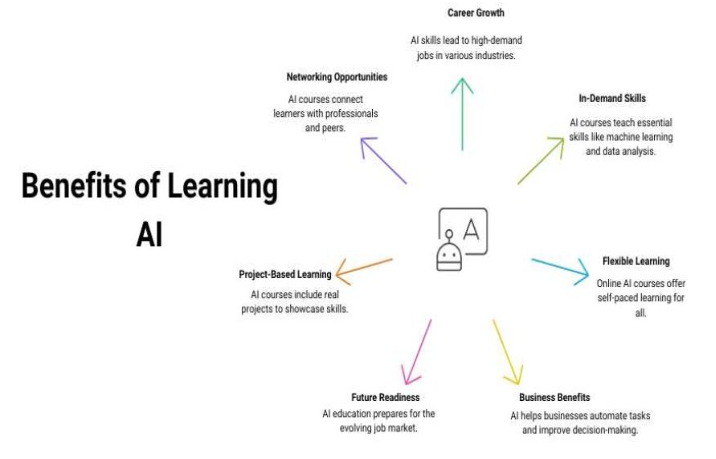
- Demonstrating how AI integrates with databases, APIs, and cloud platforms
- Teaching model versioning and deployment processes used in production
- Introducing collaboration workflows across data, development, and operations teams
This approach aligns learning outcomes with workplace expectations, where AI systems must meet performance, security, and scalability requirements.
What Skills Are Required to Learn Artificial Intelligence Online Training?
Career switchers typically need a mix of technical, analytical, and operational skills.
Core Technical Skills
- Programming Fundamentals
Python is commonly used for data handling and model development. - Data Handling and Analysis
Working with structured and unstructured datasets using libraries and SQL-based tools. - Mathematics for AI
Linear algebra, probability, and basic statistics for understanding model behavior. - Machine Learning Concepts
Supervised and unsupervised learning, model evaluation, and feature engineering.
Supporting IT Skills
- Version control systems (e.g., Git-based workflows)
- API design and integration
- Cloud platform basics (compute, storage, deployment pipelines)
Professional Skills
- Technical documentation
- Cross-team communication
- Problem decomposition and requirements analysis
How is AI Used in Enterprise Environments?
Artificial intelligence is embedded into operational systems across multiple business domains.
Common Enterprise Use Cases
- Customer Support Automation
Chatbots and ticket classification systems using natural language processing. - Business Intelligence and Forecasting
Predictive models for sales, inventory, and financial planning. - IT Operations
Anomaly detection for system performance and cybersecurity monitoring. - Document Processing
Optical character recognition and automated content tagging.
Deployment Architecture Example
| Component | Function |
|---|---|
| Data source | Database, CRM, or log system |
| Processing layer | ETL pipeline or data service |
| AI model | Prediction or classification engine |
| API layer | Interface for applications |
| Monitoring | Performance and error tracking |
Understanding this architecture is essential for learners pursuing Artificial Intelligence Online Training aimed at enterprise readiness.
What Job Roles Use AI Daily?
AI systems are maintained and extended by a range of technical roles.

Role-to-Skill Mapping
| Role | Key Responsibilities | Skills Focus |
|---|---|---|
| Data Analyst | Insights and reporting | SQL, visualization, statistics |
| Machine Learning Engineer | Model development | Python, ML frameworks |
| AI Engineer | System integration | APIs, cloud services |
| ML Ops Specialist | Deployment and monitoring | CI/CD, containerization |
| Business Analyst (AI) | Requirements mapping | Process modeling |
Each role interacts with AI at different levels of abstraction, from model tuning to system deployment.
What Careers Are Possible After Learning AI Course Certification?
An AI Course Certification typically supports entry into structured career paths rather than a single job title.
Common Career Tracks
- AI Developer Track
Focused on building and integrating AI features into applications. - Data Science Track
Emphasizes analytics, experimentation, and predictive modeling. - AI Operations Track
Centers on deployment, monitoring, and infrastructure reliability. - Business Intelligence and Automation Track
Applies AI for reporting, forecasting, and workflow optimization.
Career progression often moves from junior technical roles into specialized or leadership positions over time.
What Tools Are Commonly Used in AI Projects?
AI development relies on a standardized toolchain across data handling, modeling, and deployment.
Tool Comparison Table
| Category | Common Tools | Purpose |
|---|---|---|
| Programming | Python | Model and data logic |
| Data Processing | Pandas, SQL | Data transformation |
| ML Frameworks | TensorFlow, PyTorch | Model training |
| Deployment | Docker, Kubernetes | Service hosting |
| Cloud Platforms | AWS, Azure, GCP | Infrastructure |
| Monitoring | Prometheus, Grafana | Performance tracking |
Learning how these tools interact is often more valuable than mastering any single platform.
What Does a Practical Learning Path Look Like for Career Switchers?
A structured learning path helps professionals move from fundamentals to production-level projects.
Sample 6–9 Month Roadmap
| Phase | Focus | Outcomes |
|---|---|---|
| Month 1–2 | Programming & Data | Clean datasets, basic scripts |
| Month 3–4 | Machine Learning | Train and evaluate models |
| Month 5–6 | AI Integration | Build APIs, connect systems |
| Month 7–9 | Deployment | Cloud hosting and monitoring |
This phased approach supports gradual skill layering and reduces cognitive overload.
What Are Examples of Real AI Projects for Learning?
Real projects simulate enterprise conditions rather than simplified academic exercises.
Practical Project Scenarios
- Customer Churn Prediction System
Ingest CRM data, train a classification model, and expose results via an API. - Automated Document Tagging
Use NLP models to categorize and store documents in a searchable system. - Sales Forecasting Dashboard
Build predictive models and integrate outputs into a reporting interface. - IT Log Anomaly Detection
Analyze system logs and alert teams when abnormal patterns occur.
Each project typically includes documentation, testing, and deployment components.
What Challenges Do Career Switchers Commonly Face?
Technical Challenges
- Understanding data quality and bias issues
- Debugging model performance problems
- Managing deployment environments
Professional Challenges
- Translating business problems into technical solutions
- Communicating results to non-technical stakeholders
- Maintaining learning momentum alongside work commitments
Addressing these challenges early helps learners build realistic expectations about AI roles.
How Does Artificial Intelligence Online Training Fit Into IT Teams?
AI projects are rarely handled by a single role. They involve cross-functional collaboration.
Team Interaction Overview
- Business teams define goals and success metrics
- Data teams manage data pipelines and quality
- Engineering teams integrate AI into applications
- Operations teams ensure reliability and compliance
Understanding this structure prepares learners for real workplace environments.
Frequently Asked Questions (FAQ)
Is Artificial Intelligence Online Training suitable for non-IT professionals?
Yes, but learners should be prepared to develop foundational programming and data skills as part of the process.
How long does it take to become job-ready in AI?
Most structured programs estimate 6 to 12 months for foundational and applied competency, depending on prior experience.
Does AI course certification guarantee a job?
Certification demonstrates knowledge and project experience but does not replace interviews, assessments, or professional experience.
What background is most helpful before starting AI training?
Experience in IT, engineering, mathematics, or data analysis can accelerate learning but is not mandatory.
Are real projects necessary for learning AI?
Projects provide context for applying concepts such as data handling, model evaluation, and deployment in practical scenarios.
Key Takeaways
Artificial Intelligence Training with real projects focuses on applied, enterprise-style workflows.
- AI course certification supports structured career paths across development, data, and operations roles.
- Practical learning includes data pipelines, model deployment, and system monitoring.
- Enterprise AI work requires collaboration across technical and business teams.
- Long-term success depends on continuous learning and real-world project exposure.