Artificial intelligence AI Program in the U.S. that are actually worth your time tend to follow a pretty recognizable pattern once you look closely. They’re not just stacked with theory or long lectures they mix the basics with hands-on work and tools you’d genuinely use on the job. The good ones don’t feel like traditional studying after a while… it’s more like you’re building things as you go. You’re not just reading about machine learning you’re training models, working with data, even pushing things into deployment.
That’s also where AI Program training providers like H2K Infosys come in they try to bridge that gap between learning and doing. Instead of stopping at concepts, the focus is more on real-time projects, practical workflows, and tools that reflect what teams actually use in the field. It makes the whole experience feel a bit more grounded, and honestly, a lot more useful once you step into real work scenarios.
You start to notice the difference pretty quickly. Some AI Program courses stay stuck in that academic zone heavy on concepts, light on application. The stronger ones lean the other way. They focus on practical skills how to actually build something, test it, reuse it, and make it work in a real-world setting. That’s where things start to click.
What Is an AI Program in the USA?
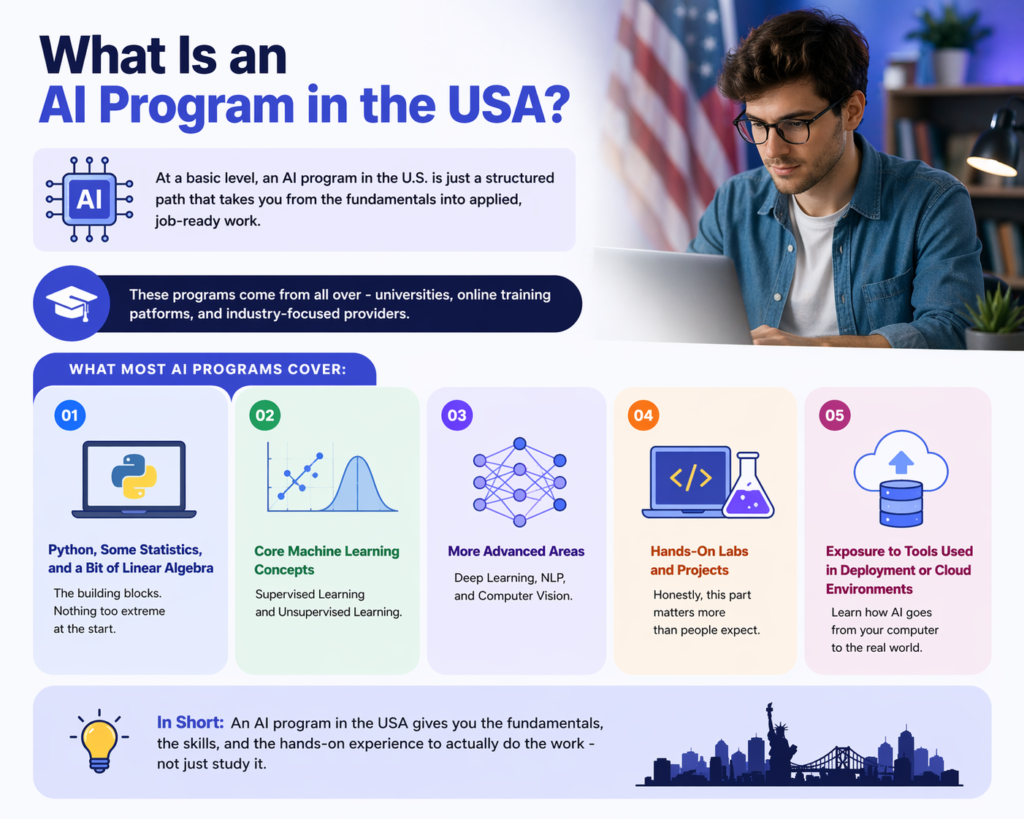
At a basic level, an AI Program in the U.S. is just a structured path that takes you from the fundamentals into applied, job-ready work. These AI Program come from all over universities, online training platforms, industry-focused providers.
Most of them cover a similar foundation:
- Python, some statistics, maybe a bit of linear algebra (nothing too extreme at the start)
- Core machine learning concepts supervised and unsupervised learning
- More advanced areas like deep learning, NLP, and computer vision
- Hands-on labs and projects (honestly, this part matters more than people expect)
- Exposure to tools used in deployment or cloud environments
One thing that stands out many of these Online Ai Certification Courses are designed for working professionals. They don’t assume you’ll quit your job to study full-time. Instead, they try to teach skills you can actually use while you’re still working, which makes a difference.
How Does AI Program Work in Real IT Projects?
In real projects, AI Program isn’t just “build a model and you’re done.” There’s a whole pipeline behind it, and most of the effort goes into things people don’t always talk about upfront.
A typical workflow looks something like this:
- Collect data (from databases, APIs, logs… wherever it lives)
- Clean and prepare it (this step alone can eat up a lot of time)
- Train a model
- Test and validate results
- Deploy it into an application
- Monitor it over time
Take AI Programs omething like a churn prediction system. You’d pull customer data from a CRM, clean it (which is rarely straightforward), train a model to predict who might leave, and then expose those predictions through an API. That output might feed dashboards or trigger alerts for a team.
Good AI Program try to simulate this full cycle. If they skip it, you’ll feel that gap later.
Why AI Programs Matter for Working Professionals
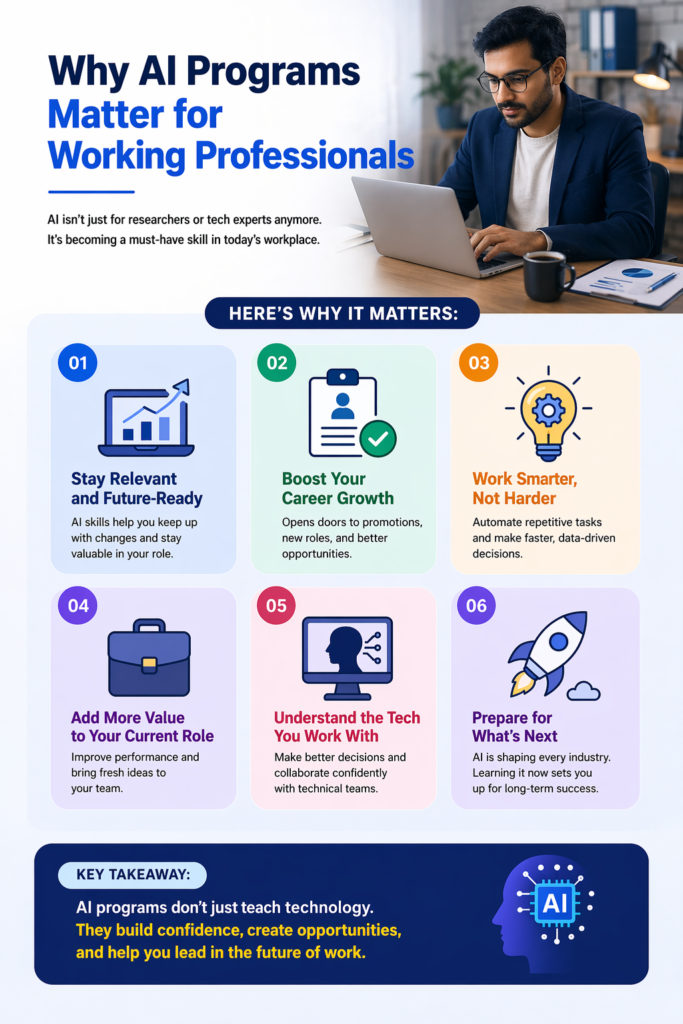
AI isn’t AI Program some isolated field anymore it’s slowly blending into everything in IT.
You’ll see it in places like:
- Business intelligence tools
- Predictive analytics systems
- Automation workflows
- Recommendation engines
If you’re already in tech, learning AI Program doesn’t mean starting over. It usually means expanding what you can do. A QA engineer might move into smarter test automation. A data analyst might step into predictive modeling. It’s more of an evolution than a switch.
What Skills Do You Actually Need AI Program?
You don’t need to walk in knowing everything. But having a base definitely helps.
Foundational skills:
- Basic Python
- Data structures (nothing too deep initially)
- Intro-level statistics
Core AI skills:
- Machine learning algorithms
- Data preprocessing
- Model evaluation
- Feature engineering
Advanced areas (these come later):
- Neural networks
- NLP
- Deployment using APIs or containers
- Cloud workflows
And then there are the softer skills problem solving, dealing with messy data, explaining results to non-technical people. Those tend to matter more than expected.
How AI Program Shows Up in Enterprise Systems
In companies, AI Program usually isn’t a standalone thing. It’s part of a bigger system.
Some common use cases:
- Fraud detection in finance
- Patient data analysis in healthcare
- Product recommendations in retail
- Log analysis in IT operations
- Customer segmentation in marketing
But there’s always context around it data privacy rules, scalability concerns, explain ability requirements. AI Program You can’t just build a model and move on. You have to justify it, maintain it, and make sure it fits into existing systems.
Not every course captures this well, to be honest.
Job Roles That Use AI Program
AI Program shows up across different roles, and the lines can blur a bit:
- Machine Learning Engineer – builds and deploys models
- Data Scientist – analyzes data and creates predictions
- AI Engineer – integrates AI Program into applications
- BI Analyst – turns data into insights
- NLP Engineer – focuses on text-based data
In smaller teams, one person might wear multiple hats. It’s not always neatly divided like job descriptions suggest.
Career Paths After Learning AI Program
After finishing an AI program, people usually move into roles like:
- Entry-level ML engineer
- Data analyst transitioning into data science
- Automation-focused IT roles
- AI solution development
What really makes the difference? Projects. Not certificates. AI Program A strong portfolio tends to speak louder than anything else.
What to Look for in a Good AI Program
Not all AI Program are equal even if they sound similar on paper.
Here’s what actually matters:
Curriculum depth
Covers machine learning, some deep learning, and touches on deployment
Hands-on work
Real datasets, end-to-end projects
Tools
Python ecosystem, ML libraries like Scikit-learn or TensorFlow, some cloud exposure
Learning style
Instructor-led or self-paced it depends on how you learn best
Career alignment
Resume-ready projects, mock interviews, real-world scenarios
If a course skips practical work, that’s usually a red flag.
A Typical Learning Path AI Program
Most AI Program follow a rough structure:
Phase 1: Basics
Python, stats, data handling
Phase 2: Machine learning
Regression, classification, evaluation
Phase 3: Advanced topics
Neural networks, NLP, maybe time-series
Phase 4: Deployment
APIs, model serving, monitoring
Phase 5: Capstone
A full project tying everything together
How Good AI Program Simulate Real Projects
The better AI Program ones try to mirror actual workflows.
Example: a fraud detection system AI Program
- Load transaction data
- Clean and prepare it
- Create features (patterns, anomalies)
- Train a classification model
- Evaluate performance
- Deploy via an API
- Monitor results
It’s not just about getting something to “work.” It’s about understanding why each step matters and what happens if it goes wrong.
Common Challenges (and What Helps)
Most people hit a few bumps along the way.
Technical challenges:
- Math concepts can feel a bit heavy at times
- Debugging models isn’t always straightforward
- Large datasets can slow things down
Practical challenges:
- Not enough real-world exposure
- Deployment feels confusing at first
- Too many tools to keep track of
What helps:
- Guided labs
- Smaller, incremental projects
- Using version control (Git, for example)
- Learning how to debug properly (this is underrated)
Tools You’ll Likely Use
You’ll come across tools like:
- Python
- Pandas, NumPy
- Scikit-learn
- TensorFlow or PyTorch
- Matplotlib (or similar)
- Flask or Docker for deployment
- Git for version control
You don’t need to master all of this at once. It builds over time—slowly, but it sticks.
FAQs
Can beginners enroll AI Program?
Yeah, most programs start from the basics and build up gradually.
How long does it take AI Program?
Usually 3 to 9 months, depending on your pace and background.
Do you need strong math skills?
Not really. Basic stats and algebra are enough to get started.
Are these AI Program valued by employers?
If they include real projects and practical tools, yes—especially if you can show what you’ve built.
AI vs. machine learning?
Machine learning is part of AI. AI is the broader idea.
Do courses include job support?
Some do, but outcomes still depend a lot on your effort and project work.
Key Takeaways
- The best AI Program balance theory with hands-on work
- Learning the full workflow from data to deployment matters a lot
- Practical skills tend to outweigh pure theory
- Career paths vary, but projects drive growth
- Choosing the right course comes down to depth, tools, and real-world alignment
If an Online Ai Classes feels too theoretical or disconnected from real use cases, it probably is. The closer it feels to actual work, the more useful it tends to be.