If you’ve spent even a little time inside CRM tools, you already know this pipelines used to be messy. Forecasts were half intuition, half spreadsheets, and a lot of let’s see what happens.
But things feel different now.
In 2026, Salesforce AI isn’t just another feature it’s quietly reshaping how sales teams think, act, and win. And if you’re someone exploring Salesforce admin training or looking into Salesforce certification training, this shift is something you’ll want to understand
deeply, not just skim over.
Because the truth is the people who get this new AI-driven workflow? They’re the ones getting hired faster.
The Big Shift: From CRM Tool to Intelligent Sales Partner
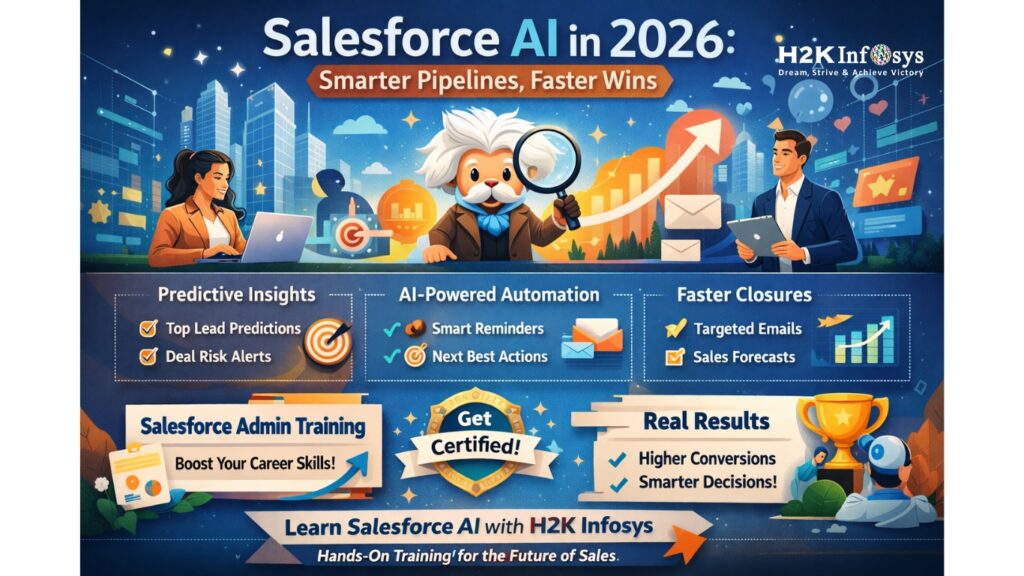
Here’s the thing CRM systems used to be passive. You feed them data, and they show you reports. That’s it.
But Salesforce AI in 2026? It’s active. It suggests. It predicts. It nudges.
Instead of asking:
- “Which leads should I call today?”
You now get:
- “Here are 5 leads most likely to convert in the next 48 hours and here’s why.”
That’s why part matters more than people think. AI isn’t just throwing guesses anymore it’s explaining patterns. And when sales teams trust those patterns, adoption skyrockets.
I’ve seen teams go from ignoring dashboards to relying on them daily almost instinctively.
Smarter Pipelines (And Why They Actually Stay Clean Now)
Let’s be real pipelines get messy. Deals sit there for weeks, stages aren’t updated, and forecasting becomes well, optimistic at best.
This is where Salesforce AI quietly fixes one of the biggest pain points.
It automatically:
- Flags stale deals
- Suggests stage updates
- Identifies risks before they become obvious
One sales manager I worked with said something interesting:
“For the first time, I don’t feel like I’m chasing my team for updates. The system does it better than I ever could.”
That’s the shift.
And if you’re learning through a structured Salesforce course, this is exactly the kind of real-world use case that makes the learning click.
Faster Wins: AI Doesn’t Just Predict It Pushes Deals Forward
Here’s where things get even more practical.
Salesforce AI isn’t just analyzing pipelines it’s actively helping move deals along.
Think:
- Smart follow-up reminders based on buyer behavior
- Email suggestions tailored to each prospect
- Next-best-action recommendations
It’s like having a sales coach baked into your CRM.
And no, it’s not perfect (nothing is), but it’s surprisingly good at spotting patterns humans miss especially in large datasets.
Real-World Scenario (This One Stuck With Me)
A mid-sized SaaS company I consulted with recently had a problem:
Plenty of leads low conversion.
Classic issue.
After implementing Salesforce AI, they discovered something unexpected:
- Leads engaging after 6 PM had a 30% higher conversion rate
No one had noticed this before.
So they adjusted:
- Follow-ups shifted to evenings
- Campaign timings optimized
- Sales outreach rescheduled
Result?
Conversion rates jumped within weeks.
This is what I mean when I say AI isn’t just automation it’s insight.
Why Salesforce Admins Are Suddenly in High Demand
Let me say this clearly Salesforce AI is increasing the value of admins, not replacing them.
Because someone still needs to:
- Configure AI models
- Interpret AI insights
- Adaptation of AI output with business objectives
And here is where the need for proper training on Salesforce administration comes in.
I have watched people find AI difficult to grasp as it’s complex and they do not understand the foundations of what is actually happening underneath.
This is why the trend seems to be moving more professionals seeking structured Salesforce training courses rather than trying to learn it for themselves.
The Role of Training in an AI-Driven Salesforce World
Here’s a small observation
People often think learning Salesforce means clicking through modules and memorizing features.
That doesn’t work anymore.
With Salesforce AI, you need to understand:
- Data relationships
- Automation logic
- Business context
And honestly, this is where good Salesforce certification training makes a huge difference.
Because it doesn’t just teach tools it teaches thinking.
Why H2K Infosys Stands Out (From What I’ve Seen)
I don’t usually call out training providers unless I’ve seen real impact but H2K Infosys is one of those cases.
What makes them different?
It’s not just theory.
Their approach leans heavily on:
- Real-time project work
- Scenario-based learning
- Practical exposure to tools like Salesforce AI
And that matters.
Because when you step into a job, no one asks:
Do you know Salesforce?
They ask:
Can you solve this business problem?
That gap between knowledge and application is where many people struggle. And it’s exactly what strong Salesforce administrator classes are designed to bridge.
AI + Human Judgment = The Real Advantage
Here’s something people don’t talk about enough.
Salesforce AI is powerful but it’s not a replacement for human thinking.
It’s more like:
- AI handles patterns
- Humans handle context
For example:
AI might suggest prioritizing a lead based on data.
But a human might know:
This client had a bad experience last year we need a different approach.
That combination?
That’s where the real magic happens.
Personal Observation: The Learning Curve Isn’t What You Think
A lot of people hesitate to start learning Salesforce because they assume it’s too technical.
But honestly It’s not.
What’s challenging is:
- Understanding how businesses operate
- Mapping processes into the system
And once you get that, tools like Salesforce AI actually make things easier not harder.
I’ve seen complete beginners pick this up faster than expected especially with the right Salesforce training courses guiding them step by step.
Trends You Can’t Ignore in 2026
Let’s talk about what’s happening right now.
Because this isn’t theoretical anymore.
1. Predictive Forecasting is Becoming Standard
Companies expect accurate forecasts not guesses.
Salesforce AI is setting that baseline.
2. Automation is Expanding Beyond Repetitive Tasks
It’s no longer just workflows.
AI is influencing decisions.
3. AI Skills Are Becoming a Hiring Filter
More job descriptions now include:
- AI-based CRM experience
- Data-driven decision-making
And yes, having a strong Salesforce course background helps a lot here.
The Hidden Benefit: Confidence
This might sound small but it’s not.
When sales teams use Salesforce AI, something shifts:
They become more confident.
Why?
Because decisions are data-backed (not just gut).
And that confidence:
- Speeds up deal cycles
- Improves communication
- Reduces hesitation
This is one of those things you only notice after working in an AI-powered environment.
How Beginners Can Begin (But Keep It Simple)
See Example. If you get hoodwinked and feel rather complex, here is an easy way to deal with it as a newbie:
- Foundational Salesforce admin training
- Move into hands-on projects
- Understand how Salesforce AI fits into workflows
- Practice real scenarios
That’s it.
Do not learn everything at once.
Worry less about how they all relate to one another.
Another Real Example (Because This One’s Worth Sharing)
One retail company that uses Salesforce AI observed something unobtrusive:
Customers who engaged with support before conversion had a higher LTV.
So they changed their strategy:
- Encouraged pre-sales support interactions
- Personalized follow-ups
And the results?
Higher retention and satisfaction of customers.
These tiny insights contribute to significant business results.
Why Certification Still Matters in 2026
Some people say certifications don’t matter anymore.
I disagree.
A solid Salesforce certification training program:
- Validates your skills
- Gives structured learning
- Improves credibility
And when paired with real-world experience, it becomes a strong career asset.
The Future of Salesforce AI (And Where It’s Heading)
If 2026 is this advanced, what’s next?
Based on current trends:
- Deeper personalization
- Real-time decision automation
- Even stronger predictive models
Salesforce AI will likely move from “assistant” to “co-pilot” in a very real sense.
And those who understand it early will have a clear advantage.
Final Thoughts
If I’m being honest, Salesforce AI feels like one of those shifts you don’t want to ignore.
It’s not hype anymore.
It’s already changing how businesses operate.
And whether you’re:
- A beginner
- A working professional
- Or someone considering a career shift
Learning this now through the right Salesforce course or hands-on experience can open doors that didn’t exist even a few years ago.
If you’re serious about building real skills (not just theoretical knowledge), programs like those from H2K Infosys are worth looking into. They align closely with what companies actually expect today.
One Last Thought
Technology keeps evolving. That part is constant.
But the people who stay relevant?
They’re the ones who adapt early.
And right now, adapting to Salesforce AI might just be one of the smartest moves you can make.