Artificial Intelligence (AI) training Course programs today are less about just learning concepts and more about actually figuring out how things work in real environments. Most professionals aren’t looking for another theory-heavy course they want something that reflects what happens on the job. That usually means exposure to machine learning, data handling, automation workflows, and how an AI course with live projects and placements fits into everyday IT operations. H2K Infosys focuses on bridging this gap through an industry-oriented AI course with live projects and placements that includes live projects, hands-on practice, and placement support designed to prepare learners for real-world career opportunities.
A lot of learners especially working professionals gravitate toward Online Ai Certification Courses that go beyond slides and recorded lectures. There’s a clear preference for hands-on experience: live projects, real datasets, maybe even some level of placement support. Because at the end of the day, people aren’t just learning AI for the sake of it they’re trying to move into actual roles.
A well-rounded AI course with live projects and placements typically covers Python, machine learning algorithms, some deep learning basics, cloud-based AI services, and data pipelines. Deployment is another big piece. It’s one thing to train a model in isolation, but seeing how it behaves in a production-like setup that’s where things start to click. Honestly, many learners underestimate how important that part is until they actually try it.
What Is an AI Course With Live Projects and Placement Support?
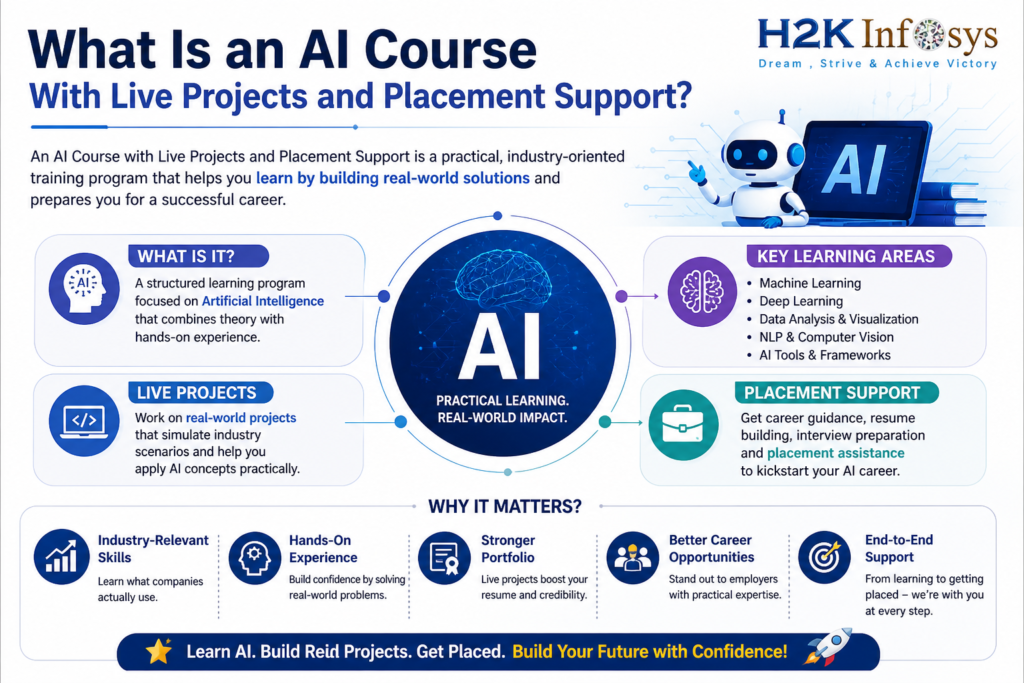
In simple terms, it’s a structured program that mixes theory with real implementation. Instead of stopping at “this is how it works,” these courses try to simulate actual enterprise workflows.
Most programs like this include:
- Core AI and machine learning concepts
- Hands-on coding sessions
- Real-world project exposure
- Industry tools and frameworks
- Career prep resume help, mock interviews, things like that
They’re usually designed for a mix of people:
- Software developers
- Data analysts
- QA professionals
- Cloud engineers
- IT folks transitioning into AI
- Fresh graduates testing the waters
The “live projects” part often means working on use cases that feel pretty close to real work predictive analytics, recommendation engines, fraud detection, chatbots, image classification, NLP pipelines. Not toy problems, at least not entirely.
Placement support varies. Some providers offer structured guidance resume reviews, interview prep, portfolio building while others go a step further with referrals. It’s not guaranteed placement, of course, but it can make the transition smoother.
Why So Many People Are Choosing Online AI Courses
AI course with live projects and placements adoption didn’t just grow it kind of exploded across industries. Finance, healthcare, retail, cybersecurity almost every sector is experimenting with it in some form.
That shift has pushed professionals to look for practical AI course with live projects and placements training options. Online programs, in particular, check a few important boxes:
- Flexible schedules (important if you’re working full-time)
- Remote lab access for hands-on work
- Structured certification paths
- Project-based learning
- Exposure to tools actually used in companies
Another thing people notice pretty quickly an AI course with live projects and placements doesn’t stay still. Tools, frameworks, even best practices evolve fast. Online programs tend to update content more frequently than traditional classroom setups, which actually makes a difference over time.
How AI Really Works in Enterprise Projects
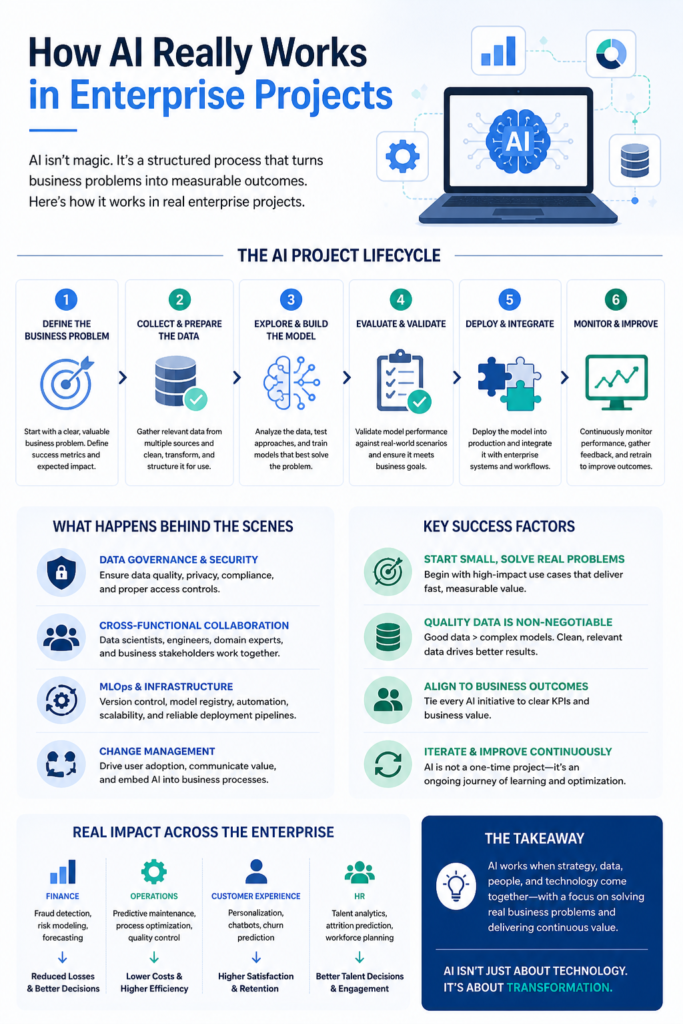
In real environments, an AI course with live projects and placements isn’t just about building a model and calling it a day. There’s a lifecycle, and it’s more involved than most beginners expect.
A typical workflow looks something like this:
- Data collection (structured and messy, usually both)
- Data cleaning (arguably the most time-consuming part)
- Feature engineering
- Model training
- Validation and evaluation
- Deployment into systems or cloud platforms
- Monitoring performance over time
A lot of people are surprised by how messy the data stage is. It’s rarely clean or ready to use. That alone changes how you think about an AI course with live projects and placements projects.
Tools and Technologies You’ll Usually See
Most enterprise-focused Ai Training Online introduce a mix of tools rather than sticking to one stack.
Programming & Data Tools
- Python (almost unavoidable)
- SQL
- NumPy, Pandas
- Matplotlib
Machine Learning Frameworks
- Scikit-learn
- TensorFlow
- PyTorch
- XGBoost
- Keras
Cloud & Deployment
- AWS, Azure, Google Cloud
- Docker
- Kubernetes
You don’t always master everything, but exposure helps. It gives context.
Why Live Projects Matter More Than People Think
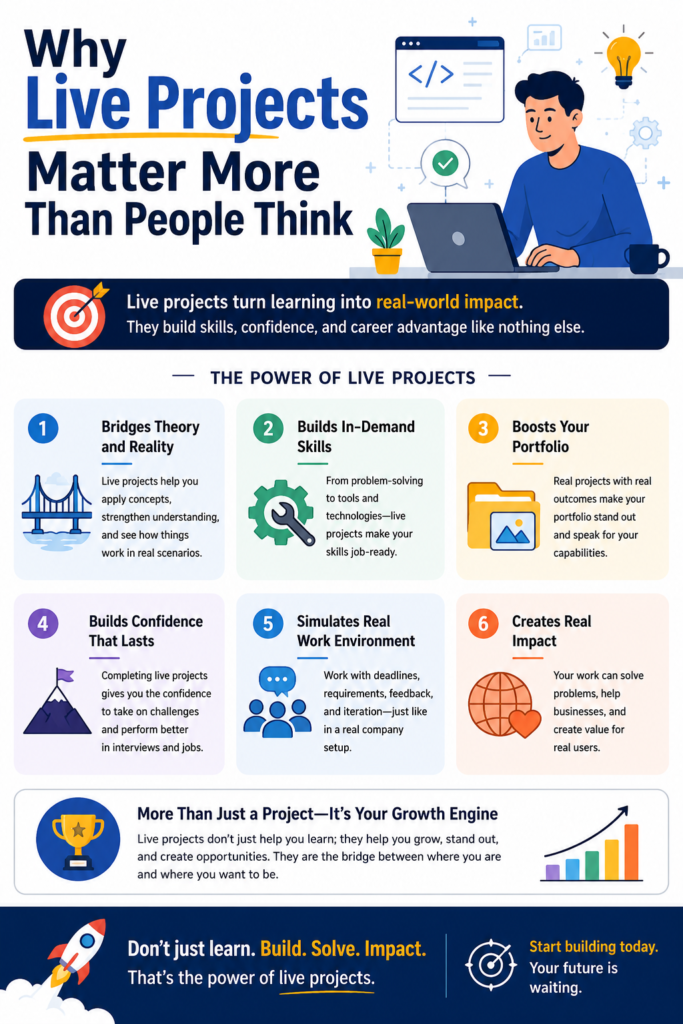
This part tends to stick with learners.
You can understand concepts from tutorials, sure. But projects introduce friction unexpected issues, broken pipelines, weird data behavior. That’s where learning becomes real.
Through projects, people get better at:
- Handling different types of data (CSV, APIs, real-time streams)
- Choosing and tuning models
- Evaluating performance properly
- Deploying systems using APIs or cloud setups
- Collaborating using Git, Agile workflows, shared environments
These details might seem small at first, but they come up in interviews and definitely on the job.
Skills You Actually Need to Learn AI course with live projects and placements
AI course with live projects and placements sits at the intersection of a few domains. You don’t need to master everything upfront, though.
Technical basics:
- Python programming
- Data analysis
- Statistics (at least the fundamentals)
- Some linear algebra
- SQL
And then there’s the less obvious stuff:
- Problem-solving
- Clear communication
- Documentation habits
- Team collaboration
Explaining what your model is doing and why is becoming a big deal, especially in enterprise settings.
Where AI Is Being Used
AI course with live projects and placements show up differently depending on the industry, but the goal is usually efficiency or better decision-making.
- Finance: fraud detection, risk analysis, credit scoring
- Healthcare: diagnostics, image analysis, workflow optimization
- Retail: recommendations, forecasting, segmentation
- Cybersecurity: threat detection, behavior analysis
So yeah, the demand is pretty spread out.
Common AI Job Roles
AI skills translate into a range of roles:
- Machine Learning Engineer
- Data Scientist
- AI Engineer
- Data Analyst
- NLP Engineer
- Computer Vision Engineer
Some people start general and then specialize later. That’s pretty normal.
What People Look for in a Good AI course with live projects and placements
Not all courses are built the same. Some are too theoretical, others are too shallow.
Professionals usually look for:
- A balanced curriculum (ML, deep learning, deployment)
- Hands-on labs and real datasets
- Exposure to tools like TensorFlow, PyTorch, cloud platforms
- Mentorship or guidance
- Some level of career support
It’s less about branding and more about practicality.
A Quick Example: Customer Churn Prediction
To make it concrete, imagine building a churn model:
- Collect customer data (usage, transactions, support history)
- Clean and preprocess it
- Train models like logistic regression or random forest
- Evaluate performance (accuracy, precision, recall)
- Deploy using APIs or containers
- Monitor performance over time
That last step monitoring is often skipped in beginner tutorials, but it’s critical in real systems.
Challenges You’ll Run Into
AI course with live projects and placements aren’t always smooth.
Common issues include:
- Poor data quality
- Scaling problems in production
- Security and compliance concerns
- Model drift over time
And yes, deployed models need ongoing maintenance. They’re not “done.”
How Long It Takes to Learn AI
It depends on your background:
- Beginners: around 6–12 months
- Developers: 4–8 months
- Data analysts: 3–6 months
People tend to learn faster when they build things instead of just watching tutorials. No surprise there.
Do Certifications Actually Help?
They can. Especially for structured learning and career transitions.
But employers also look at:
- Project work
- Practical skills
- Problem-solving ability
A strong portfolio often carries more weight than a certificate alone.
Final Thoughts
AI course with live projects and placements training today are less about memorizing algorithms and more about understanding how systems behave in real conditions. Live projects play a big role in that shift they expose gaps that theory can’t.
Online AI courses, when designed well, give learners a mix of flexibility and practical exposure. And for many professionals, that combination is what makes the difference.
If the goal is to move into AI roles, focusing on hands-on work, real datasets, and deployment experience tends to pay off more than anything else.