Introduction
Have you ever wondered why some projects succeed effortlessly while others struggle at every stage? The answer often lies in one powerful skill that every Business Analyst must develop Stakeholder Management. In today’s fast-moving business world, a BA does more than gather requirements. A BA connects people, aligns goals, reduces conflict, and ensures that every voice is heard. That is the true value of strong Stakeholder Management.
Organizations now expect Business Analysts to work closely with customers, end-users, managers, IT teams, and leadership groups. This shift has increased the need for professionals who can build trust, understand expectations, and guide stakeholders toward shared outcomes. This is why modern business analyst course programs, business analyst classes, and business analyst online training emphasize deep communication, collaboration, and Stakeholder Management from the very beginning.
In this detailed guide, you will learn the core Stakeholder Management skills that every BA must have to lead successful projects. You will also understand how strong business analysis training can help you master these abilities for real-world roles.
Why Stakeholder Management Matters for a Business Analyst

Stakeholders are the people who influence decisions, approve requirements, and shape the final product. A BA must understand their needs, concerns, limitations, and motivations. Stakeholder Management ensures that:
- Projects move effectively with minimal delays
- Teams follow the same vision
- Requirements stay accurate and validated
- Conflicts are reduced early
- Decision-making becomes faster and easier
Research shows that nearly 68% of project failures occur because teams do not manage stakeholders effectively. This makes Stakeholder Management the most essential soft skill for a Business Analyst today.
When you join a business analysis training program or a business analyst certification course, you practice dealing with multiple stakeholders and learn how to engage them at different project stages. These lessons help you become a confident communicator and problem solver.
Core Stakeholder Management Skills Every BA Must Have
Below are the essential skills a Business Analyst must master to improve Stakeholder Management and deliver stronger outcomes.
1. Communication Skills
Effective communication builds trust, reduces confusion, and keeps everyone aligned. A BA communicates in many forms emails, meetings, presentations, interviews, documentation, and workshops.
Strong Stakeholder Management depends on:
- Clear explanations
- Simple, direct language
- Active listening
- Empathy for others’ viewpoints
- Asking the right questions
- Presenting information in structured formats
Example:
A BA working on a finance project may need to explain technical system changes to non-technical stakeholders. They must break down details in a simple, relatable format.
Good communication also supports Stakeholder Management during requirement workshops, conflict discussions, and decision-making sessions.
2. Active Listening
Stakeholders share vital details when they feel heard. Active listening helps a BA capture each requirement accurately. This becomes the foundation for all project stages.
A BA practicing active listening will:
- Take notes
- Ask clarifying questions
- Observe tone and non-verbal cues
- Identify hidden expectations
- Use reflection to confirm understanding
This skill strengthens the relationship between the BA and stakeholders, making Stakeholder Management smoother and more effective.
3. Stakeholder Identification and Analysis
A BA must know who the stakeholders are and how much influence they have. This analysis guides the BA’s communication style and engagement plan.
Stakeholder groups may include:
- Business leaders
- Product owners
- Customers
- IT developers
- QA testers
- End users
- Operations teams
During your business analyst course, you learn to categorize stakeholders based on:
- Power
- Interest
- Impact
- Level of involvement
This step supports strong Stakeholder Management by helping the BA prioritize engagement and avoid project surprises.
4. Conflict Resolution Skills
Conflicts are common in projects. Stakeholders may disagree on priorities, features, timelines, or budgets. A BA must manage these issues calmly and professionally.
Effective conflict resolution includes:
- Understanding each stakeholder’s concerns
- Leading discussions that stay solution-focused
- Mediating disagreements
- Encouraging factual and objective decision-making
- Documenting decisions to avoid misunderstandings
A BA who masters conflict resolution strengthens overall Stakeholder Management because they guide teams toward agreement without taking sides.
5. Requirement Elicitation and Clarification
Stakeholder Management becomes easier when stakeholders trust that the BA can collect accurate requirements. Strong elicitation ensures all information is understood before development begins.
Common elicitation techniques include:
- Interviews
- Workshops
- Use cases
- Surveys
- Observation
- Brainstorming
- Document analysis
A trained BA uses these tools to bring clarity to complex scenarios.
Your business analyst classes or business analyst online training will teach these techniques in detail so that you can apply them confidently in real projects.
6. Negotiation and Persuasion
Not all stakeholders agree immediately. A BA must negotiate priorities, features, and scope in a way that respects everyone’s needs.
Effective negotiation supports Stakeholder Management by helping the BA:
- Align the team on what is feasible
- Manage unrealistic expectations
- Justify timelines and budgets
- Ensure critical requirements are not overlooked
This skill becomes especially important when managing high-level stakeholders who hold decision-making authority.
7. Emotional Intelligence
Emotional intelligence allows a BA to understand how stakeholders think, feel, and react. It helps the BA respond calmly, build trust, and maintain long-term relationships.
A BA with strong emotional intelligence can:
- Recognize emotional triggers
- Stay patient during stressful discussions
- Respect cultural and personality differences
- Adjust communication style based on the audience
This ability supports long-term Stakeholder Management and improves collaboration throughout the project lifecycle.
8. Documentation and Transparency
Stakeholders appreciate clarity. A BA must document all requirements, changes, decisions, and follow-up actions.
Transparent documentation helps with Stakeholder Management because it:
- Prevents misunderstandings
- Provides a reference for teams
- Supports change control
- Builds trust with leadership
Modern projects rely heavily on accurate documentation for smooth delivery.
9. Presentation and Visualization Skills
Sometimes stakeholders grasp ideas better through visuals. A BA should be able to create:
- Process maps
- Workflows
- Wireframes
- User stories
- Decision trees
- Data flow diagrams
These visuals make communication clear and support strong Stakeholder Management because stakeholders can quickly understand key concepts.
10. Relationship Building
Stakeholder Management is not a one-time task. It is a continuous responsibility. A BA must build relationships through:
- Consistent communication
- Respect
- Honesty
- Follow-up
- Reliability
These relationships help the BA gain stakeholder support, even during difficult phases of the project.
How a Business Analyst Learns Stakeholder Management Through Training
Modern business analysis training programs teach Stakeholder Management through real-world examples, case studies, and project simulations. Students practice:
- Conducting interviews with mock stakeholders
- Analyzing stakeholder personalities
- Handling conflicts
- Presenting business requirements
- Negotiating scope changes
- Leading requirement workshops
A business analyst certification course also provides frameworks for communication, elicitation, and documentation. These skills prepare learners for BA jobs across industries.
BA training and placement programs often offer hands-on exposure to scenarios involving multiple stakeholders. These experiences build confidence and improve real-world performance.
Real-World Example of Stakeholder Management in Action
Scenario:
A company wants to develop a new mobile application for customer service. During requirement gathering, the BA notices that:
- The marketing team wants more features
- The IT team wants a simpler version
- The leadership team wants fast delivery due to budget limits
- Customers expect a smooth and attractive interface
The BA uses Stakeholder Management to:
- Understand the goals of each group
- Compare conflicting priorities
- Build a roadmap that aligns with the business vision
- Negotiate features based on feasibility
- Keep all teams updated
- Gain approval through transparent communication
This example shows how Stakeholder Management strengthens the BA’s role and helps ensure successful project delivery.
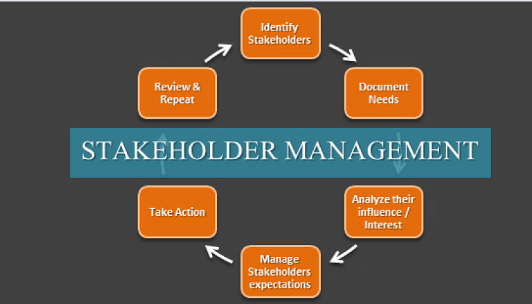
Step-by-Step Guide to Practicing Stakeholder Management
Here is a simple, practical guide that new Business Analysts can follow:
Step 1: Identify Stakeholders
List all individuals or groups who impact or receive impact from the project.
Step 2: Classify Stakeholders
Use categories such as:
- High power, high interest
- High power, low interest
- Low power, high interest
- Low power, low interest
Step 3: Build an Engagement Plan
Define:
- How often to communicate
- What information to share
- Which channel to use
Step 4: Conduct Requirement Sessions
Interview, workshop, or observe stakeholders to gather accurate information.
Step 5: Manage Conflicts Early
Use neutral, fact-based discussions to align teams.
Step 6: Maintain Transparency
Document all decisions and ensure everyone has access.
Step 7: Evaluate Relationships Regularly
Review stakeholder expectations and adjust engagement methods when required.
This process builds a strong foundation for Stakeholder Management and ensures smoother project progress.
How Stakeholder Management Supports BA Career Growth
Strong Stakeholder Management skills increase a BA’s value within any organization. They help BAs:
- Lead challenging projects
- Improve their communication confidence
- Build trust with leadership teams
- Deliver high-quality solutions
- Move into advanced roles such as Product Owner, Project Manager, or BA Lead
Employers prefer candidates who can manage people as well as processes. This is why business analyst course, business analyst classes, and business analyst online training programs highlight Stakeholder Management as a core learning area.
Key Takeaways
- Stakeholder Management is one of the most important skills for Business Analysts.
- Effective Stakeholder Management improves project success and reduces conflict.
- BAs must master communication, negotiation, listening, and emotional intelligence.
- Business analysis training helps you practice Stakeholder Management in real-world scenarios.
- BA training and placement programs support long-term career success by improving both technical and interpersonal skills.
Conclusion
Strong Stakeholder Management makes you a confident and successful Business Analyst. Build these skills with expert-led business analyst training from H2K Infosys and prepare for real-world roles.
Enroll today and start your journey toward a rewarding BA career.