If you’ve been checking out BA Training or looking into a business analyst certification online, you’ve probably noticed one thing: everyone talks about “business analysis” like it’s a single skill. It’s not. It’s more like a toolkit with different lenses, each solving a different kind of problem.
When I first started checking out business analysis training, I assumed it was mostly about gathering requirements. Turns out that’s just one slice of a much bigger picture.
Let’s break down the Types of Business Analysis in a way that actually reflects real-world work, not just textbook definitions.
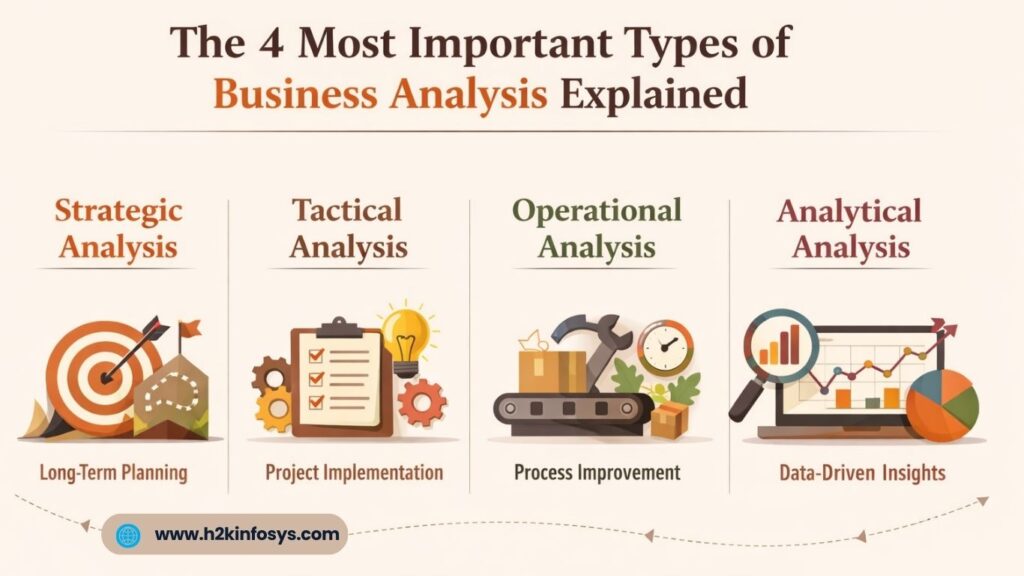
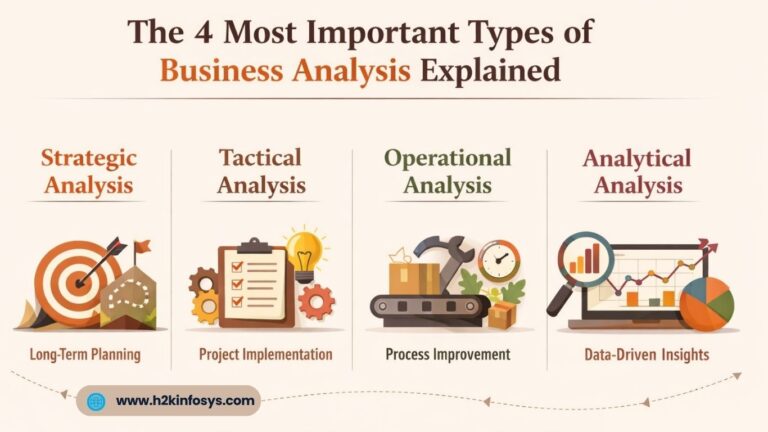
1. Strategic Business Analysis (Big Picture Thinking)
This is where companies decide where they’re going. Strategic analysis is less about spreadsheets and more about direction.
For instance, imagine a company deciding whether to enter a new market or launch a new product. That’s strategic.
What it involves:
- Market research
- Competitor research
- Business model research
- Long-term planning
Real-world example:
In 2025, many startups in India started integrating AI into their products not just as a feature, but as a business strategy. Business analysts were heavily involved in determining if this was financially feasible or not.
This is one of the most impactful Types of Business Analysis because decisions made in this area will trickle down and affect everything else.
2. Tactical Business Analysis (Bridging Strategy and Execution)
Now, strategy sounds great but someone has to turn it into action. That’s where tactical analysis steps in.
So, if the strategic business analysis concludes, “We need to come up with a mobile application,” the tactical business analysis would be, “Alright, got it. But what does the application need to do?”
What it involves:
- Defining the business requirements
- Determining the priority of the features
- Stakeholder communication
- Determining the implementation steps
A practical scenario:
Suppose a bank wants to enhance its online presence. A tactical business analyst would sit with the stakeholders and understand the problems of the customers. Then he would come up with the actual features of the application.
When individuals choose to take business analyst courses or business analyst classes, this is the skill they practice the most.
Among all Types of Business Analysis, this is the one where the business analysts spend most of their time.
3. Operational Business Analysis (Making Things Work Better)
This is the “let’s fix what’s broken” part of business analysis.
Operational business analysis is the process of improving the internal business processes of the company. This could be to cut costs and make the business processes smoother.
What it involves:
- Process mapping
- Identifying the bottlenecks
- Optimizing the processes
- Measuring the performance
A real-life example:
A logistics company faces the problem of delays. An operational business analyst would analyze the problem and conclude that the issue lies with the warehouse sorting process.
This is one of the Types of Business Analysis where the business analysts can directly improve the business performance. This is one of the most sought-after types of business analysis in the industry.
4. Analytical Business Analysis (Data-Driven Decisions)
Now we are talking about the data-driven decisions.
Analytical business analysis is the process of utilizing data to make decisions. With the advent of AI and data tools in 2026, this type of business analysis has gained immense importance.
What it involves:
- Data analysis and visualization
- Predictive modeling
- KPI tracking
- Reporting insights
What’s happening right now:
Companies are investing heavily in data-driven roles. Tools like Power BI, Tableau, and even AI-assisted analytics platforms are becoming standard skills in business analysis online training programs.
This is one of the fastest-growing Types of Business Analysis, especially for those entering the field through business analyst training and placement programs.
Why Understanding These Types Actually Matters
Here’s something I wish someone had told me earlier knowing the Types of Business Analysis helps you figure out where you fit.
Not everyone enjoys strategy. Not everyone loves data. Some people thrive in stakeholder discussions, others in process optimization.
And that’s okay.
When you explore BA Certification paths or business analyst certification online, you’ll notice that many programs now tailor learning based on these different analysis types.
Because the industry itself is evolving.
How These Types Work Together (In Real Life)
In reality, these Types of Business Analysis don’t exist in isolation.
A single project might involve:
- Strategic analysis to define the goal
- Tactical analysis to plan the solution
- Operational analysis to enhance execution
- An analytical analysis to evaluate the outcome
It’s almost like a cycle, rather than a straight line.
In fact, I have witnessed projects failing, not because the idea itself was bad, but because one of these levels has been totally ignored.
Choosing the Right Path for You
If you are new to the idea of business analyst courses, then let me give you a quick way of thinking about it:
- Do you like thinking at a high level? → Strategic
- Do you like working with teams or working with requirements? → Tactical
- Do you like fixing processes or execution? → Operational
- Do you like working with data or insights? → Analytical
Understanding the Types of Business Analysis makes your learning journey a whole lot more targeted—and, let’s be honest, way less confusing.
Conclusion
The term ‘business analyst’ might sound vague, but when you understand the Types of Business Analysis, it makes perfect sense.
And the best part? It’s a field that’s growing.
Companies these days aren’t looking for business analysts; they are looking for people who know the types of business analysis. So, if you are thinking of moving into the field of business analysis with the help of business analysis training or a structured business analyst certification online, then you are at a great advantage.