In 2026 and beyond, the future of Business Analysis Careers seems quite bright. This is because more and more businesses are using AI, going digital, and needing to make decisions based on data. People that get organized BA training, get a BA certification, and take practical business analyst courses are setting themselves up for long-term professional progression, greater pay, and leadership positions.
You may have seen something fascinating if you’ve been paying attention to recruiting trends lately. Companies are not only recruiting engineers and data scientists; they are also engaging business analysts to link technology to business results. That bridge job is more important than ever. I’ve seen companies have trouble not because they didn’t have enough data, but because they didn’t have enough people who knew how to read it and make actual decisions based on it.
Let’s look at where Business Analysis Careers are going and why now is a great time to go into this industry.
Why Business Analysis Careers Are Growing Faster Than Ever
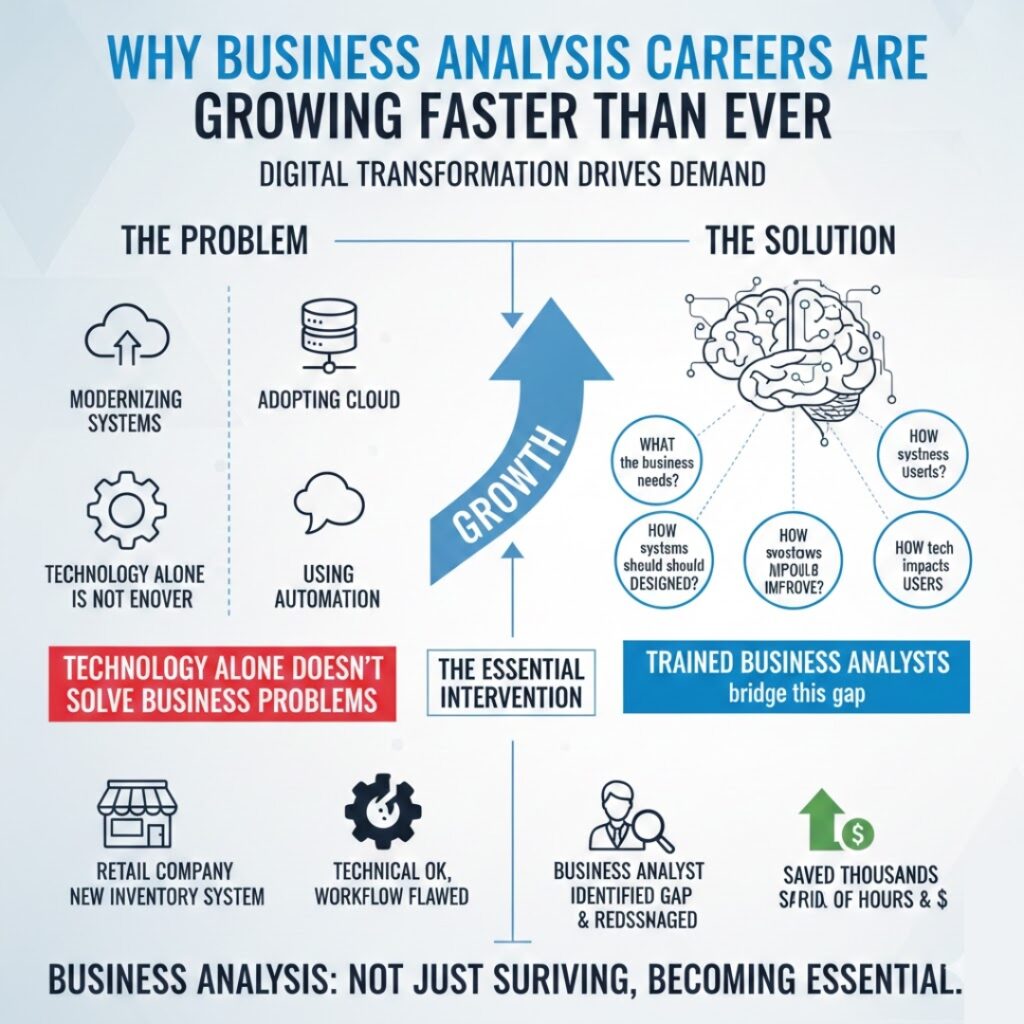
One major reason Business Analysis Careers are expanding is the explosion of digital transformation initiatives. Every company today banks, healthcare providers, retail companies, even government agencies is modernizing systems, adopting cloud platforms, and using automation.
But technology alone doesn’t solve business problems. Someone needs to understand:
- What the business actually needs
- How systems should be designed
- How workflows can be improved
- How technology impacts users
This is where professionals trained through business analysis training, business analyst certification online, and hands-on business analysis online training programs make a real difference.
I remember working with a retail company that implemented a new inventory system. The developers built everything correctly from a technical perspective. But the system didn’t match how store managers actually worked. A trained business analyst stepped in, identified the workflow gap, and redesigned the requirements. That single intervention saved the company thousands of hours of operational inefficiency.
This is exactly why Business Analysis Careers are not just surviving they’re becoming essential.
The Move Toward AI-Powered Business Analysts
The use of artificial intelligence and automation is one of the greatest advancements that is changing Business Analysis Careers.
Analysts these days don’t merely gather requirements. They are collaborating with:
- Dashboards for analytics that use AI
- Tools for predicting the future
- Insights from machine learning
- Business intelligence systems that work in real time
People who are taking modern business analyst seminars and getting their business analyst certification online are studying technologies like:
- Power BI
- SQL Tableau
- The foundations of Python
- Jira and Agile tools
AI can look at trends, but it can’t completely understand the context of a business or what people care about. The analyst still has to do that.
This change is opening up whole new job prospects in Business Analysis, especially for people who know a lot about both business and technology.
Business Analysis Careers Are Expanding Across Every Industry
One thing that surprises many beginners is how flexible Business Analysis Careers are. You’re not limited to one industry.
Business analysts are now in demand in:
- Healthcare organizations are improving patient systems
- Financial institutions optimizing risk models
- E-commerce companies are improving customer journeys
- Technology companies launching new products
- Government agencies digitizing public services
A professional completing structured Business Analyst training and placement programs can move between industries more easily than many other technical roles.
That flexibility is a huge advantage, especially in uncertain job markets.
From collecting requirements to giving strategic advice
People used to think of business analysts as people who wrote requirement documents. That job still exists, but it has changed a lot.
Business analysis careers today entail making strategic decisions.
Analysts nowadays assist businesses address questions like:
- Which features of the product should be given the most attention?
- Where are operational inefficiencies costing you money?
- How might the experience of customers be better?
- What processes can be automated without risk?
Structured business analysis training teaches professionals how to not just write down requirements, but also how to look at business processes, find hazards, and suggest fixes.
Because of this strategic influence, analysts are important people to have on executive-level decisions.
How Business Analysts Help Products Succeed in the Real World
Let’s look at a real-world example from a fintech startup.
The business wished to add a new mobile banking service. Developers were ready to start building it right away. The business analyst did user research first, though, and found something surprising, clients didn’t want more features. They wanted confirmations of transactions to come faster.
The corporation made transactions faster instead than adding capabilities that weren’t needed. A lot more customers were happy.
The main effect of Business Analysis Careers is that they assist businesses focus on what really important.
Remote work is opening up more business analysis jobs.
Remote work is another big trend that is changing Business Analysis Careers.
Business analysts can operate from home, unlike other technical professions that need access to physical infrastructure.
- Tools for working together
- Platforms for managing requirements
- Video conferences
- Analytics solutions that run in the cloud
Many people who have finished online business analyst certification programs are now working from home for organisations all around the world.
This has made it possible to work in other countries, which wasn’t possible before.
Why Companies Prefer Certified Business Analysts
Employers are more and more interested in hiring people who have formal BA certification and organised business analyst training since certification shows:
- Understanding of frameworks for business analysis
- Knowledge of Agile and how projects work
- Ability to correctly gather and write down requirements
- Being familiar with tools in the actual world
Certification gives companies peace of mind that candidates are ready for the job.
This is one reason why people that are credentialed generally move up faster in Business Analysis Careers.
Career Path from Entry-Level to Advanced
One of the best things about working in business analysis is that there is a clear path to growth.
Typical progression includes:
Entry Level Roles
- Junior Business Analyst
- Business Analyst Associate
- Requirements Analyst
Mid-Level Roles
- Business Analyst
- Product Analyst
- Systems Analyst
Advanced Roles
- Senior Business Analyst
- Product Owner
- Business Analysis Manager
Leadership Roles
- Strategy Analyst
- Business Consultant
- Product Manager
Professionals who complete strong Business Analyst training and placement programs often move through these stages faster.
Business Analysis Careers Offer Strong Salary Growth
Salary growth is another reason many professionals are switching into Business Analysis Careers.
Average salary ranges (depending on experience and location):
- Entry Level: $65,000 – $85,000 per year
- Mid Level: $90,000 – $120,000 per year
- Senior Level: $120,000 – $150,000+ per year
The demand continues to rise because businesses rely heavily on data-driven decision-making.
The Impact of Agile and Product Management
Agile methodologies have been a game changer for Business Analysis Careers.
Business analysts have close collaboration with:
- Product managers
- Developers
- QA testers
- Stakeholders
Analysts no longer write big requirement documents in advance. Instead, they work in an iterative process.
This collaboration is a big factor in making the role and working environment a lot more engaging.
Business analysis online training teaches Agile workflows, which are a requirement in most organizations now.
Why Career Switchers Are Choosing Business Analysis
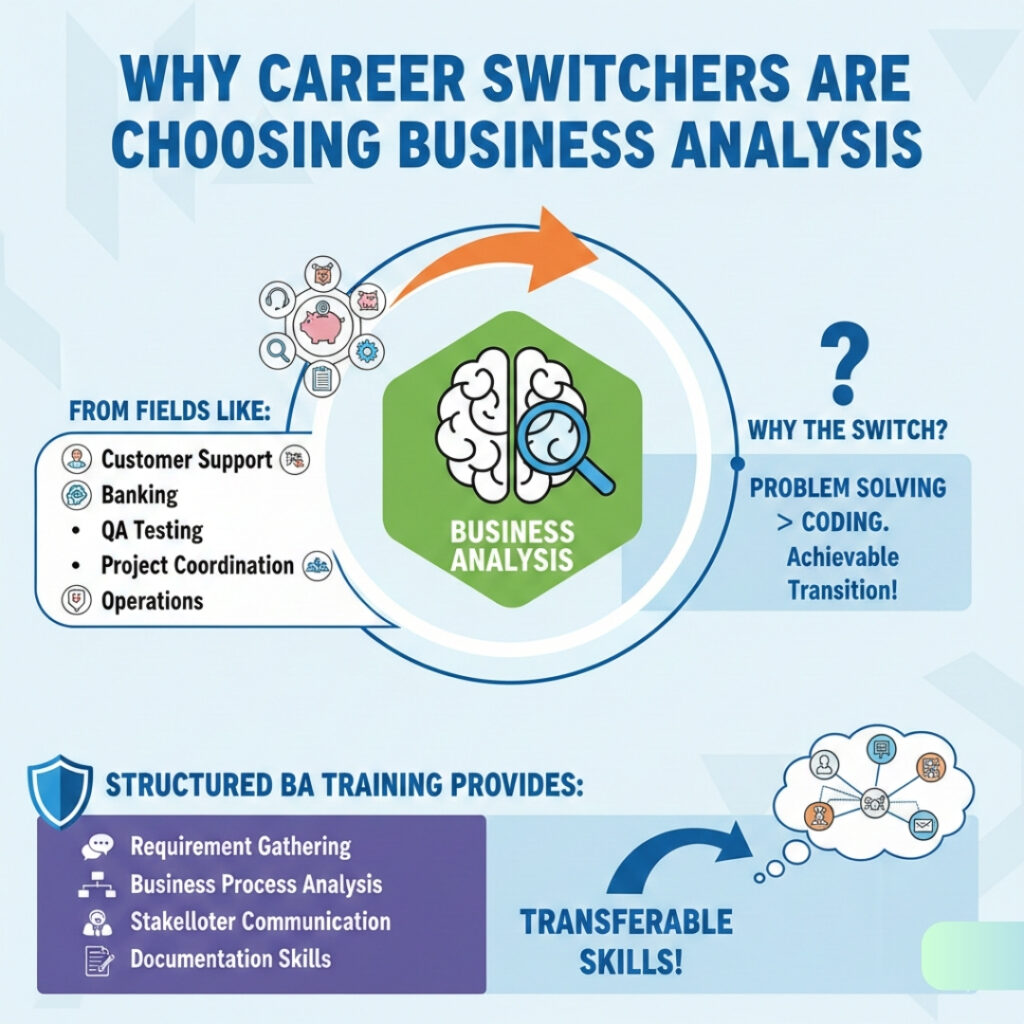
Many professionals are transitioning into Business Analysis Careers from fields like:
- Customer support
- Banking
- QA testing
- Project coordination
- Operations
The transition is achievable because business analysis focuses more on problem solving than coding.
Structured ba training programs help professionals learn:
- Requirement gathering
- Business process analysis
- Stakeholder communication
- Documentation skills
These skills are transferable from many other roles.
How H2K Infosys Helps Prepare Professionals
Training providers such as H2K Infosys emphasize practical business analyst training, include actual projects, and incorporation of career development services.
This methodology leads learners to comprehend the theory as well as the workings of actual entities.
Typical components of strong Business Analyst training and placement programs include:
- Simulated real-life projects
- Resume workshops
- Mock interview preparation
- Training on Agile tools
- Case studies from the industry
All the components above significantly enhance job readiness.
Skills Needed for Business Analysis Jobs in the Future
People who want to work in Business Analysis in the future should learn how to do the following:
Technical Skills
- Basic SQL
- Tools for visualizing data
- Tools for managing requirements
Business Skills
- Analysis of processes
- Communication with stakeholders
- Solving problems
Emerging Skills
- Analytics with the help of AI
- Tools for automation
- Frameworks for digital transformation
These talents will help you keep your job for a long time.
Why Business Analysis Careers Will Remain Future-Proof
Technology continues to evolve rapidly, but businesses will always need professionals who understand both business and technology.
AI can analyze data, but it cannot fully replace human decision-making.
This makes Business Analysis Careers one of the most future-proof career paths in technology.
Organizations will continue to rely on analysts to:
- Translate business needs into solutions
- Improve operational efficiency
- Support strategic decision-making
This demand isn’t slowing down anytime soon.
Conclusion
The future of business analysis careers is bright, stable, and full of opportunities for people who invest in the right training through organized business analyst courses, business analyst certification online, and business analysis training. Business analysis is one of the most valuable and future-ready career pathways in the modern job market. This is because there is a growing demand for it in many fields, it offers flexible remote work options, and it has a lot of potential for high salaries.