If you’ve been anywhere near the Salesforce ecosystem lately whether through projects, client calls, or even just scrolling LinkedIn you’ve probably noticed one thing AI is no longer a “feature.” It’s becoming the backbone.
And honestly, this didn’t happen overnight.
A couple of years back, most businesses were still figuring out dashboards and workflows. Now? They’re asking how AI can predict customer churn, write sales emails, and guide reps during live conversations. That’s where Salesforce AI Technology starts getting really interesting.
Let’s unpack what’s actually happening (not the buzzword version), where it’s going, and why it matters, especially if you’re thinking about Salesforce admin training or leveling up your career.
AI in Salesforce: Not Just Hype Anymore
There was a time when AI in CRM meant basic recommendations “Hey, maybe call this lead.” Useful, sure. But not groundbreaking.
Now, Salesforce AI Technology is doing things that feel a bit smarter. Almost like having a junior analyst working alongside you.
Take a real example from a client project I worked on recently. Their sales team struggled with follow-ups. Leads were slipping through the cracks not because reps didn’t care, but because they were juggling too much.
Once we implemented AI-driven insights, the system started:
- Prioritizing leads based on engagement patterns
- Suggesting next actions (call, email, demo)
- Even drafting email responses
And suddenly, their conversion rates improved. Not dramatically overnight but steadily. And that’s the kind of change businesses actually care about.
That’s the real power of Salesforce AI Technology quiet, consistent improvement.
So, What’s the “Next Big Thing” Exactly?
If I had to boil it down, I’d say this:
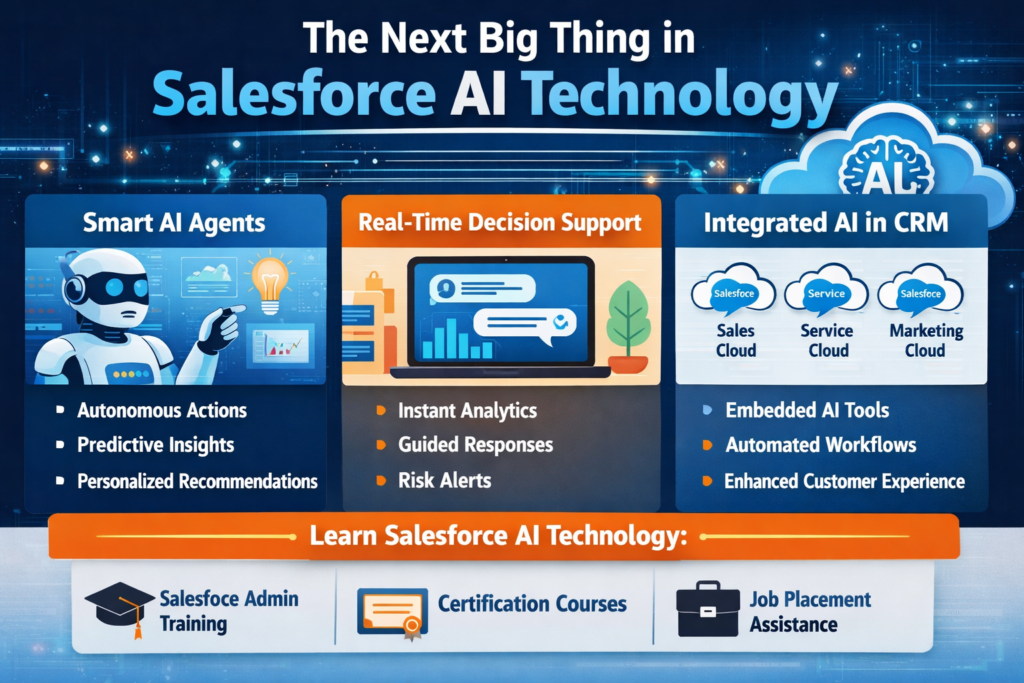
The future of Salesforce AI Technology is autonomous, generative, and deeply integrated AI agents.
Let me explain that without sounding like a product brochure.
1. AI That Doesn’t Wait for Instructions
Earlier systems needed triggers. Now, AI is starting to act on its own (within boundaries, of course).
Imagine this:
- A deal is slowing down
- The system detects reduced engagement
- It automatically suggests a strategy shift
- It even drafts a personalized re-engagement email
That’s not automation. That’s assistance with context.
And yes, this is already happening through tools like Einstein AI and newer generative layers.
2. Generative AI Inside CRM (Not Just Add-On Tools)
You’ve probably used ChatGPT or similar tools. Now imagine that power directly inside Salesforce.
That’s where Salesforce AI Technology is heading embedding generative AI into:
- Sales Cloud
- Service Cloud
- Marketing automation
So instead of switching tools, everything happens in one place.
I’ve seen teams reduce their email drafting time by almost 40%. Not because AI replaces them but because it removes the “blank page” problem.
3. Real-Time Decision Intelligence
This is the part that’s honestly a bit underrated.
AI is moving toward real-time insights during interactions.
For example:
- A customer is chatting with support
- AI analyzes sentiment instantly
- It suggests responses to the agent
- It flags escalation risks
It’s subtle, but incredibly powerful.
And again, this is where Salesforce AI Technology is quietly reshaping customer experience.
Why This Matters for Your Career (Not Just Companies)
Let’s switch perspective for a second.
If you’re exploring a Salesforce course or thinking about switching careers, this shift isn’t just “nice to know.” It’s essential.
Because the role of a Salesforce professional is changing.
Earlier, admins focused on:
- Data management
- Reports
- Workflow automation
Now? They’re expected to understand:
- AI-driven insights
- Prompt-based workflows
- Data quality for AI models
Which means
Salesforce admin training today needs to include AI concepts. Otherwise, you’re learning half the picture.
The Rise of AI-Skilled Salesforce Admins
Here’s something I’ve noticed in hiring trends (and yes, this is very real):
Companies aren’t just looking for “Salesforce admins” anymore.
They want:
- Admins who understand AI recommendations
- People who can configure AI tools
- Professionals who can explain AI outputs to business teams
And that’s a big shift.
Because Salesforce AI Technology isn’t just technical it’s interpretive.
You need to:
- Understand what AI is suggesting
- Decide if it makes sense
- Adjust configurations accordingly
It’s part tech, part business thinking.
Real-World Scenario: Where AI Actually Helps
Let me walk you through something practical.
A retail company I worked with had thousands of customer records. Their problem?
Too much data, not enough clarity.
Once we implemented Salesforce AI Technology, the system started identifying:
- High-value customers likely to churn
- Buying patterns across seasons
- Best times to send marketing campaigns
One interesting moment I remember clearly is when the AI flagged a segment of customers who hadn’t purchased in 6 months but were highly engaged with emails.
Marketing ran a targeted campaign.
Result? A noticeable spike in repeat purchases.
Not magic. Just smarter data use.
Where Salesforce AI Technology Is Headed Next
Alright, let’s talk future but realistically, not sci-fi.
Hyper-Personalization at Scale
AI will make every customer interaction feel tailored.
Not just “Hi [First Name]” but:
- Product suggestions based on behavior
- Timing based on engagement patterns
- Messaging based on preferences
And this will happen automatically.
AI + Voice + Conversational Interfaces
Voice assistants integrated with CRM? Already in progress.
Imagine sales reps saying:
“Show me my highest priority leads today.”
And getting real-time answers.
That’s where Salesforce AI Technology is quietly evolving.
AI Governance and Trust
This one’s important and often ignored.
As AI gets more powerful, companies are becoming cautious.
Questions like:
- Can we trust AI recommendations?
- Is the data biased?
- How do we audit AI decisions?
So future Salesforce professionals will also need to understand ethical AI usage.
Why Training Matters More Than Ever
Let’s be honest learning Salesforce randomly from YouTube isn’t going to cut it anymore.
Because Salesforce AI Technology adds complexity.
You need structured learning that covers:
- Core CRM concepts
- AI integration
- Real-world scenarios
- Hands-on practice
That’s where Salesforce training and placement programs actually make a difference.
Not just theory but guided experience.
A Quick Note on Certifications
If you’re aiming for Salesforce certification courses, here’s something to keep in mind:
Certifications are still valuable but they’re evolving.
Earlier, passing an exam was enough.
Now, employers ask:
- Can you implement AI features?
- Have you worked on real projects?
- Do you understand business use cases?
So combine certifications with practical exposure.
That’s the winning combination.
Why H2K Infosys Stands Out Here
I don’t usually jump into promotions without reason but this is one case where it makes sense.
If you’re serious about learning Salesforce AI Technology, platforms like H2K Infosys are aligning their training with current industry needs.
What I like (and this comes from observing learners, not just marketing claims):
- They include real-time project experience
- Their Salesforce trainings cover practical use cases
- There’s a focus on job readiness not just theory
And honestly, that last part matters more than anything.
Because at the end of the day, you’re not just learning you’re preparing for a role.
Common Mistakes People Make While Learning Salesforce Today
Let me save you some time here.
1. Ignoring AI Completely
Some learners still focus only on basics. That’s risky.
2. Over-Focusing on Certification
Passing exams without real skills doesn’t help much anymore.
3. Not Practicing Real Scenarios
Reading isn’t enough. You need to build things.
A More Practical Learning Path (If You’re Starting Now)
If I were starting fresh today, here’s what I’d do:
- Learn core CRM concepts
- Enroll in structured Salesforce admin training
- Practice with real-world use cases
- Explore AI features within Salesforce
- Take relevant Salesforce certification courses
- Work on mock or live projects
And yes, I’d pick a program that includes Salesforce training and placement support because that bridge between learning and getting hired is crucial.
Final Thoughts
Here’s the thing
Salesforce AI Technology isn’t coming it’s already here. Just not evenly distributed yet.
Some companies are fully leveraging it. Others are still figuring it out.
That gap? It’s your opportunity.
If you understand both Salesforce and AI, you’re in a strong position. Not just for jobs but for long-term growth.
And if you’re still wondering whether it’s worth learning
Well, let’s just say this skills around Salesforce AI Technology are only going to get more valuable from here.