Benefits of Enrolling in an AI Course this changing how companies hire, build products, serve customers, and solve business problems. Professionals now need practical AI skills to stay competitive in today’s job market. An AI course with placement helps learners gain structured training, hands-on project experience, and career support in one program. The best AI certification courses teach Python, machine learning, deep learning, NLP, Generative AI, and real-world use cases. Placement assistance also guides learners with resumes, mock interviews, and job search planning. This combination helps students, fresh graduates, and working professionals build confidence and move toward rewarding AI career opportunities with clarity and focus.
That is where an AI Course with Placement becomes useful. A structured course helps you learn the right skills. Placement assistance helps you present those skills to employers. This mix can save time, reduce confusion, and improve your job search.
The best AI certification courses do more than explain theory. They train you with Python, machine learning, deep learning, natural language processing, Generative AI, real-time projects, resume support, mock interviews, and job guidance. H2KInfosys focuses on this practical learning model for students, working professionals, and career changers.
Industry data supports the need for AI skills. The World Economic Forum reports that AI and information processing technologies are expected to transform 86% of businesses by 2030. It also lists AI and big data among the fastest-growing skills. McKinsey reports that 78% of survey respondents say their organizations use AI in at least one business function.
Why AI Training Matters in Today’s Job Market
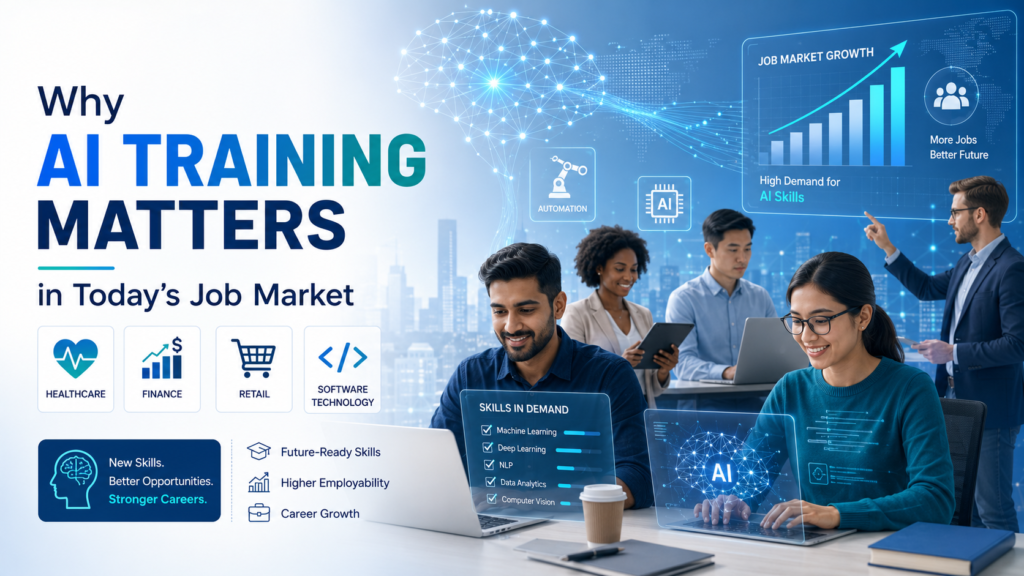
Companies now use AI to solve real business problems. A retail company uses AI to recommend products. A hospital uses AI to read medical images faster. A bank uses AI to detect fraud. A software team uses AI tools to write test cases, review code, and create documentation.
These examples show one simple fact: AI skills now support many job roles.
AI is not only for data scientists. It also helps:
- Software developers
- QA testers
- Business analysts
- Data analysts
- Cloud engineers
- Cybersecurity professionals
- Product managers
- Marketing analysts
- Support teams
LinkedIn reports that 70% of the skills used in most jobs may change by 2030, with AI acting as a key driver of this shift. This means learners need current skills, not outdated course content.
A practical AI course helps learners build those current skills in a guided way.
What Is an AI Course with Placement Assistance?
An AI course with placement teaches AI concepts and also supports your job search. This type of program helps you move from learning to applying, then from applying to interviewing.
A strong AI placement program usually includes:
- Live or instructor-led training
- Python and AI tool training
- Machine learning projects
- Deep learning basics
- NLP and Generative AI use cases
- Resume preparation
- Mock interviews
- Job search guidance
- Interview question practice
- Career support after course completion
H2K Infosys lists AI course features such as hands-on projects, personalized career assistance, resume preparation, mock interviews, certification, and job placement support. These support areas matter because most learners do not struggle only with learning. They also struggle with how to show skills during interviews.
Benefit 1: You Learn Job-Ready AI Skills
The biggest Benefits of Enrolling in an AI Course is job-ready training. You do not learn random topics. You learn tools and workflows that companies use.
A useful AI course should cover:
Core AI Concepts
You learn what AI means and how it works. You study supervised learning, unsupervised learning, classification, regression, clustering, neural networks, and model evaluation.
Python for AI
Python is a leading language for AI projects. You use Python libraries such as:
- NumPy
- Pandas
- Matplotlib
- Scikit-learn
- TensorFlow
- Keras
Machine Learning
You learn how models find patterns in data. For example, a bank can use a classification model to predict if a transaction is normal or suspicious.
Deep Learning
You learn how neural networks handle images, text, audio, and large datasets. Deep learning supports use cases like image recognition and voice assistants.
Natural Language Processing
NLP helps machines process human language. Chatbots, sentiment analysis tools, resume scanners, and translation tools use NLP.
Generative AI
Generative AI helps create text, images, code, summaries, and reports. Many companies now use Generative AI in marketing, support, software development, and knowledge management.
Benefit 2: You Build Real-World Projects
Employers want proof. A certificate helps, but a project shows skill.
The Benefits of Enrolling in an AI Course include real-time projects. These projects help learners apply concepts to business problems.
Example AI projects include:
- Customer churn prediction
- Product recommendation system
- Resume screening model
- Sentiment analysis dashboard
- Fraud detection model
- AI chatbot for customer support
- Image classification model
- Sales forecasting model
A project helps you answer interview questions with confidence. You can explain the business problem, dataset, algorithm, result, and improvement plan.
Simple AI Workflow Diagram
Business Problem
      ↓
Data Collection
      ↓
Data Cleaning
      ↓
Feature Engineering
      ↓
Model Training
      ↓
Model Evaluation
      ↓
Deployment
      ↓
Monitoring and Improvement
This workflow appears in many AI jobs. A course with hands-on projects helps you practice each step.
Benefit 3: You Get Practical Coding Experience
AI learning becomes stronger when you write code. A practical Benefits of Enrolling in an AI Course helps you move from watching lessons to building models.
Here is a simple machine learning example in Python:
from sklearn.datasets import load_iris
from sklearn.model_selection import train_test_split
from sklearn.ensemble import RandomForestClassifier
from sklearn.metrics import accuracy_score

# Load sample data
data = load_iris()
X = data.data
y = data.target

# Split data into training and testing sets
X_train, X_test, y_train, y_test = train_test_split(
    X, y, test_size=0.2, random_state=42
)

# Train model
model = RandomForestClassifier(random_state=42)
model.fit(X_train, y_train)

# Predict results
predictions = model.predict(X_test)

# Check accuracy
accuracy = accuracy_score(y_test, predictions)
print("Model Accuracy:", accuracy)
This small example teaches a full AI process. You load data, split data, train a model, predict results, and check accuracy. Real projects use larger datasets, but the flow remains similar.
Benefit 4: Placement Assistance Makes the Job Search Clear
Many learners complete online courses but still feel stuck. They ask:
- Which job roles should I apply for?
- How should I write my resume?
- How should I explain my project?
- What interview questions should I expect?
- How do I show AI skills without work experience?
Placement assistance solves these problems with structure.
A good placement support team helps you create a job-focused resume. It helps you highlight AI projects, tools, and outcomes. It also helps you prepare for common AI interview questions.
This support matters because hiring has become skill-based. IBM reports that limited AI skills and expertise was the top barrier to successful AI adoption among surveyed enterprises, with 33% citing it as a challenge. If companies face skill gaps, trained candidates can stand out when they show practical ability.
Benefit 5: You Prepare for AI Interview Questions
AI interviews test both theory and application. You must explain how models work. You must also show how you solve problems.
Common AI interview questions include:
- What is the difference between AI, machine learning, and deep learning?
- What is overfitting?
- How do you handle missing data?
- What is model accuracy?
- When should you use classification?
- What is a confusion matrix?
- How does NLP support chatbots?
- How do you evaluate a machine learning model?
- How did you build your project?
- What problem did your model solve?
Mock interviews help you practice these answers. They also help you improve your speaking style. This matters because many candidates know the answer but fail to explain it clearly.
Benefit 6: You Build a Strong AI Portfolio
A portfolio helps recruiters see your work. It gives you proof beyond your resume.
A strong AI portfolio should include:
- Project title
- Business problem
- Dataset details
- Tools used
- Model used
- Results achieved
- Screenshots or dashboard links
- GitHub code link
- Short project summary
For example, a customer churn project can show how a company can identify customers who may leave. A fraud detection project can show how banks can flag suspicious activity. A chatbot project can show how companies can reduce support load.
These projects help beginners compete with more confidence.
Benefit 7: You Learn AI Tools Used in Real Work
Modern AI jobs require tool knowledge. A practical Benefits of Enrolling in an AI Course should train you with tools that support real work.
Important AI tools include:
- Python for coding
- Pandas for data handling
- Scikit-learn for machine learning
- TensorFlow and Keras for deep learning
- Jupyter Notebook for experiments
- GitHub for project sharing
- SQL for data access
- Power BI or Tableau for dashboards
- Cloud platforms for deployment
- Generative AI tools for automation
When learners practice these tools, they understand how AI works inside business teams.
Benefit 8: You Can Move into Multiple Career Paths
AI creates many career options. You can choose a path based on your background and interest.
Popular AI job roles include:
- AI Engineer
- Machine Learning Engineer
- Data Scientist
- NLP Engineer
- AI Software Developer
- Data Analyst with AI skills
- Business Analyst with AI skills
- QA Tester with AI automation skills
- AI Product Analyst
- Prompt Engineer
The World Economic Forum lists Ai machine learning courses among the fastest-growing technology-related roles by percentage growth. This makes AI training useful for both beginners and experienced professionals.
Benefit 9: Career Changers Get a Guided Path
Many people want to enter AI from non-AI backgrounds. They may come from QA, support, business, finance, healthcare, sales, or operations. Self-learning can feel hard because AI has many topics.
A guided course solves this issue with a clear path.
Step-by-Step AI Learning Path
- Learn basic Python.
- Learn data handling with Pandas.
- Learn statistics basics.
- Learn machine learning models.
- Build small projects.
- Learn model evaluation.
- Learn NLP and Generative AI.
- Build a portfolio project.
- Prepare your resume.
- Practice mock interviews.
- Apply for AI-related roles.
This path helps learners focus on the next step instead of jumping between random videos.
Benefit 10: Certification Adds Credibility
Certification does not replace skill. It supports skill. A certificate shows that you completed structured training. It also helps recruiters identify your learning path.
A study on AI skills and hiring found that AI skills raised interview invitation chances by about 8 to 15 percentage points across selected roles in an experimental recruiter survey. The study also found that formal AI certification helped in some hiring cases.
This supports a clear point: AI certification can help when it connects to real skills, real projects, and clear interview preparation.
What Makes H2KInfosys AI Training Useful?
H2KInfosys focuses on practical AI training with career support. This model helps learners build technical knowledge and job search confidence.
The course structure supports:
- AI principles and ethics
- Language data processing
- Neural networks
- AI tools
- Algorithms and applications
- Real-world problem solving
- Resume support
- Mock interviews
- Job placement support
This mix helps learners prepare for real hiring needs. It also helps learners explain their skills in a clear and job-focused way.
Frequently Asked Questions
1. What is an AI course with placement assistance?
An AI course with placement assistance is a training program that teaches artificial intelligence skills and also supports your job search. It usually includes AI concepts, Python programming, machine learning, deep learning, real-time projects, resume support, mock interviews, and placement guidance.
2. Who should enroll in an AI course with placement?
Students, fresh graduates, software professionals, QA testers, data analysts, business analysts, and career changers can enroll in an AI course with placement. The course helps learners build job-ready skills and prepare for AI-related roles in different industries.
3. What skills will I learn in an AI training course?
You will learn Python, data handling, machine learning, deep learning, natural language processing, model evaluation, Generative AI basics, and real-world AI project development. You will also learn how to explain your projects during job interviews.
4. Why is placement assistance important in an AI course?
Placement assistance helps learners move from training to employment. It supports resume building, interview preparation, job search planning, and project presentation. This support helps learners apply for the right AI roles with more confidence.
5. Are AI certification courses useful for beginners?
Yes. The best AI certification courses help beginners learn step by step. A good course starts with basic Python and AI concepts. It then moves into machine learning, deep learning, projects, and interview preparation.
6. What job roles can I apply for after completing an AI course?
After completing an AI course, you can apply for roles such as AI Engineer, Machine Learning Engineer, Data Analyst, NLP Engineer, AI Developer, Business Analyst with AI skills, QA Automation Tester with AI skills, and Junior Data Scientist.
7. Do I need coding experience before joining an AI course?
Basic coding knowledge helps, but many Benefits of Enrolling in an AI Course start with Python fundamentals. Beginners can learn AI if they follow a structured path and practice coding through hands-on projects.
8. What makes H2KInfosys AI training practical?
H2KInfosys AI training focuses on hands-on learning, real-time projects, instructor guidance, resume preparation, mock interviews, certification support, and placement assistance. This approach helps learners build both technical and career skills.
9. How do real-time projects help in AI career growth?
Real-time projects help learners apply AI concepts to business problems. Projects also help learners build a portfolio. A strong portfolio can show recruiters your practical skills, tools, and problem-solving ability.
10. How do I choose the best AI certification courses?
Choose the Benefits of Enrolling in an AI Course by checking the course curriculum, trainer experience, hands-on projects, placement support, interview preparation, certification value, and learner reviews. A strong course should teach practical AI skills and prepare you for real job roles.
Key Takeaways
- AI is changing many industries and job roles.
- An AI course with placement helps learners gain skills and job search support.
- The best AI certification courses include hands-on projects, tools, and interview training.
- Real projects help learners show proof of skill.
- Placement assistance helps learners build resumes, prepare for interviews, and apply with more confidence.
- H2KInfosys offers a practical path for learners who want AI training with career support.
Conclusion
Enroll in H2KInfosys Benefits of Enrolling in an AI Course to gain hands-on learning, real-time project skills, and guided placement support.
Start building stronger AI career skills today and move closer to your next technology role.