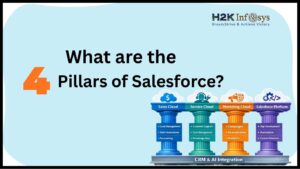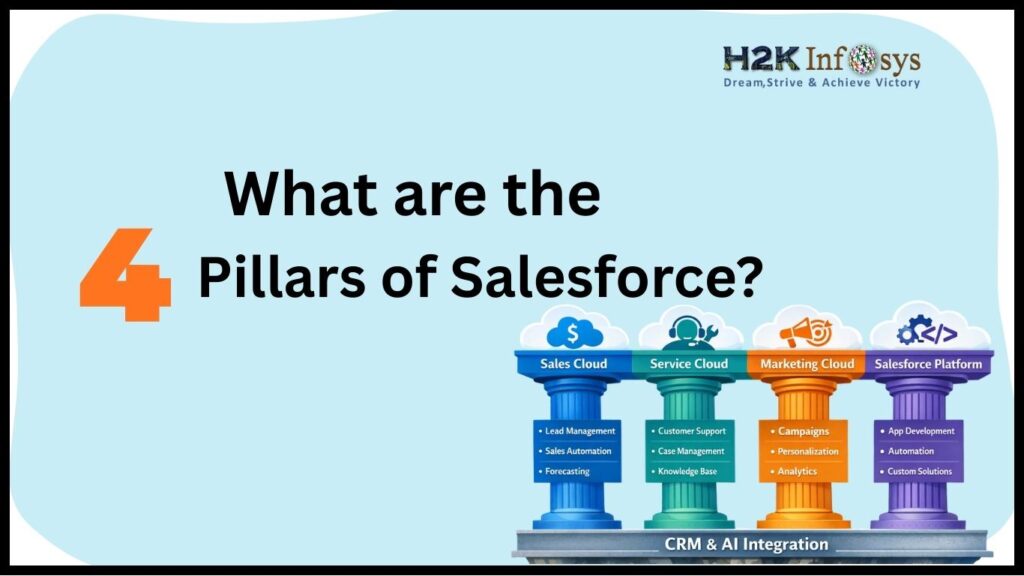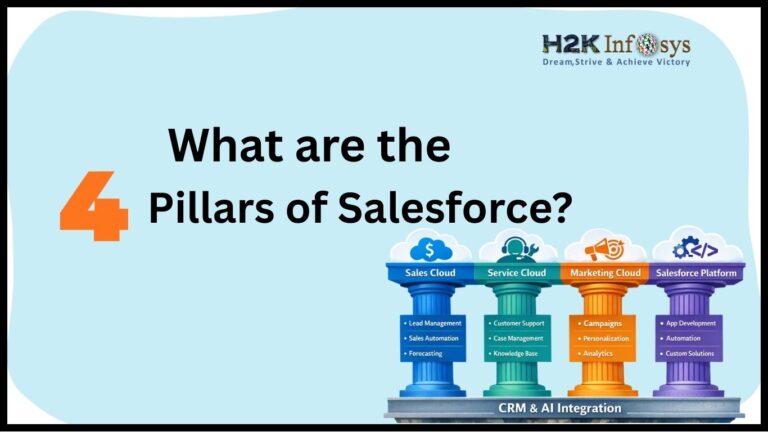
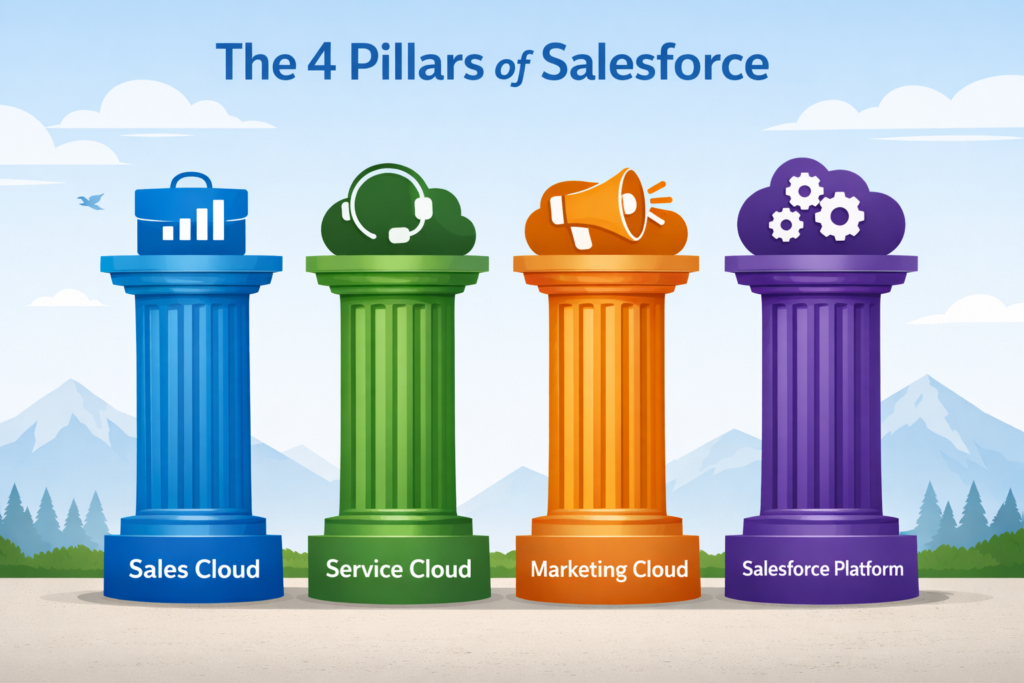
The four pillars that Salesforce is built on, which are often discussed in these communities or by these kinds of training organizations like H2kinfosys, are Sales Cloud, Service Cloud, Marketing Cloud, and Salesforce Platform.
Understanding the Pillars of Salesforce
When first learning about Salesforce, the sheer size of the ecosystem that Salesforce has built out over the years can be overwhelming. When first opening up the platform for the first time a few years ago, I remember thinking, “How does all of this fit together?”
Well, that is where the pillars of Salesforce come in.
These pillars are like the beams on which a building is built. Everything else that we have discussed so far, like the different applications or the dashboards, and the automation that we have discussed, all sit on top of these pillars. Once we have learned about the pillars of Salesforce, we can then better understand the platform that we are working on.
The pillars of Salesforce are the key functional clouds that support the way that we sell, support, or market our customers while building our own solutions.
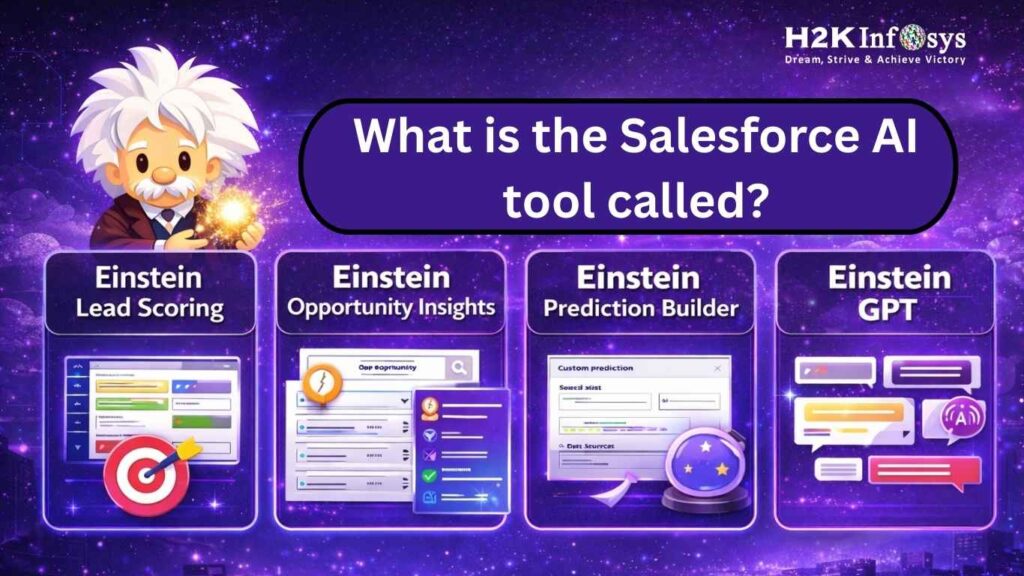
Before we get into each one individually, it is worth mentioning that something important has changed in the world of Salesforce. This is that modern Salesforce has integrated the AI Salesforce capabilities that we have discussed so far, especially in the Salesforce Einstein AI tool. This means that these pillars that we are discussing are no longer just operational systems; they are intelligent systems that learn from data.
So, let us dive into each one individually.
1. Sales Cloud – The Revenue Engine
The first one that we are going to discuss is probably the first one that most people think about when they first hear about Salesforce. This is the Sales Cloud.
If you’ve ever had a job in sales or have worked closely with a sales team, then you know just how crazy things can get without a CRM.
Sales Cloud organizes everything. Contacts. Deals. Activity history. Forecasts. Follow-ups. It’s one of the most recognizable pillars of Salesforce because it has a huge impact on revenue.
What Sales Cloud Actually Does
Sales Cloud does a few different things for businesses.
- track leads and opportunities.
- manage their accounts and contacts.
- automate their sales workflows.
- forecast revenue.
- analyze their pipeline performance.
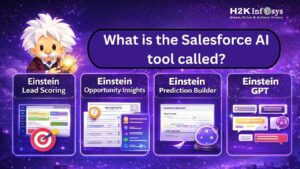
What’s interesting is that we’re seeing a big shift in the way that Salesforce is being used for this pillar in the near future, thanks to the integration of artificial intelligence. With the integration of Einstein AI Salesforce, sales teams can get predictive insights like these:
- What leads are most likely to convert
- When a lead is most likely to stall
- What leads need immediate attention
A friend of mine works for a SaaS company, and they told me something pretty interesting last year. They implemented the Einstein lead scoring tool into their sales team’s arsenal, and three months later, their conversion rate increased by a pretty significant percentage. Not because they worked any harder; just because they worked on the right leads. This is the power of the integration between AI Salesforce and the traditional pillars of Salesforce. Sales Cloud is like the growth engine that sits at the center of all the pillars of Salesforce.
2. Service Cloud – Customer Experience at Scale.
If Sales Cloud is the tool that helps companies acquire customers
Then Service Cloud is the tool that helps them retain them.
And in today’s market, that’s more important than ever. Customer Expectations Have Changed Customer expectations have changed drastically over the last few years. People expect instant support. They expect personalized interactions. They expect seamless integration between different channels like email, chat, and social media. This is where another pillar of Salesforce has a huge impact.
What Service Cloud Brings to the Table
Service Cloud is all about customer support and service operations. Service Cloud can help organizations manage
- customer cases
- support tickets
- knowledge bases
- chatbots
- call centers
What makes Service Cloud really powerful is that it can integrate with Einstein AI Salesforce. For instance:
- AI can help in automatically categorizing customer cases.
- AI can help in recommending solutions to the customer support agents.
- AI can even help in building chatbots that can solve customer issues instantaneously.
Such a combination of Salesforce and AI can help greatly reduce customer support response times. One retail company’s case study that I read recently stated that by using AI in automatically routing customer cases, the company was able to reduce average handling times by almost 30%.
From a strategic perspective, Service Cloud can help in strengthening the pillars of Salesforce by ensuring that a business does not just acquire customers but also keeps them. Honestly speaking, in today’s social media age, that’s really important for a company.
3. Marketing Cloud – Personalization in the AI Era
Marketing has changed more in the past decade than in the past fifty. Customers today want personalization in all aspects of the marketing process. That’s why Marketing Cloud is one of the biggest pillars of Salesforce.
What Marketing Cloud Does
Marketing Cloud can help organizations manage
- email campaigns
- customer journeys
- advertising campaigns
- social media marketing
- data-driven personalization.
The real magic happens when AI Salesforce capabilities get integrated. Using Einstein AI Salesforce capabilities, marketers can:
- predict customer behavior
- personalize content using AI
- Optimize marketing campaigns using AI
- even recommend actions.
One e-commerce company that I worked with was able to use Einstein AI to analyze purchase patterns. The AI system started recommending bundles in marketing emails.
Their average order value increased by almost 18%.
No extra marketing effort. Just smarter automation.
That’s why Marketing Cloud continues to enhance the pillars of Salesforce in a world where personalization drives revenue.
Without it, companies would not be able to provide a consistent customer engagement experience.
4. Salesforce Platform – The Customization Powerhouse
The fourth and most overlooked component of the pillars of Salesforce is the Salesforce Platform itself.
This is where the developers, architects, and admins truly come into their own.
While the other clouds provide pre-built features to leverage, the platform allows businesses to create custom applications.
And let’s be honest, this is what makes Salesforce unique.
What the Salesforce Platform Enables
The Salesforce Platform enables businesses to:
- Custom app development
- Workflow automation
- Integration with external systems
- Data management
- Security and compliance
Developers can leverage the tools provided by the platform to:
- Custom app development
- Workflow automation
- Integration with external systems
- Data management
- Security and compliance
And once again, Salesforce and AI have begun to transform this pillar too.
With the integration of Einstein AI into the platform, developers can now create intelligent applications without the need to develop machine learning models.
That’s a big deal.
Businesses can now develop AI-powered features directly on top of the pillars of Salesforce.
Why the Pillars of Salesforce Matter More Today
The pillars of Salesforce have been around for a long time.
But the importance of the pillars of Salesforce has grown significantly.
The older versions of Salesforce were essentially just a CRM tool.
Now they are a complete digital ecosystem.
A few factors are driving the importance of the pillars of Salesforce even higher:
1. AI-Driven Business Processes
AI is now integrated into every part of Einstein AI Salesforce.
Sales forecasting, marketing personalization, customer service automation, and more are now driven by AI.
2. Unified Customer Data
Companies are shifting toward a “single source of truth.”
Salesforce pillars make this a reality by bringing interactions into one unified system.
3. Automation Everywhere
Manual business processes are a thing of the past.
Workflows, approvals, customer interactions, and more are now automated.
4. App Ecosystems
Salesforce AppExchange, a marketplace for thousands of integrations, further expands on the pillars of Salesforce.
Real-World Example: How Companies Use the Pillars Together
Here is a simple example of how companies are using the pillars of Salesforce together:
- Marketing Cloud sends a personalized campaign targeting potential customers.
- Sales Cloud tracks these leads, converting them into customers.
- Once they are customers, Service Cloud handles customer onboarding and more.
- Salesforce Platform provides custom automation, analytics, and more for its own teams.
- All four pillars of Salesforce are working together in one system.
And then, with AI Salesforce, they can:
Predict which leads will turn into customers.
Adjust their marketing campaigns.
Provide instant customer support with Service Cloud.
And suddenly, their entire business is smarter.
Learning the Pillars: Why Certifications Matter
You must learn about the pillars of Salesforce if you are planning a career in the Salesforce ecosystem.
And trust me, it is a booming field.
According to several industry reports, Salesforce-related jobs are growing globally, especially those involving AI Salesforce integrations.
This is where Salesforce training certification comes in handy.
They enable professionals to learn:
- CRM Architecture
- Automation Tools
- Salesforce Development
- AI-Powered Analytics
- Customer Data Management
Some of the learning paths for professionals are:
- Salesforce Administrator
- Salesforce Platform Developer
- Salesforce Marketing Cloud Consultant
- Salesforce Service Cloud Consultant
Each of these learning paths gives you a better understanding of the pillars of Salesforce.
And once you get a good grasp of the pillars of Salesforce, the whole platform becomes a lot easier to use.
How AI Is Reshaping the Pillars of Salesforce
We cannot talk about the pillars of Salesforce without talking about the impact of AI on the pillars of Salesforce.
Salesforce has been investing a lot in the field of AI over the last few years.
The launch of the Einstein AI Salesforce platform was a major turning point for the company.
For the first time, AI was not used as a separate entity, but as a part of the Salesforce platform itself.
Here is how the pillars of Salesforce are being reshaped by the inclusion of AI:
Sales Cloud + AI
- Predictive lead scoring
- AI-generated sales insights
- Automated forecasting
Service Cloud + AI
- Intelligent chatbots
- Automated case routing
- Knowledge articles
Marketing Cloud + AI
- Predictive personalization
- AI-generated audience segments
- Smart campaign optimization
Salesforce Platform + AI
- AI-powered application development
- Intelligent automation
- Predictive analytics
This is how the pillars of Salesforce are evolving, making them more relevant for the digital transformation journey of a company.
A Quick Personal Observation
A quick observation from my side, which I have seen while working with many companies looking to get the most out of the Salesforce platform, is that many companies initially only use one cloud for their business processes.
And that cloud is the sales cloud.
But once they get a good grasp of the pillars of Salesforce, they understand that the true potential of the platform lies not with one cloud, but with the integration of all the pillars of the Salesforce platform.
Everything is interconnected.
And that’s precisely how Salesforce was created.
Final Thoughts
The pillars of Salesforce Sales Cloud, Service Cloud, Marketing Cloud, and the Salesforce Platform are the backbone of one of the most powerful business ecosystems on the face of the earth.
Each of the pillars of Salesforce is designed to solve one of the biggest problems facing businesses today:
Sales Cloud generates revenues
Service Cloud builds customer relationships
Marketing Cloud offers personalization
Salesforce Platform facilitates business innovation
But collectively, the pillars of Salesforce are what enable a business system where data, automation, and artificial intelligence work together.
For those who are new to the business system, learning about the pillars of Salesforce is the first step towards becoming a master of Salesforce.
But even if the trends in the business system today are any indication, especially the growth rate of Einstein AI Salesforce, its significance is only bound to increase in the years to come.